

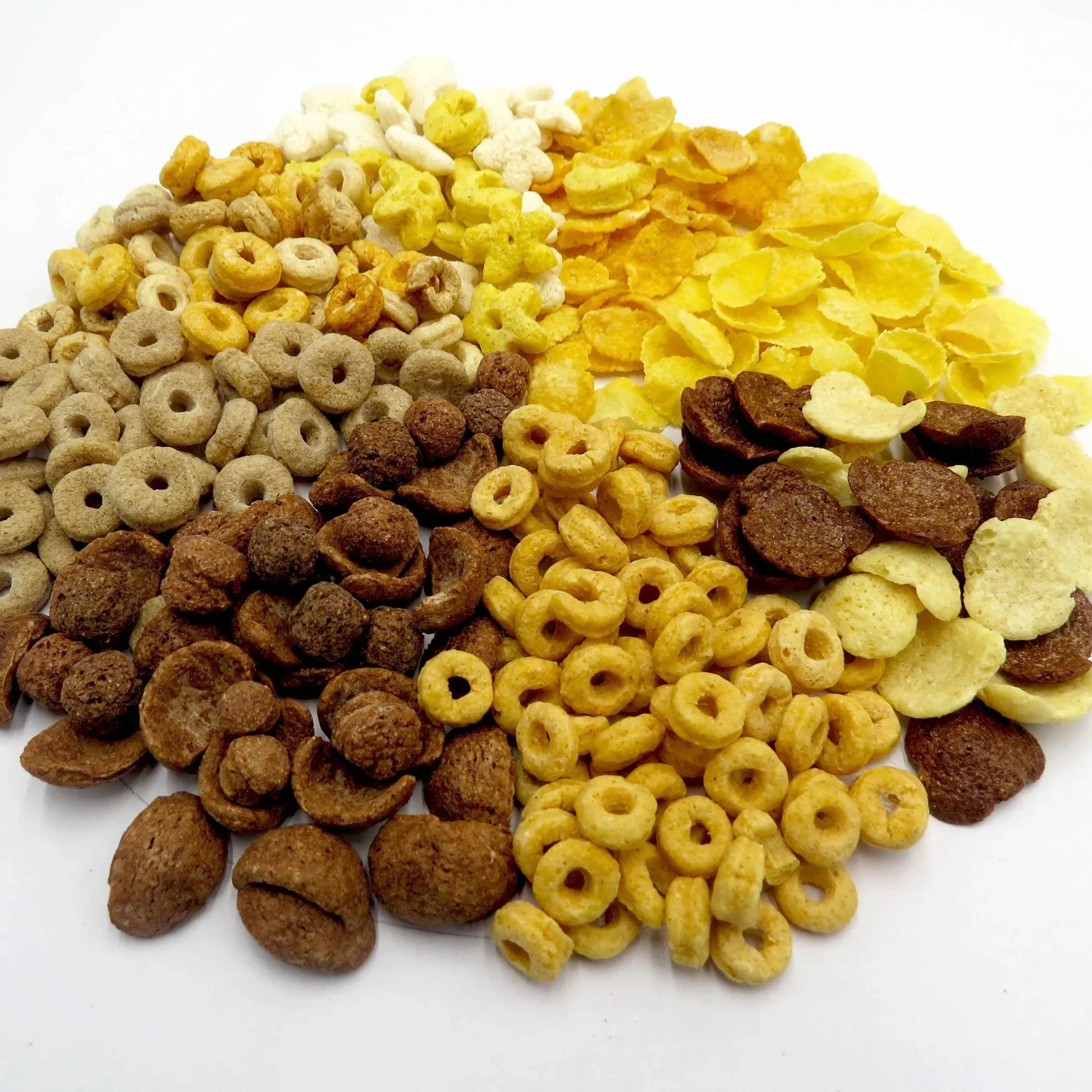
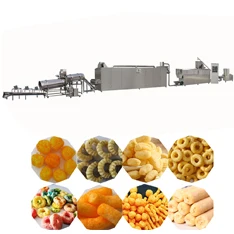
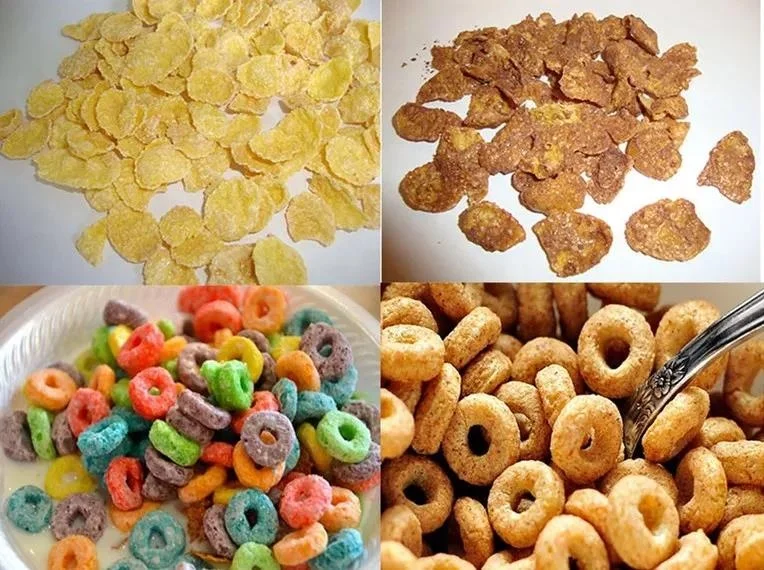
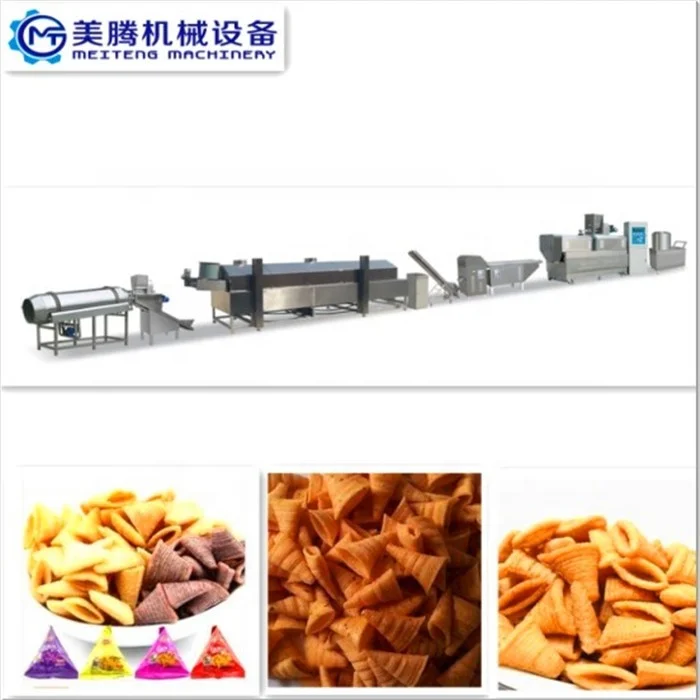
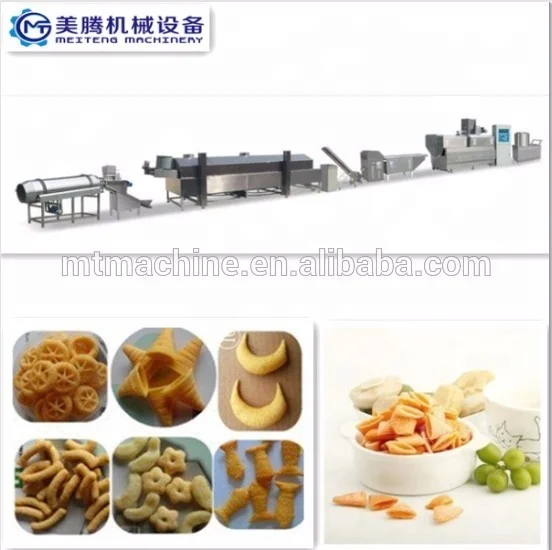

MT65 / MT70 / MT85 Corn Flakes Extrusion Production Line, Twin-Screw, PLC & MCC Control — complete turnkey layout from mixing and extrusion through multi-layer drying to seasoning and packaging. Screw configuration and die design are matched to your raw material formulation, controlling flake thickness, expansion, and crispness across corn, rice, and wheat-based cereals. Every station’s throughput is capacity-matched under one supplier, with trial runs on your actual recipe conducted in our testing workshop before shipment.
Description
Capacity-Matched Turnkey Layout — Every station in this corn flakes extrusion production line is balanced against the next, so a bottleneck at the dryer or seasoning drum never silently cuts your real throughput in half.
Technical Specifications
| Parameter | Value |
|---|---|
| Product Type | Corn Flakes & Rice Crispies Extrusion Production Line |
| Models Available | MT65, MT70, MT85 |
| Screw Type | Twin-screw |
| Installed Power | MT65: 86.35 kW / MT70: 90.75 kW / MT85: 121.06 kW |
| Power Consumption | MT65: 55 kW / MT70: 57 kW / MT85: 85 kW |
| Output Capacity | MT65: 100–150 kg/h (basis to be confirmed on actual raw material) / MT70: 150–200 kg/h (basis to be confirmed) / MT85: 200–350 kg/h (basis to be confirmed) |
| Overall Dimensions (L×W×H) | MT65: 21000×1200×2200 mm / MT70: 23000×1500×2200 mm / MT85: 28000×3500×4300 mm |
| Control System | PLC and MCC control |
| Oven Type | Electric, multi-layer (3/5/7 layers), stainless steel mesh belt, 0–200 °C |
| Cutting Size Range | 2 cm–20 cm (adjustable) |
| Seasoning Options | Octagonal drum, cylinder, single-roller, double-roller; oil/sugar spraying, coating |
| Raw Materials | Corn flour, rice flour, wheat flour, grain flour, blended cereal formulations |
| Standards | CE, ISO |
| Warranty | 1 year complete warranty, life-time maintenance service |
Application Suitability
| Application | Material or Output |
|---|---|
| Corn flakes and wheat flaking cereals | Corn flour, wheat flour, blended grain formulations |
| Rice crispies and puffed rice crackers | Rice flour, grain flour blends |
| Core-filled snacks and sandwich cakes | Peanut butter, chocolate sauce, cereal-based outer shell |
| Fortified and nutritional breakfast products | Cereal blends with added vitamin or mineral premixes |
| Chocolate-coated or sugar-glazed flakes | Corn or wheat flakes with post-extrusion coating |
What the Nameplate Capacity Doesn’t Tell You About Corn Flakes Lines
Your raw material defines the real output, not the brochure.
When buyers compare a corn flakes extrusion production line on paper, they almost always look at the nameplate kg/h figure first. I have watched lines arrive on site, get installed, and then spend weeks stuck at half the quoted rate because the buyer’s corn flour had a different moisture profile than whatever was used during the factory test. The extruder pushes through, but the oven cannot dry the flakes in time, the coating drum gets overloaded, and the packing station sits idle waiting for product that never catches up [NEED_CITE: extrusion line throughput matching principles for cereal processing].
That gap between nameplate and reality is where most turnkey breakfast cereal line projects lose money — not from the machine itself, but from the assumption that capacity is a fixed number rather than a variable tied to your specific formulation, ambient humidity, and shift pattern.
Screw Configuration and Die Design Set the Foundation
The twin-screw extruder at the heart of this line is not a single fixed geometry. Screw element arrangement and die selection are specified to your target product — whether that is a thin, crispy corn flake, a thicker wheat flake, or a core-filled rice crispie. The screw profile controls shear, residence time, and the degree of starch gelatinisation your material experiences before it exits the die. A configuration tuned for corn at a particular moisture content will behave very differently if you later switch to a high-protein grain blend without adjusting the screw elements accordingly.
Matching Oven Layers and Seasoning Drums to Extruder Output
A common failure in assembled lines is the dryer falling behind. The multi-layer electric oven on this corn flakes extrusion production line is available in 3, 5, or 7 layer configurations with a stainless steel double-layer mesh belt and a temperature range from 0 to 200 °C. The layer count is selected based on the extruder’s actual throughput and the moisture reduction required by your flake specification. Similarly, the seasoning station — whether an octagonal drum for sugar coating or a roller system for oil spraying — is sized so that product does not queue up waiting to be flavoured while the extruder keeps running [NEED_CITE: thermal load calculations for multi-layer cereal drying ovens].
Reading the Specification Sheet Like a Process Engineer
Three parameters on the spec sheet deserve closer attention than most buyers give them. First, installed power versus power consumption — the MT85 draws 121.06 kW installed but operates at 85 kW in typical conditions, which matters for your facility’s peak demand contract with the local utility. Second, the cutting size range of 2 cm to 20 cm determines whether your line can produce both snack-format pieces and larger flake formats without a mechanical changeover. Third, the PLC and MCC control system governs not just the extruder but every downstream station, meaning temperature ramps, belt speeds, and spray rates are all coordinated from a single interface — which is what keeps batch-to-batch density consistent when operators change shifts.
The Hidden Cost of Unmatched Stations
When a line is assembled from separate vendors, each station is usually quoted at its own maximum. The extruder may be rated for one throughput while the dryer was specified for a different figure, and the coating drum for yet another. The result is not just lower output — it is uneven product quality. Flakes that spend too long in the oven get over-dried and shatter during coating; flakes that move through too fast retain excess moisture and go stale before they reach the shelf. These problems rarely show up in a factory acceptance test because the test run is short enough that the bottleneck has not yet accumulated [NEED_CITE: common failure modes in multi-vendor food processing line integration].
Why This Line Is Built as One Project
Every station from the mixer through the screw feeder, extruder, core injection machine, cutter, elevator, multi-layer oven, oil injection unit, seasoning roller, and packaging machine is configured by a single engineering team that calculates throughput at each point. The screw and die configuration is documented against your raw material and target flake thickness. Voltage, frequency, and control language are confirmed for your target market before production begins. An in-house trial run is conducted on your actual formulation in the testing workshop so that capacity and product density are verified before the line ships. CE and ISO certifications are in place, and the complete line carries a one-year warranty with lifetime maintenance support.
Documentation & Verification
- Line layout drawing showing throughput calculations at every station from mixer to packaging
- Trial run report on your corn or rice flour formulation conducted before dispatch
- Screw and die configuration record matched to your target flake or crispie specification
- Electrical schematic with voltage, frequency, and PLC language confirmed per your market
- Factory test record documenting power draw, oven temperature profile, and cutting accuracy
Installation, Commissioning & Support
- Foundation and floor space planning based on the MT65/70/85 footprint dimensions provided
- Dedicated electrical circuit sizing matched to the selected model’s installed power rating
- Pre-assembled station modules shipped for sequenced on-site assembly and alignment
- First-run commissioning with screw speed, barrel temperature, and oven profile tuned to your material
- Operator training covering PLC interface navigation, die changeover, and daily cleaning procedures
- Wear parts list supplied at delivery, covering screws, dies, and mesh belt sections
What to Prepare Before Requesting a Quotation
To configure this turnkey breakfast cereal line accurately, share your target product format (flake, crispie, or core-filled), the raw material blend you plan to run, and your intended daily or shift-based output volume. Confirm your facility’s voltage, frequency, and preferred control language. If you have existing upstream batching or downstream packing equipment that this line must integrate with, provide the connection point specifications. A raw material sample sent to our testing workshop allows us to run a pre-shipment trial and return a capacity figure tied to your actual formulation rather than a generic baseline.
Frequently Asked Questions
Q: How is line capacity verified on my specific raw material and recipe before shipment?
A: We run a trial in our in-house testing workshop using a sample of your actual corn flour, rice flour, or grain blend. The extruder screw configuration, die selection, and oven temperature profile are adjusted during this run. You receive a documented trial report showing the verified throughput, flake density, and moisture level achieved on your formulation, not a generic capacity claim.
Q: How do you match dryer and seasoning capacity to the extruder output?
A: Each corn flakes extrusion production line is calculated as a complete system. The multi-layer oven layer count and belt speed are selected to handle the extruder’s verified output at your required moisture reduction. The seasoning drum size and spray rate are then matched so no station accumulates a product backlog during continuous operation.
Q: What voltage, frequency, and control language options are confirmed before production?
A: Before production begins, we confirm your facility’s electrical supply specifications and lock in the motor ratings, heater elements, and control transformer accordingly. The PLC interface language is set to match your operator team. All of this is recorded in the electrical schematic you approve before the build starts.
Q: What does on-site installation, commissioning, and operator training include?
A: Our team handles station alignment, utility connection verification, and first-run tuning of the extruder, oven, and seasoning stations on your site. Operators are trained on the PLC interface, screw and die changeover, and daily maintenance routines. We stay until the line runs stable product at the verified capacity from your pre-shipment trial report.
Q: How are screw and die configurations selected for different cereal formats?
A: Flake thickness, expansion ratio, and surface texture are all controlled by screw element arrangement and die geometry. For thin corn flakes we use a configuration that maximises starch gelatinisation with controlled expansion. For core-filled rice crispies, the die and core injection system are matched to maintain shell integrity around the filling. Each setup is recorded so you can reproduce or switch formats later.
Related products
-

Automatic Rice Crispies Extruder Machine/Chocolate Corn Flakes Extrusion Plant/wheat Flaking Snacks Production Line
¥8,500.00 Select options This product has multiple variants. The options may be chosen on the product page -

Automatic Puffed Food Snack Machine Electric Corn Puffs Snacks Making Machinery New Condition Flavorful Puff Snack Production
¥7,550.00 Select options This product has multiple variants. The options may be chosen on the product page -

Puff Corn Extruder Machine Puffed Core Filled Snack Food Production Line Machine
¥8,500.00 Select options This product has multiple variants. The options may be chosen on the product page -

Hot Sale Corn Snack Extruder Puffed Snacks Production Machine Corn Puffs Making Machine
¥20,000.00 Select options This product has multiple variants. The options may be chosen on the product page


