

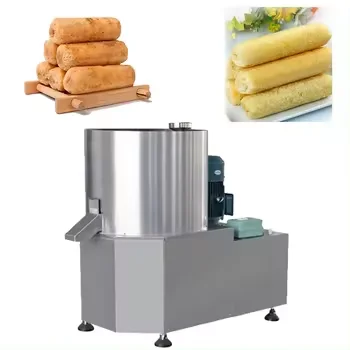
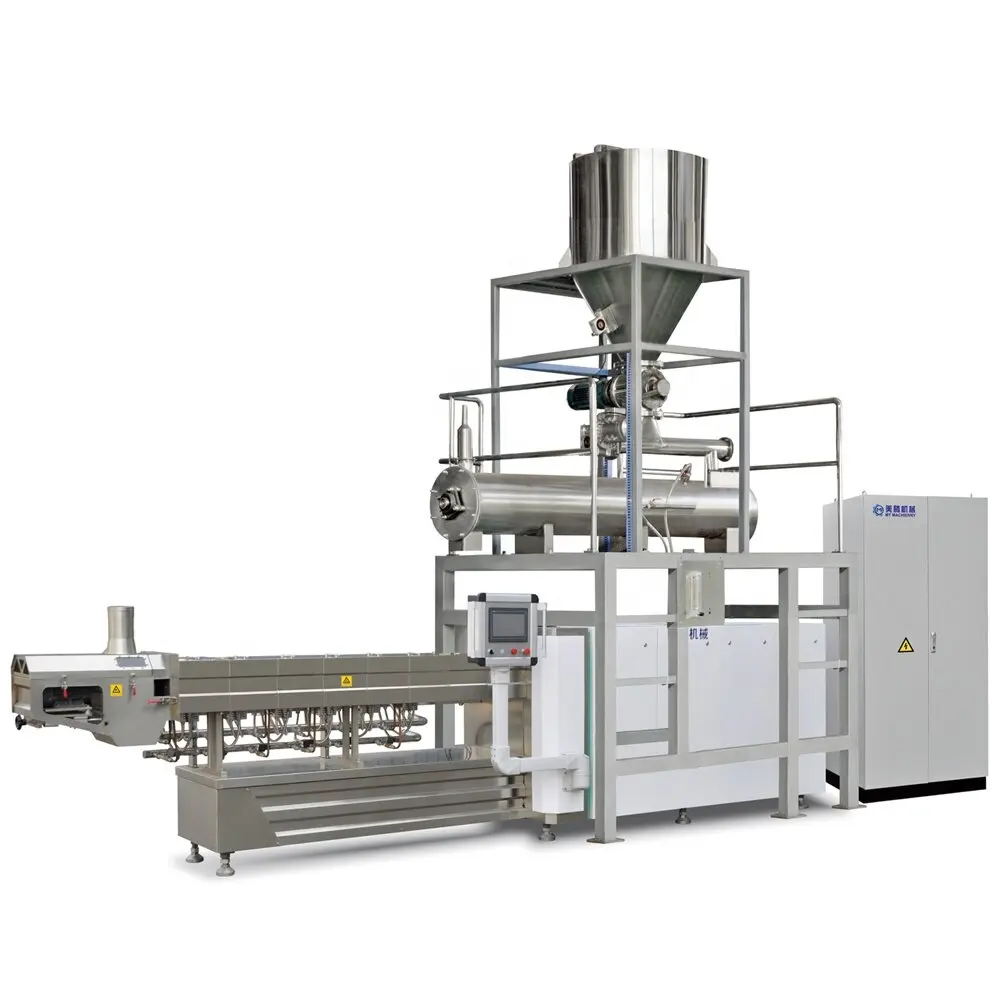
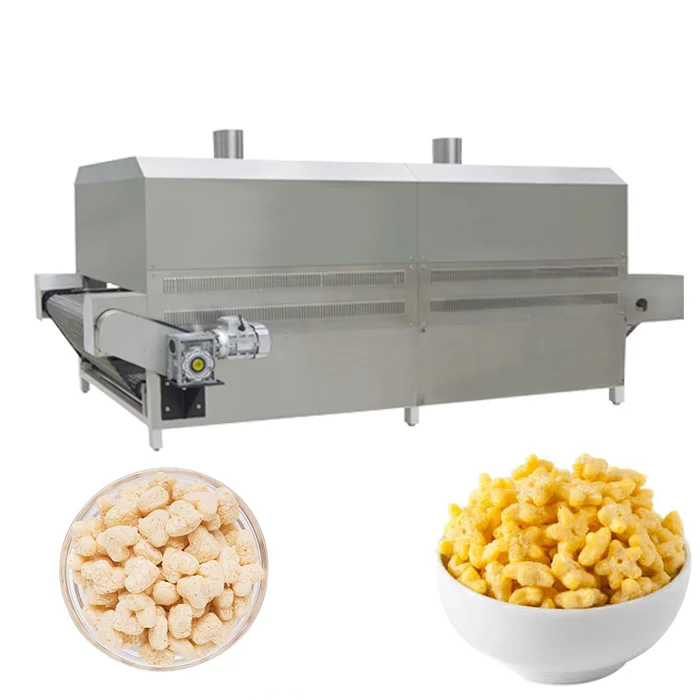
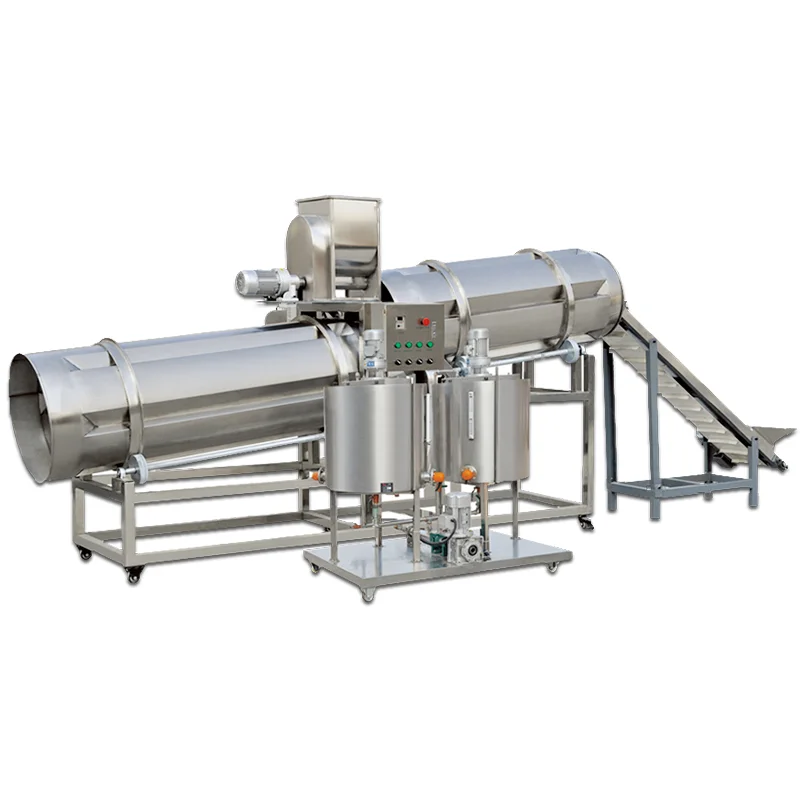

MT65 / MT70 / MT85 / MT100 Twin Screw Puffed Snack Extrusion Line, PLC Control, Automatic Lubricating & Cooling System — engineered for direct-expanded corn, rice, wheat and oat puffed snacks with interchangeable die sets covering ball, ring, stick, tube, star and heart formats.
- Twin-screw extrusion with frequency speed control allows precise management of shear, moisture and starch gelatinisation across varying raw material blends, while configurable dryer heating sources ensure moisture reduction keeps pace with extruder throughput.
- Screw configuration and die design are specified to your raw material and target product shape, with in-house trial runs performed before shipment to verify output on your actual formulation.
Description
Turnkey throughput matching — every station from batching to packing is sized so the extruder, dryer, and flavoring drums run at the same cadence on your actual corn or rice formulation.
Technical Specifications
| Parameter | Value |
|---|---|
| Model | MT65 / MT70 / MT85 / MT100 |
| Product Type | Twin Screw Puffed Snack Extrusion Line |
| Screw Type | Twin-screw |
| Raw Materials | Corn, rice, wheat, oat, barley flour, corn grits |
| Output Capacity (MT65) | 120–150 kg/h (basis not stated in source — confirm raw material, moisture content, die shape) |
| Output Capacity (MT70) | 200–300 kg/h (basis not stated in source — confirm raw material, moisture content, die shape) |
| Output Capacity (MT85) | 300–500 kg/h (basis not stated in source — confirm raw material, moisture content, die shape) |
| Output Capacity (MT100) | 600–800 kg/h (basis not stated in source — confirm raw material, moisture content, die shape) |
| Installed Power | 130 kW (MT65) / 180 kW (MT70) / 220 kW (MT85) / 240 kW (MT100) |
| Real Power Consumption | 95 kW (MT65) / 120 kW (MT70) / 130 kW (MT85) / 160 kW (MT100) |
| Control System | Frequency speed controlling system, PLC and MCC |
| Extruder Lubrication & Cooling | Automatic lubricating and cooling system |
| Dryer Heating Source | Electric / Steam / Gas (configured to customer local conditions) |
| Flavoring Station | Double drum flavoring line with sugar melting and spraying nozzle |
| Packing Station | Automatic weighing, sealing, marking, coding, bag filling |
| Die Configuration | Interchangeable dies for cheese ball, tube, stick, ring, fruit loop, star, wheel, flower, heart shapes |
| Core Filling Option | Available with additional core filling machine and cutting machine |
| Standards | CE, ISO certified |
Application Suitability
| Application | Material or Output |
|---|---|
| Direct-expanded corn puffs | Corn flour, corn grits |
| Cheese balls and rings | Corn, rice, wheat flour blends |
| Fruit loops and stars | Multi-grain flour (oat, barley, wheat) |
| Core-filled puffed snacks | Cereal flour with cream or chocolate filling |
| Breakfast cereal shapes | Rice and wheat flour formulations |
| Extruded snack sticks and tubes | Corn and rice flour |
Why Nominal Line Capacity Often Fails on the First Production Day
A puffed snack extrusion production line turnkey rated at a specific hourly output on one flour blend can lose half that throughput when the raw material changes — and buyers rarely find this out until the machine is bolted to their floor. The only reliable capacity number is the one measured on your exact formulation during a pre-shipment trial. I once spent two weeks on-site in Southeast Asia watching an extruder struggle with local corn flour that had lower starch content than the sample used for the original quote; the expansion rate dropped and the downstream dryer was suddenly oversized for the actual volume passing through it. When throughput between stations is mismatched, the extruder starves the dryer or the flavoring drums cannot keep up, and the whole line runs below its nameplate [NEED_CITE: twin-screw extrusion throughput matching principles]. That mismatch is the single most expensive surprise a snack manufacturer can face after installation.
How Screw Profile and Die Geometry Define Your Snack Texture
The twin-screw extruder at the heart of this puffed snack extrusion production line turnkey uses interchangeable screw elements and die plates to control shear, residence time, and expansion. A high-shear screw profile combined with a small-diameter die produces the rapid pressure drop needed for a light, airy cheese ball, while a lower-shear arrangement suits denser formats like cereal rings. The automatic lubricating and cooling system keeps barrel temperatures stable across long production runs, which is what maintains consistent puff diameter from the first kilogram to the last.
Matching Dryer and Flavoring Capacity to the Extruder Output
A common reason snack lines underperform is that the dryer or flavoring station was specified on a different capacity basis than the extruder. On this line, the dryer heating source — electric, steam, or gas — is selected after the extruder throughput is confirmed on the buyer’s recipe, so moisture reduction happens at the same rate the product leaves the die. The double drum flavoring line with sugar melting and spray nozzles is sized to handle the full extruder output without product backing up. When these stations are throughput-matched, the line runs continuously rather than cycling on and off to let downstream equipment catch up [NEED_CITE: food extrusion line station balancing].
Reading the Power and Control Specs for Real-World Impact
Installed power on the MT85 is listed at 220 kW, but real power consumption during steady-state extrusion sits around 130 kW — the difference matters when you are calculating transformer sizing and monthly energy cost for the facility. The frequency-controlled speed system lets operators fine-tune screw RPM without stopping the line, which is how you adjust expansion on the fly when ambient humidity shifts between morning and afternoon shifts. PLC and MCC control means the entire puffed snack extrusion production line turnkey — from batching through packing — can run under one interface, reducing the chance that a miscommunication between separate control panels causes a batch to go out of spec. The automatic lubricating system also ties into this control architecture, triggering maintenance alerts before bearing wear affects screw alignment.
The Hidden Cost of Skipping Pre-Shipment Raw Material Trials
When a snack line ships without a documented trial on the buyer’s actual flour, the first week of production becomes an expensive experiment. Operators adjust moisture levels, swap die plates, and change screw elements while the dryer sits idle and packaging film runs to waste. I have seen facilities lose an entire production shift chasing the right expansion ratio because the screw configuration was copied from a generic build rather than matched to the starch content and particle size of the local grain [NEED_CITE: extrusion screw configuration and raw material matching]. That lost time compounds when the snack must meet a specific bulk density for retail packaging — every failed run means product that cannot be sold.
Why Buyers Specifying Complete Lines Choose This Configuration
Every station on this puffed snack extrusion production line turnkey is selected and sized under one supplier, so the batching system, extruder, dryer, flavoring drums, and packing station share a single throughput target rather than being assembled from separate vendors with different capacity assumptions. Screw configuration and die design are specified to the buyer’s raw material and target product shape before production begins. An in-house testing workshop allows trial runs on customer-supplied flour before the line ships, producing a documented report rather than leaving product development to the installation week. The line covers formats from cheese balls and fruit loops to core-filled snacks on the same base extruder platform. Electrical schematics confirm voltage, frequency, and PLC language against the buyer’s facility before fabrication starts, so commissioning does not stall over a control panel wired for the wrong supply [NEED_CITE: industrial machinery electrical specification standards].
Documentation & Verification
- Line layout drawing showing throughput matched at every station from batching to packing
- Trial run report on your specific corn or rice flour performed before shipment
- Screw and die configuration record tied to your target snack shape and density
- Electrical schematic confirming voltage, frequency, and control language for your facility
- CE declaration of conformity and ISO certificate for the complete line
- Wear parts list with part numbers for screws, dies, and dryer belts
Installation, Commissioning & Support
- Foundation plan accounts for extruder weight and dryer length across the MT65 to MT100 range
- Dedicated power circuit sized to real consumption figures (95–160 kW depending on model)
- Extruder ships with barrel and screw assembly separate for workshop door clearance
- Commissioning includes screw RPM and barrel temperature profiling on your raw material
- Operator training covers die changeover procedures for all included snack shapes
- Spare screw elements and die plates shipped with the initial order to cover first replacement cycle
What to Include in Your Inquiry
To size a line correctly, share your target snack format, the exact flour or grit specification you will run (including starch and moisture data if available), and your required daily output in kilograms. Include your facility voltage and frequency, the control language your operators need, and whether you plan to run core-filled variants alongside direct-expanded shapes. If you can send a sample of your raw material, a pre-shipment trial can be scheduled before the quotation is finalized.
Frequently Asked Questions
Q: How is the line capacity verified on my specific raw material before shipment?
A: Your flour or grit sample is run through the extruder in the in-house testing workshop using the screw and die configuration specified for your target product. A trial run report documents the actual throughput, expansion ratio, and product density achieved, so the capacity figure in the quotation reflects your material rather than a generic benchmark.
Q: How do you ensure the dryer and flavoring stations are not bottlenecking the extruder output?
A: Each station is sized after the extruder throughput is confirmed on your recipe. The dryer belt length and heating capacity, as well as the flavoring drum volume and spray rate, are calculated to match the confirmed extruder output, so product flows continuously without upstream or downstream bottlenecks.
Q: What voltage, frequency and PLC language options are available for my market?
A: Electrical schematics are prepared after confirming your facility supply — whether 380V/50Hz, 440V/60Hz, or another standard. The PLC interface language is set to match your operators’ requirements before the control panel is wired, avoiding relabeling or reprogramming during commissioning.
Q: How are screw configuration and die design selected for my target snack shape and texture?
A: Screw element arrangement and die geometry are chosen based on your raw material’s starch content, particle size, and the expansion level your product requires. The trial run validates this selection, and the configuration record is included in the documentation so replacements can be ordered with the correct part numbers.
Q: What does the on-site installation, commissioning and operator training process look like?
A: Engineers supervise uncrating, station alignment, and utility connections, then run the line on your material while adjusting screw speed and barrel temperatures. Operators are trained on die changeover, daily lubrication checks, and troubleshooting common expansion issues, with a wear parts list provided for ongoing maintenance planning.
Related products
-

Puff Corn Extruder Machine Puffed Core Filled Snack Food Production Line Machine
¥8,500.00 Select options This product has multiple variants. The options may be chosen on the product page -

Puff Corn Snacks Food Line Puffed Rice Ball Production Making Equipment Machines
¥10,565.00 Select options This product has multiple variants. The options may be chosen on the product page -

Fully automatic puff snack processing line
¥8,500.00 Select options This product has multiple variants. The options may be chosen on the product page -

New Condition Automatic Corn Puff Snacks Food Extruder Cheese Ball Making Machine Plant
¥100.00 Select options This product has multiple variants. The options may be chosen on the product page


