

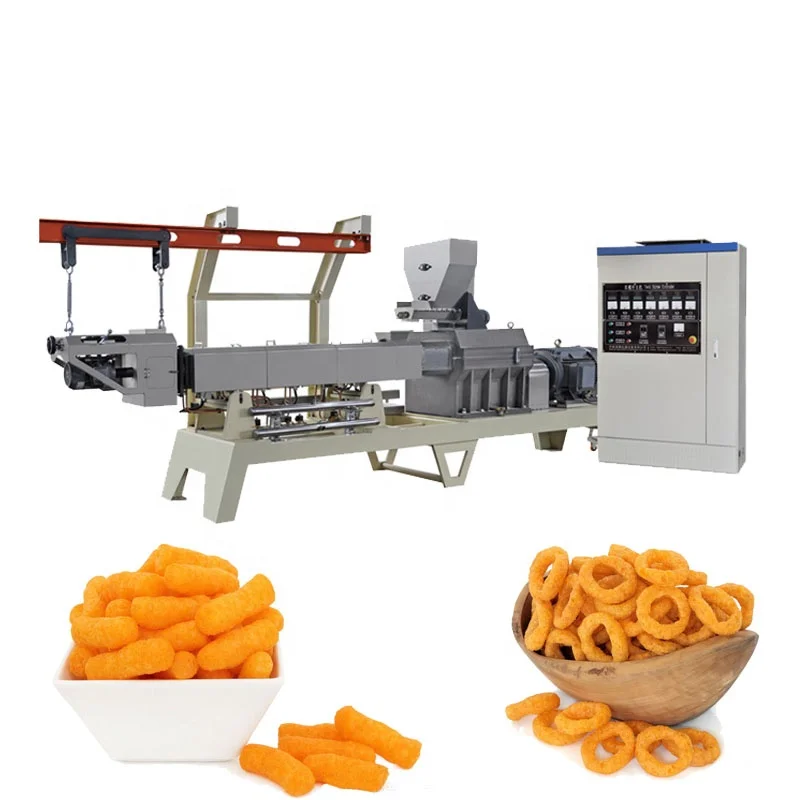


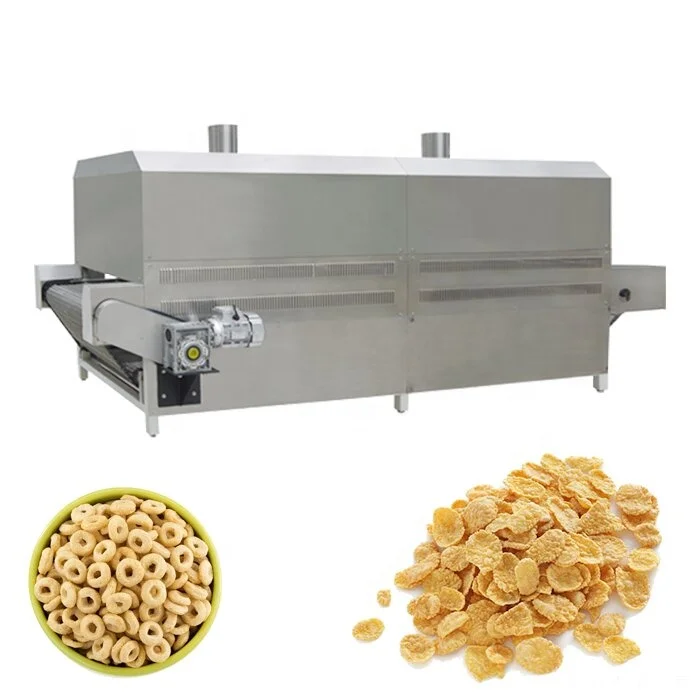
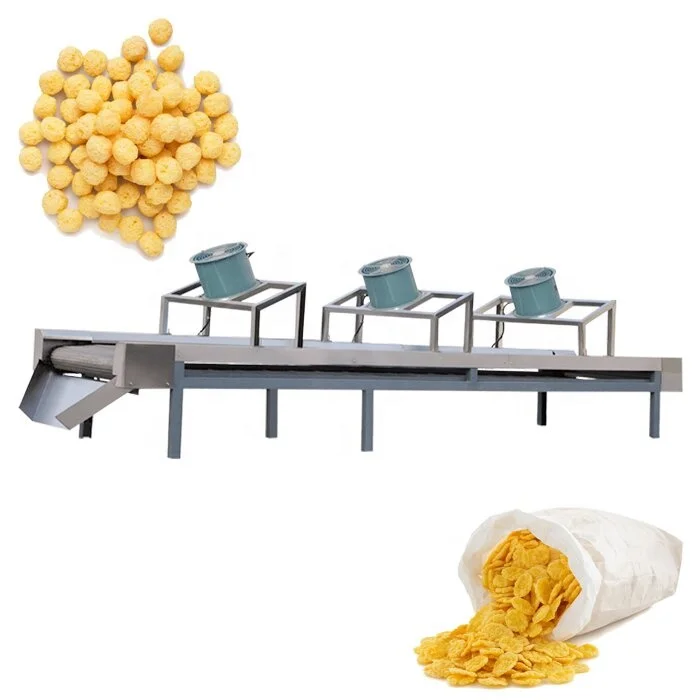
MT65 / MT70 / MT85 / MT75 / MT95 Twin-Screw Puffed Snack Processing Line, 84–260 kW Installed Power, Stainless Steel Construction — throughput-matched from powder mixer through extruder, roaster, seasoning drum and cooler under one supplier.
- Screw configuration and die design specified to buyer’s raw material and target snack density, not a generic build
- Five model tiers cover pilot through full-scale production with capacity balanced across every station
Turnkey layout, phased installation and on-site commissioning with operator training delivered as one project.
Description
Thermally balanced line stations — the roaster belt length and infrared array are sized to match the twin-screw extruder output, preventing wet-center product at high throughput.
Technical Specifications
| Parameter | Value |
|---|---|
| Model | MT65 / MT70 / MT85 / MT75 / MT95 |
| Product Type | Twin-Screw Puffed Snack Processing Line |
| Installed Power | 84 kW (MT65) / 132 kW (MT70) / 239 kW (MT85) / 186 kW (MT75) / 260 kW (MT95) |
| Power Consumption | 59 kW (MT65) / 92 kW (MT70) / 167 kW (MT85) / 140 kW (MT75) / 180 kW (MT95) |
| Output Capacity | 120–150 kg/h (MT65) / 200–250 kg/h (MT70) / 300–400 kg/h (MT85) / 400–500 kg/h (MT75) / 500–1000 kg/h (MT95) (basis not stated in source — confirm raw material, moisture, product format) |
| Overall Dimensions (L×W×H) | 21000×1200×2200 mm (MT65) / 23000×1500×2200 mm (MT70) / 28000×3500×4300 mm (MT85) / 24000×1500×2800 mm (MT75) / 31000×3500×4300 mm (MT95) |
| Screw Type | Twin-screw |
| Line Stations | Powder mixer, screw conveyor, twin-screw extruder, sandwich machine, shaping machine, elevator, high-temperature roaster, seasoning machine, cooler |
| Material of Construction | Stainless steel |
| Control System | Available with PLC or MCC control (confirm requirement) |
| Voltage & Frequency | Configurable to target market electrical standard |
| Assembly State | Complete line from batching through extrusion, puffing, forming, sandwiching, cutting, spraying to finished product |
| Standards | CE declared |
| Warranty | 1 year complete warranty, lifetime maintenance service |
Application Suitability
| Application | Material or Output |
|---|---|
| Puffed snack production | Corn flour, wheat flour, rice flour, oat-based blends |
| Sandwich cakes and filled snacks | Corn and cereal base with cream or chocolate filling |
| Puffed rice crackers | Rice grits and rice flour blends at controlled moisture |
| Nutritious breakfast cereals | Multi-grain formulations with vitamin-fortified ingredients |
| Wheat roast and extruded bites | Whole wheat and wheat bran blends |
What "Nominal Capacity" Leaves Out on a Puffed Snack Line
A puffed snack processing line turnkey holds its stated output only when the roaster, seasoning drum, and cooler are sized to the extruder’s actual throughput on your specific raw material.
I watched a snack producer lose an entire shift because their roaster belt was too short for the extruder volume — the product left the oven with a wet center and had to be scrapped. Capacity figures quoted on paper often assume ideal corn grits at standard moisture, but when you run high-viscosity oat blends or protein-fortified mixes, the extruder output drops and the downstream stations fall out of balance. [NEED_CITE: raw material viscosity effects on twin-screw extruder throughput] The result is a line that technically runs but never reaches the rate the project was budgeted around.
Matching Throughput Across Every Station
A puffed snack processing line turnkey succeeds when each station passes product to the next at the same rate without pile-up or starvation. The powder mixer batches every 10 minutes at 385 rpm into a 150 kg tank, feeding the screw conveyor which meters material into the twin-screw extruder at a controlled rate. The high-temperature roaster then handles the expanded output over a 3.5 m effective belt length with 24 far infrared heater elements, pulling moisture down to the target level before the product reaches the seasoning drum. If any one of these stations runs faster or slower than the others, the entire line backs up or runs empty.
Why Screw Configuration Matters More Than Motor Size
The extruder barrel and screw arrangement define how raw material gelatinizes, expands, and exits the die — not the motor power alone. High-amylose corn requires a different screw pitch and barrel temperature profile than a wheat-heavy formulation, and the wrong configuration produces dense, under-expanded product regardless of how much power the main motor delivers. On this line, the screw and die combination is specified after reviewing the buyer’s actual flour blend and target texture, rather than copied from a generic build. The MT70, for example, runs a 30 kW main motor, but the output quality depends entirely on whether the screw elements match the starch behavior of the incoming material. [NEED_CITE: starch gelatinization temperature profiles in twin-screw extrusion]
Reading the Specification Sheet Against Your Actual Material
The installed power ranges from 84 kW on the MT65 to 260 kW on the MT95, but the power consumption figures — 59 kW to 180 kW respectively — tell you what the line actually draws during steady-state production. The gap between installed and consumed power indicates headroom for start-up surges and formulation changes. The high-temperature roaster alone uses 24 far infrared heaters at 3.9 kW each, plus a gas supply rated at 6.8 m³ per cycle, meaning the total thermal load on your facility is substantial. Before ordering, confirm whether your workshop electrical panel can handle the combined draw of extruder, roaster, and seasoning stations running simultaneously, and whether the local voltage and frequency match the motor and heater specifications. The overall line footprint stretches from 21 m on the MT65 up to 31 m on the MT95, so the physical layout must also account for operator walkways and raw material staging.
The Cost of Skipping a Pre-Shipment Trial Run
When a line ships without testing on the buyer’s specific raw material, the first weeks of production become an expensive experiment. Screw configurations get swapped, die openings adjusted, and roaster temperatures recalibrated — all on the factory floor with downtime costing real revenue. I have seen snack manufacturers spend multiple weeks chasing the right expansion ratio because the extruder was configured for standard corn grits while the actual recipe contained a high proportion of sticky rice flour. [NEED_CITE: commissioning delays caused by untested raw material formulations] These delays compound when the seasoning drum and cooler were never calibrated to the actual output density, leaving the end of the line mismatched from day one.
Why Source the Full Line From One Supplier
Every station on this puffed snack line — from the 4 kW powder mixer through the twin-screw extruder to the seasoning machine and cooler — is specified as a single integrated project, meaning throughput calculations account for each transfer point. The screw configuration and die design are matched to the buyer’s raw material and target snack format before production begins, rather than adapted after installation. An in-house testing workshop runs trial batches on the customer’s actual flour blend, producing a documented report before the line ships. Electrical schematics and voltage confirmation are completed during the order stage, so the control panels match the destination facility from first power-on. Stainless steel construction across all food-contact surfaces keeps the line compliant with food safety expectations in export markets.
Documentation & Verification
- Line layout and capacity calculation showing throughput at each station
- Screw and die configuration record matched to your raw material formulation
- Trial run report on your flour blend conducted before shipment
- Electrical schematic with voltage and frequency confirmed for your market
- CE declaration of conformity for industrial food extrusion equipment
- Operation and maintenance manual covering all line stations
Installation, Commissioning & Support
- Foundation must support line lengths up to 31 m with level tolerance for the conveyor and roaster sections
- Dedicated electrical circuit required matching the confirmed voltage and frequency for the total connected load
- Stations ship modular and are assembled on-site with belt and conveyor alignment verified during commissioning
- First production run supervised to set roaster temperature, screw speed, and seasoning drum timing to your recipe
- Operator training covers screw changeover, die cleaning, and daily inspection of the powder mixer and conveyor bearings
- Wear parts list provided covering screws, dies, and roaster belt components for planned replacement intervals
What We Need to Quote Your Line Accurately
Share the specific flour or grain blend you plan to run, including moisture content and any added proteins or fibers, so the screw configuration can be matched before quotation. Confirm your target hourly output, workshop ceiling height, and the local voltage and frequency standard. If you have existing upstream batching or downstream packing equipment, provide the interface specifications so the line stations align with your current setup.
Frequently Asked Questions
Q: How is line throughput verified against my raw material before shipment?
A: Your flour or grain blend is tested in the workshop before the line ships. A trial run records expansion ratio, product density, and moisture content at each station. The screw configuration and roaster settings are adjusted during this test, and a full report accompanies the shipment so commissioning starts from proven parameters rather than guesswork.
Q: What is the phased installation and commissioning schedule?
A: Stations arrive modular and are assembled in sequence — mixer and conveyor first, then extruder, roaster, and finishing equipment. Utility connections are verified before the first powered run. Commissioning includes supervised production on your recipe, with operator training running alongside initial output. The full process typically spans several days depending on line size.
Q: How are voltage, frequency, and control language confirmed?
A: During the order stage, you provide your facility’s electrical standard and preferred control interface language. The electrical schematic is drawn to match, and motor, heater, and control panel components are sourced accordingly. This prevents rewiring or component replacement after the line arrives on-site.
Q: How is capacity balanced between the extruder, roaster, and seasoning drum?
A: Each station is sized based on the extruder output calculated for your specific raw material. The roaster belt length and heater array handle the full volume at target moisture, while the seasoning drum and cooler are rated to pass the same hourly rate. This prevents pile-up or starvation at any transfer point.
Q: What screw configuration is specified for my product texture?
A: The screw element arrangement and die opening are selected based on your flour blend’s starch content, moisture level, and the target expansion ratio. High-amylose formulations require different screw pitch and barrel heating than protein-enriched mixes. The configuration is documented and tested before the extruder leaves the workshop.
Related products
-

Puffed Snacks Seasoning Flavor Machine Twin Screw Corn Puffing Food Making Extruder Equipment
¥8,355.00 Select options This product has multiple variants. The options may be chosen on the product page -

Puff Corn Snacks Food Line Puffed Rice Ball Production Making Equipment Machines
¥10,565.00 Select options This product has multiple variants. The options may be chosen on the product page -

New Puffed Snack Food Machine Production Line Corn Flake Puff Corn Making Machine Twin Screw Extruder 100-500kg/h Capacity Food
¥8,500.00 Select options This product has multiple variants. The options may be chosen on the product page -

Stainless Steel Corn Puff Cake Making Machine Corn Snack Food Machines Top Selling Snacks Machine
¥8,560.00 Select options This product has multiple variants. The options may be chosen on the product page


