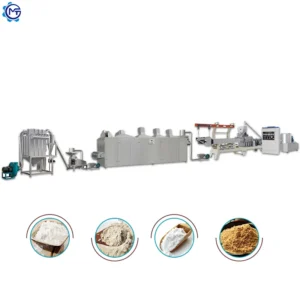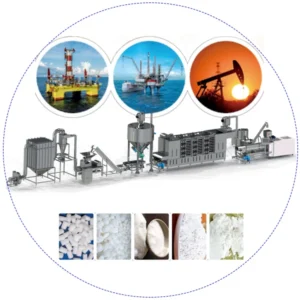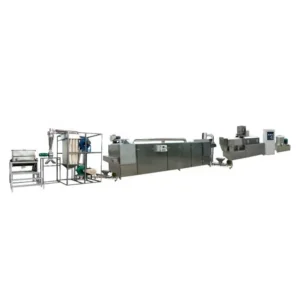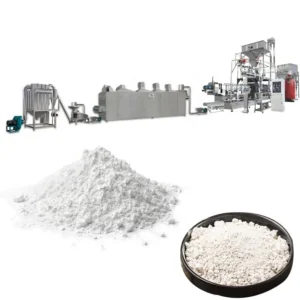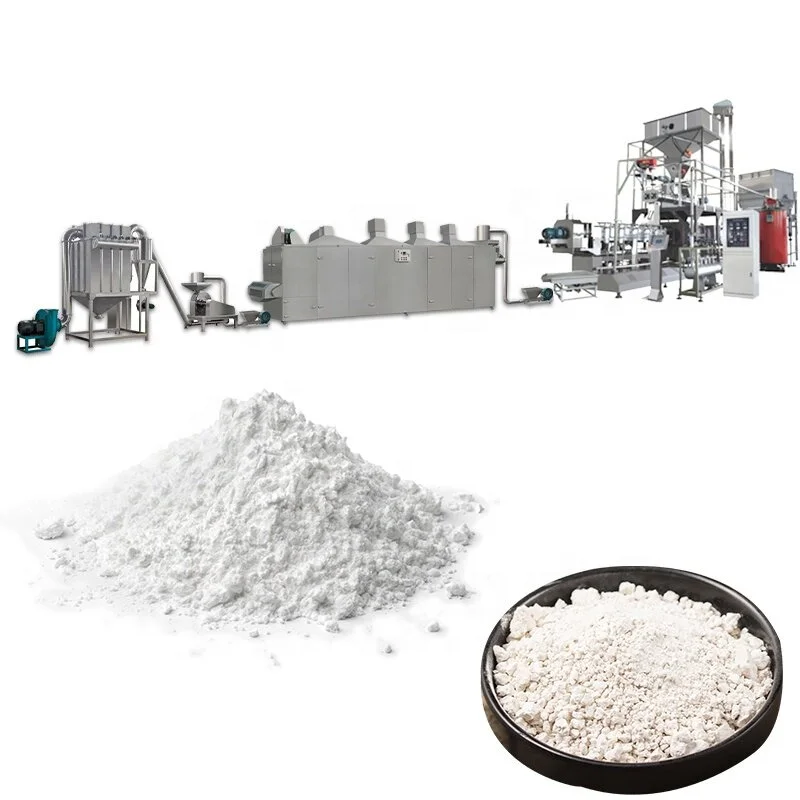


Modified Starch Extrusion Processing Line, twin-screw extruder, PLC automation, SUS304 contact parts — engineered as one turnkey project with throughput matched from batching through reaction, extrusion, drying and packing.
- Produces pregelatinized, cross-linked, oxidized and cationic starch from corn, potato, tapioca or wheat starch
- Screw configuration and segmented barrel zones specified to your raw material and target modification type
Trial runs on your actual starch source in our testing workshop before shipment, with full line layout and capacity documentation provided.
Description
Throughput-Matched Engineering — Every station from batching to packing is calculated against your actual starch moisture and modification target, preventing the extruder from running faster than the dryer can handle.
Technical Specifications
| Parameter | Value |
|---|---|
| Product Type | Modified Starch Extrusion Processing Line |
| Extruder Type | High-torque self-cleaning twin-screw extruder |
| Raw Material Compatibility | Corn starch, potato starch, tapioca starch, wheat starch |
| Product Range | Pregelatinized starch, cross-linked starch, oxidized starch, cationic starch |
| Barrel Temperature Control | Segmented temperature control (zones to be confirmed per configuration) |
| Control System | PLC touchscreen, fully automated from feeding to packaging (brand/model to be confirmed) |
| Contact Material | SUS304 / SUS316 stainless steel on all material contact parts |
| Process Flow | Raw material feeding → mixing → reaction → extrusion → drying → packaging |
| Production Continuity | Continuous production process |
| Output Capacity | (basis to be confirmed — depends on raw material, moisture %, and target modification type) |
| Assembly State | Complete line under one supplier |
| Standards | CE, ISO |
Application Suitability
| Application | Material or Output |
|---|---|
| Instant food and bakery thickeners | Pregelatinized corn or potato starch |
| Textile warp sizing and finishing | Cross-linked or oxidized wheat starch |
| Paper coating and corrugated adhesives | Cationic tapioca or corn starch |
| Oil drilling fluid additives | Modified starch with controlled viscosity |
| Construction material binders | Cross-linked starch for gypsum and mortar |
| Pharmaceutical tablet binders | Pregelatinized starch meeting pharmacopeia requirements |
Why Nominal Capacity Rarely Survives First Contact with Your Starch
A modified starch production line turnkey is only as fast as its slowest downstream station.
Buyers often receive a quote highlighting extruder output while the dryer, cooler, and packing sections are sized generically. When the actual raw material enters the barrel — say a high-amylose corn starch with a different gelatinization window — the extruder must slow down, and the rest of the line follows. I once watched a line stall at roughly sixty percent of quoted output because the airflow dryer could not handle the moisture load coming off the die. The starch left the extruder too wet, the dryer choked, and the customer spent weeks re-balancing the system on their own floor. [NEED_CITE: typical moisture reduction targets for pregelatinized starch drying]
Matching the Extruder Reaction Zone to the Modification Chemistry
Each starch modification demands a specific residence time, shear profile, and barrel temperature curve. Pregelatinization requires rapid moisture penetration and high shear to rupture granule structure, while cross-linking depends on a longer, gentler reaction zone where the reagent has time to bond before the starch exits the die. The twin-screw configuration and segmented barrel heating allow operators to adjust both variables independently, keeping the modified starch production line turnkey flexible across different chemistries.
Preventing the Dryer Bottleneck Before It Happens
The most common failure point on a starch line is the transition from extrusion to drying. Wet product leaves the die at a moisture level that must drop substantially before packing. If the dryer was chosen by nominal capacity rather than actual evaporation duty, moisture remains too high and the product clumps or degrades in storage. We calculate the dryer’s evaporation load from the real inlet moisture measured during a trial run, then match the air volume and residence time accordingly. This step is non-negotiable in any modified starch production line turnkey project that expects to run at rated output. [NEED_CITE: industrial drying load calculation methods for high-moisture starch products]
What the Barrel Zones and Screw Elements Actually Do
Segmented barrel temperature control lets you set distinct thermal profiles along the screw length — feeding zone kept cool to prevent premature gelatinization, reaction zone heated to the exact activation temperature of your reagent, and die zone adjusted for clean cut-off. The high-torque self-cleaning design means viscous, cross-linked starch does not build up between runs, cutting changeover time when you switch from cationic to oxidized grades. SUS304 or SUS316 contact surfaces resist the mild acids and alkalis used in modification chemistry, extending screw and barrel life. The PLC touchscreen records temperature and screw speed data for each batch, giving you traceability that food and pharmaceutical customers demand.
When the Wrong Screw Configuration Costs You Weeks
Copy-paste screw builds produce the wrong degree of modification — under-reacted starch that fails viscosity specs or over-sheared product with broken granule structure. Either outcome means the buyer spends weeks experimenting with element combinations after installation, burning raw material and missing delivery schedules. [NEED_CITE: effect of screw element geometry on starch modification degree] The configuration must be specified against the buyer’s exact starch source and target modification before the machine is assembled.
Why Sourcing the Whole Line from One Supplier Matters
Single-supplier responsibility means throughput calculations are done once, across every station, instead of each vendor quoting their own island of capacity. The batching system, mixer, extruder, dryer, cooler, and packing section are all balanced to the same production target. The in-house testing workshop runs your actual starch through the line before shipment, producing a trial report that confirms modification rate, moisture drop, and output. Screw and die records are documented per product, so reorders and grade changes start from a known baseline rather than guesswork. Electrical schematics are drawn for your site voltage and frequency, and the PLC language is set before the control cabinet leaves the factory. On-site commissioning covers phased startup — extruder first, then dryer, then packing — with operator training built into the schedule.
Documentation & Verification
- Line layout and capacity calculation showing matched throughput at every station
- Trial run report on your specific starch source and target modification type
- Screw and die configuration record tied to your raw material and product spec
- Electrical schematic with confirmed voltage, frequency, and PLC language
- CE declaration of conformity and ISO certificate for the complete line
- Operation and maintenance manual with wear parts list and replacement intervals
Installation, Commissioning & Support
- Foundation plan aligned with extruder footprint and dryer ductwork routing
- Dedicated power circuit sized to the high-torque extruder motor and heating zones
- Modular assembly allowing extruder, dryer, and packing stations to commission in sequence
- First-run parameter logging via PLC touchscreen for repeatable batch setup
- Operator training covering screw element changes and barrel temperature adjustments
- Wear parts inventory list for screws, dies, and seals with reorder part numbers
What We Need to Build Your Line Proposal
Send us the type of starch you process — corn, potato, tapioca, or wheat — along with the target modification (pregelatinized, cross-linked, oxidized, or cationic) and your expected daily output. Include your site voltage, frequency, and preferred PLC language. If you have existing upstream mixers or downstream packing equipment, let us know so the new line interfaces correctly. We can schedule a trial run on your raw material in the testing workshop before finalizing the configuration.
Frequently Asked Questions
Q: How is line output capacity verified, and on which raw material and modification type?
A: Output is verified through a trial run in our testing workshop using the buyer’s actual starch source and target modification. We measure inlet and outlet moisture, modification rate, and continuous throughput under real conditions, then issue a trial report. Capacity figures quoted before this step are estimates based on reference materials and may differ once your starch enters the barrel.
Q: How are screw configuration and barrel zones specified for different starch modifications?
A: Pregelatinized starch needs high shear and rapid heating to rupture granules, while cross-linked and cationic grades require longer residence times at moderate temperatures. We select screw elements and set barrel zone temperatures based on your reagent chemistry and starch source, documenting the configuration so future runs start from a proven baseline.
Q: How do you ensure drying and packing capacity matches the extruder output?
A: We calculate the dryer evaporation duty from the actual moisture content measured at the extruder die during the trial run. Air volume, temperature, and residence time are then matched to that load. Packing speed is set to the confirmed continuous output, so no station bottlenecks another on the modified starch production line turnkey.
Q: Can I send my raw material for a trial run before committing to the order?
A: Yes. We operate an in-house testing workshop where your starch is run through the extruder and dryer at production scale. The resulting trial report covers throughput, moisture reduction, and modification quality, giving you verified data before the purchase decision.
Q: What is included in on-site installation and operator training?
A: Our commissioning team handles phased startup — extruder, then dryer, then packing — along with electrical verification and PLC parameter loading. Operators receive hands-on training covering screw element changes, barrel temperature adjustment, and routine maintenance. Wear parts lists and reorder numbers are provided so replacements are available when first needed.
Related products
-
Modified and Pregelatinized Starch Processing Equipment – Pregelatinized Corn Cassava Modified Starch Puffing Machine
¥65.00 Select options This product has multiple variants. The options may be chosen on the product page -
Pregelatinized Low-Cost Modified Starch Line – High-Efficiency Automated Starch Processing Machine
¥65.00 Select options This product has multiple variants. The options may be chosen on the product page -
Automatic Pregelatinized Starch Processing Machine – Large-Scale New Condition Modified Starch Production Line
¥65.00 Select options This product has multiple variants. The options may be chosen on the product page -
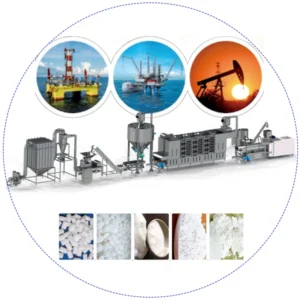
Big Capacity Modified Starch Production Line Making Machine
¥30.00 Select options This product has multiple variants. The options may be chosen on the product page