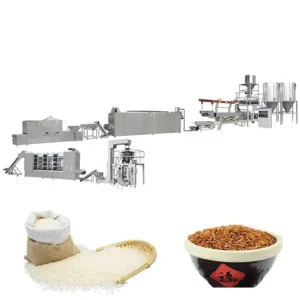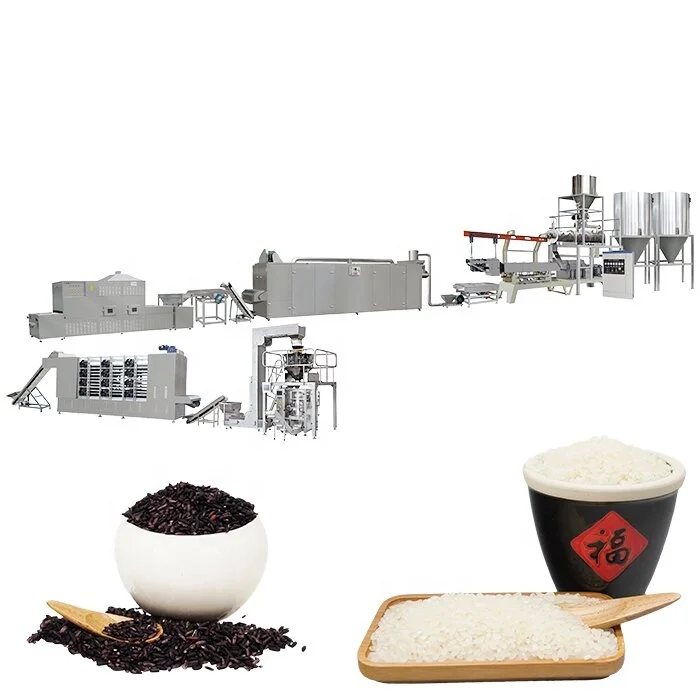


Fortified Rice Making Machine, Twin-Screw Extrusion, 110 kW Main Drive, CE Certified — turnkey nutritional rice line covering mixing, extrusion, multi-stage drying, cooling and packing under one layout. Throughput is matched across every station so the dryer or cooler never bottlenecks the extruder, with screw configuration and die design specified to your raw material and target grain size.
- Pre-shipment trial runs validate density, shape and moisture against your actual recipe before installation begins.
Description
Turnkey Line Throughput Matching — Every station from the 15 kW mixer through the 110 kW twin-screw extruder to the 5000 mm cooling dryer is sized to the same mass flow, so the fortified rice processing line turnkey never bottlenecks at a single machine.
Technical Specifications
| Parameter | Value |
|---|---|
| Product Type | Fortified Rice Making Machine / Instant Rice Processing Line |
| Screw Type | Twin-screw |
| Screw Length | 2500 mm |
| Mixing Machine Power | 15 kW |
| Mixing Tank Thickness | 1.5 mm stainless steel |
| Mixer Cover Thickness | 1.2 mm |
| Extruder Feeder Power | 1.5 kW (frequency control) |
| Extruder Main Power | 110 kW (frequency control) |
| Cutting Power | 2.2 kW (frequency control) |
| Oil Pump Power | 0.75 kW |
| Vibrating Screen Power | 0.2 kW |
| Vibrating Screen Dimension | 1700 × 1210 × 740 mm |
| Dryer Heating Type | Electric heating (gas, diesel or steam available on request) |
| Cooling Dryer Power | 2.2 kW |
| Cooling Dryer Dimension | 5000 × 1500 × 1900 mm |
| Line Stations | Mixing → Feeding → Twin-screw extrusion → Vibrating screen cooling → Air conveying → Drying (low-temperature dryer + baked oven) → Cooling dryer → Lifting → Polishing drum → Air conveying → Storage tank → Packaging |
| Assembly State | Complete turnkey line |
| Standards | CE certified, ISO certified |
Application Suitability
| Application | Material or Output |
|---|---|
| Fortified and artificial nutritional rice | Rice flour blended with vitamin and mineral premix |
| Instant rice and minute rice | Pre-gelatinised rice flour for rapid rehydration |
| Self-heating rice meals | Extruded rice grains formulated for retort and flameless heater packs |
| Grain-based nutritional powder base | Blends of corn, millet, oat, quinoa and legume flours |
When Nominal Capacity Fails on Your Actual Recipe
The rated output on a spec sheet is meaningless until the extruder has run your exact flour blend at your target moisture.
A fortified rice processing line turnkey quoted at a nominal throughput can fall short the moment the recipe changes from standard white rice flour to a multigrain premix with higher fibre or protein content. Different starch profiles gelatinise at different barrel temperatures, and the screw configuration that works on one blend can produce under-expanded, overly dense grains on another. I have watched lines sit idle for weeks while technicians swap screw elements and recalibrate the temperature zones [NEED_CITE: starch gelatinisation behaviour across grain varieties]. The only reliable way to confirm capacity is a pre-shipment trial run on the buyer’s actual raw material.
Line Layout That Matches Every Station
Designing a fortified rice processing line turnkey is not simply placing machines in sequence. The 15 kW mixer must discharge batches at intervals that keep the 110 kW extruder feeder supplied without surge or starvation. Downstream, the low-temperature dryer and baked oven must remove moisture at a rate that matches the extruder output, while the 5000 mm cooling dryer brings grain temperature down before the polishing drum. If any station is undersized, the entire line slows to that bottleneck.
Phased Installation and Utility Planning
A complete line arrives as multiple modules — mixer platform, extruder frame, dryer sections, cooling conveyor and packing interface. The installation sequence matters: utility connections for electric, gas or steam heating must be roughed in before the dryer modules are positioned, and the air-conveying ductwork between the vibrating screen and dryer must align with the structural steel. Phased commissioning starts with dry runs of individual stations, then progresses to wet trials with material, and finally to a continuous run that validates throughput across the full line [NEED_CITE: turnkey line commissioning stages for food extrusion plants].
What the Power Ratings Mean for Your Production Floor
The 110 kW main drive on the twin-screw extruder, combined with a frequency-controlled feeder at 1.5 kW, gives operators fine control over residence time and shear energy — two variables that directly determine how completely the starch in a multigrain blend gelatinises. A 2500 mm screw length provides sufficient barrel zones for gradual temperature ramp-up, which is important when processing heat-sensitive vitamin premixes. On the cooling side, the 0.2 kW vibrating screen with its 1700 × 1210 mm deck separates and air-cools grains immediately after cutting, preventing clumping before the product enters the dryer. The 2.2 kW cutting motor, also on frequency control, allows the operator to adjust grain length without stopping the extruder.
The Hidden Cost of an Unmatched Dryer
When the dryer capacity is sized for a different extruder output, the consequences show up slowly. Grains that enter the dryer too quickly retain excess internal moisture, leading to cracking during storage or secondary dampness in the packaging. An undersized cooling dryer then feeds warm grains into the polishing drum, where surface starch becomes tacky and causes clumping. These defects are often blamed on the raw material when the real cause is a throughput mismatch between stations [NEED_CITE: moisture migration defects in extruded rice products].
Why Source the Full Line Here
The line is engineered as a single system, not assembled from separate vendors, so the mixer batch size, extruder throughput, dryer belt speed and packing rate are calculated together from the start. Screw and die configurations are specified to the buyer’s raw material rather than copied from a generic build. An in-house testing workshop runs the buyer’s actual flour blend before the line ships, validating expansion ratio and grain density. Electrical schematics are prepared with the target market’s voltage, frequency and control language confirmed in advance. Installation engineers remain on site through commissioning and operator training, and a documented wear-parts list ensures the first replacement set is ready before the original screws and dies reach end of life.
Documentation & Verification
- Line layout drawing showing throughput matching at each station
- Screw and die configuration record specified to your grain blend
- Factory trial-run report on your actual raw material before dispatch
- Electrical schematic with voltage, frequency and control language confirmed
- CE declaration of conformity and ISO certificate for the complete line
- Operation and maintenance manual with wear-parts replacement schedule
Installation, Commissioning & Support
- Foundation plan sized to the 5000 × 1500 mm cooling dryer footprint and extruder vibration load
- Dedicated circuit provisioning for the 110 kW extruder main drive and dryer heating elements
- Modular assembly sequence so the dryer sections and air-conveying ductwork align on first fit
- Wet commissioning with your grain blend to validate screw configuration and temperature profile
- Operator training covering frequency-control adjustment of feeder, cutter and cooling conveyor
- First wear-parts set including screw elements and dies supplied with a replacement schedule
What to Include in Your Inquiry
To configure a line that holds its rated throughput on your recipe, share your raw material composition, target grain dimensions and daily production volume. Specify the voltage and frequency at your facility, the control language your operators require, and whether your workshop has existing upstream milling or downstream packing equipment. If your formula contains heat-sensitive micronutrient premixes, note the required retention levels so the barrel temperature profile can be designed accordingly.
Frequently Asked Questions
Q: How is line capacity verified against my actual raw material and recipe?
A: Before the line ships, your flour blend and premix are run in our in-house testing workshop. We record expansion ratio, grain density and moisture at each station, then adjust screw configuration and barrel temperature zones until the output matches your product specification. The trial-run report is shared for your approval.
Q: What voltage and frequency options are supported for my target market?
A: The electrical system is configurable to match local supply standards. Voltage, frequency and control-panel language are confirmed during the engineering stage so that the 110 kW main drive, heating circuits and PLC interface all operate correctly on arrival without transformer upgrades.
Q: How is throughput matched between the extruder, dryer, cooler and packing station?
A: Each station is sized during layout design based on the mass flow from the extruder. Dryer belt length, cooling conveyor speed and polishing drum cycle time are calculated so no station accumulates surplus product or starves the next, keeping the entire fortified rice processing line turnkey balanced at the target output.
Q: What is the installation, commissioning and operator-training schedule?
A: Installation proceeds in phases — structural positioning, utility connection, then dry and wet trials. Engineers remain on site through commissioning and conduct operator training covering frequency-control parameters, screw maintenance and daily cleaning routines for the mixer, extruder and dryer sections.
Related products
-

Hygienic Stainless Steel Infant Rice Powder Processing Line Automatic 500kg/h Capacity PLC Controlled
¥9,500.00 Add to cart -

Automatic Instant Powder Production Line Nutritional Powder Extruder Machine
¥10,000.00 Select options This product has multiple variants. The options may be chosen on the product page -

High Precision Automatic 500kg/h Baby Food Nutrition Powder Rice Extrusion Processing Line
¥9,500.00 Add to cart -
CE cerelac Instant Baby Food Porridge Making Machine Production Line
¥35,000.00 Select options This product has multiple variants. The options may be chosen on the product page