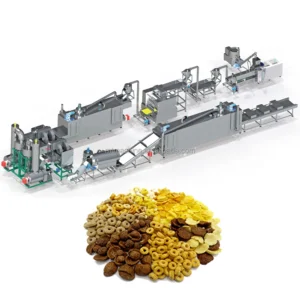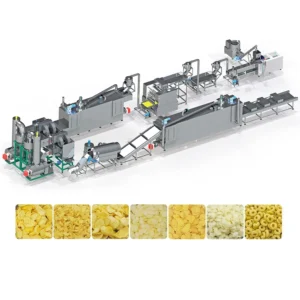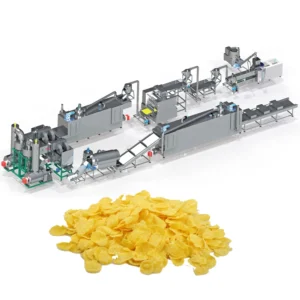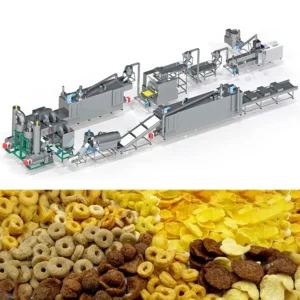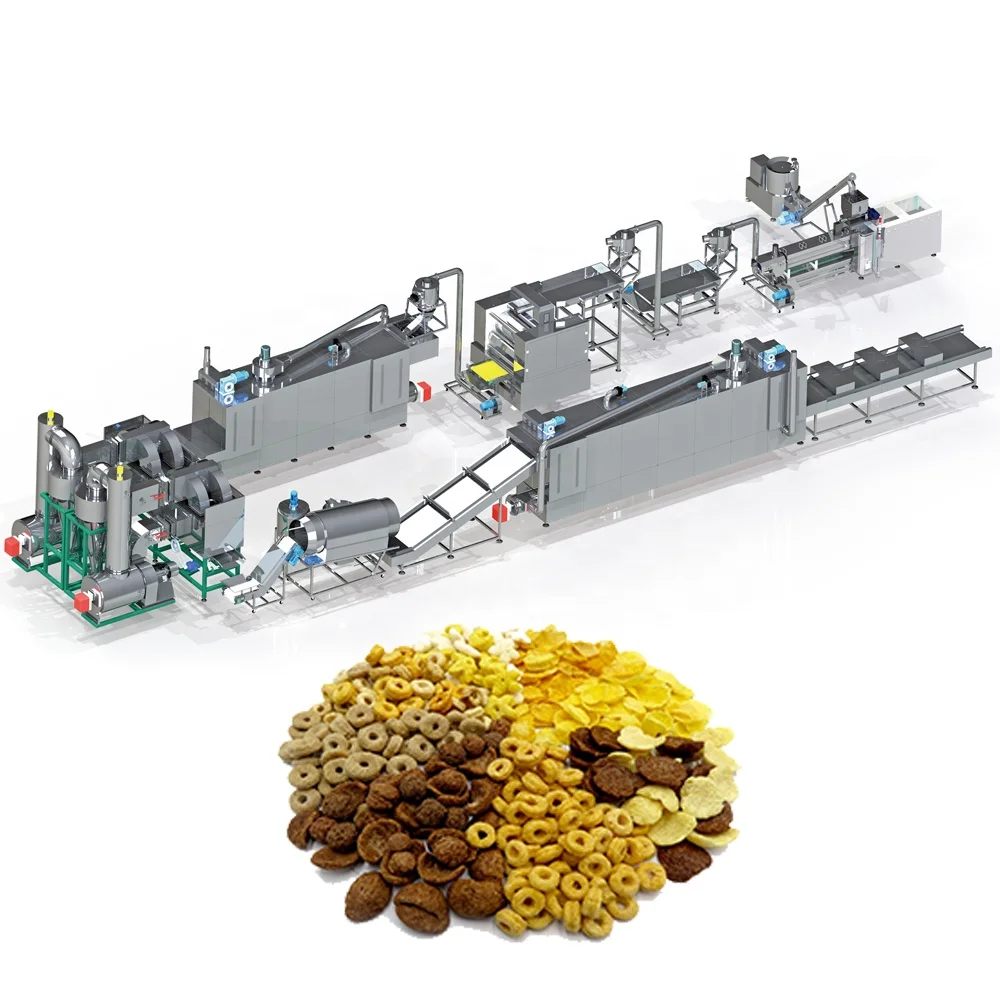

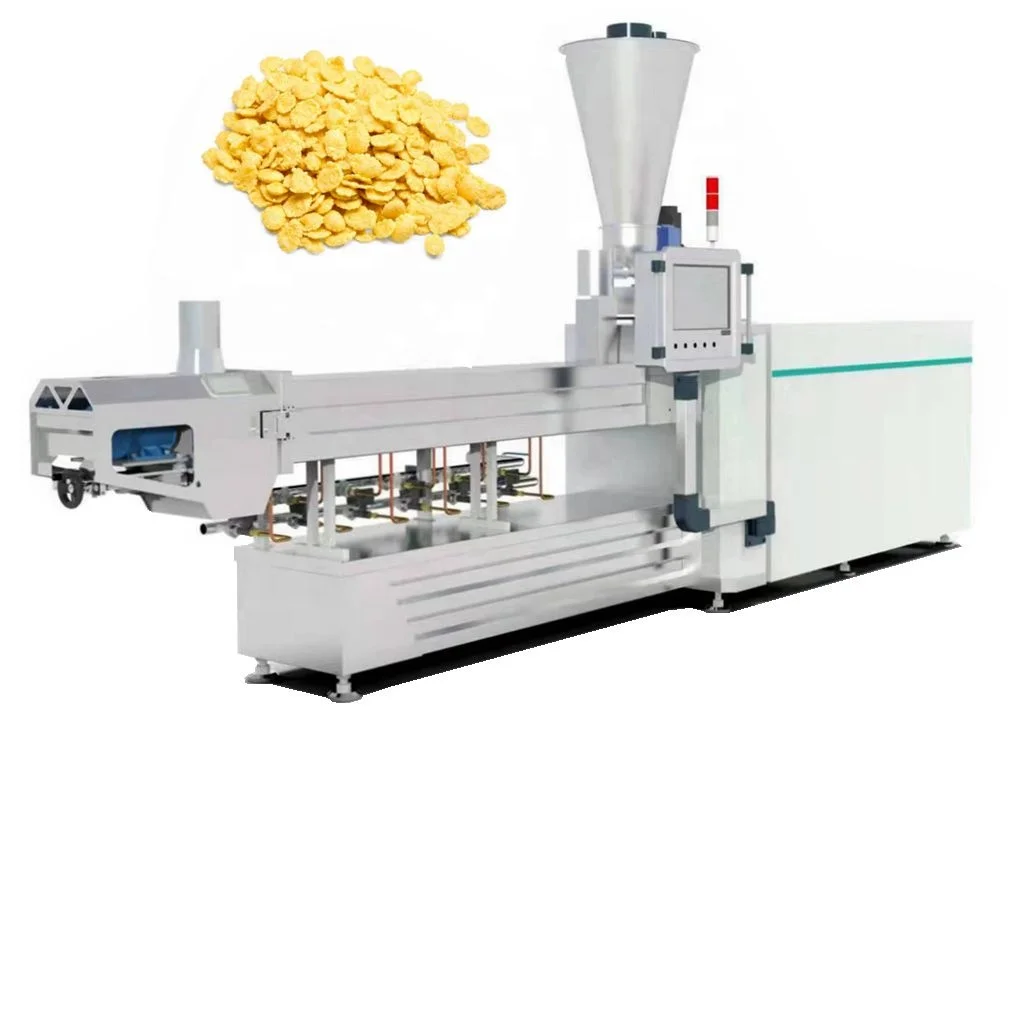
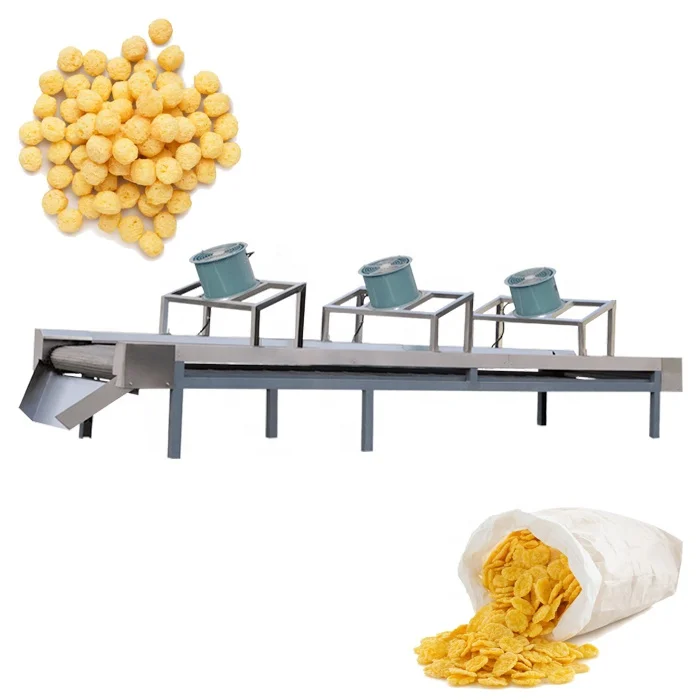
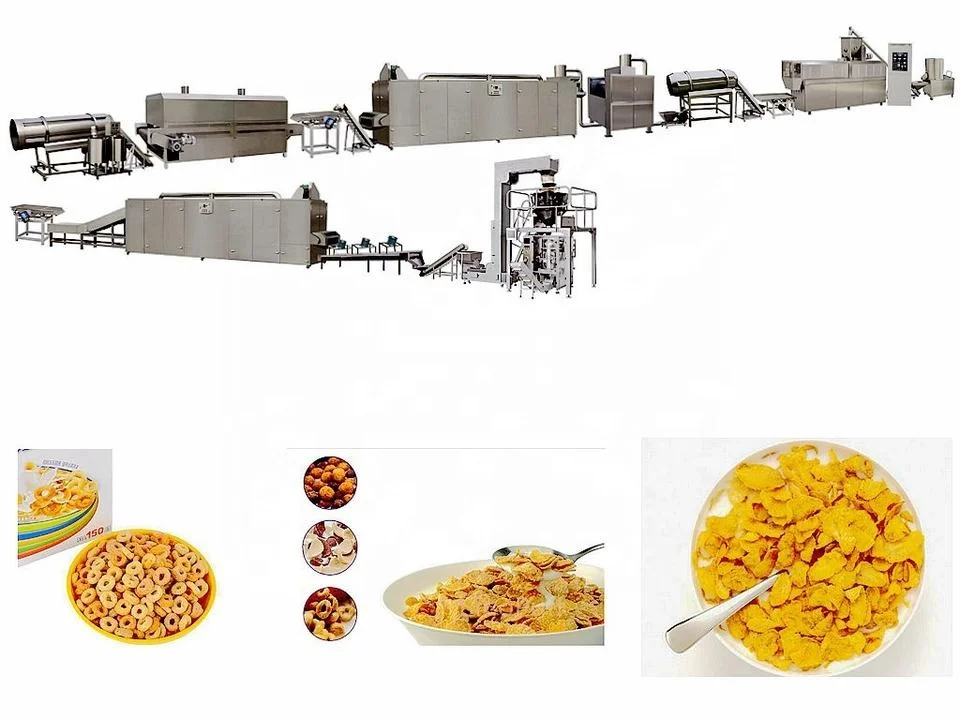
MT70 / MT85 / MT75 Corn Flakes Production Line, 150–500 kg/h Output, Twin-Screw Extruder — complete turnkey system from mixing through extrusion, flaking, drying, roasting to packing. Screw configuration and die design are matched to your cereal blend and target flake density, with PLC-controlled flaking machinery ensuring consistent thickness and texture across all production runs.
- Twin-screw extrusion with automatic lubrication and wear-resistant screws
- Hot air roasting oven with dual circulating fans for uniform blistering
- Trial run validation on your raw material before shipment confirms achievable capacity
Description
Turnkey Line Accountability — Every station from batching to packing is throughput-matched under one supplier, eliminating the bottleneck risk that plagues multi-vendor cereal projects.
Technical Specifications
| Parameter | Value |
|---|---|
| Product Type | Corn Flakes Production Line |
| Models Available | MT70 / MT85 / MT75 |
| Installed Power | 160 kW (MT70) / 190 kW (MT85) / 210 kW (MT75) |
| Power Consumption | 120 kW (MT70) / 140 kW (MT85) / 150 kW (MT75) |
| Output Capacity | 150–200 kg/h (MT70) / 300–400 kg/h (MT85) / 300–500 kg/h (MT75) (basis to be confirmed) |
| Overall Dimensions (L×W×H) | 41×1.5×2.2 m (MT70) / 43×1.5×3.2 m (MT85) / 45×1.5×3.5 m (MT75) |
| Extruder Type | Twin Screw (MT75) |
| Control System | PLC control with MCC available for full line |
| Heating Source (Dryer) | Gas or Electric |
| Raw Materials | Corn, rice, wheat, oat, barley powder |
| Key Features | Hydraulic double-roller flaking, infrared temperature control, dual circulating fan roasting oven, cyclone dust removal, automatic screw lubrication and cooling |
Application Suitability
| Application | Material or Output |
|---|---|
| Natural corn flakes production | Corn grits and corn powder |
| Sugar-coated breakfast cereal | Corn flakes with sugar spraying and coating |
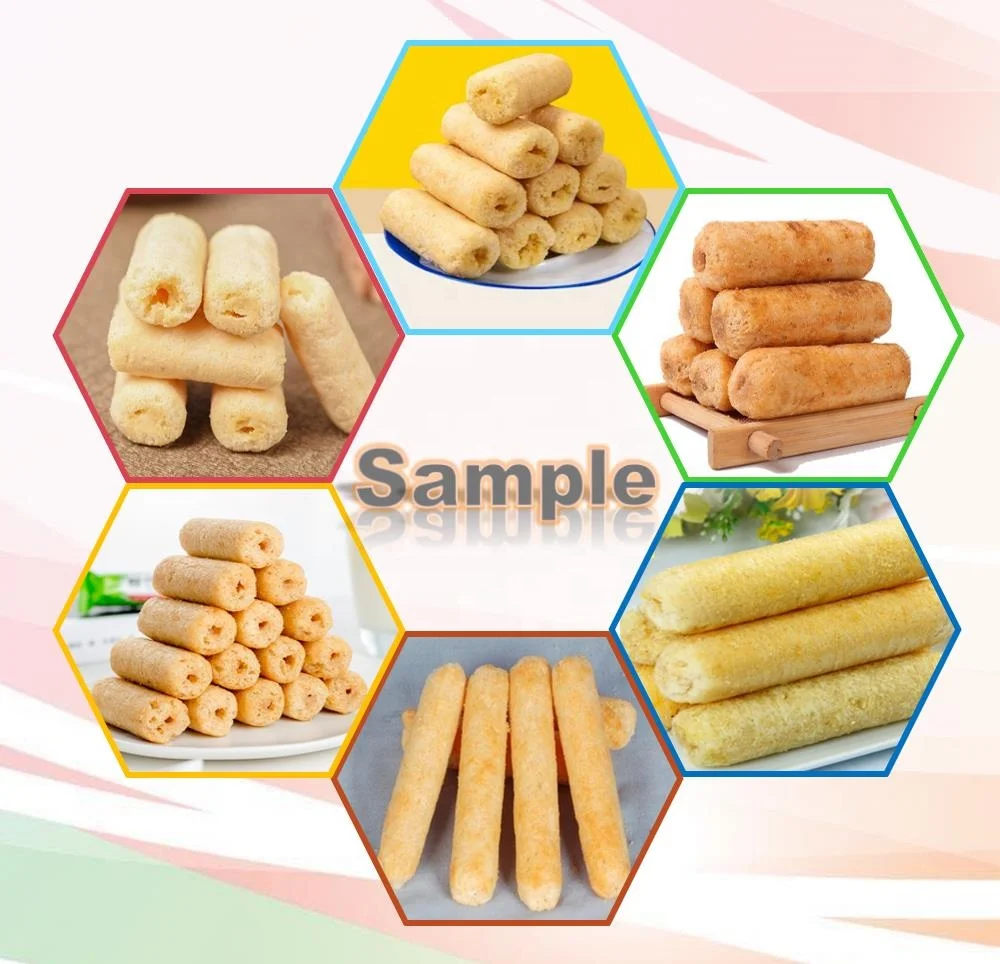
| Extruded cereal shapes | Ball, tube, stick, ring, fruit loop, star, wheel, flower, heart from corn, rice, wheat, oat, barley blends |
| Small to medium-scale cereal plants | Lines configured from mixing through extrusion, flaking, roasting, cooling to packing |
Why Your Corn Flakes Line Must Be Validated on Your Actual Recipe Before It Ships
A capacity number without a raw material recipe is just marketing.
I once watched a client unbox a breakfast cereal line rated for a certain throughput, only to find that their local corn grits — coarser than what the vendor tested with — produced flakes that were thick, hard, and barely expanded. The line ran, but output fell far below what was quoted. That gap between catalog numbers and real production is where most cereal extrusion projects quietly fail [NEED_CITE: cereal extrusion capacity validation on buyer raw material]. A corn flakes production line turnkey should be proven on the exact grain blend and moisture content you plan to run, not on a generic benchmark recipe. The screw configuration, barrel temperature profile, and die geometry all shift when you change the starch source or particle size, and those shifts directly determine whether your flakes blister properly in the roaster or come out flat and dense.
Matching the Extruder to Your Cereal Blend
A corn flakes production line turnkey begins with the extruder, and the extruder begins with the screw. The MT75 uses a twin-screw design with automatic lubrication and cooling, which matters because corn-based doughs generate significant shear heat during gelatinisation. Screw configuration and die design are specified to the buyer’s raw material, so when your recipe shifts from pure corn to a corn-oat or corn-wheat blend, the compression ratio and residence time are recalculated accordingly. This is the difference between consistent starch gelatinisation and a barrel full of half-cooked dough that clogs the die.
How the Flaking and Roasting Stages Define Flake Texture
After extrusion, the pellet passes through a hydraulic double-roller flaking system with infrared sensor temperature control. The roller gap and pressure determine flake thickness, which in turn governs how the piece behaves in the hot air roasting oven. That oven uses dual circulating fans and a conciliation burner with high-temperature spraying tubes to produce the blistering that gives corn flakes their characteristic crunch. If the flake enters the roaster too thick, the surface scorches before the interior dries. Too thin, and it shatters during cooling and packing. Throughput matching between the flaker, dryer, and roaster is what keeps the texture consistent hour after hour [NEED_CITE: flake thickness and roasting temperature relationship in breakfast cereal processing].
Reading the Numbers That Actually Matter
The installed power across the three models — 160 kW, 190 kW, and 210 kW — reflects the total connected load from mixer through roaster, not just the extruder motor. For a buyer planning electrical infrastructure, power consumption figures of 120 kW, 140 kW, and 150 kW indicate what the line draws under normal running conditions, which determines transformer sizing and circuit breaker selection. The overall dimensions, reaching up to 45 meters in length for the MT75 configuration, dictate the minimum workshop bay length before accounting for raw material staging and finished goods staging areas. The PLC control system manages barrel temperature zones, roller pressure, and roaster fan speed, providing repeatability that manual adjustment cannot sustain across shifts.
The Hidden Cost of Mismatched Stations
When a buyer sources the extruder from one vendor and the dryer from another, the dryer often arrives with insufficient belt width or residence time to handle the extruder’s actual output. The result is a bottleneck that forces the extruder to run below its capable rate, and the flakes enter the roaster with residual moisture that ruins blistering [NEED_CITE: throughput mismatch between extruder and dryer in cereal lines]. I have seen entire cereal projects stall at commissioning because the roaster could not keep up, and the packing station sat idle waiting for product that the upstream bottleneck was withholding. These mismatches are invisible on paper when each machine is quoted separately.
Why a Single-Source Turnkey Approach Works Here
A corn flakes production line turnkey sourced from one supplier means the mixing capacity, extruder throughput, flaker speed, dryer residence time, roaster volume, and packing rate are all calculated against the same target output. Screw configuration records are specific to your grain blend, not copied from a generic build. The in-house testing workshop runs your actual raw material before the line ships, producing a trial run report that documents achievable throughput and flake quality. Pre-sales consultation covers line layout and utility planning, and the commissioning team stays on-site through operator training and parameter optimisation. Documentation — from electrical schematics to CE declarations — arrives as a complete package, not scattered across multiple vendor emails.
Documentation & Verification
- Line layout and capacity calculation matched to your corn blend and target flake specification
- Screw and die configuration record tied to your raw material particle size and moisture
- Trial run report from in-house testing on your grain before dispatch
- Electrical schematic with voltage and frequency confirmed to your local supply
- Factory test record documenting throughput and flake density under PLC control
- CE declaration of conformity and ISO certificate included with customs documentation
Installation, Commissioning & Support
- Foundation and utility planning based on line dimensions up to 45×1.5×3.5 m
- Dedicated circuit design around 120–150 kW running load depending on model selected
- Gas or electric dryer heating configured to match local fuel availability and cost
- PLC and MCC commissioning with control language set to operator preference
- Trial production runs supervised on-site to validate flake thickness and blistering
- Wear parts list with screw and die replacement intervals documented at handover
What to Prepare Before Requesting a Quote
To configure a line that actually delivers on your factory floor, share your grain blend and particle size, your target daily output, and your available workshop dimensions including ceiling height. Confirm your local voltage and frequency, and let us know if you need the control interface in a specific language. If you have existing batching or packing equipment that the new line must integrate with, provide those specifications so the layout accounts for the connection points.
Frequently Asked Questions
Q: How is line capacity verified on my specific raw material before shipment?
A: We run your actual grain blend through the extruder in our in-house testing workshop, documenting throughput, flake density, and blistering behaviour in a trial run report. Screw configuration and barrel temperatures are adjusted during this test, and the line only ships once the results match your product specification.
Q: How do you ensure throughput is matched between the extruder, flaker, dryer, and roaster?
A: Each station is sized during the layout phase based on the same target output and your specific recipe. The flaker roller width, dryer belt length, and roaster volume are all calculated so that no single station restricts the one before it, preventing the bottleneck that occurs when machines are sourced separately.
Q: What is included in the turnkey project scope for this line?
A: The scope covers line layout design, utility planning for power and gas connections, throughput matching across all stations, shipment, on-site installation, commissioning with supervised production runs, operator training on the PLC system, and a wear parts programme for screws, dies, and flaking rollers.
Q: How are screw configuration and die design determined for my target flake texture?
A: We start with your raw material analysis — grain type, particle size, starch content, and moisture. The screw pitch, compression ratio, and die opening are then selected to achieve the gelatinisation and pellet density your roaster needs to produce proper blistering and crunch in the final flake.
Related products
-
New Automatic Cornflakes Making Machine Oats Snack Food Chips Extruder Processing Line
¥30.00 Select options This product has multiple variants. The options may be chosen on the product page -
Automatic 500kg/h Corn Flakes Making Machine New Condition High Productivity Sweet Breakfast Cereal Processing Line From Factory
¥8,500.00 Select options This product has multiple variants. The options may be chosen on the product page -

Corn Flakes Production Line Breakfast Cereal Production Machine Line Corn Flake Making Machinery
¥59,800.00 Select options This product has multiple variants. The options may be chosen on the product page -
New Technical Automatic Cereal Nutritional Powder Instant Porridge Baby Food Making Machine
¥10,000.00 Select options This product has multiple variants. The options may be chosen on the product page