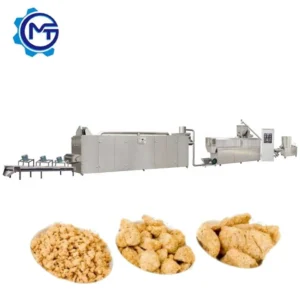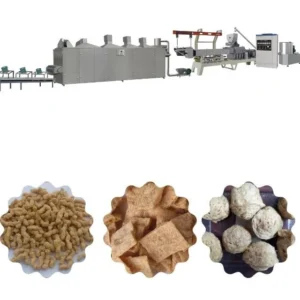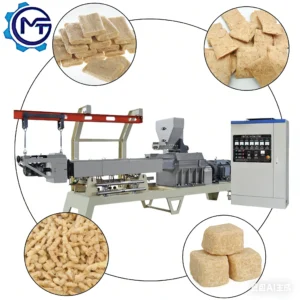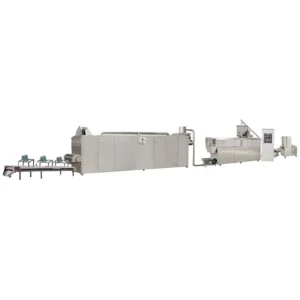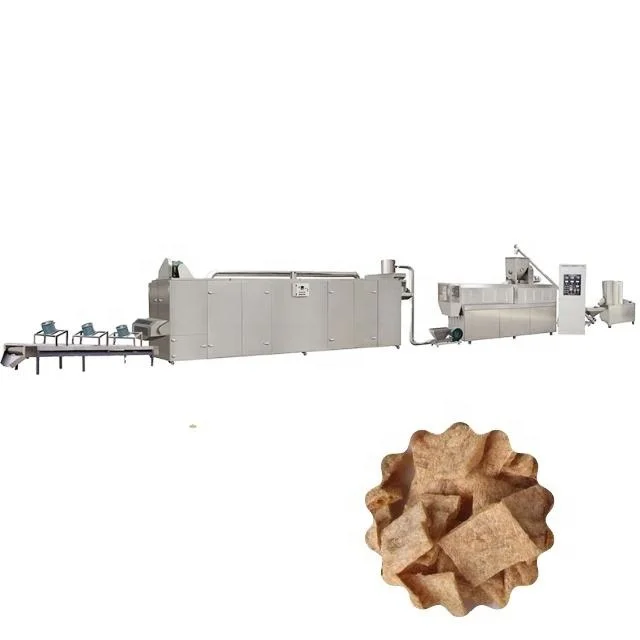


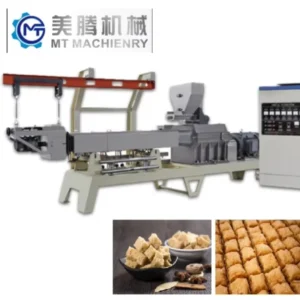
MT65 / MT70 / MT85 Textured Soybean Protein Extrusion Production Line, Twin-Screw, CE Certified — complete turnkey TVP processing system from raw material batching through extrusion, drying, cooling, and packing. Twin-screw extrusion platform with screw configuration and die design matched to your soybean meal formulation and target fiber structure. Full line stations engineered as one project with balanced capacity, preventing bottlenecks between extruder, dryer, and cooler. In-house trial runs on your raw material validate texture before shipment.
- Screw configuration specified to buyer’s formulation
- Line throughput matched across every station
- On-site installation and commissioning included
- Multiple models covering different production tiers
Description
Complete Line Integration — Every station from batching to packing is engineered as one project with matched throughput, so your extruder never waits on the dryer.
Technical Specifications
| Parameter | Value |
|---|---|
| Product Type | Textured Soybean Protein (TVP) Extrusion Production Line |
| Model Options | MT65 / MT70 / MT85 |
| Screw Type | Twin-screw |
| Installed Power | 85 kW (MT65) / 120 kW (MT70) / 195 kW (MT85) |
| Actual Power Consumption | 65 kW (MT65) / 90 kW (MT70) / 165 kW (MT85) |
| Output Capacity | 150–200 kg/h (MT65), 200–300 kg/h (MT70), 600–800 kg/h (MT85) (basis to be confirmed — depends on raw material and moisture) |
| Overall Dimensions | 18000×1300×2300 mm (MT65) / 20000×1500×2400 mm (MT70) / 24000×3500×4300 mm (MT85) |
| Powder Mixer Tank Volume | 150 kg |
| Powder Mixer Rotary Speed | 385 rpm |
| Powder Mixer Mixing Time | 10 min per batch |
| Powder Mixer Power | 4 kW |
| High-Temperature Roaster Effective Belt Length | 3.5 m |
| High-Temperature Roaster Far Infrared Heater Power | 3.9 kW × 24 |
| Gas Consumption | 6.8 m³ (basis to be confirmed — depends on gas type and pressure) |
| Cooling Machine Temperature Range | 0–260°C (basis to be confirmed — verify with manufacturer catalog) |
| Material | Stainless steel (all machinery) |
| Standards | CE, ISO |
Application Suitability
| Application | Material or Output |
|---|---|
| Textured soybean protein for ham and sausage formulations | Low-temperature soybean meal at controlled moisture |
| Plant-based meat alternatives for quick-frozen product lines | Soybean meal and peanut meal blends |
| TVP ingredients for canned food and fast food supply chains | Defatted soy flour with target fiber structure |
| Soy meat analogues for retail and foodservice packaging | Soy protein concentrate processed through twin-screw extrusion |
Why Nominal Capacity Means Nothing Without Your Raw Material
A textured soybean protein production line turnkey rated at 800 kg/h on paper may produce half that when your soybean meal arrives with higher moisture than the test sample. I have stood on factory floors in Southeast Asia watching a brand-new line stall because the buyer ordered based on a brochure number. The soybean meal from a local supplier carried more moisture than the specification sheet assumed, and the extrudate came out gummy instead of fibrous. Two weeks of screw reconfiguration and barrel temperature tuning followed before the line ran anything sellable.
Every protein source behaves differently under heat and shear. Peanut meal gelatinises at a different temperature window than soybean meal, and the fiber alignment your market expects — long, striated strands that pull apart like chicken — depends entirely on screw element sequencing and die geometry matched to your exact formulation [NEED_CITE: twin-screw extrusion screw configuration for texturized protein]. Without a trial run on your actual raw material before shipment, you are commissioning a line blind.
How Line Layout Determines Whether Your TVP Line Runs or Bottlenecks
A textured soybean protein production line turnkey is not simply an extruder with a dryer bolted on. Every station — mixing, conveying, extrusion, drying, cooling, packing — must be sized so that material flows continuously without pile-ups or starvation. If the roaster belt cannot carry the volume the extruder pushes, moisture stays trapped in the product and the fiber structure collapses during storage. If the cooling stage is undersized, the TVP enters packaging warm and condensation ruins shelf life.
What Trial Runs Reveal That Brochures Never Will
Running your specific soybean meal through the extruder before the line ships uncovers problems that only appear under real conditions. The fiber tear pattern, the rehydration speed after soaking, the bulk density in the packaging — all of these are shaped by the interaction between your raw material’s protein content, its moisture, and the screw profile installed in the barrel [NEED_CITE: soybean meal extrusion behavior at varying moisture levels]. A trial run report becomes your baseline document: when the first production batch at your factory does not match it, you know the issue is material variation, not machine design.
Reading the Specs That Actually Matter
The installed power versus actual consumption gap across the MT65, MT70, and MT85 models reflects the difference between peak motor draw during startup and steady-state running load. For utility planning, the actual consumption figure determines your transformer sizing and monthly energy cost. The powder mixer’s 385 rpm and 10-minute batch cycle define how many batches per hour feed the extruder — if the mixer cannot keep pace with an MT85 running at higher capacity, the extruder starves and temperature stability in the barrel breaks down. The roaster’s 3.5-meter effective belt length and far infrared heater array determine residence time: too short and residual moisture causes clumping; too long and the surface over-dries while the core stays soft. The cooling machine’s stated range requires confirmation against your local ambient conditions and the bulk density target your packaging format demands.
The Cost of Skipping Station-by-Station Capacity Matching
I have seen producers lose an entire shift because the dryer could not handle what the extruder was pushing. The material backed up on the conveyor, cooled unevenly, and the fiber structure that took months to develop in the lab turned into a dense, unusable puck. On another line, the packaging station ran faster than the cooler could supply, so workers were hand-feeding bags and introducing contamination at every transfer point. These are not defects in individual machines — they are failures in line-level engineering where each station was sourced separately and nobody calculated the flow between them [NEED_CITE: production line throughput matching methodology].
Why This Line Is Engineered as One Project
The mixing, extruding, drying, cooling, and packing stations are specified together so throughput is balanced from the first batch to the last bag. The screw configuration and die design are selected against your soybean meal or peanut meal formulation, not copied from a generic build. An in-house testing workshop runs your actual raw material before shipment, producing a trial report that validates fiber texture and density. Electrical schematics, voltage confirmation, and control language are documented for your target market before production starts. On-site installation includes commissioning and operator training so the line runs correctly from day one, not after weeks of trial and error.
Documentation & Verification
- Line layout drawing showing throughput calculations matched across extruder, dryer, and cooler
- Trial run report on your specific soybean meal with fiber structure and density measurements
- Screw and die configuration record mapped to your formulation and target product
- Electrical schematic with voltage, frequency, and control language confirmed for your market
- Factory test record documenting running conditions before dispatch
- Wear parts list with screw elements and die specifications for reorder
Installation, Commissioning & Support
- Floor plan review accounting for the MT85’s 24-meter length and utility connection points
- Power supply verification against 195 kW installed capacity with dedicated circuit planning
- Sectional delivery and on-site assembly sequencing for confined workshop access
- First-run parameter setting on your raw material with barrel temperature and screw speed calibration
- Operator training covering screw changeover, die cleaning, and moisture adjustment procedures
- Spare screw elements and dies supplied with recommended replacement intervals documented
Before You Request a Quote
Provide your raw material specification — protein content, moisture level, and particle size — along with your target fiber structure and bulk density. Share your local voltage and frequency, preferred control language, and available workshop floor area with ceiling height. If you have existing upstream milling or downstream packaging equipment, note the interface requirements so the line layout accounts for them.
Frequently Asked Questions
Q: How is line throughput verified on my specific soybean meal formulation and moisture content?
A: Your raw material is run through the extruder in the testing workshop before shipment. The trial documents fiber tear pattern, rehydration speed, and bulk density under controlled screw configuration and barrel temperature. This report becomes your commissioning baseline, so the line arriving at your factory already has a validated process recipe.
Q: What utility planning is required for a complete TVP line at my target capacity?
A: Power requirements depend on which extruder model anchors your line — actual consumption ranges from 65 kW to 165 kW at steady state. Gas supply for the roaster and floor space for the longest configuration at 24 meters must also be planned. A detailed utility layout is provided during the proposal stage based on your facility dimensions.
Q: How are extruder, dryer, and cooler capacities matched to prevent bottlenecks?
A: Each station is sized against the extruder’s confirmed output on your material, not a nominal catalog number. The roaster belt speed, infrared heater zones, and cooler airflow are calculated so material flows continuously without accumulation or starvation between stages.
Q: What does on-site installation, commissioning, and operator training include?
A: Engineers arrive for assembly, utility connection, and first-run calibration using your raw material. Operators are trained on screw element changeover, die maintenance, moisture adjustment, and daily cleaning protocols. Commissioning continues until the line produces product matching the pre-shipment trial report.
Q: Can the line layout be phased for future capacity expansion without replacing existing stations?
A: The initial layout can allocate floor space and utility headroom for a larger extruder or additional dryer section. Support equipment such as mixers and conveyors are specified with capacity margin so that upgrading the extruder later does not require replacing every downstream station.
Related products
-
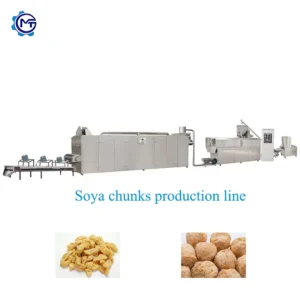
Soybean Protein Making Machine Automatic Soy Chunk Production Line
¥30.00 Select options This product has multiple variants. The options may be chosen on the product page -
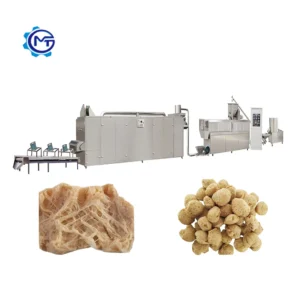
High Productivity New Soy Protein Automated Production Line Meat Substitute Processing Line
¥30.00 Select options This product has multiple variants. The options may be chosen on the product page -
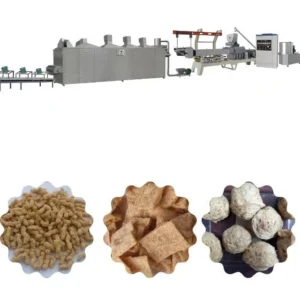
Vegetable Meat Making Machine Textured Soybean Protein Maker
¥30.00 Select options This product has multiple variants. The options may be chosen on the product page -
Automatic TVP Vegetarian Meat Manufacturing Plant
¥9,500.00 Select options This product has multiple variants. The options may be chosen on the product page