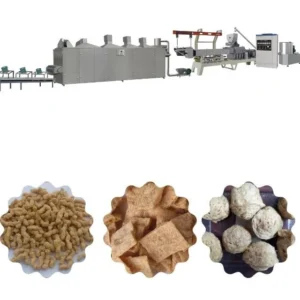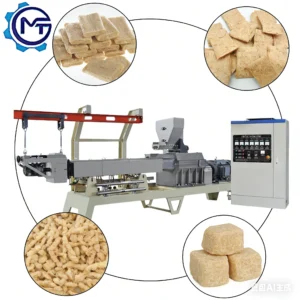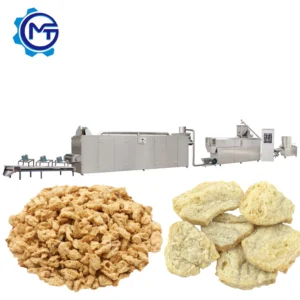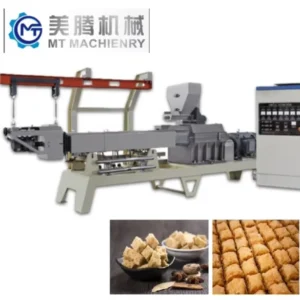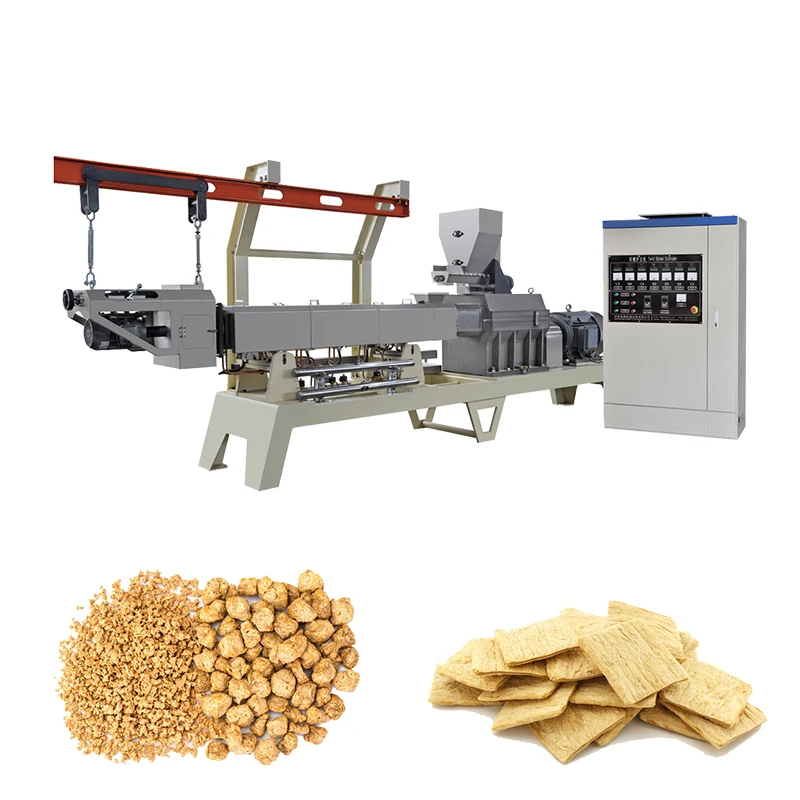


Textured Vegetable Protein Production Line, Twin-Screw Extruder, CE Certified — engineered as one turnkey project from batching through extrusion, drying, cooling and packing, with throughput matched across every station. Screw configuration and die design are specified to your raw material formulation (low-temperature soybean meal, peanut meal) and target fibre structure for soy chunks and plant-based meat analogues. Line layout, capacity calculation and in-house trial run on your actual raw material are completed before shipment, ensuring validated performance from day one.
Description
Station-to-station throughput engineering — Every mixer, twin-screw extruder, dryer and cooler in this textured vegetable protein production line is sized against the actual mass flow of your specific soy or peanut meal formulation, not catalog nominal output.
Technical Specifications
| Parameter | Value |
|---|---|
| Product Type | Textured Vegetable Protein (TVP) Production Line |
| Extruder Type | Twin-screw (Double Screw Extruder) |
| Models Available | MT65 / MT70 / MT85 |
| Output Capacity (MT65) | 150–200 kg/h (basis not stated in source — confirm raw material, moisture and product format) |
| Output Capacity (MT70) | 200–300 kg/h (basis not stated in source — confirm raw material, moisture and product format) |
| Output Capacity (MT85) | 600–800 kg/h (basis not stated in source — confirm raw material, moisture and product format) |
| Installed Power (MT65 / MT70 / MT85) | 85 kW / 120 kW / 195 kW |
| Actual Power Consumption (MT65 / MT70 / MT85) | 65 kW / 90 kW / 165 kW |
| Overall Dimensions (MT65 / MT70 / MT85) | 18000 × 1300 × 2300 mm / 20000 × 1500 × 2400 mm / 24000 × 3500 × 4300 mm |
| Powder Mixer Tank Volume | 150 kg |
| Powder Mixer Rotary Speed | 385 rpm |
| Powder Mixer Mixing Time | 10 min per batch |
| Powder Mixer Power | 4 kW |
| High-temperature Roaster Effective Belt Length | 3.5 m |
| High-temperature Roaster Gas Consumption | 6.8 m³/h |
| High-temperature Roaster Far Infrared Heater Power | 3.9 kW × 24 |
| Contact Material | Stainless steel throughout product contact zones |
| Line Process Sequence | Raw material preparation → Mixing → Conveying → Extrusion → Conveying → Drying → Cooling → Packing |
| Assembly State | Complete line, factory-assembled stations |
| Warranty | 1 year complete warranty; life-time maintenance service |
Application Suitability
| Application | Material or Output |
|---|---|
| Soy chunks and TVP for food service and retail | Low-temperature soybean meal |
| Plant-based meat analogues with fibrous structure | Soy protein concentrate, peanut meal blends |
| Protein ingredients for ham, sausage and canned food | Texturized soy and peanut meal |
| Vegetarian meat products for quick-frozen food industry | Mixed plant protein formulations |
| Fortified food base material for nutrition programmes | Soy and legume meal blends |
Why Nominal Capacity Figures Mislead TVP Buyers
A textured vegetable protein production line turnkey rated at 300 kg/h on one soy meal formulation may deliver half that on yours.
The problem is that extruder capacity is almost always quoted against a standard reference material — typically a high-protein, low-fat soy isolate with controlled moisture. When your actual raw material arrives with different protein content, residual oil, or particle size distribution, the screw configuration and barrel temperature profile no longer match the rheology of the melt. The extruder runs, but fibre formation degrades and throughput drops. I have seen lines sit idle for weeks while technicians rework screw element sequences on-site because the trial run used a different batch of soy meal than what the buyer’s local supplier actually delivers [NEED_CITE: raw material variability in soy protein processing]. This textured vegetable protein production line turnkey approach addresses that gap by requiring your actual material be tested before any line configuration is finalised.
Layout Engineering as a Single Integrated Project
The entire line is planned as one project, which means the mixer batch cycle, extruder feed rate, dryer belt loading, and cooler airflow are calculated together rather than specified by separate vendors working from generic catalog data. When the powder mixer delivers 150 kg batches every ten minutes, the downstream extruder must accept that mass flow continuously without starving or flooding. The dryer belt length and temperature zones are then matched to the actual moisture content exiting the die. This integrated layout prevents the common situation where one station runs at partial capacity because the next station cannot keep up.
Utility Planning and Phased Commissioning
Each station on a textured vegetable protein production line turnkey installation has distinct utility requirements — three-phase power for the extruder main drive, gas supply for the high-temperature roaster, compressed air for pneumatic conveying gates, and chilled water for the cooling stage. Utility planning is completed during the layout phase so that pipe routes, cable trays and connection points are defined before equipment arrives on site. Commissioning follows a phased schedule: individual station dry runs first, then wet runs with material through each section, then full-line continuous operation [NEED_CITE: phased commissioning protocol for food extrusion lines]. This sequence isolates issues at each station before they cascade across the line.
Reading the Specifications That Actually Matter
The twin-screw extruder is the core of any TVP line, and its screw configuration — not just motor power — determines whether you get the fibrous, chewy texture the market expects. The MT65, MT70 and MT85 models differ in screw diameter and length-to-diameter ratio, which governs residence time inside the barrel and the degree of protein alignment under shear and heat. A longer barrel allows more gradual temperature profiling, which matters when working with lower-protein meals that need gentler treatment to avoid denaturing before the die. The installed power figures (85 kW for the MT65, scaling to 195 kW for the MT85) reflect main drive capacity, while actual consumption runs lower under normal load — the gap between installed and actual power is where headroom lives for harder-to-process formulations. The high-temperature roaster uses 24 far infrared heaters across a 3.5-metre effective belt length, giving the operator independent control over drying rate and surface colour development.
The Hidden Cost of Mismatched Station Capacities
When a dryer is sized below the extruder’s actual output, the line backs up — product sits on the belt too long, over-dries on the surface while retaining internal moisture, and develops inconsistent rehydration properties downstream. A cooler that cannot handle the full mass flow forces the extruder operator to reduce feed rate, which changes barrel fill level and shifts the entire thermal profile. These problems do not show up in a quotation that lists each machine separately with its own nominal capacity [NEED_CITE: throughput mismatch consequences in multi-station food lines]. The buyer only discovers the bottleneck during commissioning, when the line cannot sustain the output that was promised on paper. Sizing every station against the real mass flow of your specific formulation eliminates this failure mode before equipment is built.
Why This Supplier for Your TVP Line
Complete lines from batching through packing come from one engineering team, so throughput calculations are not handed off between separate vendors who each optimise their own station in isolation. Screw configuration and die design are specified to your raw material and target fibre structure rather than copied from a generic build that worked for a different customer’s soy formulation. An in-house testing workshop runs your actual material before shipment, producing a trial report that documents the screw element sequence, barrel temperature curve and die geometry that achieved your target texture. Pre-sales consultation, on-site installation, commissioning and operator training are delivered by the same engineers who designed the line, so the people setting parameters on day one already understand the layout decisions that were made months earlier. CE and ISO certified documentation accompanies every shipment.
Documentation & Verification
- Line layout drawing with station-to-station throughput calculations for your formulation
- Screw element sequence and die geometry record matched to your raw material
- Trial run report on your actual soy or peanut meal before factory dispatch
- Electrical schematic with voltage and frequency confirmed for your facility
- Operation and maintenance manual with wear parts identification list
- CE declaration of conformity and ISO certificate for the complete line
Installation, Commissioning & Support
- Foundation plan based on the specific extruder model footprint and dynamic load
- Three-phase power distribution sized to the installed kW of each station
- Factory-assembled stations shipped with protected screw and die elements
- Phased commissioning from individual station tests to full-line continuous run
- Operator training covering screw changes, barrel temperature adjustment and cleaning
- Wear parts list with reorder specifications for screws, dies and mixer blades
What We Need to Engineer Your Line
To prepare an accurate layout and capacity calculation for your textured vegetable protein production line turnkey project, share your raw material specification sheet including protein content, moisture range and particle size. Provide your target daily output, workshop dimensions with ceiling height, and local voltage and frequency. Let us know the language requirement for the control interface and whether you can send a representative sample of your actual soy or peanut meal for a trial run in our testing workshop before line configuration is locked in.
Frequently Asked Questions
Q: How is line throughput verified before shipment?
A: Your actual raw material is run through the configured extruder, dryer and cooler in our in-house testing workshop. The trial produces a documented report showing the screw element sequence, barrel temperature profile, die selection and achievable continuous output on your specific formulation — not a reference material.
Q: How are extruder, dryer and cooler capacities matched?
A: Each station is sized against the real mass flow exiting the previous station, accounting for moisture loss in the dryer and cooling rate requirements. This prevents bottlenecks where one station forces upstream equipment to run below its design capacity.
Q: What does the turnkey project scope include?
A: The scope covers line layout design, utility planning for power, gas, water and compressed air, phased installation scheduling, commissioning from individual station dry runs through full-line continuous operation, and on-site operator training with complete documentation handover.
Q: How is screw configuration determined for different raw materials?
A: Screw elements are selected based on your material’s protein content, moisture level and target fibre structure. Low-temperature soybean meal requires different shear profiles than peanut meal blends, and the element sequence is validated during the pre-shipment trial run.
Q: What training and documentation are provided at commissioning?
A: Operators receive hands-on training covering screw and die changes, barrel temperature adjustment, feed rate optimisation and cleaning procedures. Documentation includes the operation manual, wear parts list with reorder codes, electrical schematics and the trial run parameter record.
Related products
-

Customized Vegetarian Meat Production Line for Food Factory
¥9,500.00 Select options This product has multiple variants. The options may be chosen on the product page -
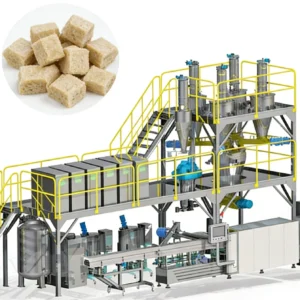
CE Certified Vegetarian Meat Processing Machine
¥9,500.00 Select options This product has multiple variants. The options may be chosen on the product page -

Vegetarian Meat Floss Production Line with Twin Screw
¥9,500.00 Select options This product has multiple variants. The options may be chosen on the product page -
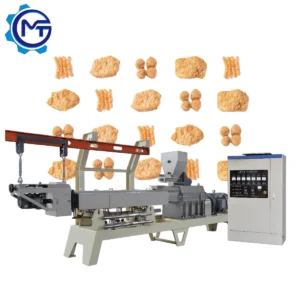
Textured Soy Protein Production Line for Vegetarian Meat Nugget Manufacturing
¥8,238.27 Select options This product has multiple variants. The options may be chosen on the product page