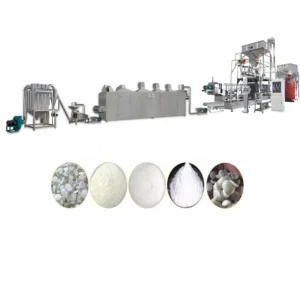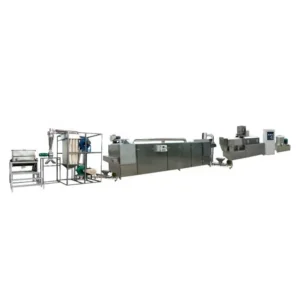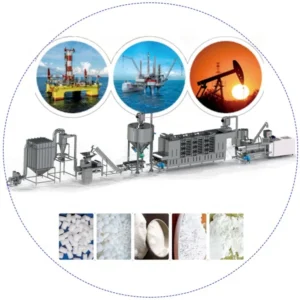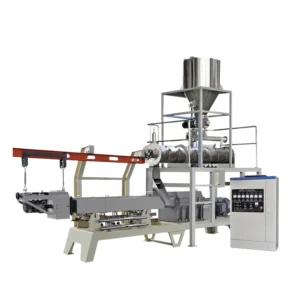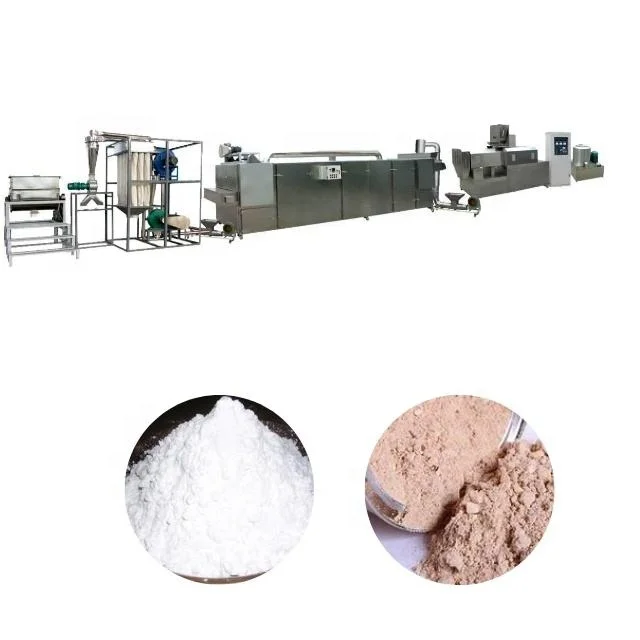


MT70 Modified Starch Processing Line, Twin-Screw Extruder, 70mm Screw, PLC Control — designed as a turnkey solution from batching through extrusion to drying. Twin-screw configuration and die design are specified to your starch type and target gelatinisation degree, with integrated barrel cooling for precise temperature profile control across zones. Three capacity tiers available to match pilot through full-scale output. In-house trial runs on your raw material validate modification degree and throughput before shipment.
- CE and ISO certified line with screw configuration record matched to your formulation
- Voltage, frequency, and control language confirmed in electrical schematic before production
- Complete documentation including trial run report, layout, and wear parts list provided
Description
Precision Throughput Matching — Every station from starch batching to drying is calibrated as one integrated line, preventing the extruder-dryer imbalance that routinely chokes nominal output on actual modified starch formulations.
Technical Specifications
| Parameter | Value |
|---|---|
| Model | MT70 / MT85 / MT100 |
| Product Type | Modified Starch Twin-Screw Extrusion Production Line |
| Screw Type | Twin-screw |
| Screw Diameter | 70 mm (MT70) |
| Screw Length | 1520 mm (MT70) |
| Screw Material | 38CrMoAl |
| Main Motor Power | 30 kW (MT70 extruder unit) |
| Installed Power | 160 kW (MT70) / 190 kW (MT85) / 210 kW (MT100) |
| Power Consumption | 120 kW (MT70) / 140 kW (MT85) / 150 kW (MT100) |
| Output Capacity | 150–200 kg/h (MT70) / 300–400 kg/h (MT85) / 300–500 kg/h (MT100) (basis not stated in source — confirm raw material type, moisture content and target modification degree) |
| Feeding Power | 0.75 kW |
| Cutting Power | 0.75 kW |
| Oil Pump Power | 0.37 kW |
| Heating Ring | 7 × 2 kW = 14 kW |
| Voltage & Frequency | 380V 50Hz Three Phase (configurable to 415V 60Hz, 220V 60Hz, etc.) |
| Overall Dimensions | 41000 × 1500 × 2200 mm (MT70 line) / 43000 × 1500 × 3200 mm (MT85) / 45000 × 1500 × 3500 mm (MT100) |
| Extruder Unit Dimension | 2900 × 900 × 1820 mm |
| Cooling System | Integrated barrel cooling |
| Control System | PLC and MCC control |
| Contact Materials | Food-grade stainless steel (conveyors may use PVC) |
| Fuel Options | Gas / diesel / electricity / steam (specified at inquiry) |
| Standards | CE, ISO certified |
Application Suitability
| Application | Material or Output |
|---|---|
| Food-grade modified starch production | Corn starch, wheat flour — thickener and stabiliser for processed foods |
| Pregelatinised starch for industrial use | Corn starch, cassava starch — textile sizing and paper coating |
| Fortified functional starch processing | Starch-based inputs blended with nutritional additives |
| Modified starch for nutrition programmes | Starch formulations targeting specific viscosity and gelling properties |
Why "Nominal Capacity" Rarely Survives Contact with Your Actual Starch
A modified starch processing line turnkey quoted at 300 kg/h on generic corn starch will behave very differently on your cassava or wheat formulation at your local moisture content.
Over years of commissioning extrusion lines across Africa and South Asia, I have watched the same pattern repeat. A factory orders a line rated for a certain output, the machine arrives, and the moment local raw material hits the hopper the gelatinisation window shifts. Screw speed and barrel temperature profiles that worked perfectly during the factory test no longer hold the target modification degree. The extruder output drops, the dryer cannot keep up with the changed moisture load, and the entire line settles at a throughput well below what was promised [NEED_CITE: starch gelatinisation behaviour varies significantly by botanical source and moisture content]. This is why running a trial on your specific formulation before shipment is not optional — it is the only way to confirm that the modified starch processing line turnkey you are buying will actually perform on your material.
Barrel Temperature Profiling Across Gelatinisation Zones
The extrusion of modified starch depends on maintaining a controlled temperature gradient across the barrel sections. The MT70 configuration uses seven independently controlled heating zones, each rated at 2 kW, combined with integrated barrel cooling to manage the heat generated by shear. This combination allows operators to set distinct thermal conditions for the feeding, compression, and metering zones — critical when shifting between corn starch and higher-amylose formulations that demand different gelatinisation energy. A stable temperature profile directly governs the degree of starch modification and the consistency of the final product viscosity.
Screw Configuration as the Primary Process Variable
The twin-screw geometry determines residence time, shear intensity, and mixing efficiency inside the barrel. For modified starch production, the screw elements must be arranged to deliver sufficient shear for gelatinisation without degrading the polymer chains that give the starch its functional value. The 38CrMoAl screws in the MT70 are configured to a 1520 mm working length, providing the residence time needed for thorough starch modification. Die design further controls expansion and density at discharge, and must be matched to the target application — whether producing a free-flowing pregelatinised powder or a partially expanded granule for downstream milling [NEED_CITE: screw element arrangement directly influences starch modification degree and product functionality].
Reading the Specs That Actually Matter
The main motor at 30 kW on the MT70 extruder unit sets the mechanical energy ceiling for shear-driven gelatinisation. Installed power of 160 kW across the full line accounts for heating, conveying, drying, and control systems — buyers comparing lines should look at total installed power rather than extruder motor alone. The heating ring array of 14 kW distributed across seven zones gives the thermal granularity needed for modified starch work, where a two-degree shift in one zone can alter paste viscosity. Voltage at 380V 50Hz three-phase is the default, but must be confirmed against your facility standard before production begins — rewiring after delivery is not a minor adjustment. The PLC and MCC control system centralises all station parameters, which matters when a formulation change requires coordinated adjustments to screw speed, barrel temperature, and dryer settings simultaneously.
The Cost of Skipping Line-Level Throughput Verification
When the extruder, dryer, and downstream stations are sourced separately, their individual capacities rarely align under real production conditions. An extruder that can push a certain mass flow of gelatinised starch will overwhelm a dryer sized for a lower moisture load. The result is either starch accumulating before the dryer or the extruder being deliberately slowed to match — neither scenario delivers the output you paid for. On a modified starch processing line turnkey, this mismatch shows up as inconsistent moisture in the final product, surface cracking on granules, or batches that fail viscosity specifications. These failures are expensive because they appear only after installation, when returning equipment is no longer practical [NEED_CITE: throughput mismatch between extrusion and drying stations in starch processing].
What Differentiates This Procurement Path
Screw configuration and die design are specified against your raw material and target modification degree, not copied from a generic build library. An in-house testing workshop runs your actual starch formulation through the extruder before shipment, producing a trial run report that documents modification degree and throughput under controlled conditions. The complete line from batching through extrusion to drying and packing is supplied by one source, so throughput at each station is calculated to match rather than assumed. Three capacity tiers — MT70, MT85, and MT100 — allow selection based on validated output data rather than nominal ratings. Pre-sales engineering covers line layout and utility planning, and on-site commissioning includes parameter tuning on your local material with operator training on the PLC interface.
Documentation & Verification
- Line layout and capacity calculation showing matched throughput across every station
- Screw and die configuration record tied to your starch type and modification target
- Trial run report on your raw material with output and modification data recorded
- Electrical schematic with voltage, frequency, and control language confirmed before production
- Factory test record and operation manual delivered with the line
Installation, Commissioning & Support
- Foundation and floor space planning based on the MT70 line footprint of 41000 × 1500 × 2200 mm
- Dedicated electrical circuit sized for 160 kW installed power at your confirmed voltage and frequency
- Extruder unit arrives with barrel sections pre-assembled; dryer and downstream stations positioned per layout
- First production run supervised on-site with screw speed and temperature profiles tuned to your material
- Operator training covers PLC interface navigation, alarm response, and formulation changeover procedures
- Wear parts list provided for screws, dies, and heating rings with recommended replacement intervals
Preparing Your Inquiry
To receive a line configuration that reflects your actual production needs rather than a generic template, include your starch source and current moisture content, the modification degree or functional property you need the final product to achieve, and your target daily output in kilograms. Specify your facility voltage, frequency, and preferred PLC interface language. If you have existing upstream milling or downstream packing equipment, note the connection points so the line layout accounts for them.
Frequently Asked Questions
Q: How is output capacity verified against my specific starch raw material and moisture content?
A: Before shipment, your raw material is run through the extruder in the in-house testing workshop. The trial documents actual throughput, modification degree, and moisture at discharge under controlled screw speed and barrel temperature settings. This data forms the basis for final line configuration rather than relying on nominal capacity ratings from generic starch trials.
Q: What screw configuration and die design is recommended for my target modification degree?
A: Screw element arrangement and die geometry are selected after reviewing your starch type, amylose content, and target functional property. Higher modification degrees typically require longer residence times and specific shear profiles. The configuration record is documented and provided with the line so future rebuilds maintain the same process conditions.
Q: How is throughput balanced between the extruder, dryer, and downstream stations in the line?
A: Each station is sized based on the mass flow and moisture load exiting the preceding stage. The dryer capacity is calculated from the actual discharge moisture measured during the trial run, and conveying rates are set to prevent accumulation. This matching is reflected in the line layout and capacity calculation provided with the quotation.
Q: Can voltage, frequency, and PLC interface language be adapted to my factory’s utility standard?
A: The line is configurable from the default 380V 50Hz three-phase to alternatives such as 415V 60Hz or 220V 60Hz. The PLC interface language is confirmed during the specification stage before electrical schematics are finalised. This ensures the control panel and motor ratings match your facility without post-delivery modifications.
Q: What does the in-house trial run cover, and what documentation is provided before shipment?
A: The trial run processes your supplied raw material through the configured extruder and records screw speed, barrel temperature profile, throughput, and product modification data. You receive a trial run report, screw and die configuration record, and factory test documentation — all reviewed before the line is cleared for packing and dispatch.
Related products
-
Automatic Deep Processing Machine – Food Grade Modified & Pregelatinized Starch Manufacturing Line
¥65.00 Select options This product has multiple variants. The options may be chosen on the product page -
Modified and Pregelatinized Starch Processing Equipment – Pregelatinized Corn Cassava Modified Starch Puffing Machine
¥65.00 Select options This product has multiple variants. The options may be chosen on the product page -
Corn Cassava Modified Starch Powder Production Line Electric-powered Motor Automatic 400kg/h Processing Equipment New Condition
¥65.00 Select options This product has multiple variants. The options may be chosen on the product page -
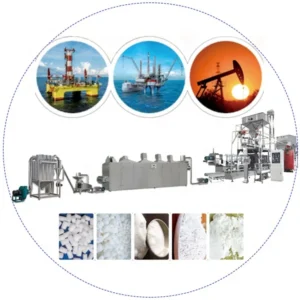
Automatic Industrial Adhesive Starch Modification Production Line – Pre-Gelatinization Extrusion Equipment
¥65.00 Select options This product has multiple variants. The options may be chosen on the product page