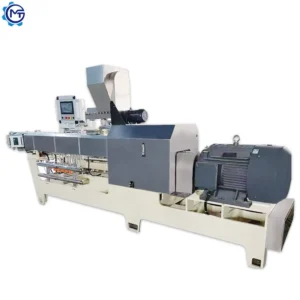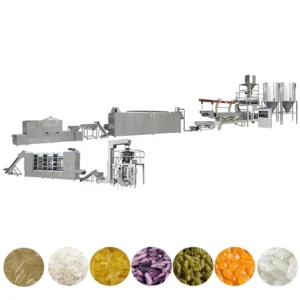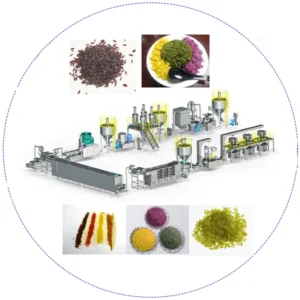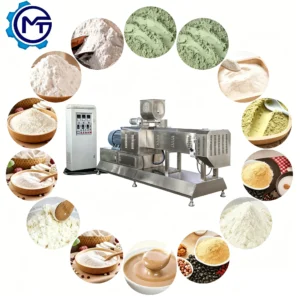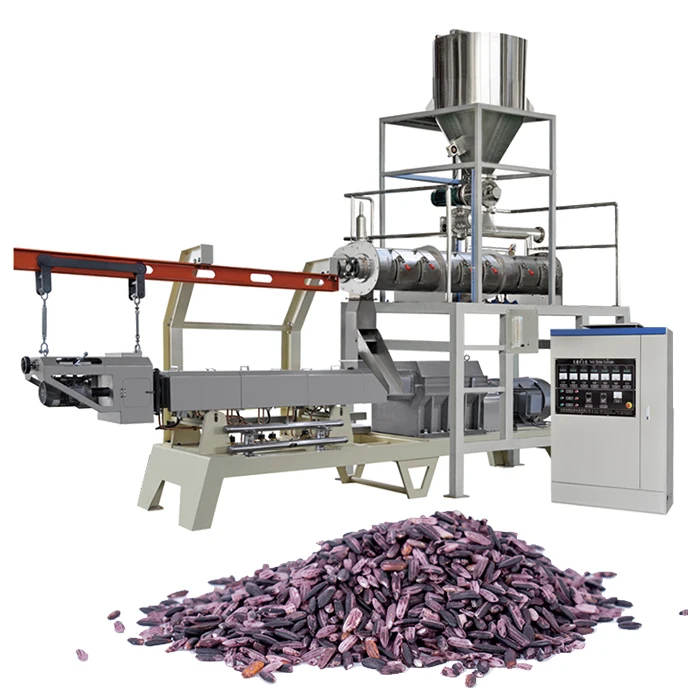

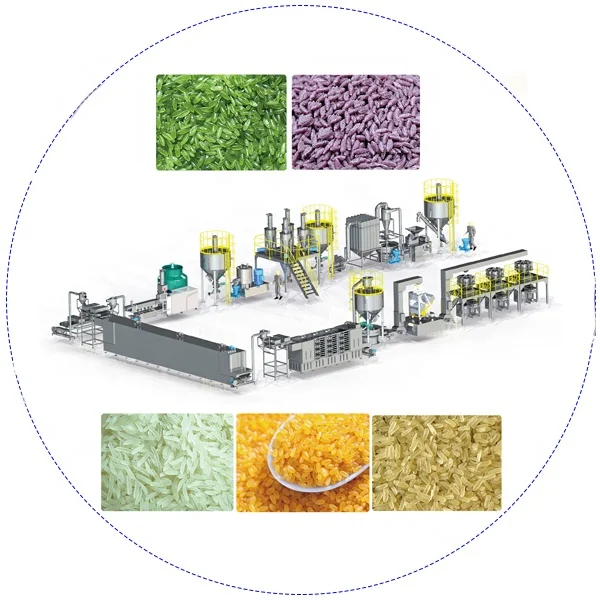
MT65, MT70, MT85, MT75, MT95 Fortified Artificial Rice Extrusion Production Line, Twin-Screw, CE Certified — configured for nutritional kernel output from broken rice, corn, millet, and multi-grain blends with added vitamins and minerals.
- Screw and die setup matched to your grain formulation’s starch-protein profile, controlling expansion and kernel density through precise moisture and shear management.
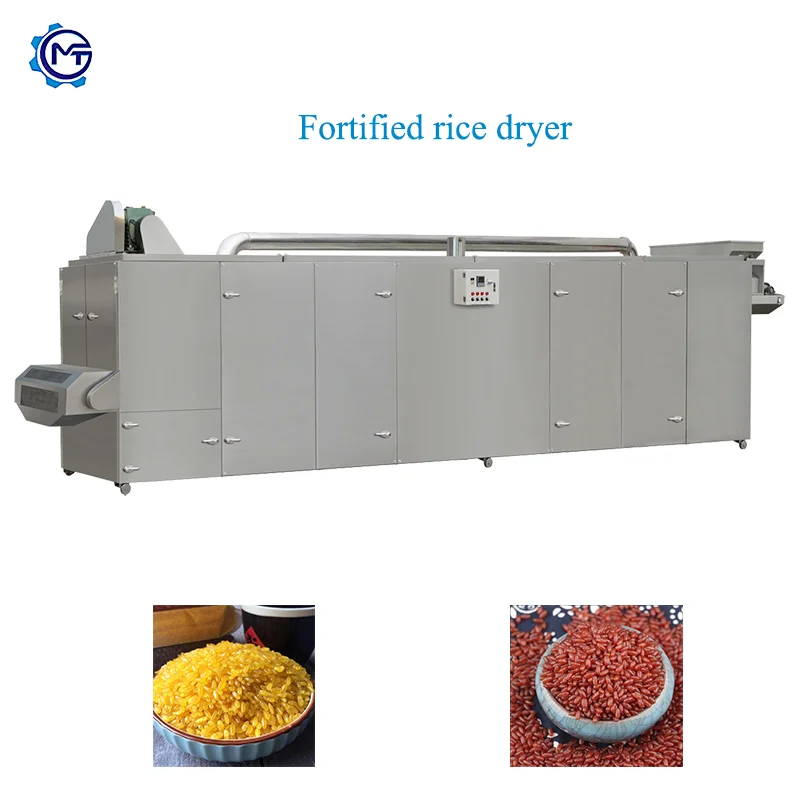
- Multi-stage drying and roasting sequence preserves micro-nutrient integrity while delivering natural rice texture and elasticity.
Layout, throughput matching, and trial runs on your raw material are completed in our testing workshop before shipment.
Description
Throughput-Matched Turnkey Engineering — Every station from batching to packing is calculated as one system, so the extruder, dryer, and roaster never starve or choke each other on your grain formulation.
Technical Specifications
| Parameter | Value |
|---|---|
| Product Type | Fortified Artificial Rice Extrusion Production Line |
| Extruder Models Available | MT65, MT70, MT85, MT75, MT95 |
| Extruder Configuration | Twin-screw with selectable single or double screw feeding system |
| Installed Power (MT65) | 85 kW |
| Installed Power (MT70) | 120 kW |
| Installed Power (MT85) | 235 kW |
| Installed Power (MT75) | 180 kW |
| Installed Power (MT95) | 260 kW |
| Actual Power Consumption (MT65) | 60 kW |
| Actual Power Consumption (MT70) | 85 kW |
| Actual Power Consumption (MT85) | 165 kW |
| Actual Power Consumption (MT75) | 135 kW |
| Actual Power Consumption (MT95) | 195 kW |
| Capacity (MT65) | 80-100 kg/h (basis not stated in source — confirm raw material formulation and moisture content) |
| Capacity (MT70) | 100-120 kg/h (basis not stated in source — confirm raw material formulation and moisture content) |
| Capacity (MT85) | 200-300 kg/h (basis not stated in source — confirm raw material formulation and moisture content) |
| Capacity (MT75) | 300-500 kg/h (basis not stated in source — confirm raw material formulation and moisture content) |
| Capacity (MT95) | 800-1000 kg/h (basis not stated in source — confirm raw material formulation and moisture content) |
| Control System | Frequency speed control with high automation (PLC / MCC to be confirmed) |
| Extruder Features | Automatic lubricating and cooling system, wear-resistant screw material |
| Dryer Heating Source | Electric or gas (selectable) |
| Dryer Feature | Circulation drying with frequency-controlled mesh belt speed |
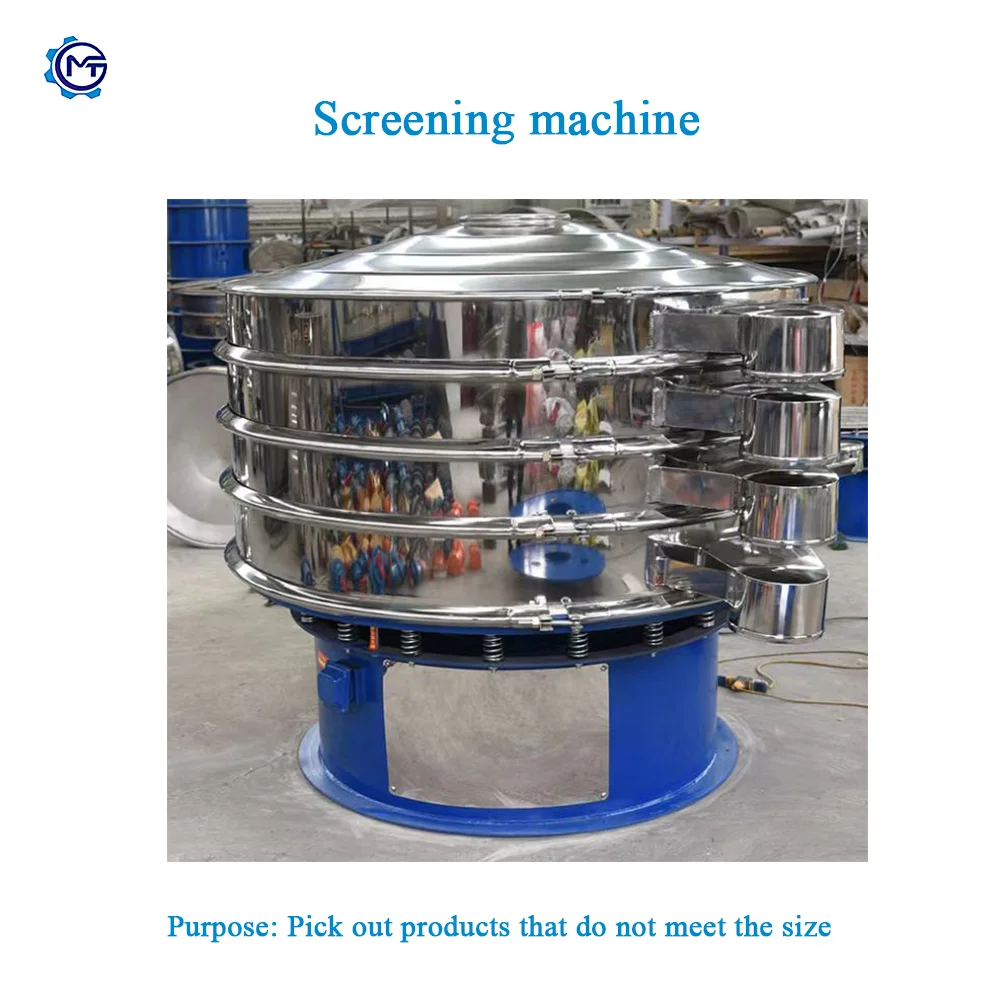
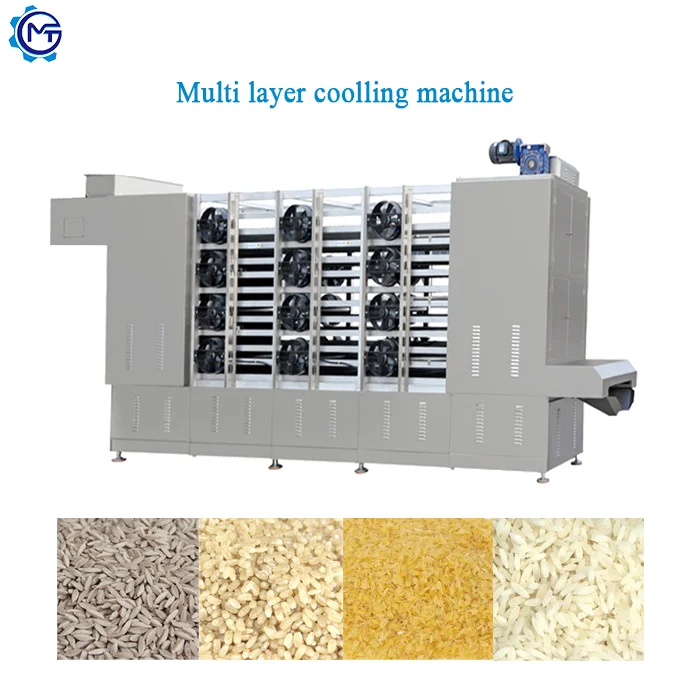
| Production Sequence | Mixing → Extruding → Vibrating → Low-temperature drying → Cooling → High-temperature roasting → Cooling → Packing |
| Voltage & Frequency | Configurable to local grid (confirm before commissioning) |
| Standards | CE, ISO |
Application Suitability
| Application | Material or Output |
|---|---|
| Fortified rice kernel production for nutrition programmes | Broken rice and rice bran base with vitamin and mineral premix |
| Artificial multi-grain rice manufacturing | Corn, millet, wheat, oats, and buckwheat blends |
| Reconstituted rice from milling by-products | Rice bran, starch, and legume flour combinations |
| Value-added grain products for breakfast cereal lines | Bean-based and oat-based formulations with added nutrients |
Why "Nominal Capacity" Is the Wrong Question for a Fortified Rice Production Line Turnkey
Capacity only matters when it is measured against your exact grain blend, protein ratio, and moisture content.
I have watched lines that were quoted at impressive hourly outputs collapse during commissioning because the buyer’s actual formulation contained higher protein or fiber than the standard test material. The screw combination that works on pure rice flour will not behave the same way when you introduce oat bran or legume flour. Die geometry that produces clean, uniform kernels on one blend will cause sticking and irregular expansion on another [NEED_CITE: starch gelatinisation behaviour across grain protein ratios]. A fortified rice production line turnkey project must be specified against the material you will actually run, not against a catalog benchmark.
Matching the Extruder to Your Grain Profile
The twin-screw extruder sits at the center of this line, and its configuration determines whether your artificial rice kernels achieve the density, texture, and cooking behaviour your market expects. The selectable single or double screw feeding system allows operators to match feed consistency to the flow characteristics of their specific grain blend. A formulation heavy in fine rice flour demands different feed mechanics than one loaded with coarse oat particles or fibrous bean flour. Each of the five available extruder models — from the MT65 to the MT95 — covers a distinct throughput band, and the right choice depends on your target daily volume and the residence time your formulation requires inside the barrel.
Why the Drying Sequence Defines Kernel Integrity
The multi-stage thermal sequence on this fortified rice production line turnkey configuration — low-temperature drying, cooling, high-temperature roasting, then a final cooling pass — is not arbitrary. Rapid single-pass drying causes surface case-hardening while the kernel interior retains moisture, leading to cracking and breakage during packing and transport [NEED_CITE: moisture gradient effects on extruded grain kernel structural integrity]. The circulation dryer uses a frequency-controlled mesh belt, so operators can adjust residence time to hit the exact final moisture specification their market or procurement contract requires. Gas or electric heating is selectable based on local energy costs and available utility infrastructure.
Reading the Power and Dimension Data Correctly
The installed power figures across the five models range from 85 kW on the MT65 to 260 kW on the MT95, but actual consumption runs notably lower — 60 kW to 195 kW respectively — because motors do not operate continuously at peak draw. This gap matters when sizing your transformer and dedicated circuit. The dimensional footprints also scale with model selection: the MT65 occupies roughly 28 meters in line length, while the MT95 extends to approximately 36 meters, with widths expanding from 1.2 meters to 3.5 meters. These measurements determine your floor plan, utility trench routing, and whether the line fits within your existing building envelope. The automatic lubricating and cooling system on the extruder reduces manual maintenance intervals but requires confirmed water supply and drainage provisions at the installation point.
The Hidden Cost of an Unbalanced Line
A bottleneck rarely announces itself in the quotation stage. It appears weeks after startup, when the dryer cannot keep pace with the extruder and semi-finished product piles up on the floor, absorbing ambient moisture and degrading before it reaches the roaster. Or the roaster runs hot and fast to compensate, scorching kernels that needed gentler treatment. Mismatched throughput between stations is one of the most frequent reasons turnkey food lines fail to reach their projected output [NEED_CITE: throughput imbalance as a primary cause of extrusion line underperformance]. On this line, every station is calculated against the extruder’s confirmed output on your specific formulation before the layout is finalized.
What Sets This Supply Approach Apart
Complete line engineering from a single supplier means the mixer capacity, extruder throughput, dryer residence time, and packing speed are all calculated as interdependent variables rather than sourced from separate catalogs. The screw configuration and die design are specified against your raw material sample, not pulled from a generic template. An in-house testing workshop allows trial runs on your actual grain blend before the line ships, so product development work happens at the factory rather than on your floor during commissioning. Electrical schematics are confirmed against your local voltage and frequency before production begins. Pre-sales engineering consultation flows directly into installation, operator training, and ongoing wear parts supply without handoff to a third party.
Documentation & Verification
- Line layout and capacity calculation showing matched throughput across every station
- Screw and die configuration record specified to your grain formulation and target kernel density
- Trial run report on your supplied raw material conducted in the testing workshop before shipment
- Electrical schematic with voltage and frequency confirmed to your site grid
- Operation and maintenance manual with wear parts list and replacement intervals
Installation, Commissioning & Support
- Floor plan review against the selected model footprint, from 28 m to 36 m line length
- Dedicated circuit sizing based on actual power consumption, ranging from 60 kW to 195 kW depending on model
- Utility confirmation for dryer heating source selection between electric and gas supply
- Frequency drive calibration on extruder and dryer motors during on-site commissioning
- Operator training covering screw configuration changes for different grain formulations
- Wear parts supply programme for screws, dies, and dryer mesh belt segments
What to Prepare Before Requesting a Layout Proposal
To size the line correctly, we need your base grain formulation with approximate protein and moisture content, your target kernel dimensions and cooking texture, and the daily or shift-based volume you intend to produce. Share your available floor space dimensions, ceiling height, and local voltage and frequency specification so the electrical package can be confirmed before production. If you have existing upstream milling or downstream packing equipment that must integrate with this line, include those interface details as well.
Frequently Asked Questions
Q: How is line capacity verified against my specific grain formulation and moisture content?
A: Before the layout is finalized, we run a trial on your actual raw material blend in the testing workshop. The extruder screw configuration, die geometry, and dryer parameters are adjusted during this test, and the confirmed throughput on your formulation becomes the basis for the capacity guarantee. This prevents the common problem where a line meets its catalog rating on standard material but underperforms on the buyer’s real recipe.
Q: How is throughput balanced between the extruder, dryer, and roaster to prevent bottlenecks?
A: Each station is calculated against the extruder’s confirmed output on your formulation. The dryer belt speed and roaster pass-through time are set so that no station accumulates backlog. This matching is documented in the line layout and capacity calculation provided before the order is placed, and verified again during the factory trial run.
Q: What does the phased installation and commissioning schedule look like for a complete turnkey line?
A: Installation proceeds in stages: mechanical placement and alignment, utility connections, electrical termination, then individual station testing before full-line dry runs. Commissioning includes running your formulation through the complete sequence with parameter adjustment at each stage. Operator training runs parallel so your team understands screw changes, dryer adjustments, and routine maintenance by the time the engineers depart.
Q: Can the line be configured for my local voltage, frequency, and control language requirements?
A: Voltage and frequency are confirmed during the specification phase before production begins, and the electrical schematic is built to match your site grid. Control panel labeling and HMI language are set to your operator preference. This prevents the common delay where a line arrives with incompatible electrical configuration and requires on-site rewiring before it can run.
Q: What operator training and wear parts support is included after commissioning?
A: Training covers daily operation, screw and die changeover procedures, dryer belt tension adjustment, and routine lubrication. A wear parts list is supplied with the line, identifying replacement intervals for screws, dies, and mesh belt segments. Ongoing parts supply is available directly from the factory, so you are not dependent on third-party distributors when the first replacement set is needed.
Related products
-
Fully Automatic 500kg/h Baby Cereal Nutrition Powder Extrusion Drying Line with PLC Control
¥9,500.00 Add to cart -

Compact Automatic Baby Cereal Nutrition Powder Production Line with 500kg/h Capacity and PLC Control
¥9,500.00 Add to cart -

Full Automatic Complete Baby Food Nutrition Powder Porridge Processing Production Line for Infant Nutrition Factory
¥9,500.00 Add to cart -

High Quality Automatic PLC Controlled 500kg/h Twin Screw Extruder Machine for Baby Rice Nutrition Powder
¥8,238.27 Add to cart