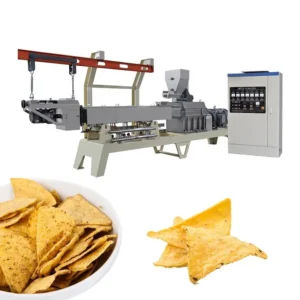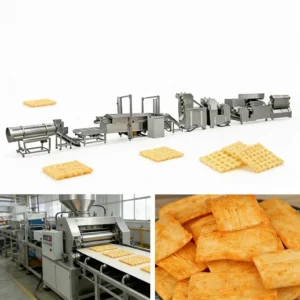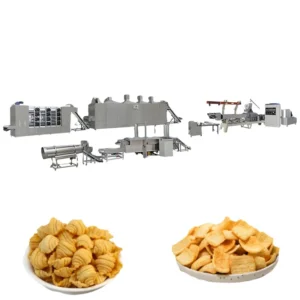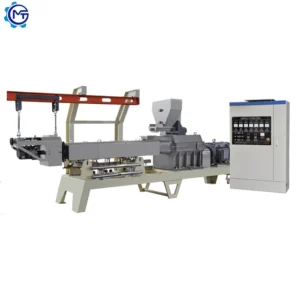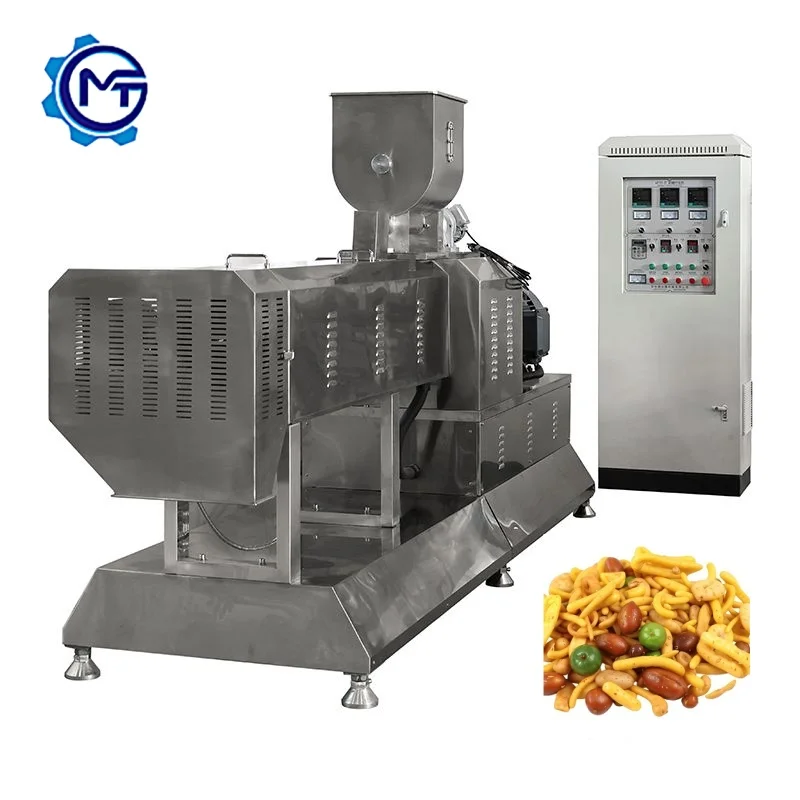


Continuous Deep Frying Machine, 60 kW Heating, 304 SS, PLC Control — designed as a throughput-matched station within a complete fried snack processing line. Double-layer mesh belt with stepless speed regulation sandwiches product for uniform frying, while the automatic oil circulation filtration system continuously removes residue to maintain oil quality.
Complete line layout from batching through packing under one supplier, with fryer capacity calculated against upstream extruder output on your actual raw material.
Description
Complete Line Throughput Matching — Every station from batching to packing is balanced against the others so no single unit bottlenecks the fried snack line.
Technical Specifications
| Parameter | Value |
|---|---|
| Product Type | Continuous Deep Frying Machine for Snack Processing Line |
| Rated Heating Power | 60 kW |
| Drive Power | 2.6 kW |
| Voltage & Frequency | 380V / 50Hz (configurable for target market) |
| Control System | PLC with frequency-variable belt speed |
| Overall Dimensions (L×W×H) | 6700 × 2200 × 1200 mm |
| Net Weight | 2000 kg |
| Output Capacity | 100–1000 kg/h (basis not stated in source — confirm product type, moisture, frying time) |
| Oil Capacity | 320 L |
| Heating Method | Electric heating / Gas heating (selectable) |
| Belt System | Upper and lower double-layer mesh belt with frequency conversion stepless speed regulation |
| Material | Food-grade 304 stainless steel |
| Oil Filtration | Automatic oil circulation filtration system |
| Slag Discharge | Bottom-mounted residue discharge system |
| Lifting System | Automatic lifting for upper hood and mesh belt |
| Standards | CE, ISO |
| Warranty | 1 year (core components: 1 year) |
Application Suitability
| Application | Material or Output |
|---|---|
| Fried nimko and extruded pellet snacks | Corn-based or rice-based extruded pellets entering fryer at controlled moisture |
| Fried snack chips and crisps | 2D/3D pellet sheets or direct-extruded chips requiring uniform oil immersion |
| Savory fried snack line integration | Positioned downstream of extruder and upstream of de-oiling drum and flavoring station |
| Continuous frying for coated pellets | Pellets with surface starch coating requiring controlled oil uptake and color development |
Why a Fryer Rated at "1000 kg/h" Can Still Stall Your Line
A fryer’s rated capacity means nothing when the extruder upstream pushes more volume than the belt can carry through the oil bath.
I have watched a fried snack line come to a full stop because the extruder was delivering product faster than the fryer could process it. The mesh belt overloaded, pieces stacked on top of each other, and half the batch came out under-fried while the other half burned. The shift was scrapped. That continuous frying machine for snack production line had a nameplate capacity that technically exceeded the extruder output, but the actual frying time required for that specific pellet formulation meant the effective throughput was far lower. [NEED_CITE: throughput calculation methods for continuous frying equipment]
When a turnkey fried snack frying line is assembled from standalone units sourced from different vendors, nobody takes responsibility for the gap between stations. The extruder supplier quotes based on dry pellet output. The fryer supplier quotes based on clean oil and a standard product. The de-oiling drum supplier assumes a certain incoming oil load. Nobody connects the numbers.
How Belt Speed and Oil Temperature Shape the Final Product
The frying result depends on the relationship between belt travel speed through the oil bath and the temperature profile maintained across the 320 L oil volume. A PLC-controlled continuous frying machine for snack production line allows operators to adjust belt speed via frequency conversion while the heating system compensates to hold temperature. This is what separates a consistent golden finish from a batch where pieces at the front of the belt fry differently than those at the rear.
The double-layer mesh belt sandwiches the product so pieces cannot float to the surface. Floating is a common problem with low-density extruded pellets — they rise, only one side contacts the hot oil, and the result is uneven color and texture. The upper belt holds them submerged for the full residence time.
Oil Filtration and Why It Matters Across a Full Shift
Continuous frying generates residue. Crumbs, starch particles, and oil degradation products accumulate in the bath. Without removal, the acid value of the oil rises, the smoke point drops, and the product picks up off-flavors. The automatic oil circulation filtration system on this unit pulls oil from the bath, passes it through a filter medium, and returns it — running continuously during production rather than requiring a shutdown. [NEED_CITE: oil degradation factors in industrial deep frying operations]
The bottom-mounted slag discharge system collects heavier particles that settle below the belt path. Between the circulation filter and the residue discharge, the oil stays within usable parameters across a full production shift, reducing the frequency of full oil changes and maintaining consistent product flavor from first batch to last.
Reading the Specs That Actually Determine Frying Performance
The 60 kW heating power determines how quickly the oil recovers temperature after cold product enters the bath. When pellets at room temperature drop into 180°C oil, they absorb thermal energy rapidly. A heating system with insufficient recovery capacity will see the oil temperature sag, extending frying time and increasing oil absorption into the product. The 60 kW rating on this unit supports the thermal load of continuous product entry at the upper end of the belt capacity.
The 6700 mm overall length defines the maximum belt travel distance through the oil. Combined with the variable belt speed, this sets the range of achievable frying times. A dense pellet requiring longer residence time needs a longer bath or a slower belt. The 320 L oil capacity provides sufficient thermal mass to buffer temperature fluctuations during continuous loading.
The food-grade 304 stainless steel construction is not a cosmetic choice. Fryer environments combine hot oil, steam, salt, and cleaning chemicals. Carbon steel corrodes under these conditions, introducing contamination and shortening equipment life. 304 stainless steel withstands the chemical environment and meets food contact material requirements across most export markets.
What Happens When the Fryer Is Not Matched to the Line
When a fryer is selected based on price or availability rather than line integration, the consequences appear during commissioning. If the oil volume is too small for the extruder output, temperature recovery fails and the product absorbs excess oil. If the belt is too short, the frying time is insufficient and the pellet remains doughy inside. If there is no filtration system, the oil degrades within hours and product quality drifts across the shift.
Downstream equipment also suffers. An overloaded fryer sends product with excess surface oil into the de-oiling station, which cannot handle the volume. Oil carries over into the flavoring drum, causing seasoning to clump rather than coat evenly. [NEED_CITE: common causes of oil carryover in snack frying lines] The packing station receives product that does not meet shelf-life specifications because residual oil accelerates rancidity.
Why Procure the Frying Station Through the Same Supplier as the Extruder
Line layout and capacity calculation are performed across every station before any unit is built, so fryer belt speed and oil volume are matched to extruder output on the buyer’s actual raw material formulation.
Screw and die configuration for the upstream extruder are documented alongside the fryer specification, ensuring the pellet density and moisture entering the oil bath are the values the fryer was configured to handle.
An in-house testing workshop conducts trial runs on customer raw material before shipment, so frying parameters are validated in advance rather than discovered during on-site commissioning.
Throughput matching extends downstream — de-oiling drum capacity, cooling conveyor length, and flavoring drum residence time are all calculated against the same production target.
Pre-sales engineering consultation through on-site installation and operator training is handled by the same team that designed the line, so the people who calculated the capacity are present when the line runs for the first time.
Documentation & Verification
- Line layout drawing showing fryer position relative to extruder and downstream stations with throughput matched at each point
- Machine specification sheet confirming oil volume, belt dimensions, heating power, and control system configuration
- Trial run report on customer raw material documenting frying temperature, belt speed, and product quality parameters
- Electrical schematic with voltage and frequency confirmed for the destination market before production begins
- CE declaration of conformity covering the frying machine and integrated safety systems
Installation, Commissioning & Support
- Foundation must support 2000 kg net weight plus oil load across the 6700 × 2200 mm footprint with level tolerance for belt alignment
- Dedicated electrical circuit required for 60 kW heating load at confirmed voltage, separate from extruder and downstream drives
- Unit ships as a complete assembly with belt, hood, filtration, and temperature control systems pre-installed for faster site placement
- First-run commissioning includes PLC parameter setting for belt speed, oil temperature zones, and filtration cycle timing on buyer’s product
- Operator training covers mesh belt tension adjustment, automatic lifting system operation, and oil change procedures
- Wear parts list covers mesh belt sections, heating elements, and filtration media with recommended replacement intervals
What We Need to Configure Your Frying Station
To propose a continuous frying machine for snack production line matched to your operation, share your pellet formulation and the moisture content entering the fryer, your target hourly output, and the frying result you expect in terms of color and oil uptake. We also need your facility voltage and frequency, and whether electric or gas heating fits your utility setup. If you have an existing extruder upstream, provide its actual output rate on your product so we can calculate the required belt speed and oil volume.
Frequently Asked Questions
Q: How is the 100–1000 kg/h capacity range determined, and what does it assume?
A: That range depends on the specific pellet type, its moisture content entering the fryer, and the frying time your product requires. A dense pellet needing longer residence time will be at the lower end of the range. We confirm actual throughput by running your raw material in our testing workshop before finalizing the fryer configuration.
Q: How do you match frying temperature and belt speed to different pellet formulations?
A: Each formulation has a different starch composition and moisture level that determines the oil temperature needed for proper expansion and the belt speed that delivers the right residence time. The PLC control with frequency-variable drive lets operators store and recall settings for each product, so changeovers are repeatable.
Q: How is fryer capacity matched to the extruder and downstream stations?
A: We calculate extruder output on your specific raw material, then size the fryer belt length and oil volume to handle that volume at the required frying time. Downstream de-oiling and cooling capacity are calculated from the same throughput figure so no station becomes a bottleneck.
Q: Can voltage and control language be adapted to our local standards?
A: Yes. The standard 380V / 50Hz configuration is adjusted to match your facility’s electrical supply. The PLC interface language is also set to your operator’s language before shipment, and electrical schematics are delivered with the confirmed voltage marked on every circuit.
Q: Is a trial run on our actual raw material available before shipment?
A: Yes. We run your extruded pellets through the fryer in our testing workshop and document frying temperature, belt speed, oil uptake, and product quality. The trial run report is shared with you before the equipment ships, so you know the line will perform on your material.
Related products
-
Frying Crispy 3D Corn Bugles Pellets Fried Chips Snacks Food Machine Production Line Bugles Making Extruder
¥100.00 Select options This product has multiple variants. The options may be chosen on the product page -
Industrial Fully Automatic Stainless Steel Deep Fried Line – Snack Factory Miscellaneous Grains Special Processing Equipment
¥65.00 Select options This product has multiple variants. The options may be chosen on the product page -
New Automatic 150-200kg/h Nimko Fried Pasta Snacks & Kurkure Making Machine Food Grade Stainless Steel High Productivity
¥8,585.00 Select options This product has multiple variants. The options may be chosen on the product page -
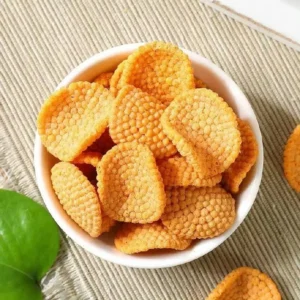
New Automatic Bugles Puff Snack Production Line Price Corn Chips Making Machine Fried Maize Machine High Productivity Large
¥8,570.00 Select options This product has multiple variants. The options may be chosen on the product page