

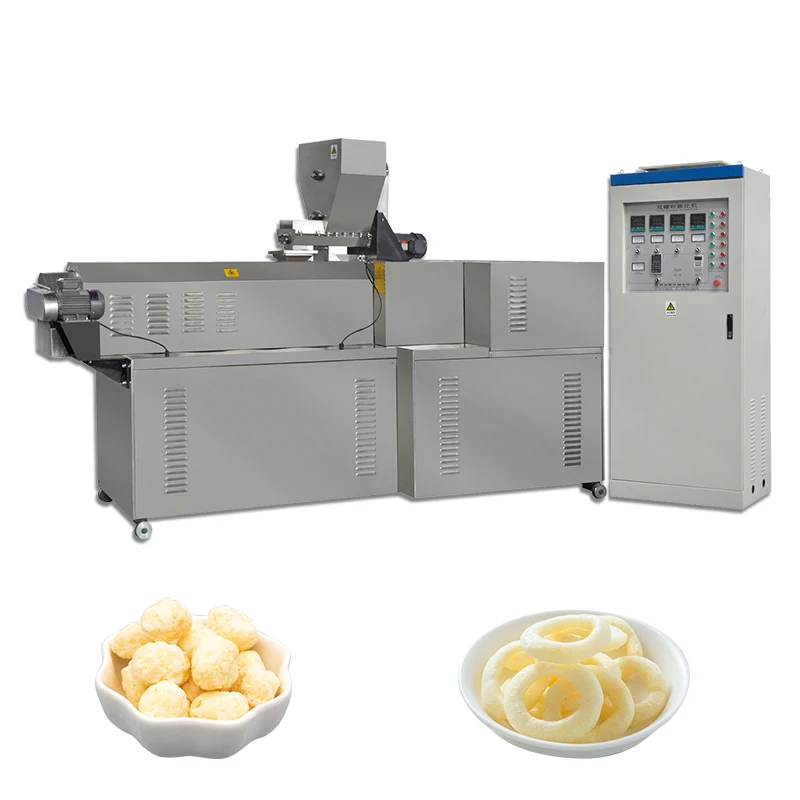
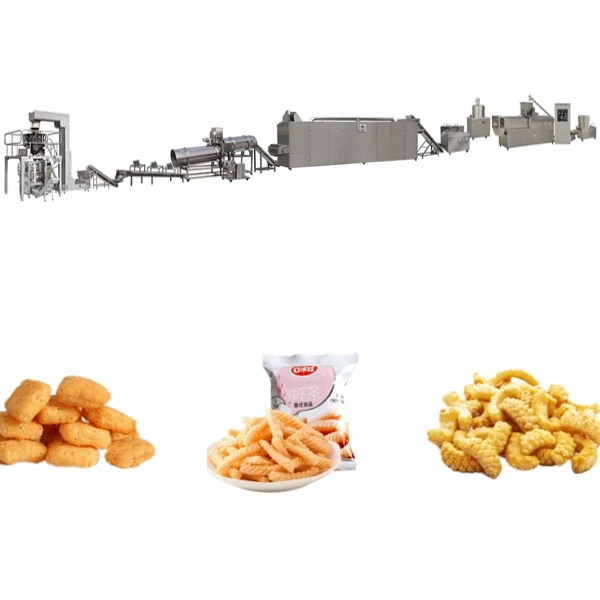
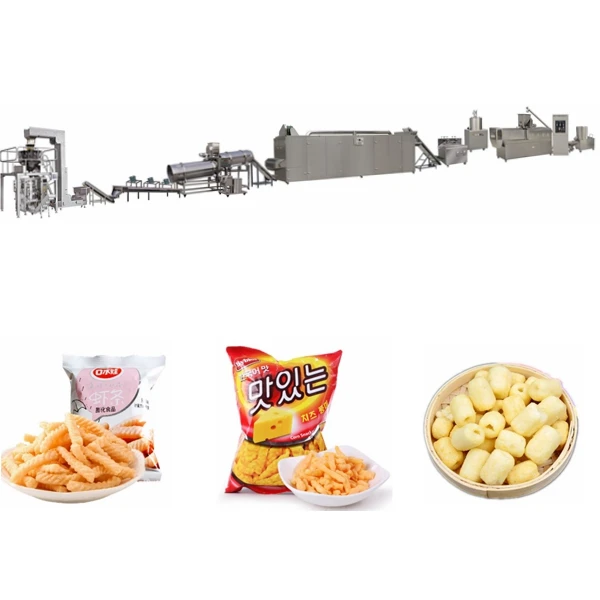

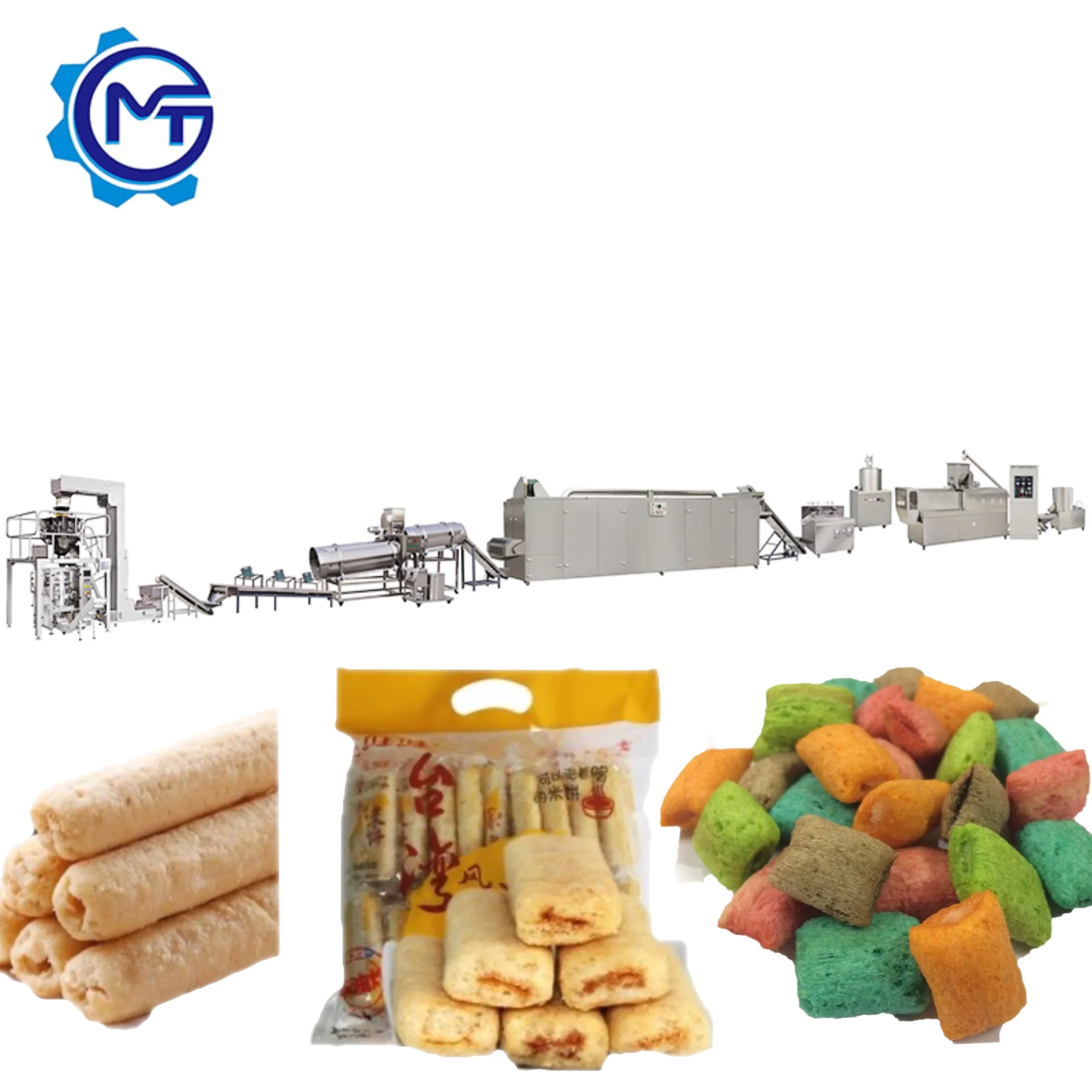
MT70 / MT85 / MT75 Twin Screw Extrusion Puffed Snack Production Line, 100–500 kg/h, PLC Control — configured for complete turnkey snack processing from batching to packing.
- Designed around factory footprint with throughput matched across extruding, drying, and coating stations
- Twin-screw extruder supports interchangeable dies for ball, tube, ring, and custom snack shapes
- Trial runs on customer raw material in testing workshop verify output before shipment
Capacity confirmed per raw material moisture and formulation during pre-sales testing.
Description
Throughput-Matched Extrusion — Every station from material batching to final packing is balanced to your target output before the line leaves our testing workshop.
Technical Specifications
| Parameter | Value |
|---|---|
| Model | MT70 / MT85 / MT75 |
| Product Type | Twin Screw Extrusion Puffed Snack Production Line |
| Screw Type | Twin Screw |
| Installed Power | MT70: 130 kW; MT85: 180 kW; MT75: 220 kW |
| Power Consumption | MT70: 95 kW; MT85: 120 kW; MT75: 130 kW |
| Output Capacity | MT70: 100–120 kg/h (basis to be confirmed); MT85: 200–300 kg/h (basis to be confirmed); MT75: 300–500 kg/h (basis to be confirmed) |
| Overall Dimensions (L×W×H) | MT70: 21 × 1.5 × 2.2 m; MT85: 25 × 1.5 × 2.2 m; MT75: 28 × 1.5 × 2.2 m |
| Control System | Automated (PLC / MCC — confirm configuration per model) |
| Raw Materials | Corn, rice, wheat, oat, barley flour, etc. |
| Heating Source (Dryer) | Gas or Electric |
| Coating System | Double tumble sugar melter, elevator, coating drum, spraying nozzle |
| Die Configuration | Interchangeable dies for ball, tube, stick, ring, fruit loop, star, wheel, flower, heart shapes |
| Voltage & Frequency | Customised to local supply (confirm at order) |
| Standards | CE, ISO |
Application Suitability
| Application | Material or Output |
|---|---|
| Corn Puffs & Cheese Balls | Corn flour, rice flour, cheese powder coating |
| Breakfast Cereal Rings | Oat flour, wheat flour, fruit loop shapes |
| Extruded Sticks & Stars | Corn grits, wheat flour, multi-grain blends |
| Core-Filled Snack Pillows | Flour blends with cream or chocolate filling |
| Fortified Nutritional Snacks | Blended flours with vitamin-mineral premix |
What "300 kg/h" Actually Means on Your Raw Material
A rated capacity on paper means nothing until it runs on your specific flour blend at your target moisture.
The most common cause of commissioning delays in snack extrusion is a line that cannot sustain its nominal output on the buyer’s actual raw material. When a twin-screw extruder is pushed beyond its stable throughput window on a particular corn or wheat flour, you get inconsistent expansion, irregular density, and product that fails texture specifications. The puffed snack extrusion production line turnkey solution must be verified against your exact recipe before it ships [NEED_CITE: twin-screw extrusion throughput verification standards].
Station-by-Station Throughput Matching
A puffed snack extrusion production line turnkey is only as stable as its weakest link between stations. When the extruder pushes 300 kg/h but the dryer can only handle 220 kg/h, product backs up, moisture content drifts, and the coating drum receives uneven feed. We calculate the mass balance at every transfer point — extruder output to dryer belt load, dryer discharge to coating drum residence time — so each station runs within its designed range rather than compensating for a bottleneck upstream or downstream.
Die Configuration and Product Expansion Control
The shape of your snack determines the die geometry, which in turn governs expansion ratio and final product density. A ring die creates a different pressure profile than a star die, meaning the same flour blend expands differently through each. We specify screw configuration and barrel temperature zones to match your chosen die set and target product texture. Switching between ball, tube, fruit loop, and heart shapes on the same extruder requires documented parameter changes — screw speed, feed rate, barrel heating — to maintain consistent output [NEED_CITE: twin-screw die geometry and expansion relationship].
Reading the Specification Sheet Correctly
Installed power tells you the electrical load to plan for in your facility, but power consumption reflects what the motors actually draw under typical running conditions. For the MT75 model, the 220 kW installed versus 130 kW consumed gap indicates headroom for startup surges and heavier formulations. The screw system features automatic lubricating and cooling, which maintains barrel temperature stability during long production runs — a factor that directly affects starch gelatinisation consistency across batches. The interchangeable die system means one extruder covers your entire shape range, reducing capital outlay compared to dedicated machines per product format.
The Hidden Cost of Skipping the Trial Run
When a snack extrusion line ships without a factory trial on the buyer’s raw material, the first production run becomes the experiment. Screw speed adjustments, moisture corrections, and die changes happen on your factory floor with your downtime budget. We have seen lines where the extruder and coating drum speeds were never synchronised before installation, resulting in weeks of commissioning delays while technicians recalibrated the entire sequence [NEED_CITE: food extrusion line commissioning failure causes]. The cost is not just lost output — it is the raw material wasted during unstable runs and the market delay while your product launch waits.
Why Procure Your Line Here
The complete line from batching to packing comes under one supplier, which means throughput matching is engineered into the design rather than assembled from separate vendors who each optimise only their own station. Screw configuration and die design are specified to your raw material formulation and target product shape, not copied from a generic template. The in-house testing workshop runs your actual flour blend before shipment, producing a documented trial report that shows capacity, expansion ratio, and texture on your recipe. Pre-sales consultation covers line layout engineering to your factory footprint, and the same technical team handles on-site installation, commissioning, and operator training. Automated PLC and MCC control systems are configured to your local voltage, frequency, and control language requirements before the panels are wired.
Documentation & Verification
- Line layout and capacity calculation matched to your factory dimensions and target output
- Screw and die configuration record specific to your raw material and product shapes
- Trial run report on your flour blend from our testing workshop before shipment
- Electrical schematic with voltage and frequency confirmed to your site supply
- CE declaration of conformity and ISO certificate for market entry compliance
- Operation and maintenance manual with wear parts list and replacement schedule
Installation, Commissioning & Support
- Foundation and floor space planned around the MT70/MT85/MT75 overall dimensions and utility connections
- Dedicated power circuits sized to the model’s installed power requirement with voltage confirmed to local grid
- Gas or electric dryer heating source selected to match your facility’s available utilities
- PLC and MCC control system programmed in your operator’s language before commissioning begins
- Twin-screw and die wear parts supplied with the line, with replacement lead times documented at order
- Operator training covers screw speed, barrel temperature, and feed rate adjustments for each die configuration
What We Need to Specify Your Line
To engineer a puffed snack extrusion production line turnkey that matches your requirements, we need your target product shapes from the available die range, the specific flour or grain blend you intend to process, and your target daily output. Confirm your facility’s available floor space and ceiling height so we can draft the line layout. Provide your local voltage, frequency, and preferred control language so the electrical system is configured before production.
Frequently Asked Questions
Q: How is line capacity verified on my specific raw material and moisture content?
A: We run your exact flour blend in our testing workshop before the line ships. The trial documents throughput, expansion ratio, and product texture on your recipe at your target moisture. This report accompanies the shipment so you know what to expect during commissioning rather than discovering capacity limits on your factory floor.
Q: How do you match throughput across extruder, dryer and coating stations?
A: We calculate the mass balance at every station transfer point during layout engineering. The extruder output, dryer belt capacity, and coating drum residence time are balanced so no station bottlenecks the next. This matching is documented in the line layout and verified during the factory trial run.
Q: What does the turnkey installation and commissioning schedule look like on site?
A: Installation follows the engineered line layout with utility connections made to pre-confirmed voltage and gas or electric supply specifications. Commissioning includes screw configuration verification, die changeover testing across your product range, and control system validation. Operator training covers parameter adjustments for consistent output.
Q: Can the line layout fit my existing factory footprint?
A: We design the layout around your available floor space and ceiling height, with the MT70, MT85, or MT75 overall dimensions as the starting constraint. The layout accounts for material flow, operator access, and maintenance clearance. Phased installation is possible if your expansion plan requires staged commissioning.
Q: What spare wear parts are supplied and what is the replacement lead time?
A: Twin screws and interchangeable dies are the primary wear components. A spare set is included based on your production volume and replacement schedule. Lead times for reordering are confirmed at the time of purchase so you can plan inventory. The wear parts list in your documentation specifies part numbers and ordering details.
Related products
-

Automatic High Productivity Puffed Corn Snacks Extruder Production Equipment New Condition Puff Snack Food Making Machine
¥11,050.00 Select options This product has multiple variants. The options may be chosen on the product page -

New Stainless Steel Automatic Puffed Rice Flour Snacks Making Machine High Productivity Multi-function
¥11,050.00 Select options This product has multiple variants. The options may be chosen on the product page -

New Condition Automatic Corn Puff Snacks Food Extruder Cheese Ball Making Machine Plant
¥100.00 Select options This product has multiple variants. The options may be chosen on the product page -

Crunchy Puffed Snack Breakfast Cereal Corn Flakes Making Machine
¥1,000.00 Select options This product has multiple variants. The options may be chosen on the product page


