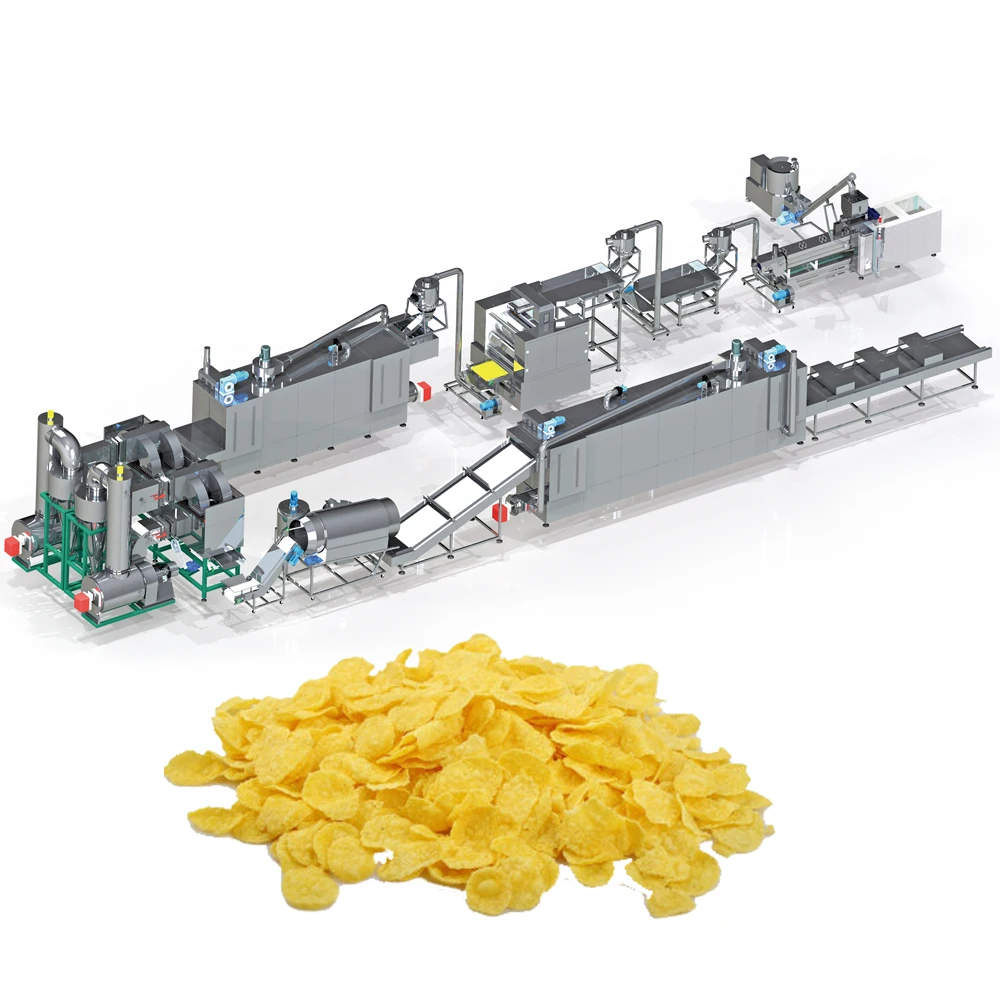
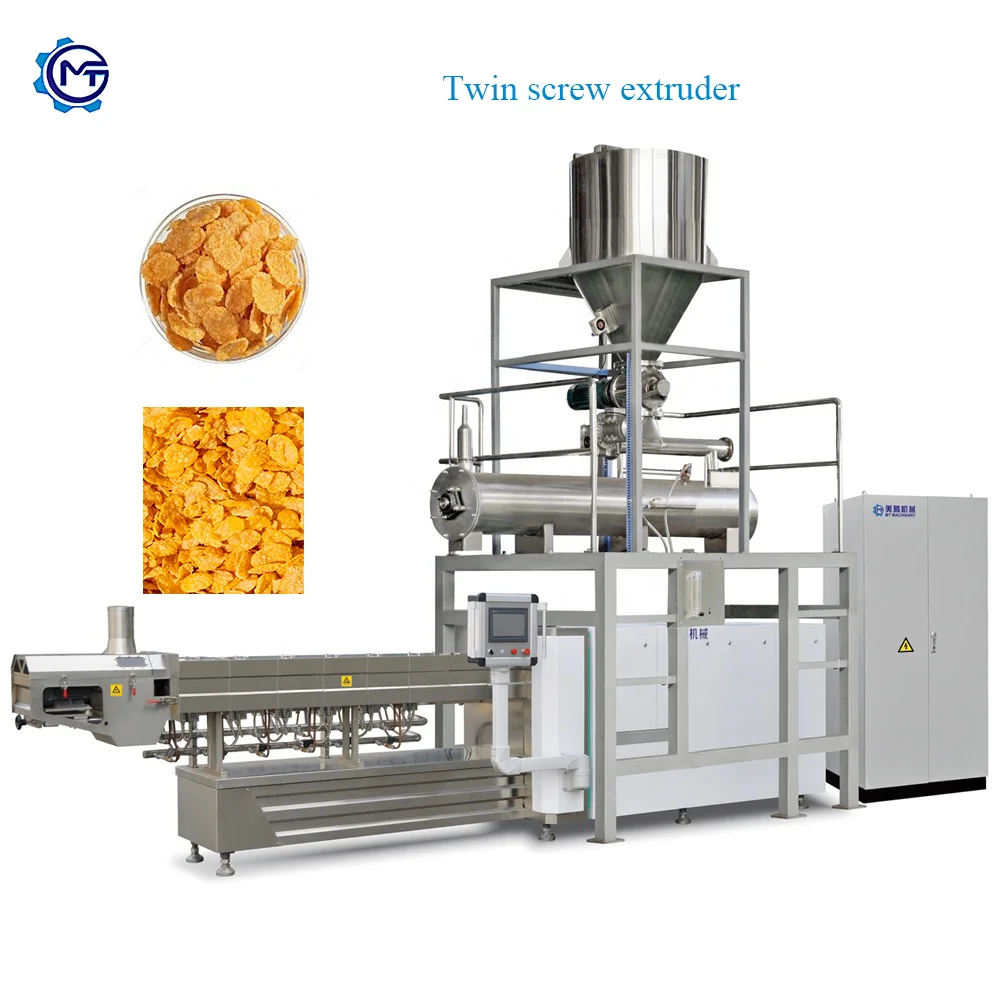
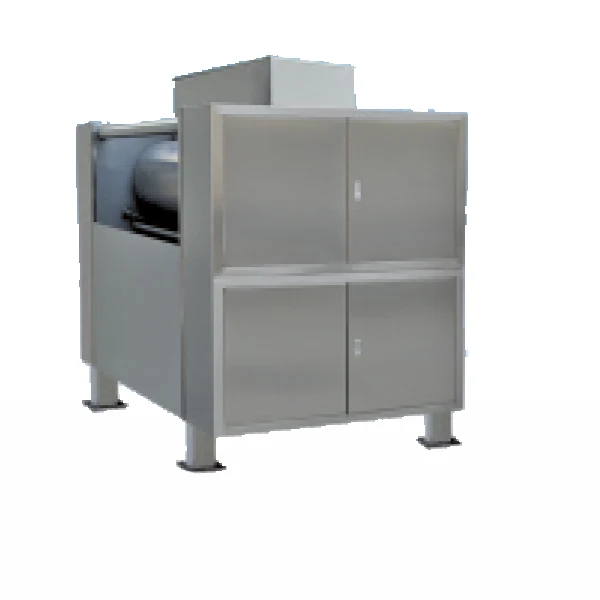
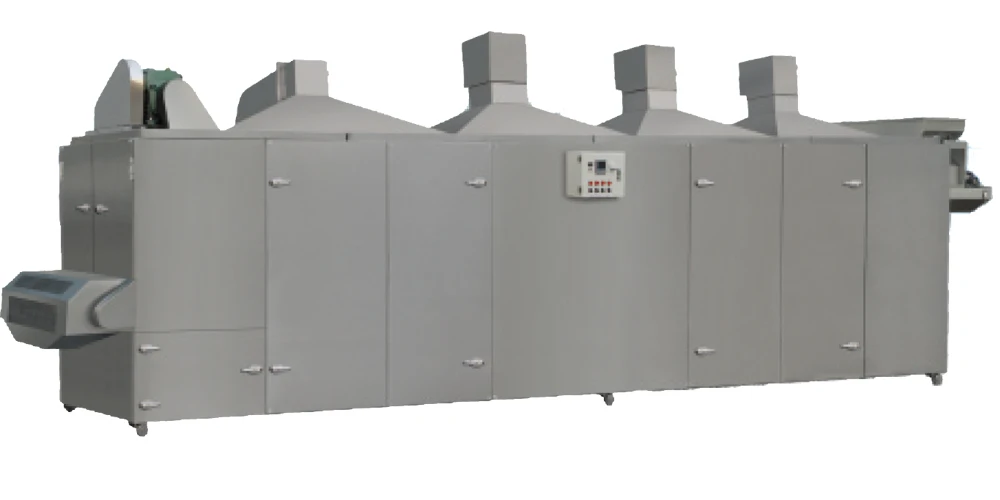
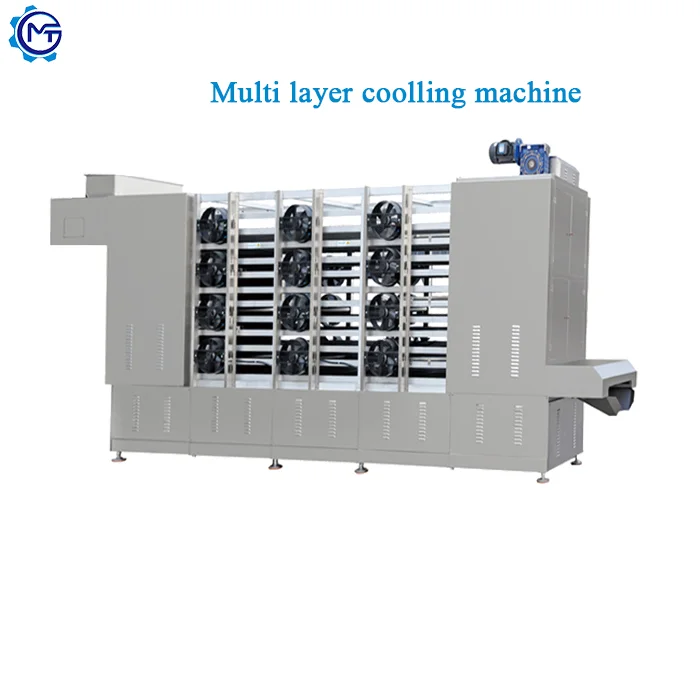

MT-65 / MT-70 / MT-75 / MT-85 Corn Flakes Production Line, Twin-Screw Extruder, Gas Oven, Sugar Spraying System — designed as a complete turnkey project with every station throughput-matched from batching to packing.
- Twin-screw extrusion with screw configuration and die design matched to your raw material for consistent flake density and texture
- Phased installation, utility planning and operator training included across mixer, press, oven and coating stations
Trial runs on your actual formulation are completed in our testing workshop before shipment, with full layout and capacity documentation provided.
Description
Throughput-Matched Stations — Every segment from the mixer to the sugar spraying drum is calculated against your corn grits formulation so the flake press never starves and the oven never runs half-empty.
Technical Specifications
| Parameter | Value |
|---|---|
| Product Type | Corn Flakes Production Line |
| Models Available | MT-65, MT-70, MT-75, MT-85 |
| Extruder Type | Twin-screw (co-rotating) |
| Output Capacity (MT-65) | 120–150 kg/h (basis not stated in source — confirm raw material and moisture content) |
| Output Capacity (MT-70) | 200–250 kg/h (basis not stated in source — confirm raw material and moisture content) |
| Output Capacity (MT-75) | 300–400 kg/h (basis not stated in source — confirm raw material and moisture content) |
| Output Capacity (MT-85) | 400–500 kg/h (basis not stated in source — confirm raw material and moisture content) |
| Installed Power Range | 84 kW (MT-65) to 239 kW (MT-85) |
| Real Power Range | 59 kW (MT-65) to 167 kW (MT-85) |
| Raw Materials | Corn grits, corn flour, rice flour, wheat flour, soya bean, peanut, walnut, sugar |
| Line Stations | Mixer, Screw Conveyor, Twin-Screw Extruder, Corn Flakes Press Machine, High-Temperature Oven, Sugar Spraying System |
| Mixer Tank Size | φ600 × 500 mm |
| Corn Flakes Press Roller | 510 × 310 × 1050 mm |
| High-Temperature Oven Heating | Gas, dual-side baking |
| Gearbox Lubrication | Oil forced automatic lubrication system |
| Extruder Self-Cleaning | Yes |
| Cutting System | Non-stop cutting |
| Standards | CE, ISO |
Application Suitability
| Application | Material or Output |
|---|---|
| Breakfast cereal production | Corn grits and corn flour formulated into toasted flakes |
| Oat-based snack food processing | Oat blends extruded and pressed into flake format |
| Fortified cereal lines | Wheat flour and soya bean blends with added nutritional premix |
| Multi-grain flake formats | Rice flour, peanut, and walnut combinations for specialty cereals |
Why the Flake Press Often Becomes the Bottleneck on a Corn Flakes Line
A mismatched press starves the oven and chokes the extruder, collapsing rated output within the first hour of production.
When a buyer sources the extruder from one vendor and adds a standalone flake press from another, the throughput numbers on paper never survive contact with the actual workshop floor. The extruder pushes dough at a steady rate, but if the press roller speed and gap are not synchronized to that output, material piles up or runs thin. The oven downstream then bakes an uneven bed, producing flakes that are either scorched or under-toasted. I spent two weeks on-site in Southeast Asia re-matching a line where exactly this happened — the customer had inserted a press they found locally, and the entire corn flakes production line turnkey layout had to be recalculated station by station to restore balance [NEED_CITE: throughput synchronization in multi-vendor extrusion lines].
Synchronizing the Extruder Output to the Press Roller
The twin-screw extruder in this corn flakes production line turnkey configuration delivers a continuous ribbon of cooked dough at a moisture level and temperature that the press roller can handle without sticking or tearing. The co-rotating screw design ensures uniform gelatinization of the corn starch, which directly affects how the dough behaves when it hits the press. If the dough is too wet, it smears across the roller; too dry, and it cracks before reaching the oven. The MT-65 through MT-85 models each pair with a press roller dimensioned to match their specific output band, so the dough ribbon width and thickness stay within the roller’s effective working zone.
Gas Oven Dual-Side Baking and Flake Bed Uniformity
After pressing, the flakes enter a high-temperature gas oven where dual-side baking addresses the most common defect in corn flake production: uneven crispness across the bed depth. Single-side heat sources leave the bottom layer over-baked while the top remains pliable, creating a mixed texture that fails packaging specifications. The gas-fired system in this line distributes heat from both above and below the conveyor belt, and the oven length is sized so that residence time matches the press output rate [NEED_CITE: thermal profile requirements for breakfast cereal baking]. This means flakes exit at a consistent moisture content ready for the sugar spraying drum without a secondary drying pass.
Reading the Specification Sheet Against Your Raw Material
The installed power figures — ranging from 84 kW on the MT-65 to 239 kW on the MT-85 — tell you the maximum draw, but the real power consumption (59 kW to 167 kW) reflects what the line actually pulls during steady-state extrusion of a standard corn grits formulation. The gap between installed and real power matters when you are sizing your workshop’s electrical supply and calculating operating cost. The oil-forced automatic gearbox lubrication system keeps the twin-screw gearbox within thermal limits during continuous runs, which is where forced-lubrication designs separate from splash-lubricated gearboxes that overheat after several hours. Non-stop cutting at the extruder die face means the dough ribbon feeds the press without interruption, eliminating the start-stop surges that create thickness variation in the final flake.
The Hidden Cost of Undersizing the Sugar Spraying Drum
When the coating drum is sized for a lower throughput than the oven delivers, flakes accumulate in the oven discharge hopper, cool below the temperature needed for sugar adhesion, and enter the drum in a condition where the coating crystallizes unevenly. The sugar spraying system on this line uses a Ø600 × 2700 mm roller with 28.75 kW total power, dimensioned to handle the full output of the corresponding oven without queuing. Buyers who treat the coating station as an afterthought often discover that their line’s effective capacity is dictated not by the extruder but by the slowest downstream station — a problem that only surfaces after installation when the line is expected to run at its quoted rate [NEED_CITE: downstream bottleneck effects in cereal processing lines].
Why Sourcing the Full Line From One Supplier Changes the Commissioning Phase
Every station in this corn flakes production line turnkey system is documented with a throughput calculation that references your specific raw material and target flake thickness, so the commissioning phase becomes a verification exercise rather than a troubleshooting marathon. The twin-screw extrusion expertise covers the interaction between screw configuration, die geometry, and the corn grits particle size you source locally, which means the screw and die setup is specified before the machine ships rather than adjusted by trial and error on your floor. The in-house testing workshop runs your actual formulation before dispatch, producing a trial run report that confirms flake density, texture, and press behavior under controlled conditions. Pre-sales engineering through installation and operator training stays with one team, so the person who calculated the oven residence time is the same person standing next to it during first production.
Documentation & Verification
- Line layout showing throughput calculation at every station matched to your corn grits formulation
- Trial run report from in-house testing on your raw material confirming flake thickness and density
- Screw and die configuration record specifying geometry for your target corn flake texture
- Electrical schematic with voltage, frequency, and control language confirmed to your destination market
- Factory test record documenting continuous run performance before crating and dispatch
Installation, Commissioning & Support
- Floor space planning based on overall line dimensions from 12 m (MT-65) to 28 m (MT-85) length
- Electrical supply sizing against real power draw from 59 kW to 167 kW depending on model selected
- Gas supply connection and pressure regulation for the dual-side high-temperature oven
- Press roller gap calibration and extruder screw configuration verification during on-site commissioning
- Operator training covering non-stop cutting adjustment and gearbox lubrication monitoring
- Wear parts list including screw elements, die plates, and press roller bearings with replacement intervals
What to Include in Your Inquiry
To configure a corn flakes production line turnkey proposal that holds its rated throughput on your floor, share the corn grits particle size and moisture content you source locally, the target flake thickness and bowl density your market expects, your workshop ceiling height and available gas supply pressure, and the voltage and frequency standard at your facility. If you are adding this line alongside existing packaging equipment, include the infeed conveyor height and speed so the sugar spraying drum discharge can be matched.
Frequently Asked Questions
Q: How is line throughput verified on my specific raw material before shipment?
A: Your corn grits or flour blend is shipped to the testing workshop where the extruder, press, and oven run a full production trial. The resulting trial run report documents actual output rate, flake thickness, and density, confirming that every station holds pace before the line is crated for dispatch.
Q: What is the phased installation and commissioning schedule for a full turnkey line?
A: Foundation and utility rough-in happens first, followed by extruder and press placement, then oven and coating drum installation. Commissioning proceeds station by station, starting with dry runs, then wet runs with your raw material, and finishing with a sustained production run that verifies throughput matching across all segments.
Q: How are utility requirements planned across all stations?
A: Gas consumption for the oven, electrical load based on real power figures, and compressed air for the sugar spraying system are calculated together so your facility can prepare supply lines before equipment arrival. The line layout document specifies connection points and minimum supply capacities for each utility type.
Q: How do you ensure the extruder, press, oven, and coating drum are capacity-matched?
A: Each station is selected from a throughput calculation that starts with your target output and works backward through the oven residence time, press roller speed, and extruder screw speed. This prevents any single station from becoming a bottleneck that limits the entire line to a fraction of its quoted capacity.
Related products
-
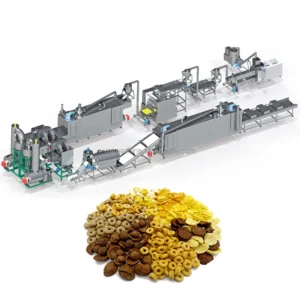
Stainless Steel Honey Small Corn Flake Breakfast Cereal Flakes Maker Making Machine Production Plant
¥30,000.00 Add to cart -
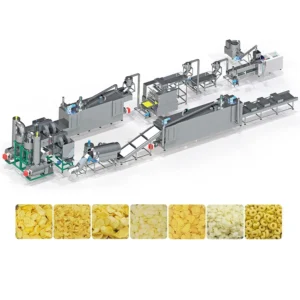
Automatic Cornflakes Making Machine Corn Flakes Breakfast Cereals Processing Production Line
¥500.00 Select options This product has multiple variants. The options may be chosen on the product page -
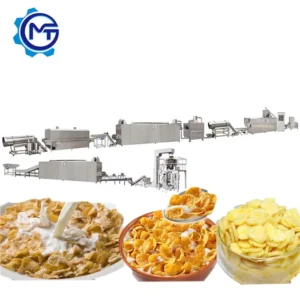
Sweet Corn Flakes Maize Breakfast Cereal Full-automatic Food Grade Stainless Steel Heat Exchanger Mixer Fryer Processing Line
¥8,000.00 Add to cart -
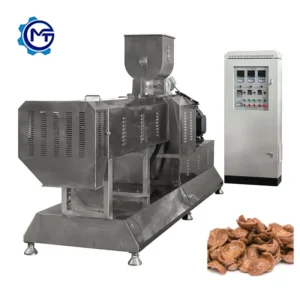
MT Cocoa Flour Puffed Breakfast Cereal Production Line-High Large Capacity Multi-Fuel (Steam/Gas/Electric) New Shandong Origin
¥8,000.00 Select options This product has multiple variants. The options may be chosen on the product page