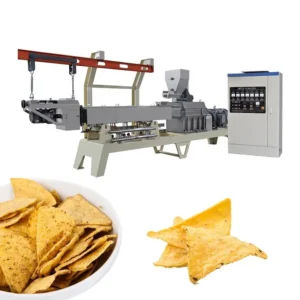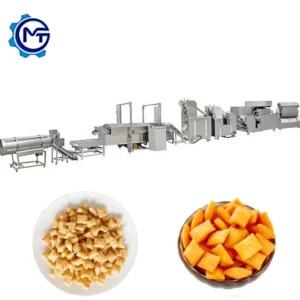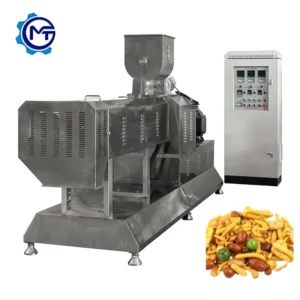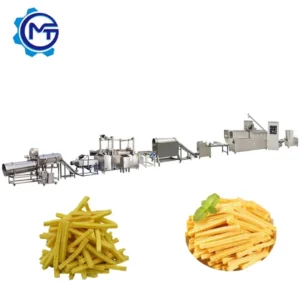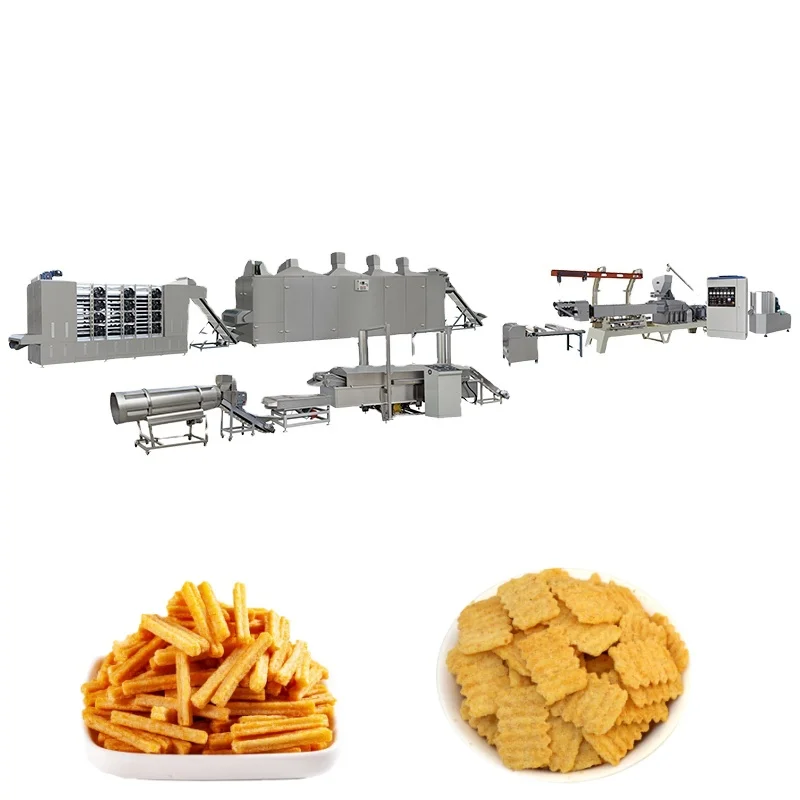


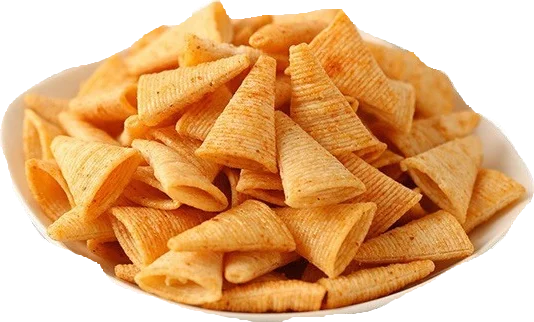
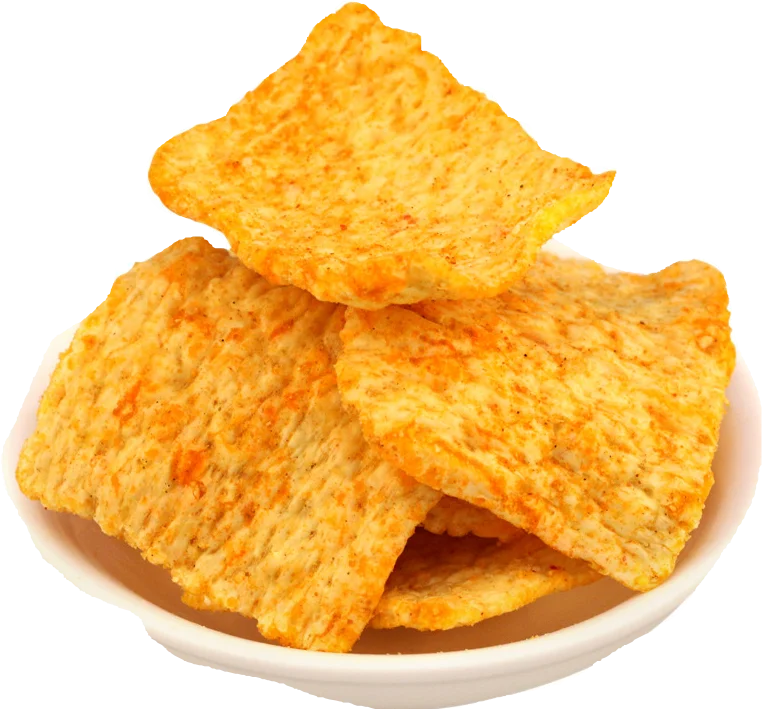

MT-65, MT-70, MT-85, MT-75, MT-95 Fried Snack Food Extrusion Production Line, Twin-Screw, 600 mm Fryer Belt — engineered as a complete turnkey project with throughput matched at every station from batching through frying and packing. Screw configuration and die design are specified to your raw material formulation and target chip density, with interchangeable moulds producing bugles, waves, and pillow shapes on one line.
- Layout and capacity calculation document provided, confirming no station bottlenecks
- Trial run on your raw material in our testing workshop before shipment
- Voltage, frequency, and control language confirmed for your market before production
Description
Matched Throughput Across Every Station — We configure the mixer, extruder, dryer, fryer, and flavouring drum as one balanced system, so the fryer belt speed and dryer residence time are calculated against the extruder’s actual output on your corn or wheat formulation rather than a catalog maximum.
Technical Specifications
| Parameter | Value |
|---|---|
| Product Type | Fried Snack Food (Bugles / Doritos) Extrusion Production Line |
| Model Options | MT-65 / MT-70 / MT-85 / MT-75 / MT-95 |
| Screw Type | Twin-screw, co-rotating sectional modules |
| Main Motor Power | 100 kW (MT-65) / 130 kW (MT-70) / 185 kW (MT-75) / 180 kW (MT-85) / 280 kW (MT-95) |
| Output Capacity | 120–150 kg/h (MT-65, basis not stated in source — confirm raw material & moisture) up to 800–1000 kg/h (MT-95, basis not stated in source) |
| Die Configuration | Interchangeable moulds for bugles, sticks, diamond chips, wavy chips, pillow shapes |
| Mixer Machine Power | 4 kW / 7.5 kW / 15 kW (matched to line model) |
| Cutting Machine Power | 1.47 kW |
| Cutting Machine Dimensions | 2500 × 600 × 1100 mm |
| Fryer Belt Width | 600 mm stainless steel mesh |
| Fryer Heating Options | Electricity / Fuel gas |
| Drying Method | Gas / Electric / Diesel heating |
| Voltage & Frequency | 3ph 380V 50Hz, 3ph 380V 60Hz, 3ph 415V 60Hz, 3ph 220V 60Hz available |
| Control System | Available with PLC or MCC control |
| Raw Materials | Corn powder, wheat flour, potato starch, potato powder, corn starch, water, vegetable oil, salt |
| Warranty | 1 year complete, life-time maintenance |
| Certification | CE compliant |
Application Suitability
| Application | Material or Output |
|---|---|
| Fried bugles and horn-shaped snacks | Corn powder and corn starch blends at controlled moisture |
| Doritos-style tortilla chips | Wheat flour and corn flour formulations |
| Wavy and pillow-shaped fried chips | Potato starch and potato powder mixes |
| Diamond and square rib chips | Multi-grain flour blends with vegetable oil |
| Stick and tube extruded fried snacks | Corn grits with supplementary starch |
Why the Fryer Belt Width Decides Your Real Output
A fryer that cannot keep pace with the extruder stalls the entire fried snack food extrusion production line turnkey before the first shift ends.
I spent weeks in a Thai factory watching a twin-screw extruder push out bugles at full rate while the downstream fryer choked on the volume. The belt was too narrow, the oil recovery too slow, and half the product sat in a holding bin losing moisture consistency. The extruder was rated correctly — the line was not. When we reconfigured that plant, the conversation started with fryer throughput and worked backwards to the extruder die, not the other way around [NEED_CITE: line throughput balancing methodology for fried extrusion plants].
This is the gap between a machine quote and a working project. The fried snack food extrusion production line turnkey you evaluate on paper needs every station — mixer, extruder, dryer, fryer, seasoning drum — calculated against the same raw material at the same moisture level. A mismatch at any single station cascades into downtime, product inconsistency, and oil degradation that affects flavour shelf life.
Screw Configuration Starts With Your Flour Blend
A co-rotating twin-screw extruder with sectional modules lets us adjust screw element sequencing — kneading blocks, reverse elements, and conveying sections — to match the gelatinisation behaviour of your specific corn or wheat formulation. A high-starch corn powder needs a different shear profile than a wheat-dominant blend. We build the screw configuration around the formulation you will actually run, not a generic build that assumes a standard recipe. The die plate is then matched to the expansion rate that formulation produces.
Die Geometry and the Expansion Problem
Bugles require a specific wall thickness and curvature that depends on dough expansion at the die face. If the extruder pushes material through a die designed for a different moisture content or starch ratio, the horns come out flat or split. We run your raw material in our testing workshop before the line ships, documenting the die geometry, screw speed, and barrel temperature profile that produces the shape your market expects. This trial run data travels with the machine and becomes the baseline for your operator training.
Motor Power, Barrel Zones, and Residence Time
The motor power range across the five models — from 100 kW on the MT-65 to 280 kW on the MT-95 — reflects not just throughput but the energy required to maintain shear and temperature across longer barrel sections. More barrel zones give finer control over the gelatinisation curve, which directly affects how the dough behaves when it enters the fryer. Under-gelatinised dough absorbs oil unevenly; over-processed dough loses structural integrity and collapses during frying. The barrel temperature profile is specified to your formulation’s gelatinisation point, not set to a default [NEED_CITE: starch gelatinisation temperature ranges for corn and wheat flour].
What Happens When Stations Are Sourced Separately
Buying the extruder from one supplier and the fryer from another creates a responsibility gap when the line underperforms. The extruder vendor blames the fryer’s oil temperature stability; the fryer vendor blames the extruder’s output density. We have walked into plants where this exact dispute left a production line running at a fraction of its expected rate for months. The fried snack food extrusion production line turnkey approach eliminates that gap because one engineering team signs off on the throughput calculation from the mixer inlet to the packing station.
Why This Line Is Configured Here
The complete line — mixing through packing — is engineered under one supplier so throughput is matched at every station, not assembled from independent vendors who each optimise only their own machine. Screw configuration and die design are specified to your raw material blend and the chip texture your market requires. Before shipment, your actual raw material runs through the extruder in our testing workshop, and you receive the trial run report documenting the parameters that produced acceptable product. Electrical schematics confirm voltage, frequency, and control panel language for your facility before production begins, preventing commissioning delays that arise from mismatched power supply or untranslated HMI screens. Documentation includes the line layout and capacity calculation showing throughput at each station, not just the extruder’s nominal figure [NEED_CITE: industrial food machinery documentation standards for export].
Documentation & Verification
- Line layout showing throughput calculation matched across mixer, extruder, dryer, fryer, and seasoning stations
- Screw and die configuration record specific to your corn, wheat, or potato flour blend
- Trial run report from in-house testing workshop on your actual raw material before dispatch
- Electrical schematic with voltage, frequency, and control language confirmed for your market
- CE declaration of conformity and factory test record included with shipment
- Wear parts list covering screws, dies, and cutting rollers with recommended replacement intervals
Installation, Commissioning & Support
- Foundation and floor space planning based on line dimensions up to 30 m length for the MT-95 configuration
- Dedicated electrical circuit sized to the main motor power, from 100 kW to 280 kW depending on model selected
- Modular station delivery with sequential assembly from mixer through extruder, dryer, fryer, and packing
- On-site commissioning with barrel temperature, screw speed, and fryer belt speed calibrated to your formulation
- Operator training covering die changes for shape variants from bugles to diamond chips
- Spare screw elements, dies, and cutting rollers supplied for the first operational period
What We Need to Configure Your Line
Share the raw material formulation you plan to run — corn flour, wheat blend, or potato starch ratio — along with the chip shapes your market demands. Confirm your facility’s voltage and frequency, the available floor length, and whether your existing packing equipment will integrate or if the line should extend through to sealing. If you have a sample of your target product, send it so we can match wall thickness and expansion in the trial run before the extruder leaves the workshop.
Frequently Asked Questions
Q: How is output capacity verified against my raw material formulation?
A: We run your actual corn, wheat, or potato flour blend through the extruder in our testing workshop before shipment. The trial documents screw speed, barrel temperature, moisture level, and die geometry that produce your target chip shape. You receive this report, and the capacity figure is tied to your specific formulation — not a generic catalog number.
Q: How do you ensure the fryer and dryer do not bottleneck the extruder?
A: Each station is sized against the extruder’s verified output on your material. The 600 mm stainless steel fryer belt speed, dryer residence time, and seasoning drum throughput are all calculated from the same production rate. The line layout document shows matched capacity at every station before you approve the project.
Q: Can the line match my country’s electrical standards?
A: Voltage and frequency are confirmed before production begins. Available options include 380V 50Hz, 380V 60Hz, 415V 60Hz, and 220V 60Hz. The control panel language is also set to your operator’s requirement. The electrical schematic is part of the documentation package you review before the line ships.
Q: What spare parts should I plan for in the first years of operation?
A: We provide a wear parts list covering screw elements, die plates, and cutting rollers — the components that contact your raw material directly. Freely provided wearing parts ship with the line as reserve, and we recommend stocking additional sets based on your production schedule to avoid unplanned downtime during the initial operational period.
Related products
-

New Automatic Bugles Puff Snack Production Line Price Corn Chips Making Machine Fried Maize Machine High Productivity Large
¥8,570.00 Select options This product has multiple variants. The options may be chosen on the product page -
Frying Crispy 3D Corn Bugles Pellets Fried Chips Snacks Food Machine Production Line Bugles Making Extruder
¥100.00 Select options This product has multiple variants. The options may be chosen on the product page -
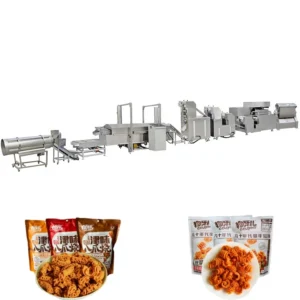
Puffed Octopus Snack Processing Line – Full-Automatic Fried Octopus Production Machinery
¥65.00 Select options This product has multiple variants. The options may be chosen on the product page -
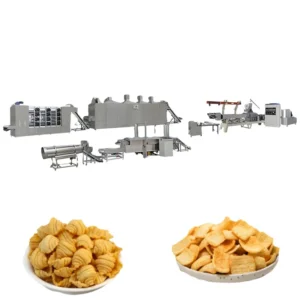
Automatic Fried Crispy Bugles Snacks Food Making Machines Wheat Flour Sala Food Extruder
¥100.00 Select options This product has multiple variants. The options may be chosen on the product page