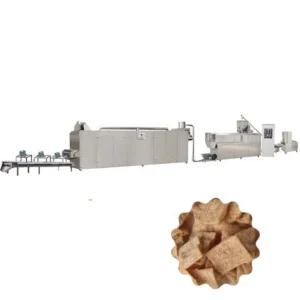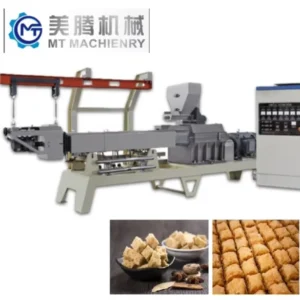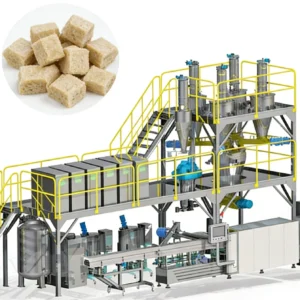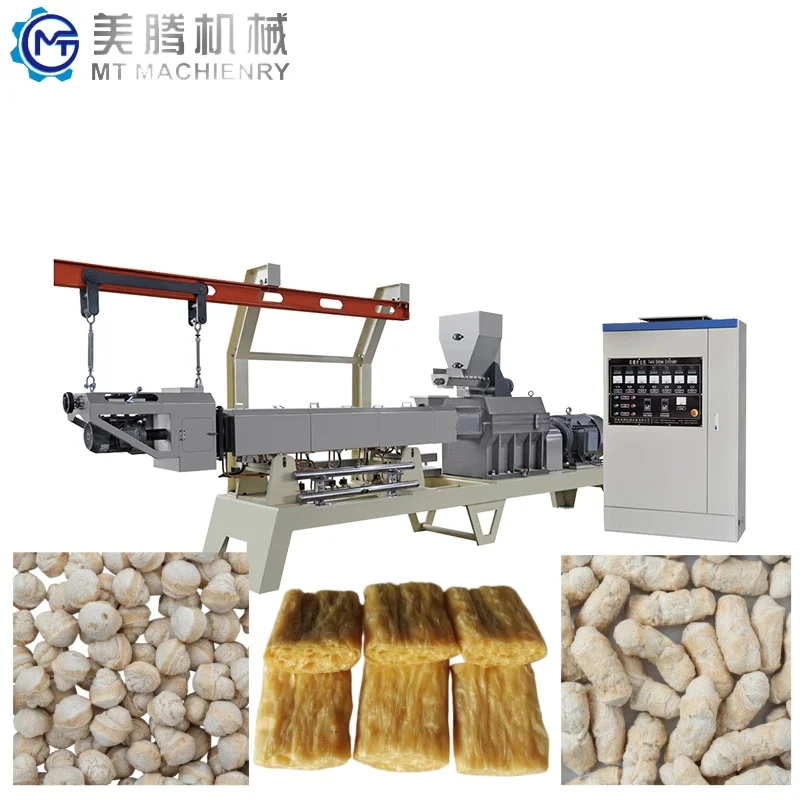

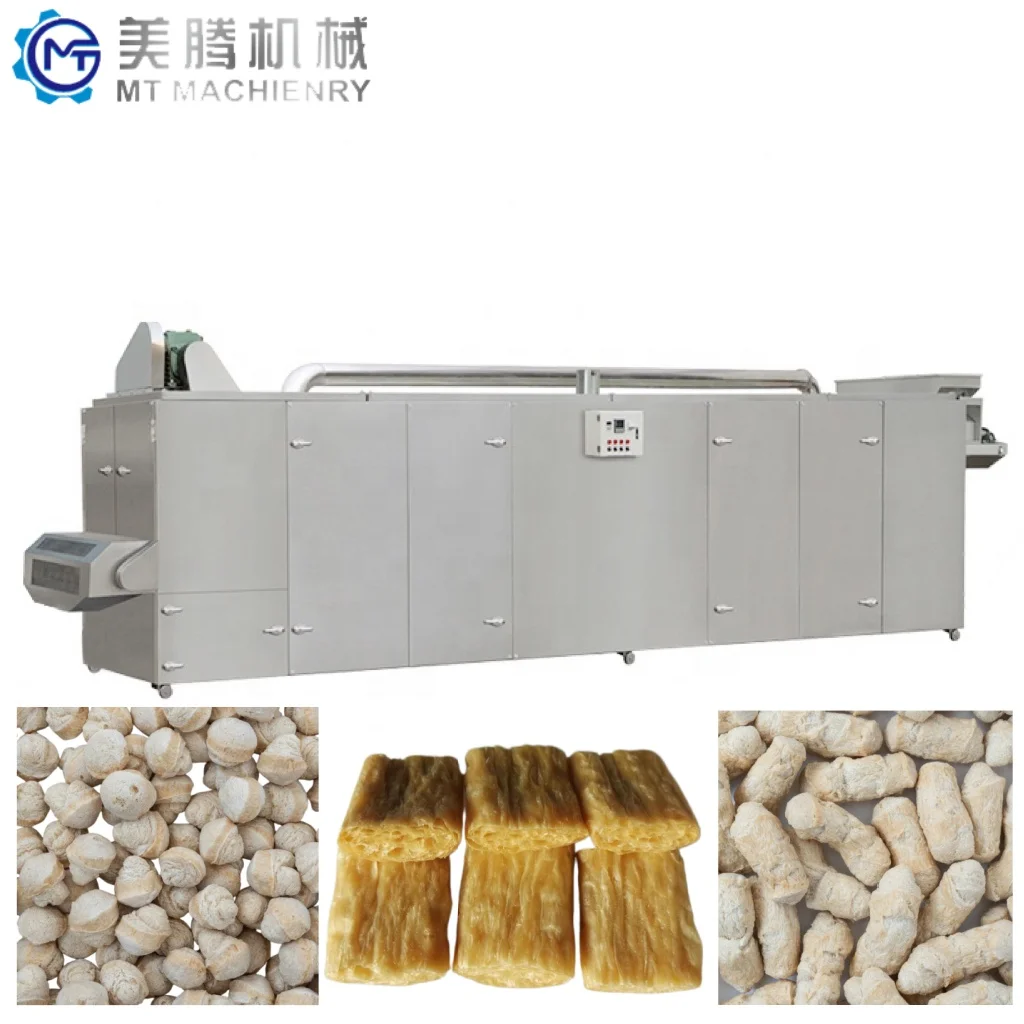
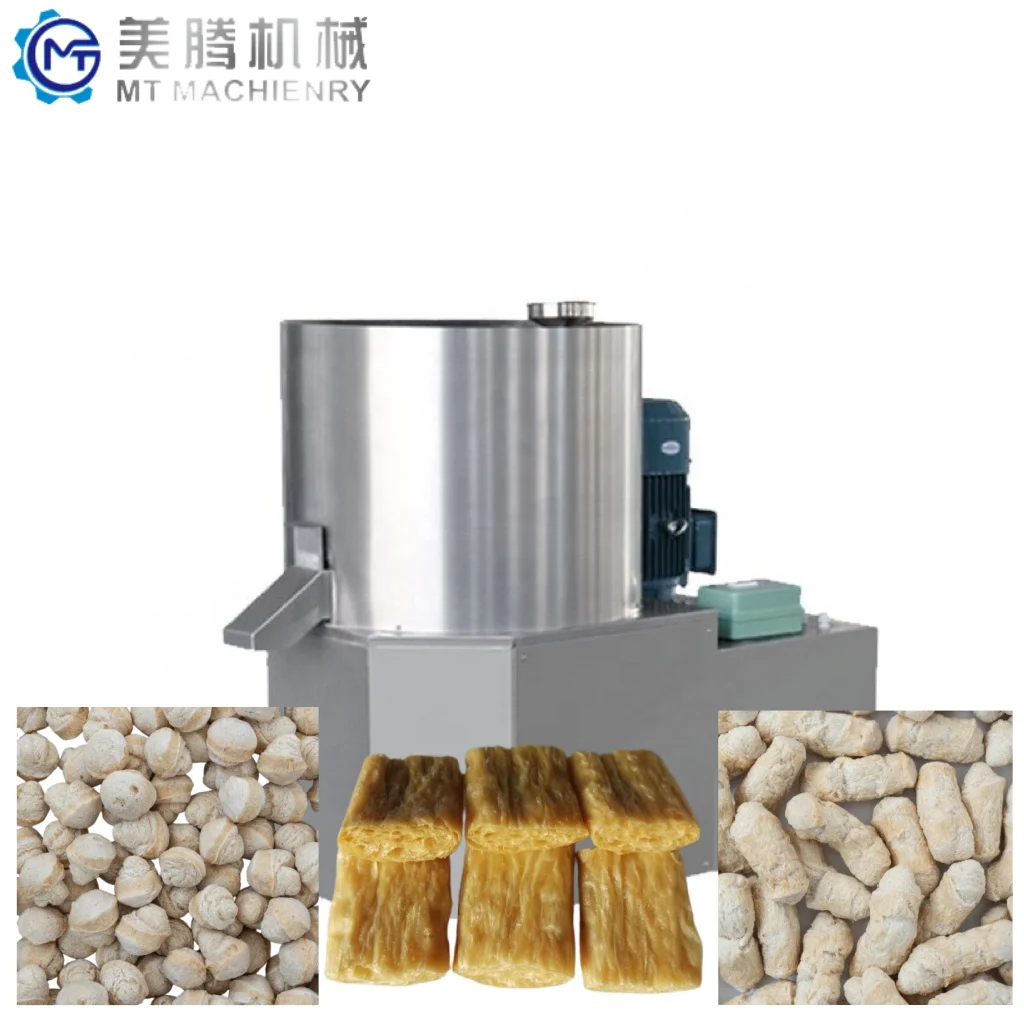

MT65 Textured Soy Protein Extrusion Line, Twin-Screw, CE & ISO Certified — configured from batching through extrusion, drying, cooling and packing under one supplier.
- Screw configuration and die design are matched to your soy or peanut meal formulation and target fiber structure, ensuring correct texture and density.
- Three capacity tiers (MT65 / MT70 / MT85) support small-scale entry to mid-volume plant-based meat production.
- All contact parts built in food-grade stainless steel with MCC and PLC control.
Layout, throughput matching and on-site commissioning by Meiteng engineers keep every station aligned to your actual raw material.
Description
Throughput-matched line engineering — We specify screw configuration, die design, and dryer capacity together against your soy formulation before building a single component.
Technical Specifications
| Parameter | Value |
|---|---|
| Model | MT65 / MT70 / MT85 |
| Product Type | Textured Soy Protein Extrusion Line |
| Screw Configuration | Twin-screw, configurable L:D ratio and barrel zones |
| MT65 Installed / Actual Power | 85 kW / 65 kW |
| MT70 Installed / Actual Power | 120 kW / 90 kW |
| MT85 Installed / Actual Power | 195 kW / 165 kW |
| MT65 Output | 150–200 kg/h (basis not stated in source — confirm raw material formulation / moisture content) |
| MT70 Output | 200–300 kg/h (basis not stated in source — confirm raw material formulation / moisture content) |
| MT85 Output | 600–800 kg/h (basis not stated in source — confirm raw material formulation / moisture content) |
| MT65 Dimension | 18000 × 1300 × 2300 mm |
| MT70 Dimension | 20000 × 1500 × 2400 mm |
| MT85 Dimension | 24000 × 3500 × 4300 mm |
| Extruder Main Motor Power | 30 kW |
| Powder Mixer Output / Power | 300–600 kg/h / 4 kW |
| Powder Mixer Tank Volume / Rotary Speed | 150 kg / 385 rpm |
| High-temperature Roaster Output | 300–400 kg/h |
| Roaster Effective Belt Length | 3.5 m |
| Roaster Far Infrared Heater Power | 3.9 kW × 24 units |
| Cooling Machine Capacity | 200–300 kg/h (basis to be confirmed) |
| Cooling Machine Temperature Range | 0–260 °C |
| Construction Material | Stainless steel (food-grade contact parts) |
| Line Stations | Raw material preparation → Mixing → Conveying → Extrusion → Conveying → Drying → Cooling → Packing |
| Control System | PLC / MCC control options available (language configurable) |
| Voltage & Frequency | Configurable to target market electrical standard |
| Warranty | 1 year complete warranty with lifetime maintenance service |
| Standards | CE certified, ISO certified |
Application Suitability
| Application | Material or Output |
|---|---|
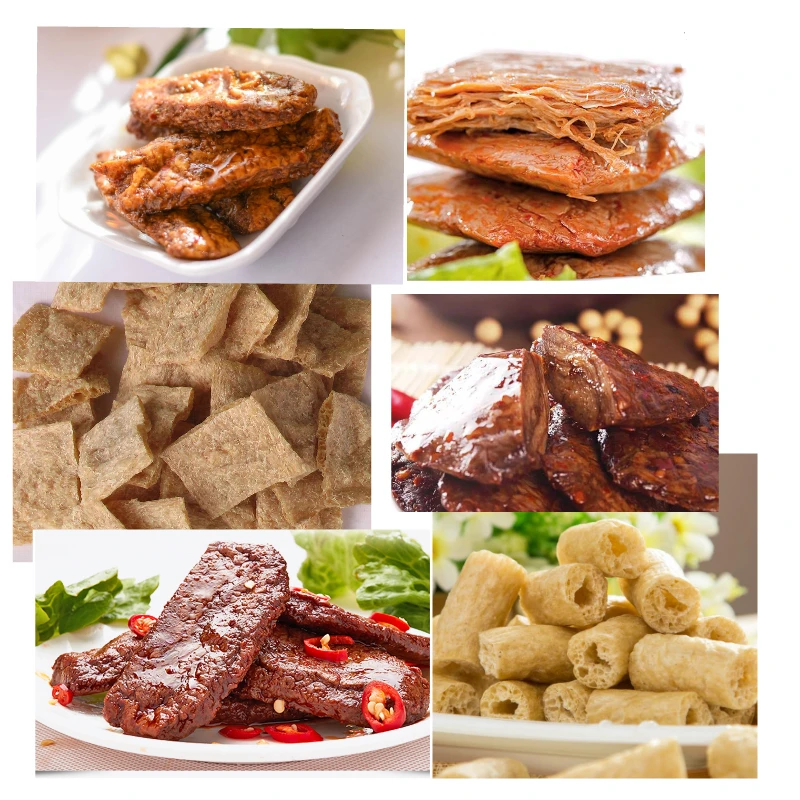
| Plant-based meat analog production | Textured soy protein (TSP) and textured vegetable protein (TVP) from soy meal |
| Lean meat extender for processed meats | Soy and peanut meal protein restructured into fibrous strands for ham and sausage |
| Canned and quick-frozen food ingredients | Meat-like fiber structures for vegetarian ready meals and fast-food components |
| Vegetarian protein retail packaging | Chunk, flake, and granule formats of extruded soy protein for consumer packs |
| Food-service meat substitute supply | Bulk textured protein with consistent fiber density for restaurant and institutional kitchens |
What "Rated Capacity" Hides About Your Soy Formulation
A textured soy protein production line turnkey rated at 200 kg/h on one soy blend may deliver half that on another with lower protein content.
I spent years commissioning protein lines across Southeast Asia and learned the hard way what happens when capacity is quoted without raw material context. A customer once ordered a twin-screw extruder based on sample throughput, but their local soy meal had noticeably lower protein than the trial material. The extruded output came out as crumbles instead of fibers, and the entire downstream drying and cutting section ran idle. The line technically worked, but production fell well short of what was promised on paper [NEED_CITE: impact of soy protein content on extrusion fiber formation]. This textured soy protein production line turnkey is specified only after your actual formulation is tested.
Matching Screw Geometry to Protein Fiber Structure
The fiber texture that defines textured soy protein comes from shear, heat, and die geometry working together inside the barrel. Our twin-screw extruder allows screw configuration and barrel temperature profiling to be set specifically for your soy meal protein percentage and target fiber coarseness. A textured soy protein production line turnkey that ships with a generic screw build will produce inconsistent strand density across batches. We record the screw element arrangement and die format as part of your line documentation so every replacement set matches the original trial result.
Why Dryer and Cooler Capacity Must Follow the Extruder
Extruded soy protein exits the die at high moisture and temperature, requiring immediate stabilization through drying and cooling. If the roaster belt speed or infrared heating capacity falls short of extruder output, product backs up and surface moisture remains uneven. The roaster on this line uses 24 far infrared heater units across a 3.5-meter effective belt length, with gas consumption specified for your local fuel type [NEED_CITE: industrial drying requirements for textured vegetable protein]. The cooling machine then brings product temperature down within a controlled range before packing. Throughput matching across these stations prevents the bottleneck where the extruder runs at partial feed because downstream equipment cannot keep pace.
Reading the Power and Dimension Data
Installed power versus actual power tells you what the line draws under normal running conditions versus peak startup load. The MT65 draws 65 kW in steady operation against 85 kW installed capacity, leaving headroom for startup surges without tripping facility breakers. The MT85, the largest configuration, requires 165 kW actual draw across a 24-meter line footprint. The powder mixer runs at 385 rpm with a 150 kg tank volume and 10-minute batch cycle, meaning mixing throughput must be verified against your extruder feed rate to avoid gaps in continuous production [NEED_CITE: continuous versus batch mixing impact on extrusion consistency]. Stainless steel construction across all food-contact surfaces meets hygiene expectations for protein destined for human consumption.
When a Generic Build Fails at Commissioning
Pain surfaces when the extruder arrives with screw elements and die plates chosen from a standard catalog rather than your specific meal formulation. The extruded protein lacks the fiber pull-apart texture your market expects, and no amount of downstream adjustment fixes what went wrong inside the barrel. Operators then spend weeks experimenting with moisture levels and barrel temperatures, consuming raw material and production time. In humid Southeast Asian workshops, I have seen textured protein lines of this class sit idle because the die format produced dense pellets instead of open fiber structures [NEED_CITE: die geometry effect on plant-based meat texture]. That downtime compounds into delayed first shipment to your customers.
Why Buyers Source This Line Here
Complete line responsibility under one supplier means mixing, extrusion, drying, cooling, and packing are calculated together rather than assembled from disconnected vendors. Screw configuration and die design are specified against your actual soy meal before the extruder enters production. An in-house testing workshop runs your raw material through trial extrusion before shipment, so fiber structure and throughput are confirmed on your formulation, not a generic benchmark. The line arrives with full documentation — electrical schematics matched to your facility voltage, trial run reports, and a wear parts list — so commissioning proceeds without surprises. On-site installation, operator training, and ongoing maintenance support are included in the scope.
Documentation & Verification
- Line layout and capacity calculation with throughput matching verified across mixing, extrusion, drying, and cooling stations
- Screw and die configuration record specifying barrel zones and die format matched to your soy meal formulation
- Trial run report documenting extrusion results on your raw material before the line ships
- Electrical schematic with voltage, frequency, and control language confirmed for your facility
- CE declaration of conformity and ISO certificate included with customs documentation
- Wear parts list identifying screw elements, die plates, and seals with replacement intervals
Installation, Commissioning & Support
- MT85 line requires approximately 24 meters of floor length with clearance for roaster exhaust and cooling airflow
- Power supply must support 195 kW installed capacity on the MT85 or 85 kW on the MT65 with dedicated circuit protection
- Roaster gas connection configured for local fuel type and calorific value before the heating section is commissioned
- PLC control language set to operator preference during on-site commissioning with full parameter documentation handed over
- Screw and die replacement training covers element sequence, torque specifications, and barrel alignment checks
- Stainless steel contact surfaces require scheduled inspection for wear at die openings and screw flight edges
Before You Request a Quote
Send us your soy meal or peanut meal specification sheet including protein percentage and particle size, along with the fiber texture format your market expects — chunk, flake, or shredded strand. Include your target daily output, facility voltage and frequency, and preferred control language so we can match the electrical package and documentation before quoting. If you have existing upstream milling or downstream packing equipment, share those details so we can confirm interface points across the textured soy protein production line turnkey.
Frequently Asked Questions
Q: How do you confirm the line will hold quoted output on my soy formulation?
A: We run your actual raw material through our in-house testing workshop before the line ships. The trial documents extrusion fiber quality, moisture at die exit, and achievable throughput on your specific soy meal. This report becomes part of your delivery documentation so there is no guesswork at commissioning.
Q: Can the screw and die setup be changed later for different protein sources?
A: Yes. The twin-screw extruder accepts interchangeable screw elements and die plates. We record the original configuration in your documentation and can supply additional sets configured for peanut meal, pea protein, or blended formulations. Each change requires a barrel temperature and moisture adjustment that we document during the trial.
Q: What electrical information do you need before building the line?
A: We need your facility voltage, frequency, and phase specification along with the control language your operators will use. The electrical schematic is then drawn to match, and the PLC interface is programmed accordingly. Confirming these details before production prevents delays during on-site commissioning and first startup.
Q: What does on-site installation and training cover?
A: Our engineers handle line assembly, utility connection verification, and first production runs at your facility. Training covers daily operation, screw and die changeover procedures, roaster temperature profiling, and routine maintenance on stainless steel contact parts. A full operation and maintenance manual with wear parts list is handed over at sign-off.
Q: How is throughput matched between the mixer, extruder, and dryer?
A: We calculate each station’s capacity against your target extruder output and raw material moisture level. The powder mixer batch cycle, extruder feed rate, roaster belt speed, and cooling machine capacity are all sized so no single station creates a bottleneck. This matching is documented in your line layout before production begins.
Related products
-
High Moisture Vegetarian Meat Extrusion Machine
¥9,500.00 Select options This product has multiple variants. The options may be chosen on the product page -
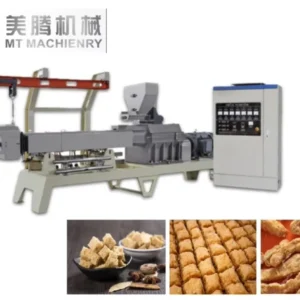
Twin Screw Extruder for High Moisture Vegetarian Meat
¥9,500.00 Select options This product has multiple variants. The options may be chosen on the product page -
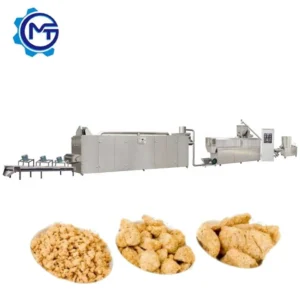
New Pea and Soybean Protein Production Line Equipment with Mechanical Extruder Food Grade Stainless Steel High Productivity
¥65.00 Select options This product has multiple variants. The options may be chosen on the product page -
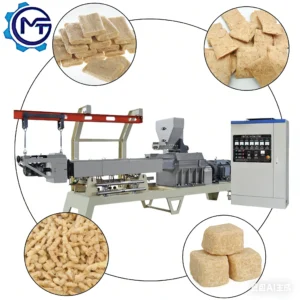
Automatic Vegetarian Meat Production Line with Twin Screw Extruder
¥9,500.00 Select options This product has multiple variants. The options may be chosen on the product page