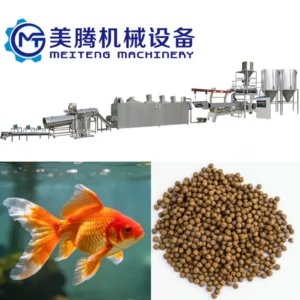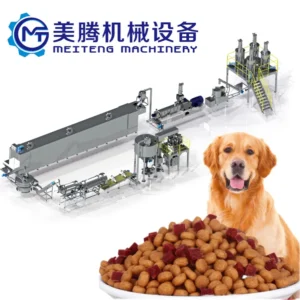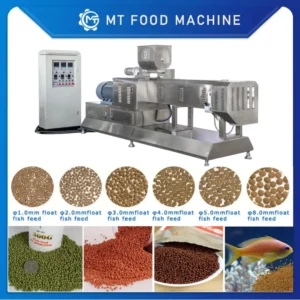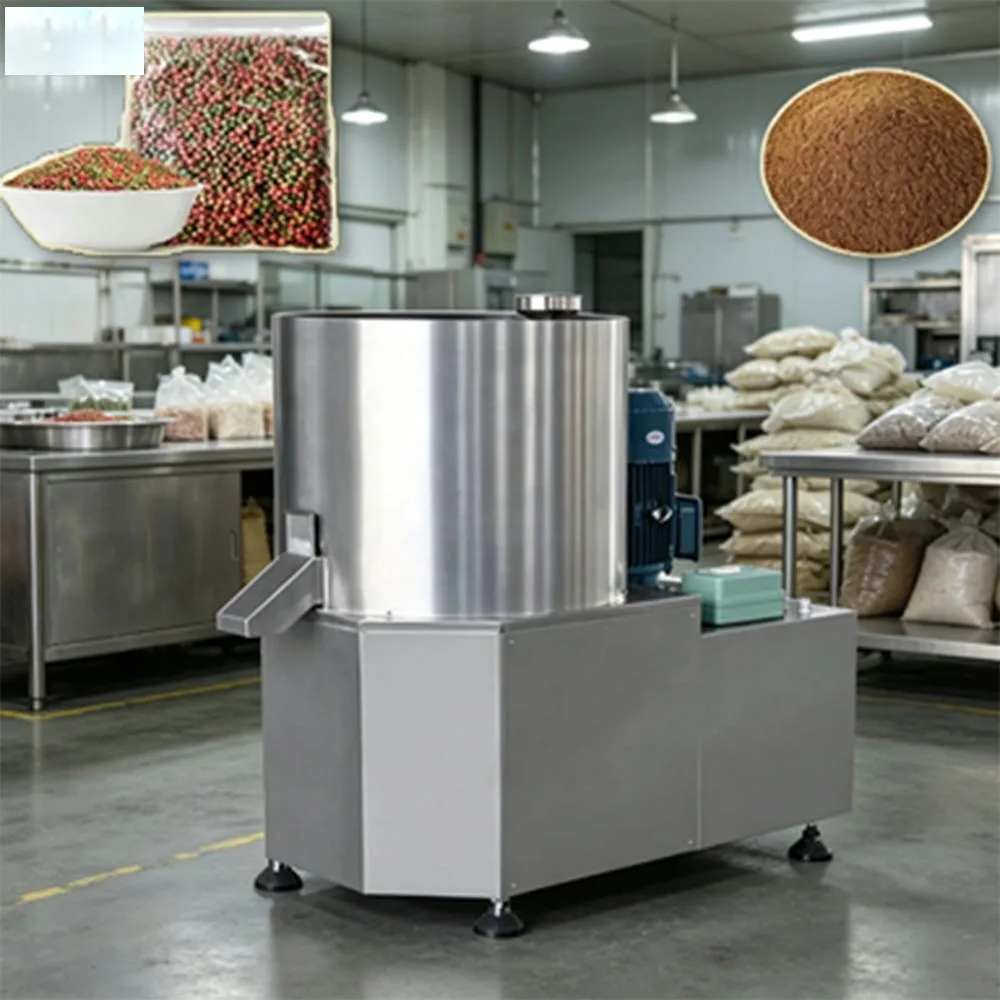


Twin Screw Floating Fish Feed Extruder, 500 kg/h, 0.5–12 mm Pellet Range — engineered as a complete turnkey project from batching to packing, with throughput matched at every station so rated output holds on your actual formulation. Screw configuration and die design are specified to your raw material for consistent floating-grade density control. – In-house trial runs on customer raw material before shipment validate capacity and pellet specification
Description
Turnkey project engineering — every throughput station is calculated as one system so your 500 kg/h rating holds from the mixer to the packer instead of collapsing at the dryer.
Technical Specifications
| Parameter | Value |
|---|---|
| Product Type | Twin Screw Floating Fish Feed Extruder |
| Output Capacity | 500 kg/h (basis not stated in source — confirm raw material formulation / moisture / pellet size) |
| Pellet Size Range | 0.5 mm – 12 mm |
| Screw Type | Twin screw |
| Structure Material | Stainless steel (main contact parts) |
| Control System | Simple control panel (PLC / MCC option available) |
| Automation Level | Fully automatic, continuous production |
| Line Functions Integrated | Feeding, mixing, extruding, pelletizing |
| Power Consumption | Low energy design (rated power value to be confirmed) |
| Assembly State | Complete integrated line |
| Certification | CE, ISO |
Application Suitability
| Application | Material or Output |
|---|---|
| Floating fish feed for aquaculture | Fish meal, soybean meal, wheat flour, starch blends for catfish, tilapia and shrimp |
| Sinking aquatic feed | High-fat formulations requiring controlled density and slower gelatinisation |
| Dry pet kibble | Meat meal, corn, rice, vitamin premix for dog and cat diets |
| Extruded pet treats | High-protein blends shaped through custom die plates |
| Fry feed for hatcheries | Micro-pellets down to 0.5 mm from finely ground protein and carbohydrate mixes |
What "500 kg/h" Actually Means on Your Formulation
Capacity is a moving target until your raw material meets the screw.
A Twin Screw Floating Fish Feed Extruder production line rated at a round number is only as reliable as the formulation it was tested on. I once saw a line in a Saudi aquaculture plant stall during commissioning because the buyer switched to a local high-fat fish meal after the factory test — the pellets sank, the dryer choked, and three weeks of production vanished. The extruder was never wrong; the data behind the rating was incomplete [NEED_CITE: raw material variability and extrusion throughput correlation]. When you review a capacity claim, the real question is which recipe, moisture level and pellet diameter produced that number.
Matching the Barrel Profile to Your Pellet Density Target
Floating feed and sinking feed demand different shear histories inside the barrel. The Twin Screw Floating Fish Feed Extruder production line achieves this by reconfiguring the screw elements and adjusting barrel zone temperatures so that starch gelatinisation is either pushed hard for maximum expansion or held back for a dense, slow-sinking pellet. A single mechanical platform covers both outcomes; what changes is the screw map and the die geometry. This flexibility matters for producers who supply multiple species across growth stages and cannot afford a second extruder sitting idle half the year.
Why Downstream Stations Decide Whether the Line Earns Its Name
An extruder that pushes out material faster than the dryer can remove moisture will force the whole line to throttle back. On turnkey feed projects the dryer, cooler, coating drum and packing scale must each be sized against the same confirmed output, not against a brochure peak. We calculate every station from one throughput document so the Twin Screw Floating Fish Feed Extruder production line runs continuously at its verified rate rather than pulsing between bottlenecks [NEED_CITE: downstream capacity matching in continuous extrusion lines].
Reading the Specs That Actually Matter on Site
The 0.5 mm to 12 mm pellet range comes from swapping die plates, but the real constraint is the conditioning moisture and screw speed that keep small fry pellets intact without over-expanding them. Stainless steel contact surfaces resist the chloride load in fish meal and the fat carryover in pet kibble recipes, cutting corrosion-related downtime that carbon steel barrels typically show after a few seasons. The integrated feeding and mixing section means batch variance is reduced before material ever enters the barrel, which is where most density failures originate. A simple control panel keeps the line operable in regions where PLC technicians are scarce, while the PLC or MCC option is available for plants that want recipe memory and remote diagnostics.
The Cost of Skipping the Trial Run
Shipping an extruder without first running the buyer’s actual formulation through a testing workshop is the single largest source of commissioning delays I have encountered on feed plant projects. The line arrives, the local raw material behaves differently from the generic test recipe, and suddenly the screw configuration needs rework while the whole factory waits. Density specifications missed at this stage force producers to sell floating-grade feed at sinking-feed prices, which erodes margins fast [NEED_CITE: extrusion trial run impact on commissioning timelines]. A few days of pre-shipment testing prevent weeks of on-site troubleshooting.
Why This Line Is Built as One Project, Not a Bundle of Machines
Throughput matching across every station eliminates the bottleneck shuffle that plagues lines assembled from separate vendors. Screw configuration and die design are locked to your raw material and target pellet density before the barrel is assembled. An in-house testing workshop runs your formulation so the trial report ships with the machine, not after it. Twin-screw expertise spans pet food, aquatic feed and snack applications, so the same engineering team handles recipe changes without bringing in outside consultants. Pre-sales consultation through installation, commissioning and ongoing maintenance keeps one responsible party on the line from first drawing to first production run.
Documentation & Verification
- Line layout showing matched throughput at every station from batching to packing
- Trial run report on your raw material executed before shipment
- Screw and die configuration record tied to your formulation and density target
- Electrical schematic with voltage, frequency and control language confirmed per destination
- CE declaration of conformity and ISO certificate for customs and regulatory filing
- Operation and maintenance manual with wear parts list and replacement intervals
Installation, Commissioning & Support
- Foundation plan sized to the integrated line footprint and vibration profile
- Electrical load schedule confirming local voltage and dedicated circuit requirements
- Modular assembly sequence so stations align without rework on site
- First-run parameter setting tied to your trial run report baseline
- Operator training covering screw swap, die change and daily sanitation routines
- Wear parts kit covering screws, dies and seals for the initial production period
What to Prepare Before Requesting a Quote
Share your target formulation, including protein source, fat percentage and moisture range, along with the pellet diameter and floating or sinking requirement for each product. Provide your factory’s available floor area, ceiling height, local voltage and frequency, and preferred control language. If you already operate upstream batching or downstream packing equipment, send the make and throughput rating so the Twin Screw Floating Fish Feed Extruder production line can be matched to your existing flow.
Frequently Asked Questions
Q: How is the 500 kg/h capacity verified for my specific formulation?
A: We run your raw material in our in-house testing workshop before the line ships. The resulting trial report records actual output, moisture, pellet density and screw configuration, so the capacity figure you receive is tied to your recipe, not a generic benchmark.
Q: How are the dryer, cooler and packing stations sized against the extruder?
A: Every downstream station is calculated from the same throughput document used for the extruder. This prevents bottlenecks where one station forces the entire line to throttle back during continuous production runs.
Q: What does the phased installation schedule look like for a complete line?
A: Installation follows a station-by-station sequence aligned to your factory readiness. Commissioning starts with dry runs, moves to wet trials with your raw material, and finishes with operator training on screw swaps, die changes and daily maintenance.
Q: How do you select screw and die configuration for floating versus sinking feed?
A: Configuration is chosen based on your formulation’s starch and fat content plus the target pellet density. If market specifications shift after delivery, the screw elements can be rearranged and a new die plate fitted without replacing the barrel assembly.
Q: Which utility connections must my factory have ready before installation?
A: You need confirmed electrical supply matching the line’s voltage and frequency, steam for conditioning, compressed air for controls and actuation, and process water for cooling. We provide a utility requirement sheet once the line configuration is finalized.
Related products
-
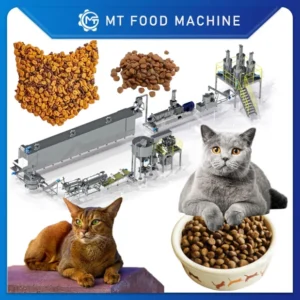
250-300kg/h Capacity PLC Controlled Multi-Species Cat Food Processing Line
¥35,000.00 Select options This product has multiple variants. The options may be chosen on the product page -
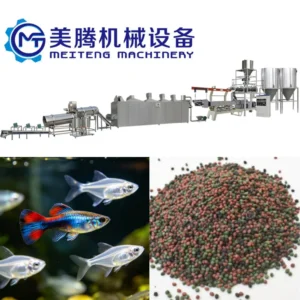
200-300kg/h Capacity Multi-Species Fish Feed Processing Line to Produce Fish Food
¥34,000.00 Select options This product has multiple variants. The options may be chosen on the product page -
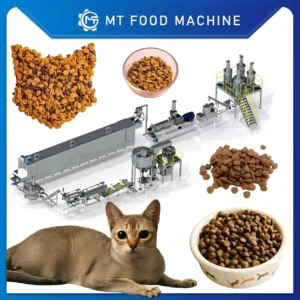
200-250kg/h Capacity PLC Controlled Multi-Species Dog Food Processing Line with MT-70 Extruder
¥35,000.00 Select options This product has multiple variants. The options may be chosen on the product page -
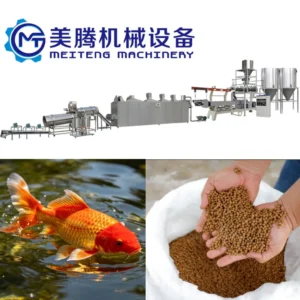
1.0-1.5t/h High Capacity Multi-Species Fish Feed Processing Line to Produce Fish Food
¥45,000.00 Select options This product has multiple variants. The options may be chosen on the product page