

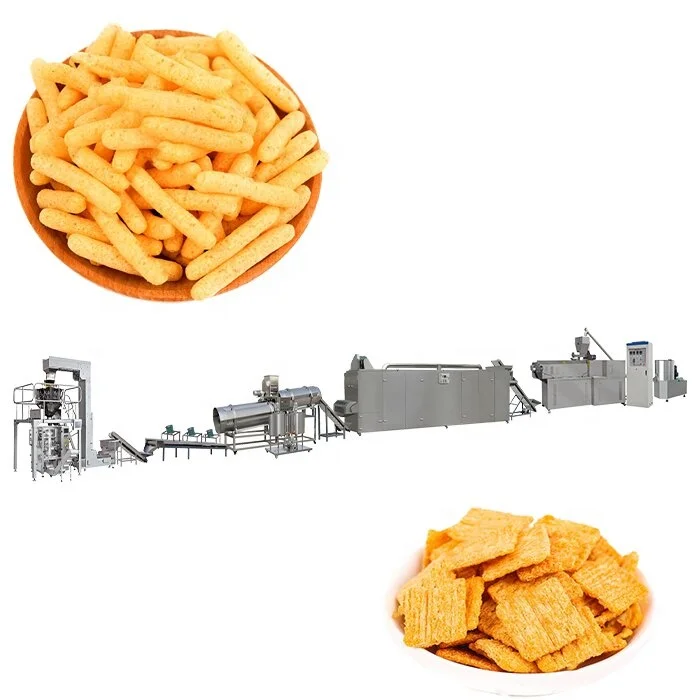
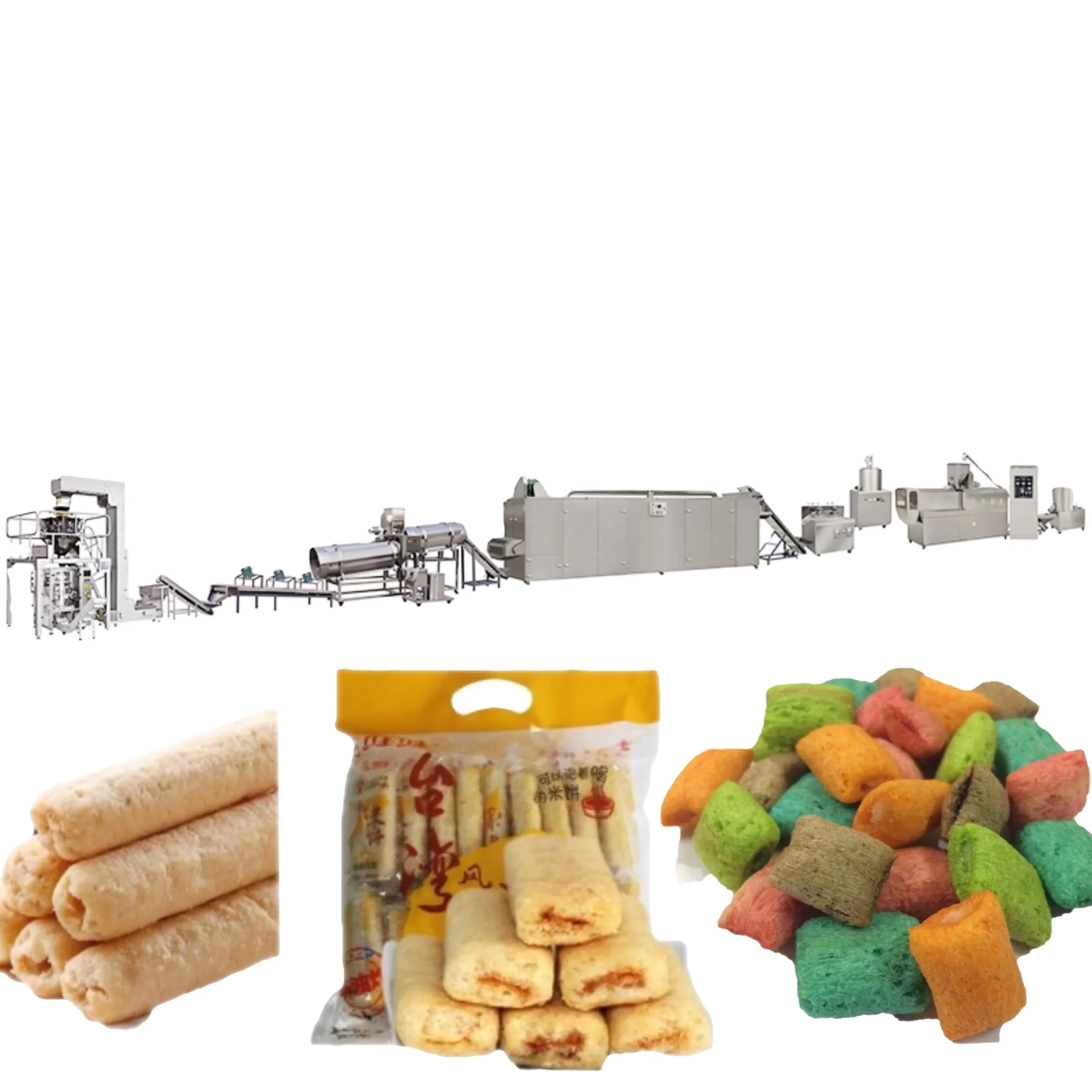
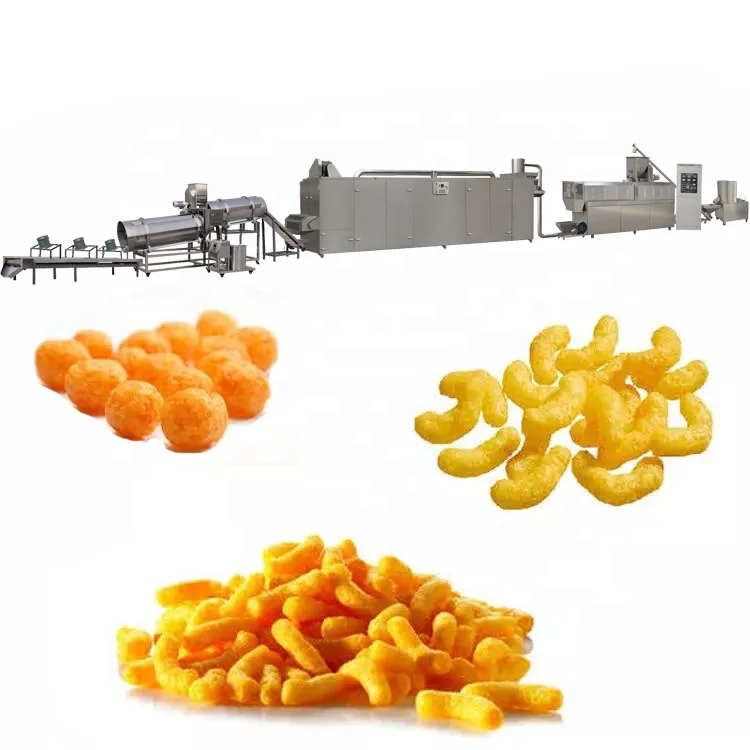
MT65 / MT70 / MT85 Twin Screw Puffed Snack Food Extrusion Line — twin screw extrusion with PLC/MCC control, Siemens main motor, nitriding-treated barrel and screw, interchangeable die shapes, 5-layer SUS mesh belt dryer.
- Screw configuration and die design specified to your corn or rice flour formulation and target snack geometry, controlling expansion, density and surface texture through barrel temperature profile and moisture management.
- Turnkey line from batching through extrusion, drying, flavouring and packing with throughput matched across every station — backed by in-house trial runs on your raw material before shipment.
Description
Throughput-Matched Line Design — Every station from batching to packing is sized to the extruder’s real output on your specific corn or rice flour blend, eliminating the bottleneck effect that plagues multi-vendor assemblies.
Technical Specifications
| Parameter | Value |
|---|---|
| Product Type | Twin Screw Puffed Snack Food Extrusion Line |
| Model | MT65 / MT70 / MT85 |
| Screw Type | Twin Screw |
| Main Motor | Siemens |
| Control System | Available with PLC or MCC control |
| Installed Power (MT65) | 70 kW |
| Real Power (MT65) | 40 kW |
| Output Capacity (MT65) | 100–150 kg/h (basis not stated in source — confirm raw material, moisture, and product shape) |
| Dimensions (MT65) | 20,000 × 1,200 × 2,200 mm |
| Installed Power (MT70) | 100 kW |
| Real Power (MT70) | 70 kW |
| Output Capacity (MT70) | 200–240 kg/h (basis not stated in source — confirm raw material, moisture, and product shape) |
| Dimensions (MT70) | 25,000 × 1,500 × 2,200 mm |
| Installed Power (MT85) | 200 kW |
| Real Power (MT85) | 150 kW |
| Output Capacity (MT85) | 300–400 kg/h (basis not stated in source — confirm raw material, moisture, and product shape) |
| Dimensions (MT85) | 30,000 × 3,500 × 4,300 mm |
| Barrel & Screw Material | Nitriding process, high strength, wear-resistant, self-cleaning |
| Feeding System | Speed-adjusted inverter converter, food-grade stainless steel twin screw feeder |
| Gearbox | Automatic lubrication function |
| Drive Cooling | Increased radiator for forced cooling on driving part |
| Cutting System | Rotary cutting knife fixed on die head seat, V-belt drive |
| Dryer Type | 5-layer mesh belt, SUS construction |
| Dryer Max Temperature | 160°C (source value — verify against manufacturer catalog) |
| Dryer Heating Options | Electric / gas / oil |
| Cooling Machine | Stainless steel belt, 450 mm width, fan-assisted |
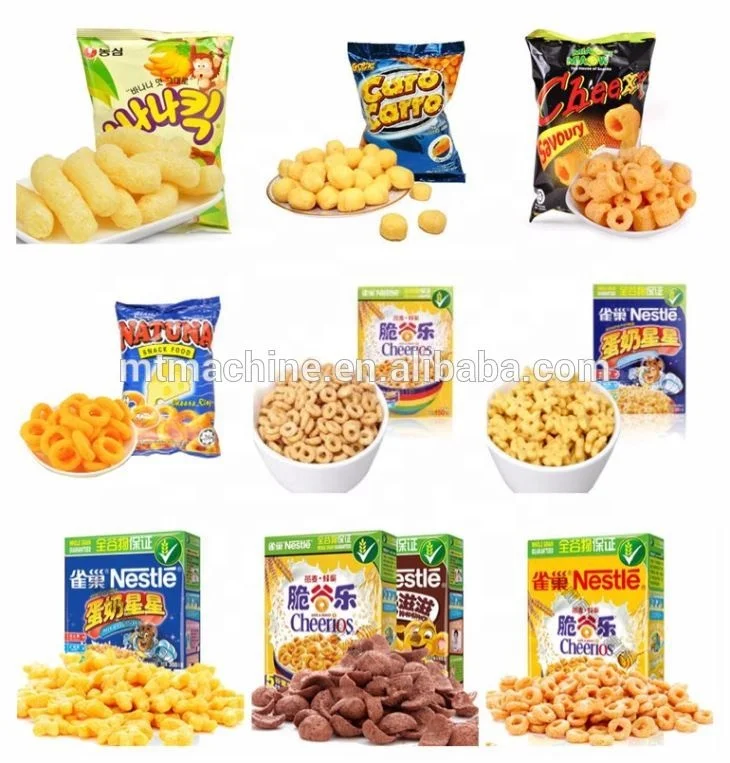
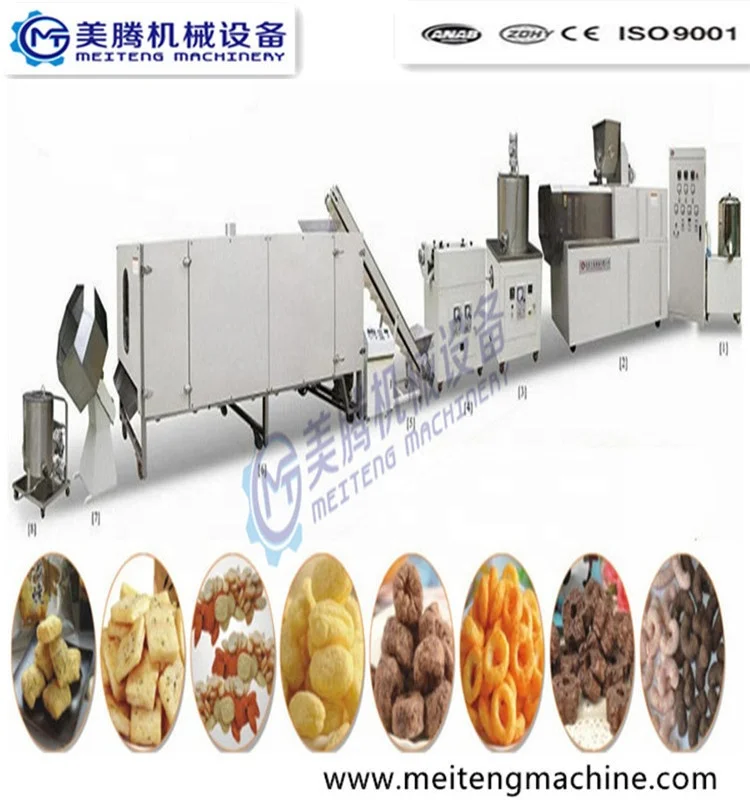
| Die Configuration | Interchangeable moulds — flowers, stars, wheels, square boxes, hearts, smiles, rings, strips; custom shapes available |
| Line Stations | Mixer → Screw Conveyor → Extruder → Vibrate Cooler → Dryer → Flavoring System → Cooling Machine → Packing Machine |
| Standards | CE, ISO |
Application Suitability
| Application | Material or Output |
|---|---|
| Puffed corn snacks (Nik Naks style) | Corn flour, corn grits, grain-based blends |
| Fried extruded snacks | Rice flour, wheat flour, starch-based formulations |
| Core-filled snacks | Grain blends with cream or chocolate filling |
| Artificial rice | Rice flour, corn flour, fortified starch blends |
| 2D and 3D pellet snacks | Potato starch, corn starch, modified starch |
| Breakfast cereal shapes | Corn flour, oat flour, multigrain blends |
What "Rated Capacity" Leaves Out About Your Snack Line
A puffed snack food extrusion production line turnkey only meets its nameplate output when every downstream station can actually handle what the extruder delivers.
I spent years on factory floors across Shandong watching lines get installed where the extruder was rated for a certain throughput, but the dryer or flavouring drum was sized for something smaller. The result is a line that technically works but never reaches the output the buyer planned around. With corn-based puffed snacks, moisture content and oil percentage in the raw flour shift expansion behaviour significantly. A formulation with higher fat content produces denser kibble that requires different drying profiles and longer residence time in the mesh belt dryer [NEED_CITE: effect of fat content on extrudate expansion and drying requirements]. When the dryer cannot keep pace, product backs up, moisture targets are missed, and the flavouring system receives inconsistent feed.
How Twin Screw Extrusion Shapes Puffed Snack Texture
The twin screw configuration on the MT65, MT70, and MT85 allows operators to adjust screw element sequencing to control shear intensity and residence time inside the barrel. This directly governs starch gelatinisation degree, which determines the final expansion ratio and crunch density of corn-based and rice-based puffed snacks. The puffed snack food extrusion production line turnkey relies on this configurability to switch between a light, airy Nik Naks-style curl and a denser, crunchier pellet shape without changing the base hardware. Nitriding-treated barrels and screws resist the abrasive wear that corn grits impose over extended production runs.
Matching Dryer and Flavouring Capacity to Extruder Output
A five-layer stainless steel mesh belt dryer with selectable heating — electric, gas, or oil — gives the line flexibility to hit specific moisture targets across different snack formats. The critical point is that drying capacity must be calculated against the extruder’s actual output on the buyer’s raw material, not a generic rating. When moisture leaves the extruder barrel at a given percentage and the target packed moisture is lower, the dryer must provide sufficient belt area and air flow to achieve that reduction within the line’s cycle time. The semi-automatic or automatic flavouring system downstream must then handle the dried product volume without creating a secondary bottleneck [NEED_CITE: throughput balancing principles in snack food processing lines].
Reading the Specifications That Actually Matter
The installed power versus real power gap on each model reflects the difference between peak motor draw and sustained operating load — a distinction that affects your electrical infrastructure planning. For the MT65, real power consumption sits around 40 kW against a 70 kW installed figure, meaning your transformer and cabling must accommodate the higher value even though day-to-day energy cost tracks the lower one. The speed-adjusted inverter on the feeding system controls how consistently raw material enters the extruder barrel, which in turn stabilises product density across long runs. Siemens main motors paired with the forced-cooling radiator on the driving section allow continuous operation at rated load without thermal derating — a practical concern in warm-climate factories where ambient temperature compounds motor heat generation.
The Hidden Cost of a Generic Screw and Die Build
When screw configuration and die geometry are copied from a standard template rather than matched to the buyer’s actual flour blend, the extruder produces product outside the density and texture specification the market expects. Corn flour with higher residual oil expands less than a low-fat corn grit, and a screw combination optimised for the latter will deliver under-expanded, tough product on the former. Die orifice diameter and land length control the final shape’s wall thickness and expansion direction — get these wrong and rings collapse or strips curl unpredictably. The cost surfaces after installation, when reformulation trials consume raw material, production time, and operator attention while the line sits below its commercial output target [NEED_CITE: screw configuration impact on extrudate geometry in twin screw food extrusion].
Why Buyers Source the Full Line From One Supplier
Throughput matching across every station — mixer, conveyor, extruder, dryer, flavouring drum, cooler, and packing — is calculated before the line ships, so no single machine constrains the others. Screw and die combinations are specified against the buyer’s raw material sample rather than pulled from a generic catalogue, which prevents the density and texture mismatches described above. An in-house testing workshop runs trial production on the buyer’s actual corn flour, rice flour, or grain blend before dispatch, generating a trial run report that documents output, expansion ratio, and moisture levels. Pre-sales line layout and capacity calculation give buyers a clear picture of utility requirements, floor space, and phased installation sequence. CE and ISO certification covers the full line, simplifying customs documentation and import compliance across different markets.
Documentation & Verification
- Line layout drawing with throughput calculation matched to your raw material and target snack shape
- Screw and die configuration record specific to your formulation, not a generic build sheet
- Electrical schematic with voltage and frequency confirmed for your facility’s power supply
- Trial run report on your actual corn or rice flour performed in the testing workshop before shipment
- Factory test record documenting output, moisture, and product geometry at each station
- Operation and maintenance manual covering daily inspection points and wear part replacement intervals
Installation, Commissioning & Support
- Floor plan review confirming the MT85’s 30,000 mm line length fits within your facility’s available space and ceiling height
- Dedicated electrical circuit sized to the installed power rating with voltage and frequency matching local grid standards
- Section-by-section assembly sequence for the five-layer dryer and cooling conveyor to minimise installation downtime
- First-run parameter logging on your raw material, including barrel temperature profile, screw speed, and feeder rate
- Operator training covering die changeover procedure, screw element cleaning, and inverter adjustment for different snack shapes
- Wear parts list with lead times for replacement screws, dies, and cutting blades to support uninterrupted production scheduling
What We Need to Configure Your Line
To prepare a line layout and capacity proposal, share your primary raw material type and its typical moisture and fat content, the target snack shape or shapes you plan to produce, and your desired hourly output range. Confirm your facility’s available floor length and width, ceiling height, and local voltage and frequency standard so the electrical package and motor specifications can be matched before production begins. If you have existing upstream batching or downstream packing equipment that the new line must integrate with, provide make and model details so interface points can be engineered accordingly.
Frequently Asked Questions
Q: How is output capacity verified on my specific corn or rice flour formulation rather than a nominal rating?
A: Before shipment, your raw material is run through the extruder in the in-house testing workshop. Output is measured at steady state, expansion ratio and product moisture are recorded, and the results are documented in a trial run report. This replaces reliance on generic capacity figures that do not account for your flour’s oil content, particle size, or starch composition.
Q: How are screw configuration and die design matched to my raw material and target snack shape?
A: Screw element sequencing and die orifice geometry are selected based on your raw material’s behaviour during extrusion — specifically its expansion characteristics, gelatinisation temperature, and viscosity under shear. The configuration record is documented and provided with the line so you can replicate or adjust settings for future production runs.
Q: What trial run is performed on my raw material before the line ships?
A: A full production trial using your actual flour blend is conducted in the testing workshop. The extruder runs at target throughput, product passes through the dryer and flavouring system, and final snack samples are evaluated for density, moisture, crunch texture, and shape accuracy. Results are compiled into a report shared with you before dispatch.
Q: How is throughput balanced across mixing, extruding, drying, flavouring and packing stations to prevent bottlenecks?
A: Each station’s capacity is calculated against the extruder’s verified output on your material. Dryer belt area, flavouring drum volume, and cooling conveyor speed are all sized so that product flows continuously without accumulation or starvation at any point. The line layout document shows these matched capacities for every station.
Q: What installation, commissioning and operator training is included in the turnkey scope?
A: On-site installation covers mechanical assembly, electrical connection, and utility hookup for the full line from mixer to packing station. Commissioning includes first-run parameter setting on your raw material and verification of throughput at each station. Operator training covers daily operation, die changeover, screw cleaning, inverter adjustment, and wear part inspection procedures.
Related products
-

Automatic Corn Crisps Extruder Production Machine for Maize Chips and Corn Sticks New Condition
¥8,000.00 Select options This product has multiple variants. The options may be chosen on the product page -

Puffed Snack Food Machine Snack Food Machine Puffed Snack Machine
¥11,050.00 Select options This product has multiple variants. The options may be chosen on the product page -

Twin Screw Corn Puffs Extruder Machine Small Corn Snack Food Extruder Machine
¥100.00 Select options This product has multiple variants. The options may be chosen on the product page -

Stainless Steel Corn Puff Cake Making Machine Corn Snack Food Machines Top Selling Snacks Machine
¥8,560.00 Select options This product has multiple variants. The options may be chosen on the product page


