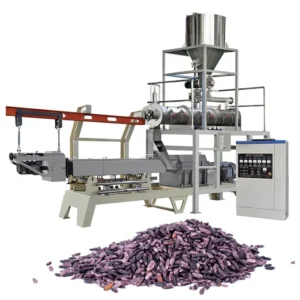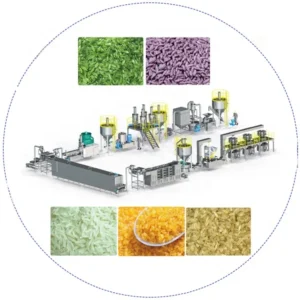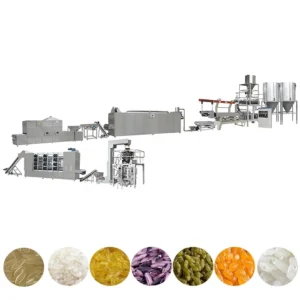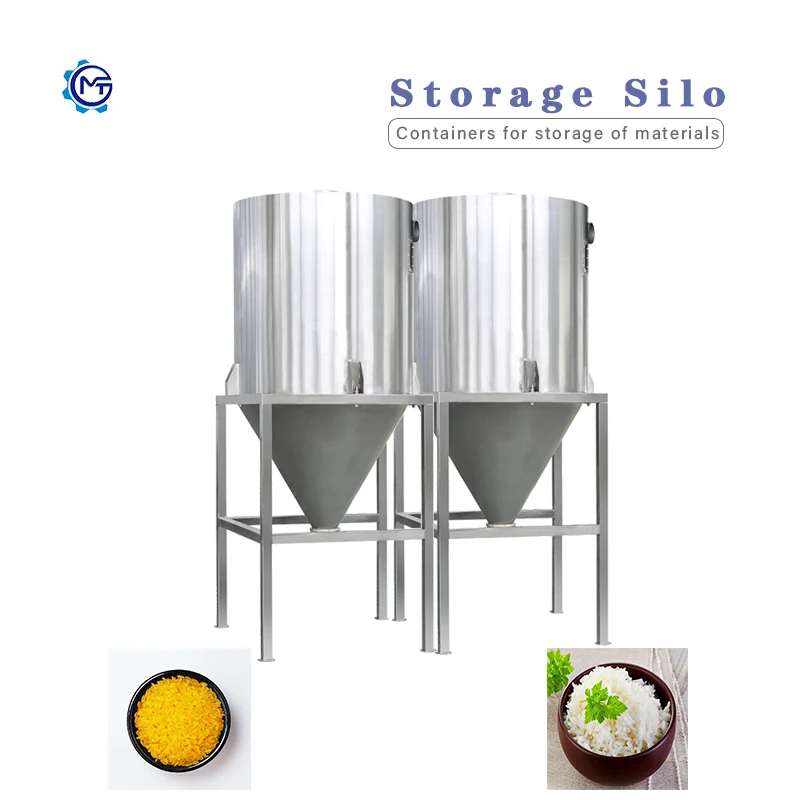
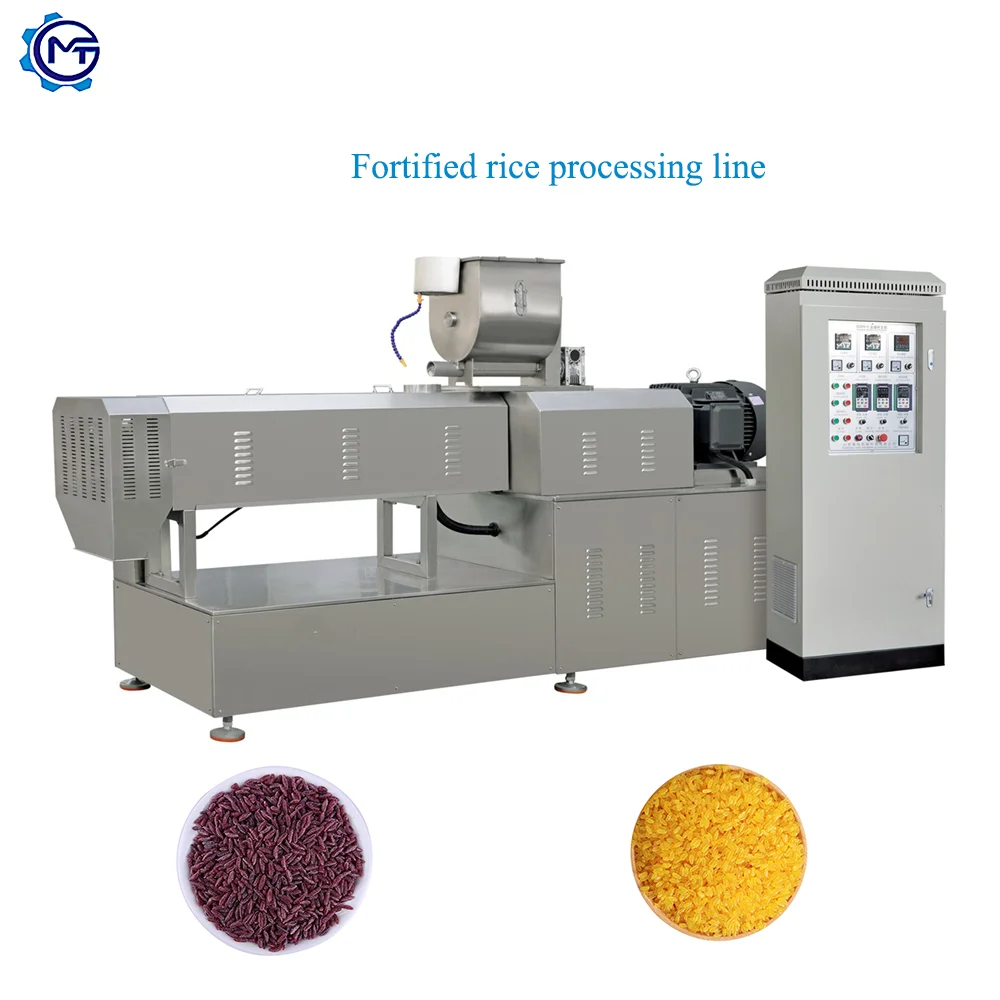
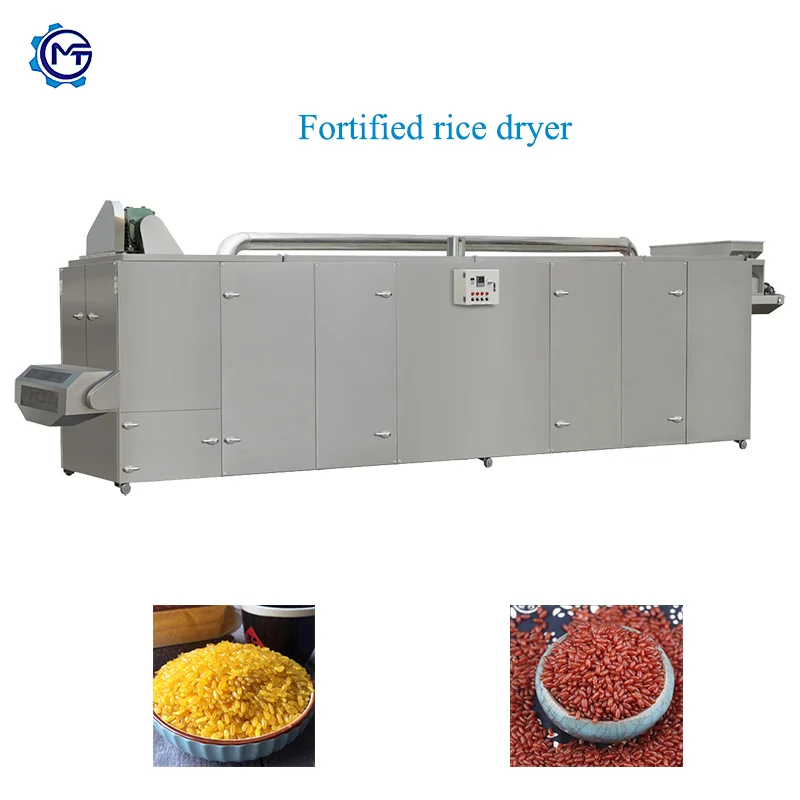
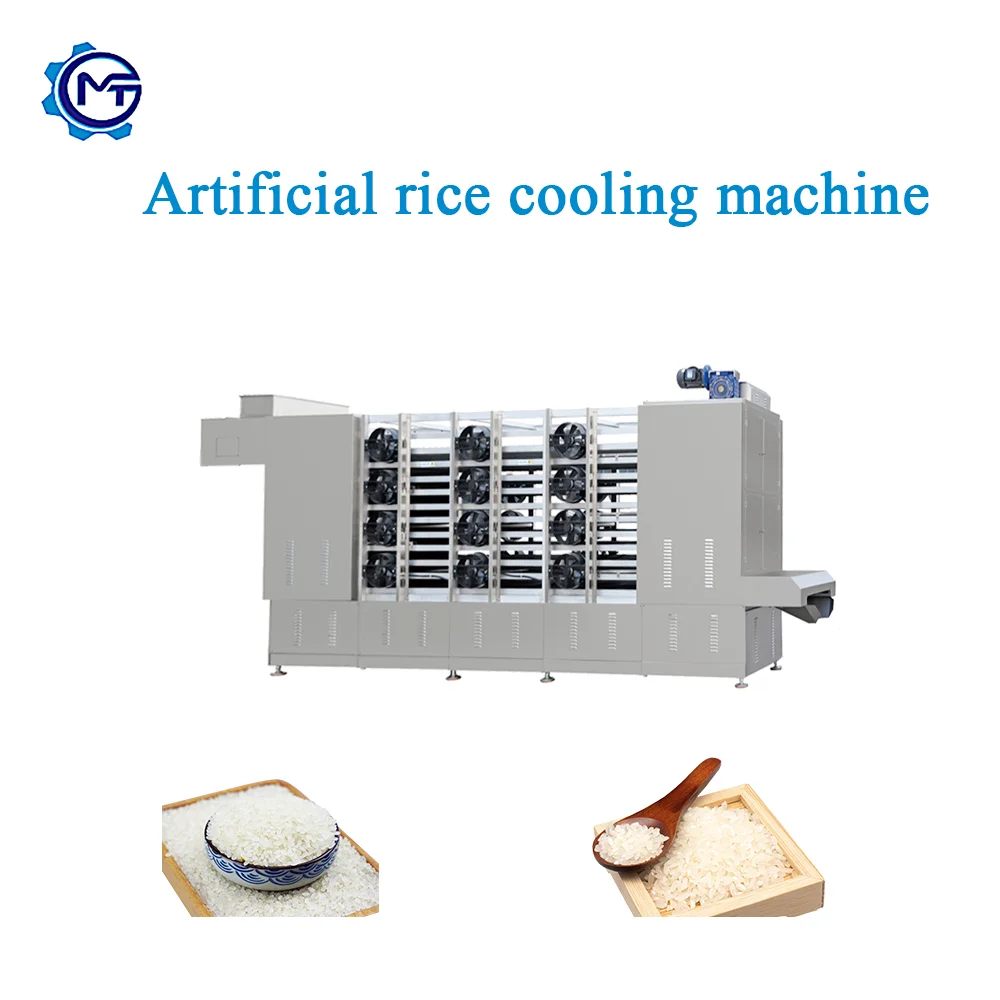
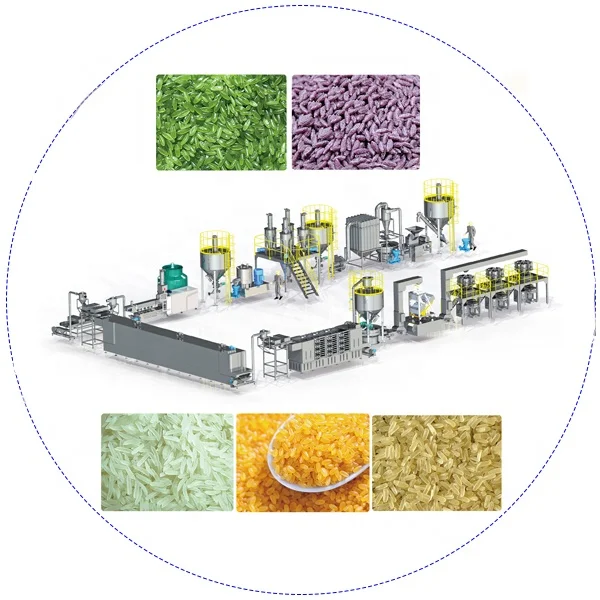
MT75 Fortified Rice Kernel Extrusion Production Line, Twin Screw, PLC Control, 300-500 kg/h — complete turnkey line from mixing through extrusion, multi-stage drying, roasting to packing.
- Throughput matched across every station — extruder output, drying capacity and cooling rate calculated together to eliminate bottlenecks
- Screw configuration and die design specified to your raw material blend and target kernel density
- Low-temperature drying followed by high-temperature roasting controls moisture gradient and kernel integrity
- Frequency-driven speed adjustment on extruder and dryer for stable production parameters
Trial runs on your formulation in our testing workshop before shipment, with full line layout, electrical schematic and commissioning support from one supplier.
Description
Throughput Matched Across Every Station — we calculate extruder output, dryer belt speed and cooler airflow together so a 300–500 kg/h target holds on your actual vitamin-mineral premix blend, not just on clean rice flour.
Technical Specifications
| Parameter | Value |
|---|---|
| Product Type | Fortified Rice Kernel Extrusion Production Line |
| Model | MT75 |
| Screw Type | Twin Screw |
| Installed Power | 180 kW |
| Power Consumption | 135 kW |
| Output Capacity | 300–500 kg/h (basis not stated in source — confirm raw material formulation and moisture content) |
| Overall Dimensions (L×W×H) | 32×3.5×4.3 m |
| Control System | PLC with frequency speed control |
| Feeding System | Single or twin-screw feeding (configured to material) |
| Drying Oven Heating Source | Electric or gas |
| Drying Oven Feature | Circulation drying with variable mesh-belt speed |
| Lubrication | Automatic lubricating system |
| Cooling | Integrated cooling system |
| Standards | CE |
Application Suitability
| Application | Material or Output |
|---|---|
| Fortified rice kernel production | Broken rice, rice bran, corn, millet, wheat, oats, buckwheat, bean, starch base with vitamin and mineral premix |
| Nutritional rice for food aid programmes | Grain blends with micro-nutrient solidification targeting institutional and retail specifications |
| Reconstituted rice processing | Starch and grain flour blends extruded into uniform kernel geometry with controlled density |
| Artificial rice kernel manufacturing | Multi-grain formulations requiring twin-screw shear and die shaping for consistent grain appearance |
What "500 kg/h on Paper" Leaves Out on a Fortified Rice Line
Capacity is only real when it holds on your exact formulation, moisture level and premix ratio — not on the supplier’s standard test flour.
I have stood in workshops where a line ran perfectly during factory acceptance on white rice flour, then choked on a coarse brown rice and millet blend the moment it landed on the buyer’s floor. The extruder barrel clogged, the die face smeared and the drying oven could not pull moisture out of the denser kernels fast enough. A fortified rice production line turnkey must be validated on the buyer’s actual raw material before it ships, not after it arrives and the contractor is already behind schedule. [NEED_CITE: raw material variability in grain extrusion processes]
How Screw Configuration Handles Premix Without Killing Kernel Texture
Adding a vitamin-mineral premix changes the rheology inside the barrel. The particulate size, fat content and fibre load of the fortification blend alter melt viscosity and shear response. On a fortified rice production line turnkey, the screw elements — kneading blocks, reverse-flight sections and conveying zones — are arranged so the premix disperses evenly without over-shearing the starch matrix. Over-shearing destroys the gel structure that gives the reconstituted kernel its bite. Under-dispersing leaves hot spots of concentrated minerals that discolour the kernel surface during the high-temperature roasting stage.
Why the Dryer and Cooler Cannot Be Sized as Afterthoughts
A common failure mode on grain extrusion lines is the extruder running at full output while the dryer belt backs up because moisture removal cannot keep pace. Fortified rice kernels carry more internal moisture after extrusion than plain puffed snacks, and the low-temperature drying stage must reduce that gradient slowly to prevent surface cracking. The subsequent high-temperature roasting stage then sets the final kernel density. If the cooler downstream lacks sufficient residence time, kernels stack in the packing hopper still warm, trapping residual moisture that triggers mould growth in the bag. Every station’s throughput is calculated against the same target so no single unit dictates the line’s real output. [NEED_CITE: multi-stage drying protocols in grain kernel extrusion]
Reading the Power and Screw Specs Against Your Formulation
The MT75 carries 180 kW installed power with 135 kW typical consumption, leaving thermal and mechanical headroom for high-fibre or high-fat blends that demand more torque. The twin-screw configuration provides positive conveying, meaning material advances regardless of its friction coefficient — critical when buckwheat or bean flour reduces the mix’s natural lubricity. The PLC with frequency speed control lets operators adjust screw speed and feeder rate independently, maintaining a consistent fill ratio inside the barrel as formulation ratios shift between production runs. The line stretches 32 metres in length, which reflects the number of processing stages rather than footprint waste: mixing, extrusion, vibrating separation, low-temperature drying, cooling, high-temperature roasting, a second cooling pass and packing.
When a Generic Die Setup Costs You a Week of Production
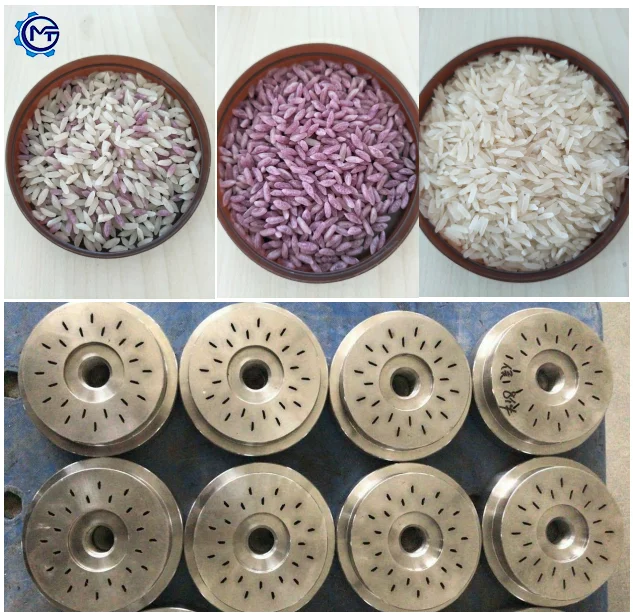
Copying a screw and die configuration from a standard white-rice build onto a coarse multi-grain formulation leads to die-face buildup within the first hour. Operators then spend shifts scraping the die, adjusting barrel temperatures zone by zone, and scrapping kilograms of off-spec kernels that fail the density test the buyer’s market demands. On one installation involving a brown rice and miscanthus blend, the standard die produced kernels that fractured during drying because the internal moisture channel was too narrow for the fibre load. Reconfiguring the die orifice geometry and adding a conditioning section upstream took several days on site that a pre-shipment trial run would have caught in the factory. [NEED_CITE: die design and raw material interaction in twin-screw extrusion]
Why Buyers Source the Full Line From One Supplier
Specifying extruder, dryer and cooler from separate vendors means each supplier guarantees only their own unit, leaving the integration gap — belt speeds, transfer chutes, airflow balance — as the buyer’s problem. Sourcing the complete line keeps the throughput calculation under one roof, so the vibrating separator is rated for the extruder’s actual output and the drying oven’s mesh-belt speed is matched to the kernel residence time the formulation demands. The in-house testing workshop runs the buyer’s raw material through the configured screw and die set before the line ships, producing a trial run report that documents real output, kernel density and moisture curve. Electrical schematics arrive with voltage and frequency locked to the destination site, avoiding the commissioning delays that occur when a 400 V motor meets a 440 V supply. Spare wear parts — screws, die plates, barrel liners — ship with the line so the first replacement cycle does not halt production while a purchase order clears procurement.
Documentation & Verification
- Line layout drawing with station-by-station capacity calculation for your formulation
- Trial run report on your supplied grain blend and premix ratio before dispatch
- Screw and die configuration record mapped to your target kernel density
- Electrical schematic with voltage, frequency and control language confirmed to site
- Factory test record documenting output, moisture curve and kernel integrity
- CE declaration of conformity covering the complete assembled line
Installation, Commissioning & Support
- Foundation plan accounts for the 32 m line length and vibrating station isolation
- Dedicated power circuit sized for 180 kW installed load with PLC panel clearance
- Modular station delivery allows phased rigging through standard workshop doors
- First-run commissioning includes screw speed and dryer belt calibration on your material
- Operator training covers PLC parameter adjustment and die changeover procedure
- Wear parts inventory covers initial screw, die plate and barrel liner replacement cycles
What We Need to Configure Your Line
To size the extruder, dryer and cooler correctly, share your base grain formulation, the premix type and inclusion rate, the target kernel dimensions and density specification. Confirm your site voltage, frequency and preferred control language. If you are integrating into an existing facility, provide the available floor length, ceiling height and any upstream milling or downstream packing equipment the line must connect to.
Frequently Asked Questions
Q: How is line capacity verified before the fortified rice production line turnkey ships?
A: We run your supplied raw material — including your exact premix blend and moisture level — through the configured screw and die set in our testing workshop. The trial run produces a documented report showing actual output rate, kernel density, moisture gradient through each drying stage and visual kernel quality. This report ships with the line so the buyer can verify installation performance against the pre-shipment benchmark.
Q: How do you match throughput between the extruder, dryer and cooler?
A: Each station is calculated against the same target output and the specific moisture removal profile your formulation requires. The dryer mesh-belt speed, circulation airflow and roasting zone temperature are set so the extruder’s output does not queue at the dryer infeed. The cooler’s residence time is then sized to bring kernels to packing temperature without bottlenecking the upstream stages.
Q: What does the turnkey scope cover for a greenfield factory project?
A: The scope includes line layout drawing, utility planning for power and ventilation, station-by-station installation sequence and a commissioning schedule. We send engineers on site for assembly supervision, first-run parameter tuning on your material and operator training covering PLC operation, screw changeover and routine maintenance intervals.
Q: Can the line be configured for a different voltage or control language?
A: Electrical schematics are prepared with your destination voltage, frequency and phase confirmed before production begins. The PLC interface language is set to your operator preference. Motor ratings, heater elements and control transformers are all specified to match the site supply, so commissioning does not stall on electrical mismatches.
Q: How is the screw and die set chosen for our specific grain blend?
A: Screw elements — conveying flights, kneading blocks, reverse sections — are arranged based on your formulation’s fibre content, fat level and premix particle size. Die orifice geometry is matched to the target kernel shape and density. The configuration is documented and tested on your material before shipment so adjustments happen in the workshop, not on your factory floor.
Related products
-
Máquina de hacer polvo de nutrición de cereal de arroz para bebés fortificado con hierro automático 500kg/h controlada por PLC
¥8,238.27 Add to cart -

Línea de producción de polvo de nutrición de cereales para bebés automática y compacta con capacidad de 500 kg/h y control PLC
¥9,500.00 Add to cart -
Máquina comercial de mezcla y molienda de polvo de arroz para bebés de acero inoxidable
¥8,238.27 Select options This product has multiple variants. The options may be chosen on the product page -

Línea de proceso de fabricación de extrusora de polvo de nutrición para bebés de 500 kg/h automática industrial
¥8,238.27 Add to cart