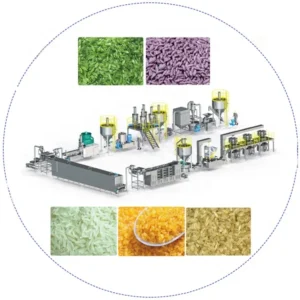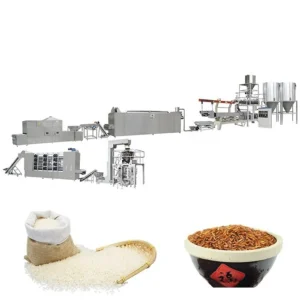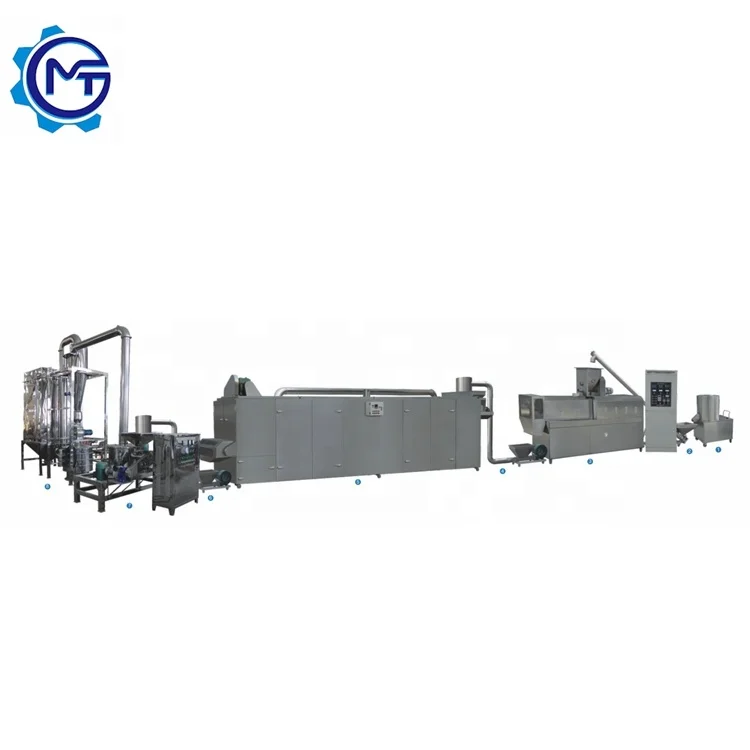


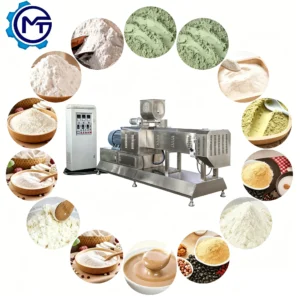
MT65 Nutritional Powder Processing Line, Twin-Screw, 66 kW Installed Power — engineered as a complete turnkey project from mixing through extrusion, drying, milling, and packing.
- Screw configuration and die design matched to your cereal blend and target powder fineness
- Stainless steel contact materials across all food-grade stations
- Voltage and frequency confirmed to destination country standard before production
Backed by in-house trial runs on your actual raw material formulation, line layout with throughput calculation at every station, and on-site commissioning support.
Description
Integrated Throughput Engineering — Every station on this nutritional powder processing line is capacity-matched from mixing through packing, so the extruder never waits on the dryer and the mill never starves the packer.
Technical Specifications
| Parameter | Value |
|---|---|
| Product Type | Nutritional Powder Processing Line |
| Model | MT65 (also available in MT70, MT85 configurations) |
| Installed Power | 66 kW |
| Real Power Consumption | 50 kW |
| Output Capacity | 100–150 kg/h (basis to be confirmed against buyer’s raw material formulation and moisture content) |
| Voltage & Frequency | 380V/50Hz 3-phase, 220V/50Hz single-phase; custom voltage configurable per destination country |
| Screw Type | Twin-screw |
| Overall Line Dimensions | 19,000 × 1,200 × 2,200 mm |
| Line Stations | Mixing system → Extrusion system → Drying system → Milling system → Packing system |
| Machine Materials | Stainless steel construction throughout food-contact zones |
| Assembly State | Complete integrated production line |
| Standards | CE certified, ISO certified |
Application Suitability
| Application | Material or Output |
|---|---|
| Infant baby food production | Cereal flours (corn, wheat, rice, oat) blended with milk powder and natural fruit or vanilla flavors |
| Fortified blended flour (FBF) | Corn and soy base blended with micronutrient premix for institutional feeding programmes |
| Corn soy blend (CSB) | Whole corn grits and defatted soy flour extruded and milled to specified particle size |
| Samaposha-type nutritional powders | Multi-grain blends with added vitamins, minerals, and protein isolates |
What "100 kg/h on Paper" Means When Your Formula Has Double the Viscosity
Capacity is meaningless unless it is measured on your exact raw material blend, at your target moisture content, running through every station on the line.
I spent years on the assembly floor fitting screws into barrels, and later moved into line design. The pattern I keep seeing: a buyer orders a nutritional powder processing line turnkey based on a brochure number, the machine arrives, and the actual formulation — heavy on soy isolate, maybe sticky with added fats — refuses to feed through the screw at the promised rate. The extruder runs, but it runs at half speed. Then the dryer sits idle waiting for material, and the mill cycles on and off. Two extra weeks of commissioning, sometimes more, just to get the die parameters and barrel temperature profile sorted. [NEED_CITE: common causes of extrusion line throughput shortfall on high-viscosity formulations] That is the gap this project scope is built to close.
Throughput Matching Across Every Station
A nutritional powder processing line turnkey project fails when stations are sized independently. The extruder may push 150 kg/h, but if the dryer only handles 100 kg/h of that moisture load, the line backs up. This configuration engineers the full sequence — mixing, extrusion, drying, milling, packing — as one continuous flow, with each station calculated against the same mass balance.
Trial Runs Before the Crate is Nailed Shut
The testing workshop runs your actual raw material formulation through the twin-screw extruder before shipment. The screw configuration, die selection, and barrel temperature zones are adjusted to your blend during this stage, not guessed at from a generic build sheet. You receive a documented trial run report showing what the line produced, at what rate, and with what powder fineness out of the mill. [NEED_CITE: importance of pre-shipment trial runs on customer-specific formulations in food extrusion]
Reading the Spec Sheet Like a Process Engineer
The MT65 carries 66 kW installed power but draws around 50 kW in real operation — the gap accounts for motor efficiency and the fact that not every heater zone runs at maximum simultaneously. For a plant budgeting electrical infrastructure, that 50 kW figure is the one that determines transformer sizing and cable runs. The twin-screw design matters here because nutritional powder blends often contain high-protein components like soy isolate that demand strong shear and mixing within the barrel; a single-screw would struggle to gelatinise starch uniformly in a blend with that much protein loading. The 19-metre line footprint tells you the bay length you need, but also that the drying section has enough residence length to pull moisture down to safe storage levels before milling — a shorter dryer would leave you with powder that clumps in the bag. Voltage confirmation happens before production starts, so a plant running 440V/60Hz does not receive a 380V/50Hz cabinet and face weeks of rewiring on the floor.
The Cost of Skipping the Configuration Conversation
When a line ships with a generic screw profile and the buyer’s formulation is outside the standard range, the consequences cascade. Material surges through the die unevenly, producing a fraction that is too coarse for the target mesh size after milling. The operator compensates by slowing feed rate, which drops output below what the business plan assumed. Wear on the screw flights accelerates because the material is riding the barrel instead of being conveyed forward. Replacement screw elements arrive late because no wear parts list was agreed at order stage. [NEED_CITE: premature screw wear caused by incorrect configuration for high-protein extrusion blends]
Why Source This Line From One Project Scope
The entire sequence from batching to packing sits under one supplier, so throughput calculations are not passed between vendors who each optimise their own station. Screw configuration and die design are specified to your raw material blend and target powder fineness, not copied from a catalogue default. The in-house testing workshop runs your formulation before the line is packed, so commissioning on your floor is verification, not development. Twin-screw expertise spans the full range of nutritional powder ingredients — cereal bases, soy isolates, milk powders, micronutrient premixes. Pre-sales engineering through on-site installation and ongoing maintenance support are handled by the same team that configured the line.
Documentation & Verification
- Line layout drawing showing throughput match across mixing, extrusion, drying, milling, and packing stations
- Trial run report on your specific raw material blend conducted before shipment
- Electrical schematic with voltage, frequency, and control language confirmed to your site
- Screw and die configuration record linked to your target powder specification
- CE declaration of conformity and ISO certificate included in shipment documentation
- Operation and maintenance manual with wear parts list and replacement intervals
Installation, Commissioning & Support
- 19-metre line footprint requires a clear bay with adequate overhead clearance for the 2.2-metre frame height
- 380V 3-phase supply with dedicated circuit rated for 66 kW installed draw at the main panel
- Line ships in station modules; on-site assembly aligns extruder, dryer, and mill on a level pad
- First-run commissioning verifies barrel temperature profile and die pressure against trial run baseline
- Operator training covers screw speed adjustment, moisture control, and milling screen changes
- Wear parts list specifies screw elements, die plates, and milling screens with reorder part numbers
Preparing Your Inquiry
To scope a nutritional powder processing line turnkey project accurately, we need your raw material formulation including protein and fat percentages, target powder mesh size, and daily production volume. Confirm your facility voltage and frequency, the control language your operators require, and whether you can ship a sample batch of your blend for trial runs in the testing workshop.
Frequently Asked Questions
Q: How is line capacity verified on my specific raw material blend?
A: Your formulation is run through the twin-screw extruder in the testing workshop before shipment. A documented trial run report records output rate, moisture content after drying, and powder fineness after milling. The capacity figure quoted in your contract is tied to that test, not to a generic brochure rating.
Q: How do you prevent bottlenecks between extrusion, drying, and milling?
A: Each station is sized against the same mass balance from the project design stage. The dryer is rated for the moisture load the extruder delivers, and the mill is rated for the dried throughput. The line layout document shows this station-by-station match before you approve the order.
Q: What does the installation and commissioning schedule look like?
A: The line arrives in station modules that are assembled and aligned on your floor. Commissioning verifies temperature profiles, screw speed, and die parameters against the pre-shipment trial run. Operator training runs concurrently so your team can operate independently within the first production week.
Q: How are voltage, frequency, and control language confirmed?
A: Your site electrical specifications are collected during the inquiry stage and written into the machine specification sheet. The electrical schematic and cabinet are built to those values. Control panel labels and HMI language are set to your operator requirements before the cabinet is wired.
Q: What spare wear parts are included with the line?
A: The initial shipment includes a wear parts list specifying screw elements, die plates, and milling screens matched to your configuration. Reorder part numbers are documented so replacements can be sourced without re-engineering the setup when your first change-out is due.
Related products
-

Línea de Producción Automática Instantánea de Polvo Máquina Extrusora de Polvo Nutricional
¥10,000.00 Select options This product has multiple variants. The options may be chosen on the product page -

Línea de procesamiento de extrusión de arroz en polvo nutricional para bebés de alta precisión 500kg/h
¥9,500.00 Add to cart -
Línea de producción de alimentos para bebés en polvo de nutrición fortificada totalmente automática
¥8,238.27 Select options This product has multiple variants. The options may be chosen on the product page -

Nueva máquina automática para la producción de polvo nutricional para la línea de producción de alimentos para bebés.
¥20.00 Select options This product has multiple variants. The options may be chosen on the product page