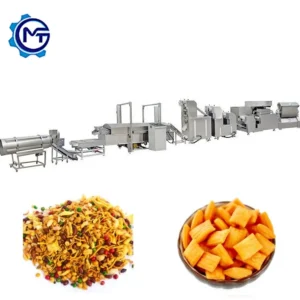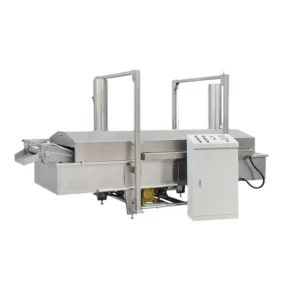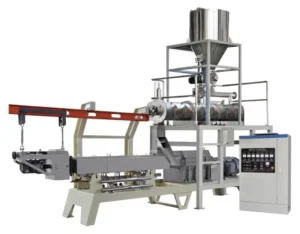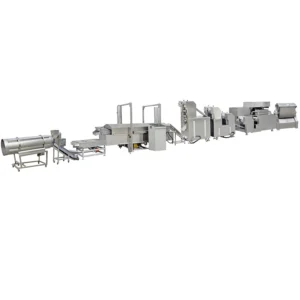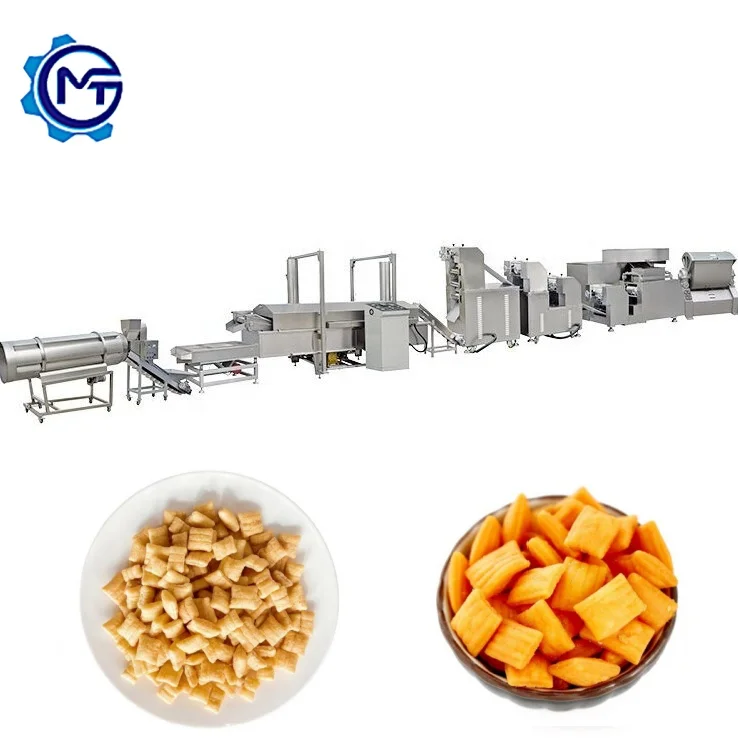


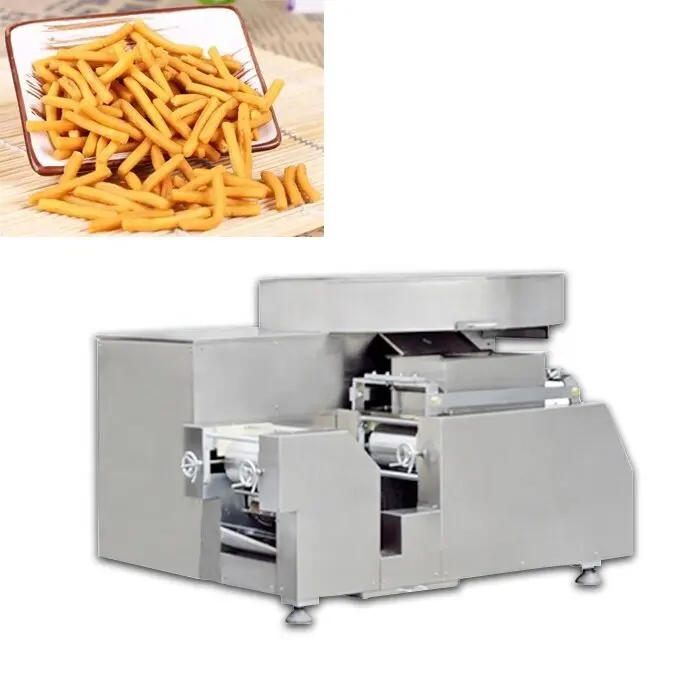
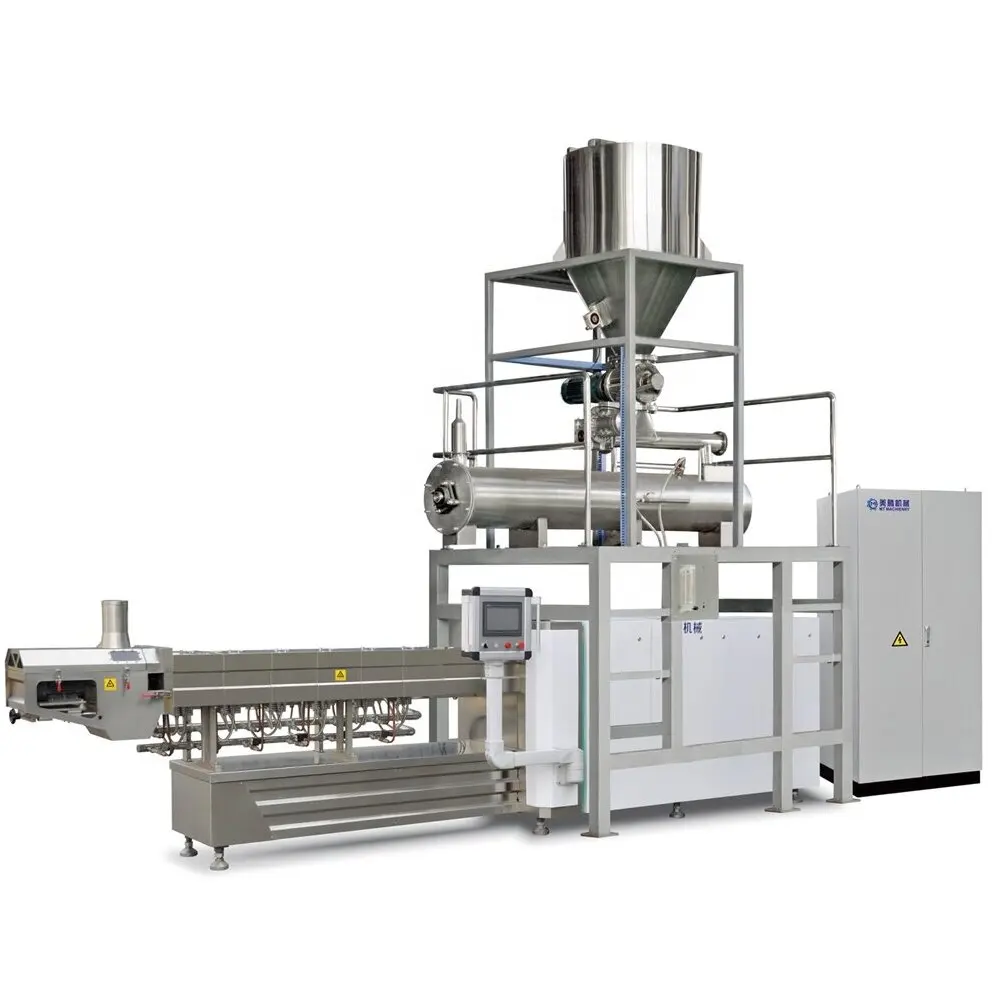

Continuous Deep Frying Machine for Snack Production Line, 380V, PLC Control, Food-Grade 304 Stainless Steel — engineered as part of a complete turnkey project where fryer throughput is matched to upstream extrusion and downstream de-oiling, seasoning, and packing stations. Double-layer mesh belt clamps product during frying for uniform heat transfer, while continuous oil circulation filtration maintains quality across long runs. Frequency-controlled conveyor speed adjusts frying time per recipe without mechanical changes.
- Line layout and capacity calculation confirm station-to-station throughput matching before build
- In-house trial run on your raw material validates product texture, density, and oil temperature profile before shipment
- On-site installation, commissioning, and operator training delivered under single-supplier responsibility
Description
Throughput matching across every station — the fryer is sized to your extruder and downstream de-oiling capacity before build, not quoted as a standalone spec sheet item.
Technical Specifications
| Parameter | Value |
|---|---|
| Product Type | Continuous Deep Frying Machine for Snack Production Line |
| Rated Power | 2.6 kW (drive/control) + 60 kW heating tube power |
| Voltage & Frequency | 380V / 50Hz |
| Control System | PLC |
| Overall Dimensions (L×W×H) | 6700 × 2200 × 1200 mm |
| Net Weight | 2000 kg |
| Output Capacity | 100–1000 kg/h (basis not stated in source — confirm product type / moisture / frying time) |
| Oil Tank Capacity | 320 L |
| Heating Method | Electric heating or gas heating (options) |
| Conveyor Type | Double-layer mesh belt with frequency conversion stepless speed regulation |
| Oil Filtration | Continuous circulation filtration system |
| Slag Discharge | Bottom-mounted residue discharge system |
| Lifting System | Automatic lifting of upper hood and mesh belt for cleaning |
| Material | Food-grade 304 stainless steel |
| Assembly State | Fully assembled, skid-mounted |
| Warranty | 1 year (core components included) |
Application Suitability
| Application | Material or Output |
|---|---|
| Fried extruded snack pellets | Potato starch, corn starch, wheat flour-based pellets |
| Bugles and triangular snacks | Corn grits and grain blend extrudates |
| Dough-based fried snacks | Wheat flour, rice flour, and tapioca starch dough sheets |
| Puffed or formed snack products | Pre-dried extrudates requiring deep frying for final expansion and texture |
Why a Fryer Quoted in Isolation Wrecks the Line Rhythm
A fryer that cannot absorb the extruder’s actual output turns every downstream station into a bottleneck.
I have stood on factory floors where the extruder pushed product onto the conveyor faster than the standalone fryer could take it. The backlog sat on cooling belts, moisture re-condensed on the surface, and what should have been a crisp pellet ended up as a dense, oil-logged reject. The problem was never the fryer alone — it was the absence of a single supplier responsible for matching throughput across the fried snack production line turnkey from batching to packing. When each machine is quoted by a different vendor, nobody owns the gap between them [NEED_CITE: throughput mismatch consequences in multi-vendor food lines].
Sizing the Fryer to the Real Extruder Output, Not the Brochure Figure
Extruder nameplate capacity is often based on an ideal material at optimal moisture. The fried snack production line turnkey approach starts by running your actual raw material in the testing workshop, measuring real throughput, and then specifying the fryer belt width and residence time to match that verified output — not a generic number.
Oil Degradation as a Throughput Problem
When product flow into the fryer is inconsistent, oil temperature swings follow. Each cold surge drops the bath temperature, extends frying time, and accelerates free fatty acid build-up. A fryer matched to a steady upstream feed holds a tighter thermal window, keeping oil quality stable over long production runs and reducing the frequency of full oil changeovers [NEED_CITE: oil degradation rate versus thermal cycling in continuous frying].
Reading the Specs That Actually Matter on a Snack Line
The 60 kW heating tube array must recover heat fast enough to handle the coldest product surge the extruder can deliver — if the extruder is rated higher than the fryer’s thermal recovery capacity, oil temperature will dip below setpoint during continuous operation. The 320 L oil tank volume determines how much thermal mass is available to buffer those surges; a smaller tank would mean sharper temperature drops with each batch of cold pellets entering the bath. The double-layer mesh belt is not just a conveying feature — it physically clamps lightweight pellets below the oil surface, preventing them from floating and receiving uneven heat on the exposed top face. Frequency-controlled belt speed lets the operator dial in frying time per recipe without swapping sprockets or changing mechanical linkages, which matters when a single line runs both thin-walled bugles and denser dough snacks that need longer immersion.
What Happens When the De-Oiling Drum Cannot Keep Up
A fryer that discharges faster than the downstream de-oiling drum can process will leave product sitting in a holding hopper, still hot and still absorbing surface oil. The result is a greasy finish, inconsistent seasoning adhesion, and a final fat content that overshoots the label claim. This mismatch is invisible until the line is running at full speed [NEED_CITE: post-fry oil absorption during product hold-up before de-oiling].
Why Procure the Whole Line from One Supplier
The fryer, extruder, dryer, de-oiling drum, seasoning station, and packing conveyor are specified together so that belt speeds, transfer heights, and buffer capacities align before steel is cut. The in-house testing workshop runs your raw material through the extruder and into the fryer before shipment, generating a trial run report that documents actual throughput and oil temperature profiles. Screw and die configuration records are linked to the fryer residence time so that product density and frying behaviour are engineered as one system. Electrical schematics confirm voltage, frequency, and PLC language against your facility supply before production begins, eliminating the commissioning delays that come from discovering a 400V machine shipped to a 415V plant. CE documentation is prepared for the complete line, not individual machines assembled on-site from different origins.
Documentation & Verification
- Line layout showing fryer position, throughput calculation, and transfer heights to upstream and downstream stations
- Trial run report on your raw material documenting actual extruder output and matched fryer residence time
- Electrical schematic with confirmed voltage, frequency, and PLC interface language for your facility
- Screw and die configuration record linked to target product density and frying behaviour
- Machinery test report and video outgoing inspection of the assembled fryer before crating
Installation, Commissioning & Support
- Skid-mounted 6700 mm frame requires a level concrete floor with clearance for the automatic hood lifting system
- Dedicated 380V / 50Hz circuit sized for the combined 62.6 kW drive and heating load
- Fully assembled delivery — no field welding; connect oil lines, power, and exhaust ducting on arrival
- PLC parameter setup including belt speed, oil temperature setpoint, and filtration cycle timing during first run
- Operator training covering mesh belt tensioning, residue discharge procedure, and oil change intervals
- Wear parts list covering mesh belt sections, heating tubes, and filtration elements for first-year stock
What We Need to Size Your Line Correctly
Share the raw material composition, target snack format, and daily output requirement so the extruder and fryer can be matched to a single verified throughput figure. Provide your facility voltage, frequency, and preferred PLC language to lock in the electrical specification before production. Let us know your available floor space and ceiling height so the line layout accounts for the 6700 mm fryer footprint, exhaust routing, and transfer conveyors to the de-oiling and seasoning stations.
Frequently Asked Questions
Q: How is fryer capacity verified against the extruder output and what product assumptions are used?
A: We run your actual raw material through the extruder in the testing workshop and measure real output. The fryer belt speed, oil temperature, and residence time are then set to absorb that verified throughput for your specific snack format, moisture level, and target final fat content — not a generic nameplate figure.
Q: What voltage, frequency and control language options are confirmed before build?
A: Your facility electrical supply is confirmed during the specification stage. The standard configuration is 380V / 50Hz, and the PLC interface language is set to your operator team’s preference. Electrical schematics reflecting these choices are issued for approval before production starts.
Q: How is the fryer integrated with upstream extrusion and downstream de-oiling, seasoning and packing stations?
A: Transfer heights, belt speeds, and buffer capacities are calculated across every station in the line layout. The fryer discharge aligns directly with the de-oiling drum infeed, and seasoning drum timing is set to match the fryer’s verified output rate, eliminating product hold-up between stages.
Q: Is a trial run on our raw material possible before shipment, and what does the report cover?
A: Yes. The trial run is conducted in the in-house testing workshop using your supplied raw material. The report documents extruder throughput, screw and die settings, fryer oil temperature profile, belt speed, frying time, and final product characteristics including expansion, colour, and fat content.
Q: What is the phased installation and commissioning schedule for the complete fried snack line?
A: The line arrives in skid-mounted modules. Installation covers positioning, utility connections, and transfer conveyor alignment. Commissioning proceeds station by station — extruder first, then dryer, fryer, de-oiling, and seasoning — with operator training running in parallel across the full production sequence.
Related products
-
Línea de producción de chips de Bugles fritos Extrusora de alimentos para bocadillos de tortilla Doritos fritos
¥100.00 Select options This product has multiple variants. The options may be chosen on the product page -
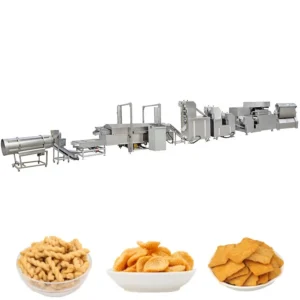
Línea de producción de máquina de alimentos para fritura de bocadillos de chips fritos de pellets de Bugles de maíz 3D crujientes, extrusora para hacer Bugles
¥100.00 Select options This product has multiple variants. The options may be chosen on the product page -
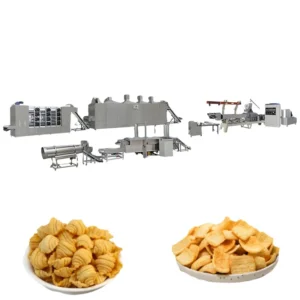
Nueva Línea de Producción de Alimentos para Freír Automática, Portátil y de Alta Productividad para Palitos de Ensalada, Chips y Snacks
¥100.00 Select options This product has multiple variants. The options may be chosen on the product page -

Electric Heating Fried Puffed Food Production Line – Salad Sticks Making Equipment
¥65.00 Select options This product has multiple variants. The options may be chosen on the product page