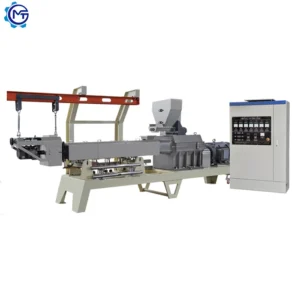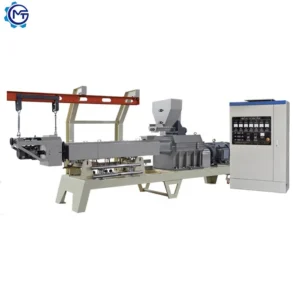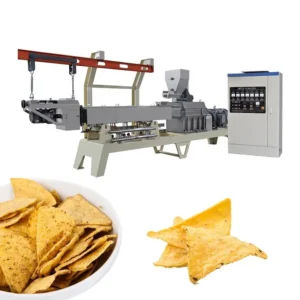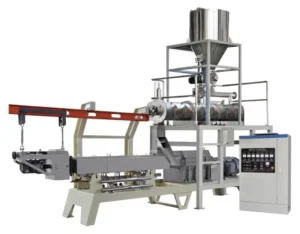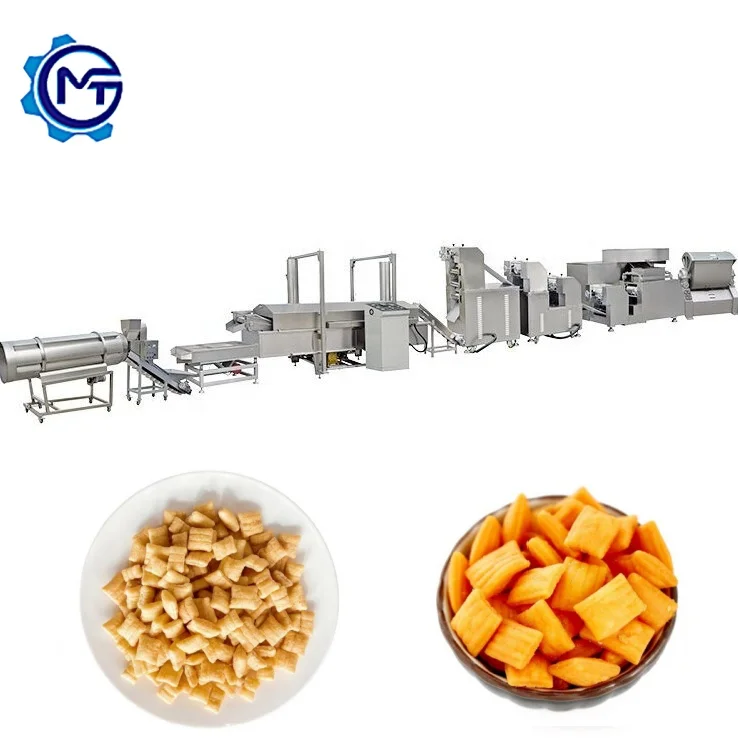


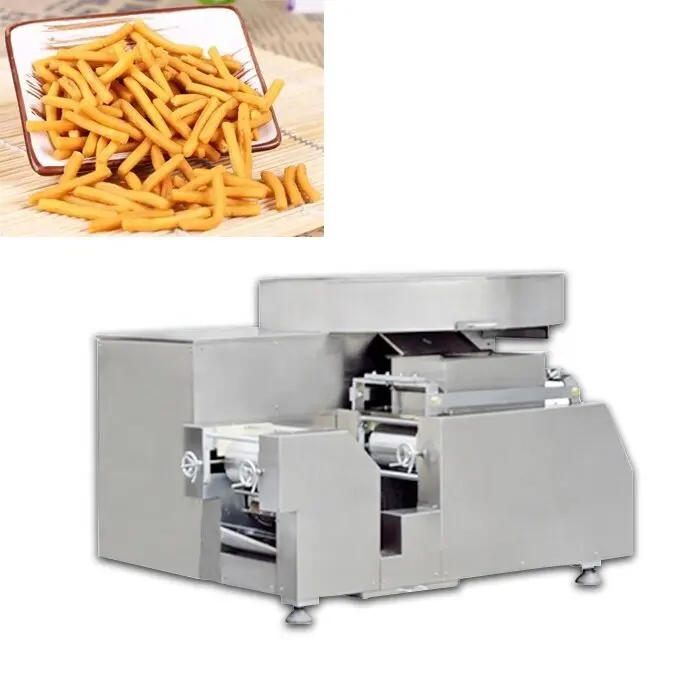
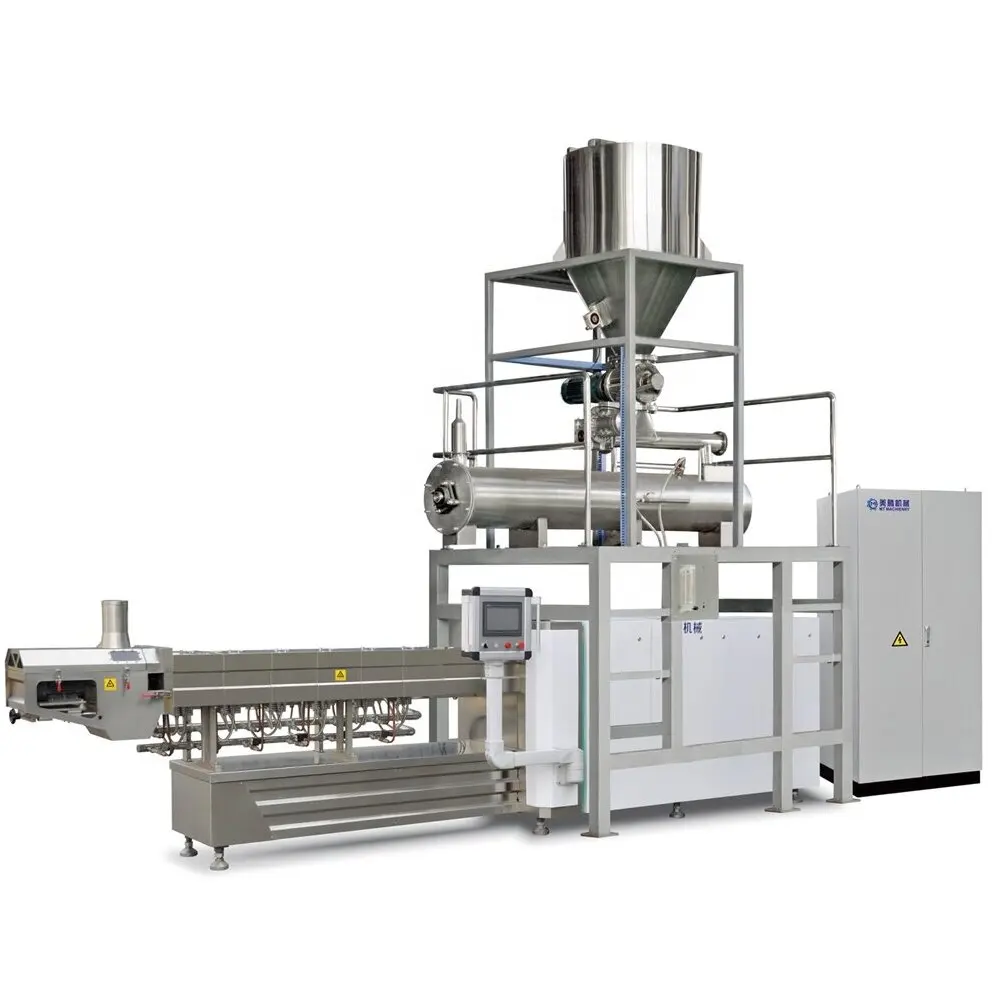

Continuous Deep Frying Machine for Snack Food Production Line, 380V/50Hz, PLC Control, 60 kW Heating — designed for fried extruded snacks such as bugles, corn chips, and fried dough products.
- Double-layer mesh belt with stepless frequency-controlled speed for precise frying time and consistent texture
- Automatic oil circulation filtration extends oil service life during continuous operation
- Food-grade 304 stainless steel with automatic hood lifting for rapid cleaning between changeovers
Delivered as one throughput-matched turnkey project from extrusion through frying to packing, with in-house trial runs on your raw material before shipment.
Description
Integrated line throughput matching — every station from extrusion through frying to packing is calculated against your actual recipe moisture and target expansion, so no single unit bottlenecks the fried snack food production line turnkey.
Technical Specifications
| Parameter | Value |
|---|---|
| Product Type | Continuous Deep Frying Machine for Snack Food Production Line |
| Rated Power | 2.6 kW (conveyor and control) + 60 kW heating tube |
| Voltage & Frequency | 380V / 50Hz |
| Control System | PLC |
| Overall Dimensions (L×W×H) | 6700 × 2200 × 1200 mm |
| Net Weight | 2000 kg |
| Oil Capacity | 320 L |
| Output Capacity | 100–1000 kg/h (basis to be confirmed) |
| Heating Method | Electric heating / Gas heating (dual option) |
| Conveyor Type | Double-layer mesh belt with frequency conversion stepless speed regulation |
| Material | Food-grade 304 stainless steel |
| Oil Filtration | Automatic continuous oil circulation filtration system |
| Lifting System | Automatic lifting of upper hood and mesh belt |
| Slag Discharge | Bottom slag discharge system |
| Standards | CE, ISO |
Application Suitability
| Application | Material or Output |
|---|---|
| Bugles production | Extruded corn dough pieces fried to hollow, crisp texture |
| Fried corn chips | Sheeted or extruded corn masa cut into triangles or strips before frying |
| Fried dough snacks | Wheat or multi-grain dough extrudates requiring uniform oil content and colour |
| Pellet-based fried snacks | 2D/3D pellet chips expanded through hot oil immersion |
What "100 to 1000 kg/h" Actually Means for a Fried Snack Food Production Line Turnkey
Capacity is only real when tested on your flour blend, moisture content, and target frying time — not copied from a catalogue.
I once set up a Bugles line for a Middle Eastern client where the extruder output and fryer belt speed were sized from different spec sheets. The dough pieces sat on the transfer conveyor too long, skinned over, and fried into dense, under-expanded shells. The whole line was down for a week while we reconfigured the screw profile and adjusted the fryer temperature zones. Since then, every fried snack food production line turnkey I work on goes through a trial run with the client’s actual raw material before anything ships [NEED_CITE: trial production verification before industrial line shipment].
Matching Extrusion Output to Fryer Residence Time
The fryer in this line runs a double-layer mesh belt with stepless frequency-controlled speed. That adjustability matters because the frying window for extruded dough snacks is narrow — a few seconds too short and the core stays gummy, a few seconds too long and the surface blisters. The belt speed must be calibrated against whatever the extruder is delivering per minute, and both machines need to ramp up or slow down together when recipe changes happen.
Oil Quality Across Long Production Runs
The automatic oil circulation filtration system continuously pulls residue from the bath during operation. For snacks like Bugles that shed fine particles during frying, this keeps the oil from breaking down prematurely and prevents dark specks on the product surface. Without continuous filtration, oil replacement frequency rises noticeably over a multi-day production campaign, and the flavour profile drifts [NEED_CITE: oil degradation effects on fried snack quality].
Why Heating Method and Temperature Profile Matter
The fryer supports both electric heating and gas heating, selectable before production begins. Electric tubes deliver 60 kW of thermal input across the oil bath. The choice between the two often comes down to local energy cost and available utility infrastructure. Gas heating tends to recover temperature faster after a cold product load enters the bath, while electric heating offers finer zone control when the PLC manages multiple set points.
Control System and Recipe Repeatability
The PLC manages conveyor speed, oil temperature, and filtration cycle timing from one interface. When you switch from a corn-based Bugles recipe to a wheat-based fried dough snack, the operator selects the stored recipe and the system recalls belt speed, temperature set point, and filtration interval. This removes most of the guesswork that causes batch-to-batch variation in colour and oil absorption.
What Happens When Stations Are Not Throughput-Matched
A fryer rated for a generous hourly output is worthless if the extruder upstream cannot feed it consistently. I have seen lines where the fryer ran at partial load because the former station delivered less than expected, and the oil overheated in the empty sections, accelerating degradation. The opposite problem — extruder output exceeding fryer capacity — causes dough pieces to pile up on the transfer conveyor, lose moisture unevenly, and fry into hard, dense shells [NEED_CITE: throughput mismatch consequences in snack processing lines].
Why Source the Complete Line from One Supplier
The entire fried snack food production line turnkey is configured under a single supplier, so the mixing system, extruder, fryer, de-oiling station, flavouring drum, cooler, and packing end are all sized to the same verified throughput. Screw and die configuration is specified against the buyer’s raw material and target snack geometry. An in-house testing workshop runs your actual formulation before shipment, producing a trial run report that documents real output, product density, and texture. Electrical schematics confirm voltage, frequency, and PLC language before production starts, avoiding commissioning delays on site. Pre-sales consultation covers line layout, utility planning, and phased installation scheduling.
Documentation & Verification
- Line layout drawing with throughput calculation across mixing, extrusion, frying, and packing stations
- Trial run report produced on your specific flour blend and recipe before shipment
- Electrical schematic confirming voltage, frequency, and PLC language for your market
- Screw and die configuration record matched to your target snack geometry
- Machinery test report and video outgoing inspection provided before dispatch
- Operation and maintenance manual with wear parts list included
Installation, Commissioning & Support
- Foundation and floor space planning based on the 6700 × 2200 mm fryer footprint plus upstream and downstream stations
- Dedicated electrical circuit sized for the combined 62.6 kW load at 380V / 50Hz
- Fully assembled fryer delivery with on-site positioning and utility connection supervision
- First-run parameter setting covering belt speed, oil temperature zones, and filtration cycle timing
- Operator training on PLC recipe selection, daily cleaning via the automatic lifting system, and bottom slag discharge
- Wear parts list covering mesh belt sections, heating elements, and seals with sourcing guidance
Requesting a Line Configuration
Send your target snack format, the flour or grain blend you plan to run, and your expected daily output so we can calculate station-by-station throughput. Include your workshop dimensions, local voltage and frequency, and preferred PLC language. If you have an existing extruder or packing machine that needs to integrate, share the make and model so the line layout accounts for it.
Frequently Asked Questions
Q: How is the line capacity verified on my specific raw material and snack format before shipment?
A: We run a trial production using your actual flour blend, moisture level, and target snack shape in our testing workshop. The trial run report documents real output, product density, colour, and texture, so capacity is confirmed on your recipe rather than estimated from generic parameters.
Q: What voltage, frequency, and PLC language options are available for my target market?
A: The standard configuration is 380V / 50Hz, but voltage and frequency are confirmed against your local supply before production begins. PLC interface language is set to match your operator team. Electrical schematics reflecting these choices are provided for approval before the line enters assembly.
Q: How do you ensure throughput is matched between the extruder, fryer, and downstream stations?
A: Each station is sized during the layout phase using your target output and product residence time requirements. The extruder screw speed, fryer belt speed, and de-oiling conveyor rate are all calculated together, then validated during the pre-shipment trial run on your raw material.
Q: What does on-site installation, commissioning, and operator training include?
A: An engineer supervises equipment positioning, utility connections, and first-run parameter setting on your site. Training covers PLC recipe management, daily cleaning using the fryer’s automatic lifting system, oil filtration maintenance, and bottom slag discharge procedures for your production team.
Q: What spare wear parts are supplied with the first shipment, and how are replacements sourced?
A: The initial shipment includes a wear parts list covering mesh belt sections, heating elements, and seals. Replacement parts are available directly from the factory, and the configuration record ensures exact matches for screws, dies, and fryer components throughout the line’s service life.
Related products
-
High-Yield Automated Fried Snack Production Line – Double Screw Salad Strips & Millet Crust Making Equipment
¥65.00 Select options This product has multiple variants. The options may be chosen on the product page -
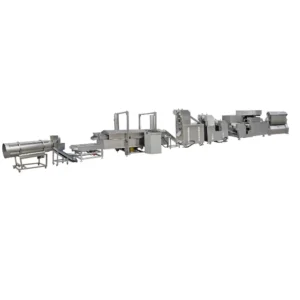
Línea de producción de máquina de alimentos para fritura de bocadillos de chips fritos de pellets de Bugles de maíz 3D crujientes, extrusora para hacer Bugles
¥100.00 Select options This product has multiple variants. The options may be chosen on the product page -
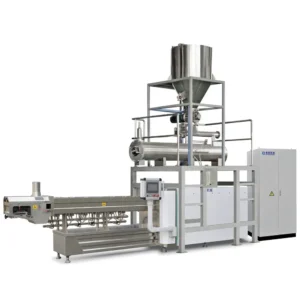
New Automatic 150-200kg/h Nimko Fried Pasta Snacks & Kurkure Making Machine Food Grade Stainless Steel High Productivity
¥8,585.00 Select options This product has multiple variants. The options may be chosen on the product page -
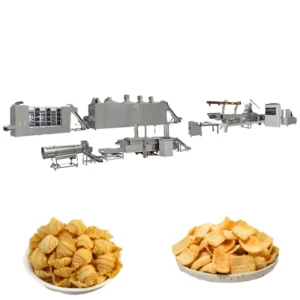
Línea de procesamiento de alimentos para bocadillos inflados de venta caliente Línea de procesamiento de bocadillos fritos Máquina para bocadillos de maíz inflados
¥100.00 Select options This product has multiple variants. The options may be chosen on the product page