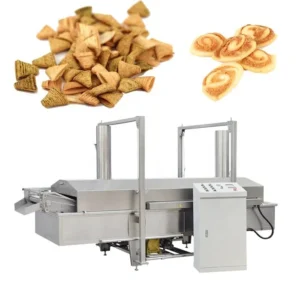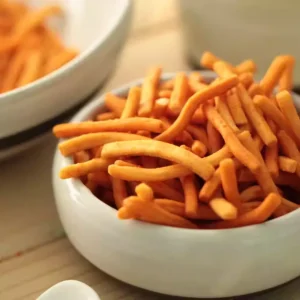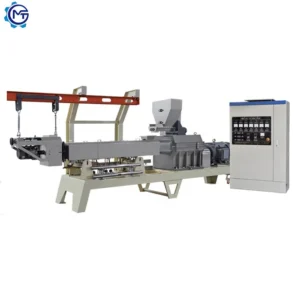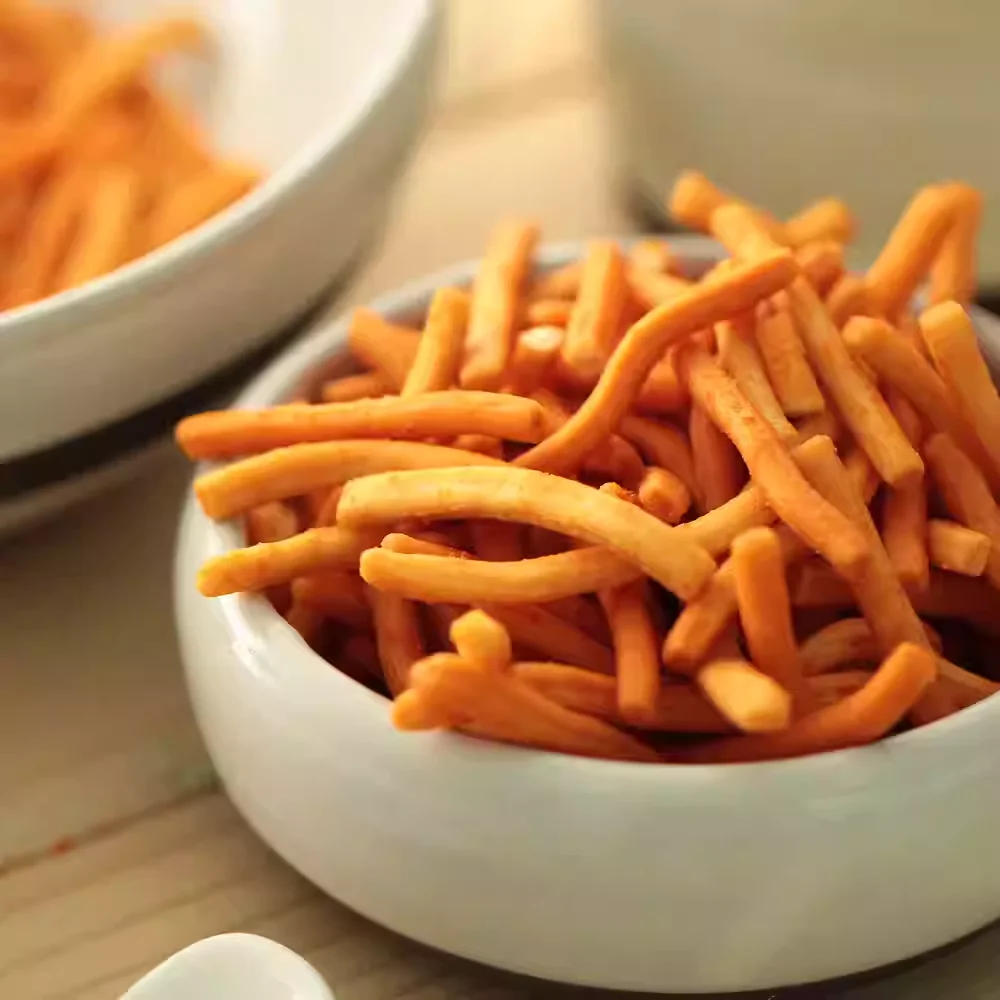


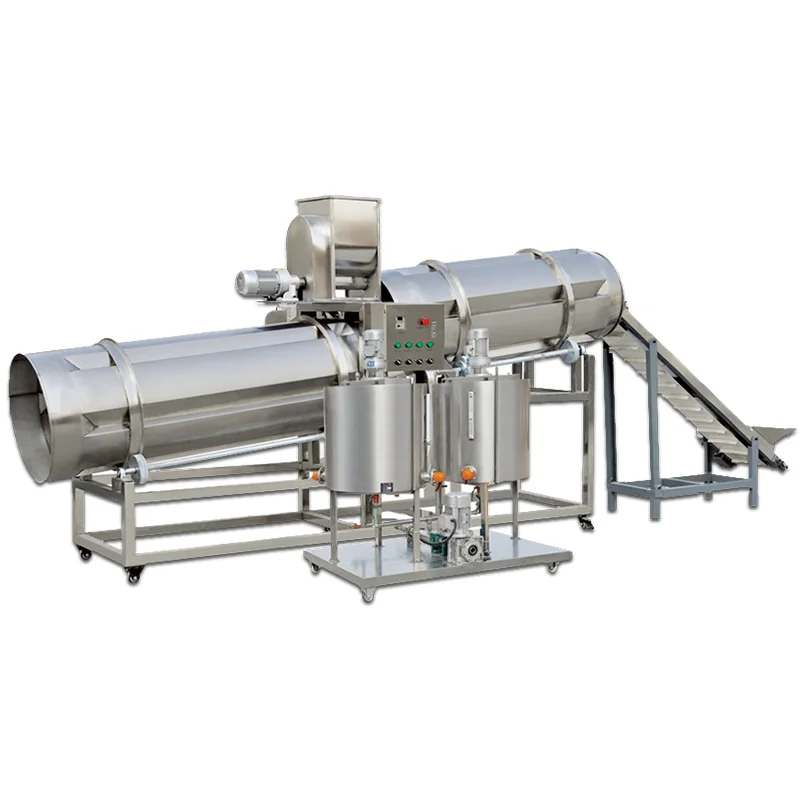
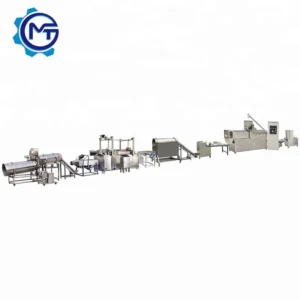
Continuous Deep Fryer for Snack Food Extrusion Line, 60 kW Heating, 380V/50Hz, PLC Control — engineered as a throughput-matched station within a complete extrusion-to-packing snack line.
- Double-layer mesh belt with frequency-controlled stepless speed regulation ensures uniform frying contact time
- Continuous oil circulation filtration extends usable oil service life while reducing acid value buildup
- Automatic hood and belt lifting system enables full-access cleaning without disassembly
- Food-grade 304 stainless steel construction with MCC-integrated PLC for synchronized upstream and downstream operation
In-house testing workshop validates frying parameters on your raw material before shipment, with line layout and capacity calculation confirming every station is matched to your extruder output.
Description
Turnkey Line Integration — Every station in this snack line is throughput-matched from extrusion through frying to packing, so no single unit becomes the bottleneck that stalls your daily output.
Technical Specifications
| Parameter | Value |
|---|---|
| Product Type | Continuous Deep Fryer for Snack Food Extrusion Line |
| Heating Tube Power | 60 kW |
| Rated Power | 2.6 kW (drive and control systems) |
| Voltage & Frequency | 380V / 50Hz (configurable to site utility) |
| Control System | PLC with MCC integration |
| Overall Dimensions (L×W×H) | 6700 × 2200 × 1200 mm |
| Net Weight | 2000 kg |
| Oil Tank Capacity | 320 L |
| Mesh Belt System | Upper and lower double-layer belt with frequency conversion stepless speed regulation |
| Heating Method | Electric heating or gas heating (selectable) |
| Construction Material | Food-grade 304 stainless steel |
| Oil Filtration | Continuous circulation filtration system |
| Slag Discharge | Bottom slag discharge |
| Hood & Belt Lifting | Automatic lifting system for upper hood and mesh belt |
| Assembly State | Fully assembled prior to shipment |
| Capacity Range | 100–1000 kg/h (basis not stated in source — confirm product type, moisture, frying temperature and belt speed) |
| Warranty | 1 year on machine and core components |
| Machinery Test Report | Provided before shipment |
| Video Outgoing Inspection | Provided |
Application Suitability
| Application | Material or Output |
|---|---|
| Corn chip production | Extruded corn masa pellets fried to a rigid, crunchy chip format |
| Pellet snack frying | 2D and 3D extruded snack pellets from potato starch or wheat flour bases |
| Core-filled snack finishing | Extruded pillows with cream or jam filling, surface-dried before frying |
| Tortilla chip lines | Sheeted corn dough cut into triangles and fried to specification |
| Protein-based snack crisps | Texturized vegetable protein or legume flour extrudates requiring oil finishing |
Why the Dryer and Fryer Must Be Sized Together
A continuous frying machine turnkey snack production line only holds its rated output when every station upstream and downstream is calculated against the same material flow.
I worked on a project a couple of years back where a buyer sourced an extruder and fryer from different suppliers. The extruder delivered to spec, but the fryer belt was too short to give the product enough residence time in the oil at the throughput the extruder was pushing. The result was under-fried chips reaching the seasoning drum — soft, oily, and unsaleable. The buyer spent weeks adjusting belt speeds and oil temperatures, but the physics would not change: the fryer was simply too small for the line. [NEED_CITE: throughput matching between extrusion and frying stations in snack food lines]
When you specify a continuous frying machine turnkey snack production line, the fryer’s belt length, oil volume, and heating capacity must all be calculated against the extruder’s actual output on your specific raw material — not the extruder’s nominal catalog rating.
How Residence Time Defines Your Chip Texture
The double-layer mesh belt on this fryer does more than move product through oil — it controls how long each piece stays submerged. For corn chips, that contact time directly determines moisture loss, oil uptake, and final crunch. The frequency-controlled stepless speed regulation lets the operator dial in belt speed in fine increments, which is necessary because even a small shift in raw material moisture changes the ideal frying duration. Without that adjustability, you are stuck choosing between over-fried chips that taste burnt and under-fried chips that go stale within days.
Oil Management as a Line Economics Problem
The 320 L oil tank with continuous circulation filtration keeps the acid value and color buildup in check across long production runs. In batch frying without filtration, operators drain and replace oil frequently, which interrupts the line and adds material cost. Here, the filtration loop runs in parallel with production, pulling sediment and fine particulates out of the oil continuously. The bottom slag discharge works alongside this system, collecting heavier debris before it carbonizes on the heating tubes. For a continuous frying machine turnkey snack production line, oil life directly affects both operating cost and product color consistency across shifts. [NEED_CITE: oil degradation rates in continuous versus batch snack frying operations]
Reading the Specs That Actually Matter
The 60 kW heating tube array is the figure that determines how fast the oil recovers temperature after cold product enters the fryer. A high extruder output means a high mass flow of relatively cool product hitting the oil — if the heating power is undersized, oil temperature drops and frying becomes uneven. The separate 2.6 kW rated power covers the drive motors for the belt, hood lift, and filtration pump. The 6700 mm overall length is not just a footprint number; it reflects the belt travel distance available for frying, which directly correlates to the maximum residence time achievable at any given belt speed. Food-grade 304 stainless steel construction throughout the oil contact zones is necessary not only for hygiene compliance but also because lower-grade steels corrode under sustained exposure to hot oil and salt-laden product residues.
The Cost of Skipping a Line-Level Capacity Calculation
When the fryer is specified in isolation, the most common failure is a mismatch in throughput. The extruder pushes product faster than the fryer can handle, and product backs up on the conveyor between the two stations. Operators slow the extruder down to match, which drops the entire line below its intended output. [NEED_CITE: production losses from mismatched station capacities in snack food lines] In other cases, the fryer is oversized — the oil volume is large, but the product load is too light to hold stable oil temperature, leading to excessive oil absorption and greasy product. Both problems are preventable with a single line-level calculation that traces material flow from the batching system through extrusion, drying, frying, de-oiling, and packing.
What We Build Into Every Snack Line Project
Each station in a turnkey project is sized against the extruder’s actual throughput on the buyer’s raw material, not catalog ratings. The fryer’s belt speed, oil volume, and heating capacity are calculated to match the upstream dryer output and the downstream de-oiling and seasoning drum intake rates. Screw and die configurations on the extruder are specified to the buyer’s target product, which in turn determines the frying profile the continuous fryer must deliver. Trial runs are conducted in the testing workshop on the buyer’s raw material before shipment, validating the full sequence from extrusion through frying. The PLC control language and voltage are confirmed to the buyer’s site utility before production begins, and the MCC panel is wired to synchronize the fryer with every other station on the line.
Documentation & Verification
- Line layout drawing showing fryer position relative to extruder, dryer, and seasoning stations
- Capacity calculation sheet matching fryer belt speed to extruder output on your raw material
- Trial run report covering frying temperature, residence time, and oil absorption on your product
- Electrical schematic with confirmed voltage, frequency, and PLC language for your site
- Wear parts list specifying mesh belt segments, heating elements, and filtration media
- Packing photographs documenting assembly state and protective measures before crating
Installation, Commissioning & Support
- 6700 mm footprint requires level concrete floor with drainage channel for oil spill containment
- 60 kW heating load needs dedicated 380V three-phase circuit separate from drive power supply
- Fully assembled delivery reduces on-site installation to utility connection and belt alignment
- First-run commissioning includes oil temperature profiling and belt speed calibration to your product
- PLC operator training covers setpoint adjustment, alarm response, and filtration system maintenance
- Mesh belt segments and heating tubes stocked as wear parts with recommended replacement intervals
What to Include in Your Inquiry
To size this fryer correctly within your line, send the product format you are targeting — corn chip, pellet chip, or core-filled snack — along with the raw material formulation and moisture content at the fryer inlet. Confirm your site voltage and frequency, the control language your operators need, and the daily output target so the belt speed and oil volume can be calculated against your actual production schedule.
Frequently Asked Questions
Q: How is the fryer capacity verified against the extruder output on my specific snack product?
A: We run your raw material through the extruder and fryer together in the testing workshop before shipment. The trial records frying temperature, belt speed, oil absorption rate, and final product moisture. The resulting report confirms whether the fryer’s belt length and oil volume hold your target throughput without product backlog or under-frying.
Q: What voltage, frequency, and control language configurations are confirmed before shipment?
A: Before production starts, we confirm your site voltage and frequency — standard is 380V/50Hz, but other configurations are available. The PLC interface language is set to match your operators. The electrical schematic is sent for your approval so there are no delays at commissioning.
Q: How does the oil filtration system integrate with the production schedule?
A: The continuous circulation filtration runs in parallel with frying, removing particulates without stopping the line. The bottom slag discharge collects heavier debris separately. Oil replacement intervals depend on your product’s oil uptake rate and production volume, which we document during the trial run.
Q: Is a trial run on my raw material performed before shipment, and what does it cover?
A: Yes. The in-house testing workshop runs your material through the extruder, dryer, and fryer in sequence. The trial report documents extrusion parameters, moisture levels at the fryer inlet, oil temperature profile, belt speed, and final product characteristics including color, texture, and oil content.
Q: How is throughput balanced between the fryer and the upstream and downstream stations?
A: Every station — batching, extrusion, drying, frying, de-oiling, seasoning, and packing — is calculated against the same material flow rate. The fryer belt speed is set so that its output matches the de-oiling conveyor intake, and its input matches the dryer discharge rate. The MCC panel synchronizes all stations to prevent bottlenecks.
Related products
-
Orion TURTLE CHIPS Maquinaria de Snack Puffing Línea de Producción Crujiente de Cuatro Capas de Celebridad de Internet
¥65.00 Select options This product has multiple variants. The options may be chosen on the product page -
Máquina automática para la fabricación de chips de costra de arroz Bugles, línea de procesamiento de alimentos fritos de rollos de pizza.
¥8,570.00 Select options This product has multiple variants. The options may be chosen on the product page -
Línea de producción de máquina de alimentos para snacks Doritos, chips extruidos, pellets, Bugles de maíz frito.
¥100.00 Select options This product has multiple variants. The options may be chosen on the product page -
Máquina para Fabricar Aperitivos de Masa Frita Línea Completa Solución de Diseño por Precio de Fábrica Máquina de Aperitivos Crujientes
¥20.00 Select options This product has multiple variants. The options may be chosen on the product page