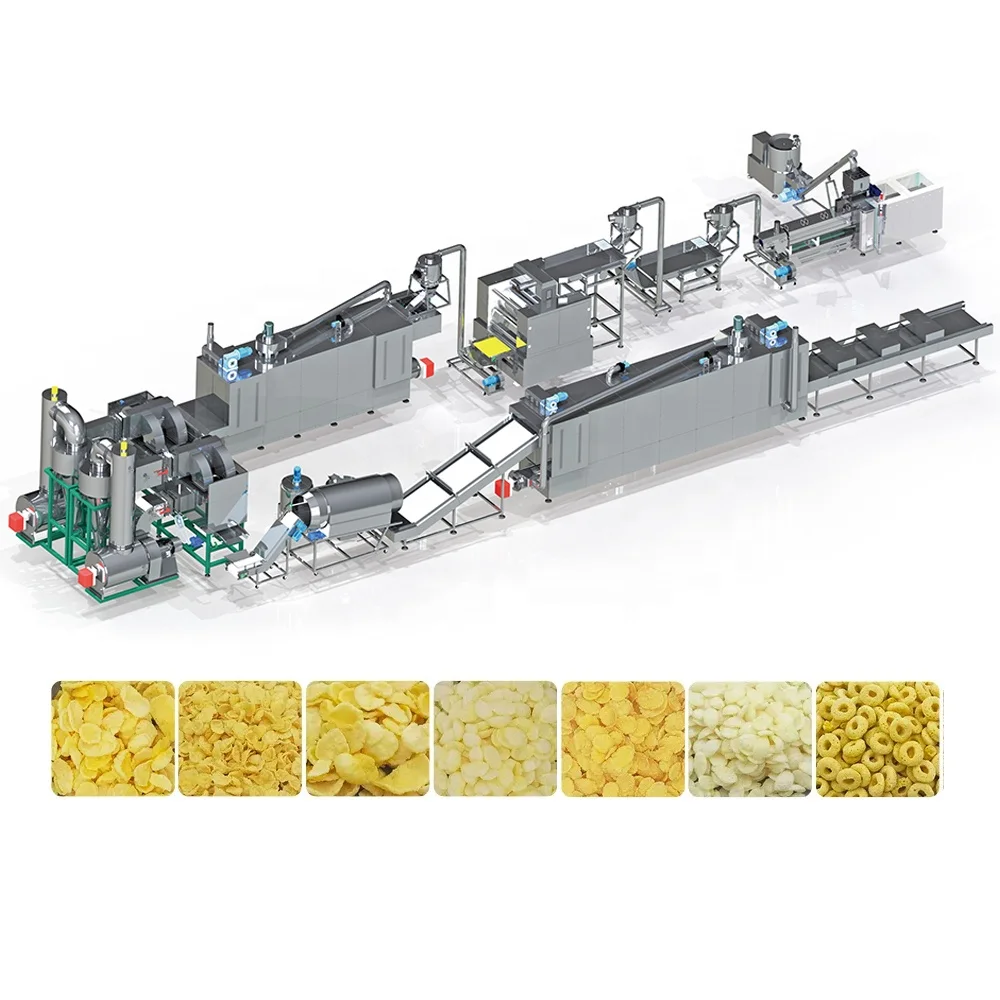
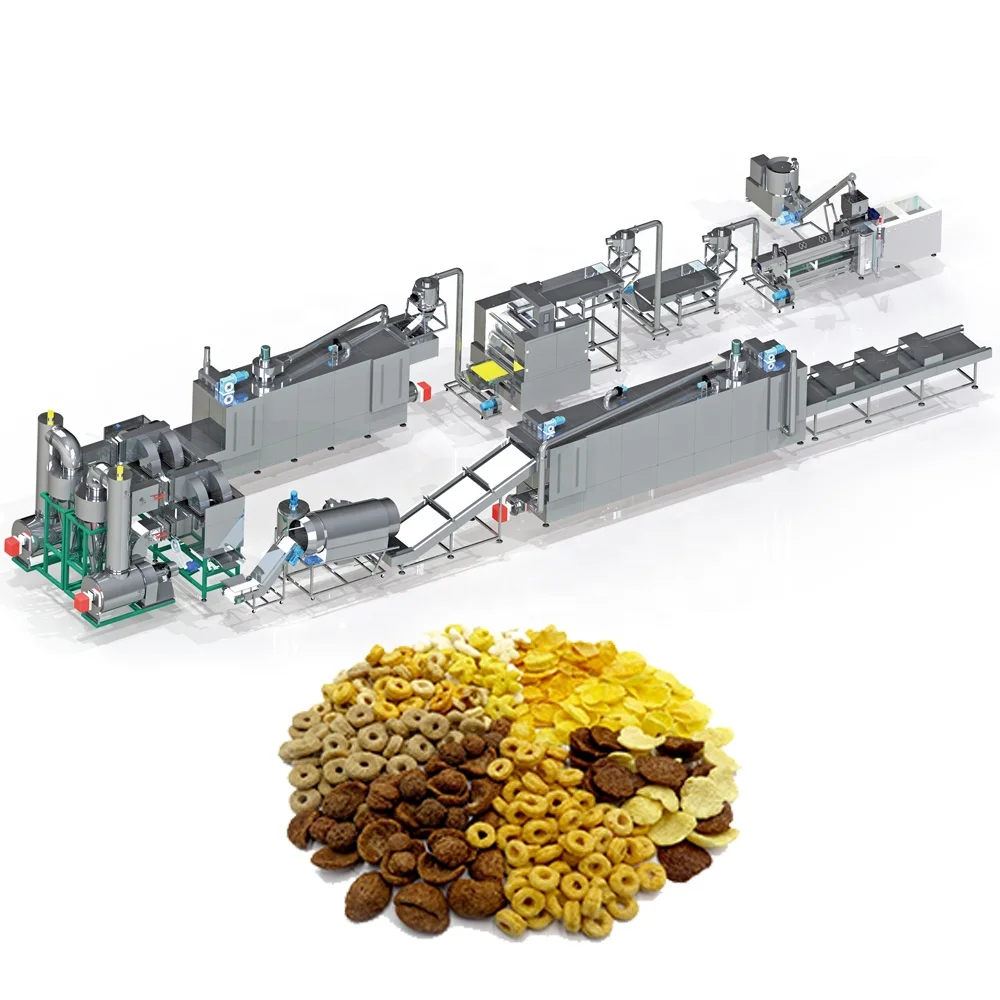
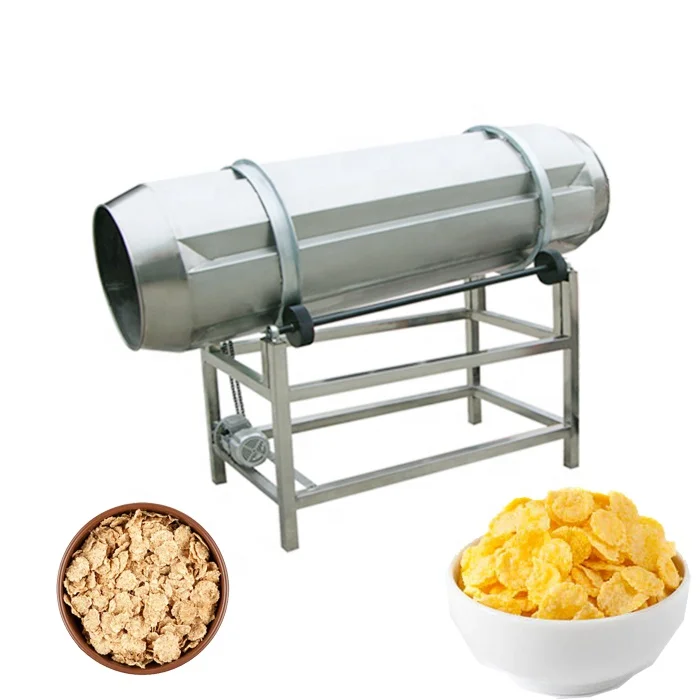
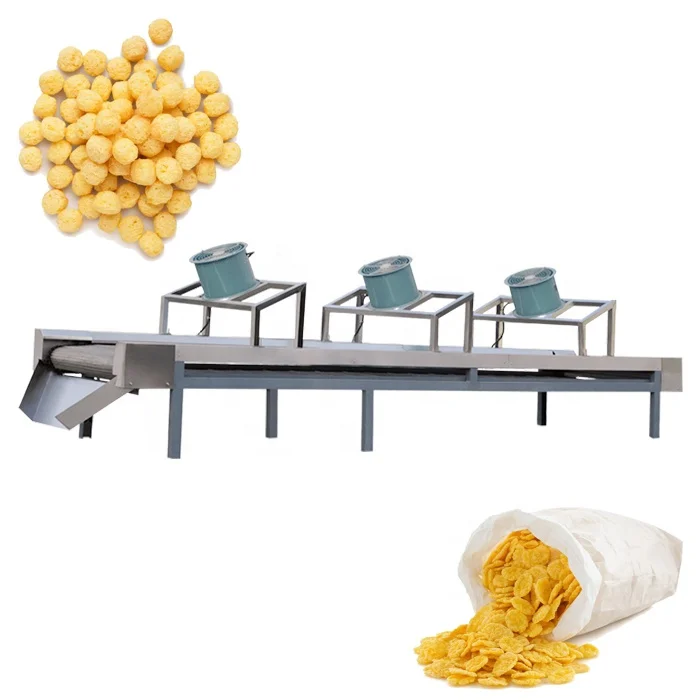
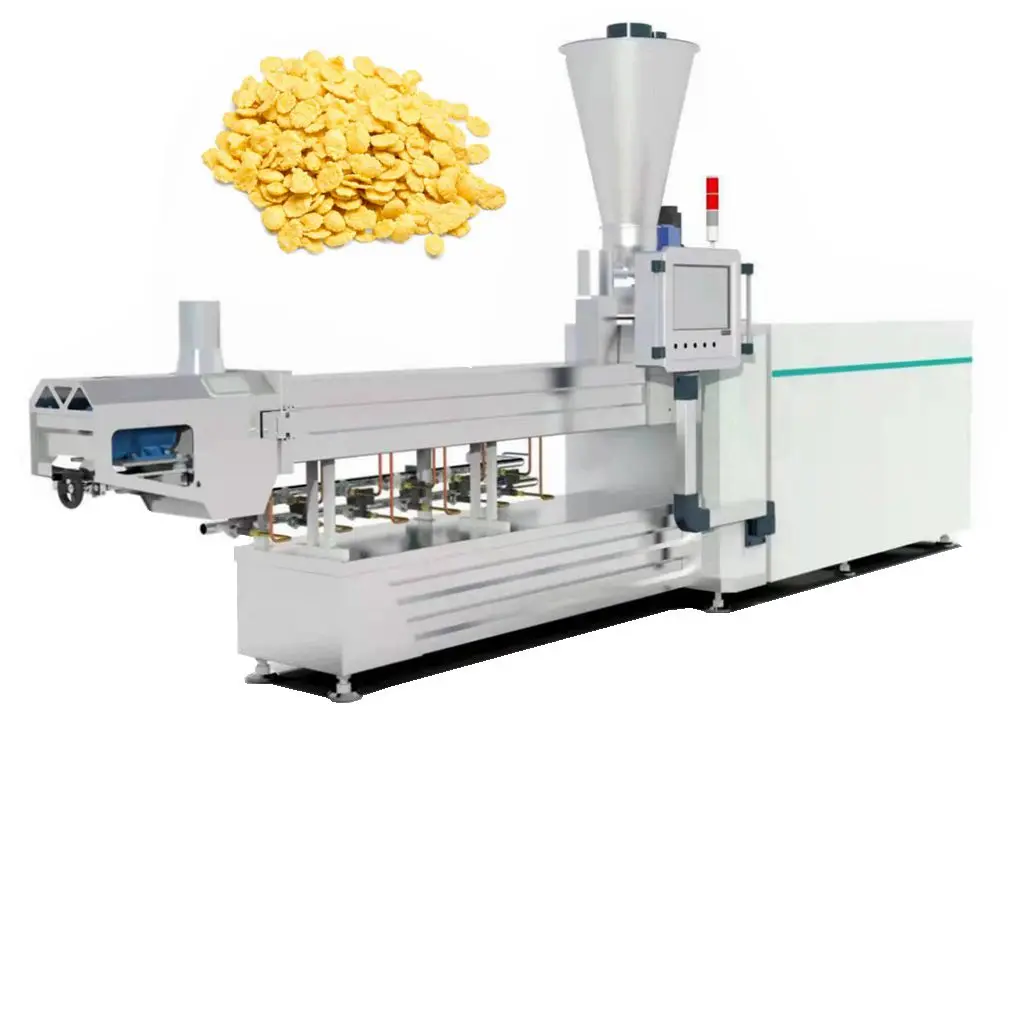
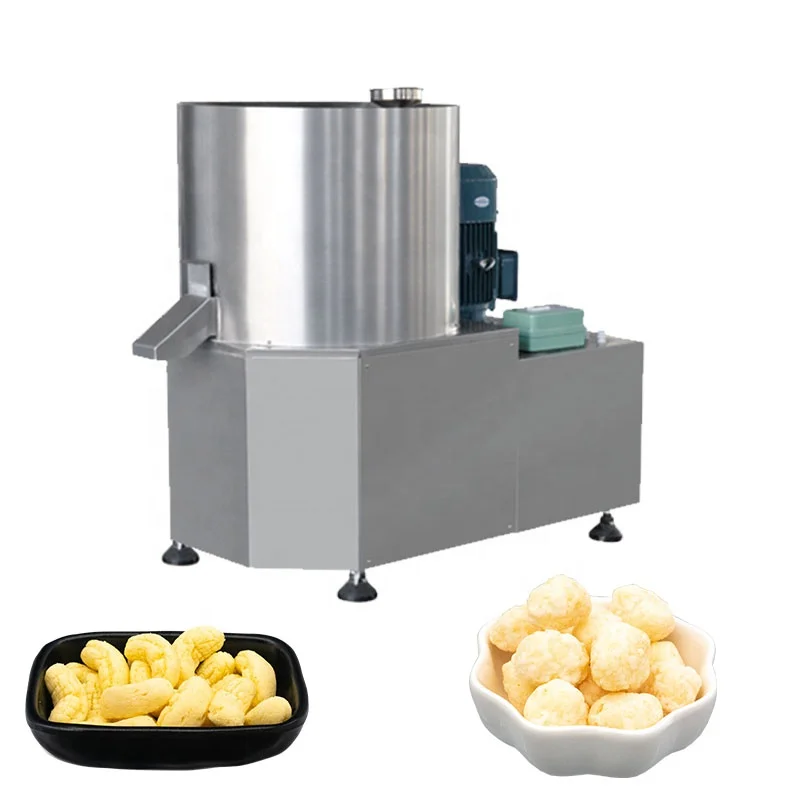
MT70 / MT85 / MT75 Corn Flakes Production Line, twin-screw extrusion, PLC control — engineered as a complete turnkey project from batching through extrusion, flaking, roasting, coating to packing. Screw configuration and die design are specified to your raw material and target flake density, with throughput matched across every station to eliminate bottlenecks. Layout is customized to your factory dimensions, and trial runs on your actual corn or multi-grain material are completed in our testing workshop before shipment.
- Three extruder models covering small-scale to high-volume cereal production
- Hydraulic double-roller flaking with infrared temperature control
- Hot air roasting oven with dual circulating fans for consistent surface blistering
- Natural and sugar-coated variants from one platform
Description
Throughput-Matched Line Design — every station from batching to packing is sized to the same output so your corn flakes line never bottlenecks at the flaker or the roaster.
Technical Specifications
| Parameter | Value |
|---|---|
| Product Type | Corn Flakes Breakfast Cereal Production Line |
| Extruder Model Options | MT70 / MT85 / MT75 |
| Extruder Screw Type | Twin Screw |
| MT70 Installed Power | 160 kW |
| MT70 Power Consumption | 120 kW |
| MT70 Capacity | 150–200 kg/h (basis not stated in source — confirm raw material and moisture content) |
| MT70 Overall Dimensions | 41 × 1.5 × 2.2 m |
| MT85 Installed Power | 190 kW |
| MT85 Power Consumption | 140 kW |
| MT85 Capacity | 300–400 kg/h (basis not stated in source — confirm raw material and moisture content) |
| MT85 Overall Dimensions | 43 × 1.5 × 3.2 m |
| MT75 Installed Power | 210 kW |
| MT75 Power Consumption | 150 kW |
| MT75 Capacity | 300–500 kg/h (basis not stated in source — confirm raw material and moisture content) |
| MT75 Overall Dimensions | 45 × 1.5 × 3.5 m |
| Flaking Machine Capacity | 200–300 kg/h (basis not stated in source — confirm upstream extruder match) |
| Flaking Machine Roller Drive | Hydraulic system, double motors for separate roller driving |
| Flaking Machine Temperature Control | Infrared sensor for even temperature pipe control |
| Dryer Heating Source | Gas or Electric |
| Roasting Oven Circulation | Dual circulating fans with cyclone dust removal |
| Control System | PLC |
Application Suitability
| Application | Material or Output |
|---|---|
| Natural corn flakes | Corn grits, corn flour |
| Sugar-coated corn flakes | Corn base with sugar spray and tumble coating |
| Multi-grain breakfast cereal | Rice, wheat, oat, barley powder blends |
| Shaped cereal variants | Ball, tube, stick, ring, fruit loop, star, wheel, flower, heart via die change |
What "300 kg/h" Actually Means on Your Raw Material
Nominal capacity means nothing if the screw profile was never tested on the grain blend you will actually run.
I once spent three sleepless nights in a South Asian cereal plant because the trial back in China used standard corn grits while the customer’s real recipe cut in rice and oat at ratios nobody had asked about. The flakes came off the roller uneven, some blistering in the roaster, some staying doughy. A corn flakes production line turnkey is only as honest as the raw material test behind it [NEED_CITE: importance of raw material trial runs in extrusion equipment procurement]. When the moisture curve, starch gelatinisation point, and protein content shift, the screw configuration and barrel temperature profile must shift with them or the whole line falls off specification.
How Throughput Matching Works Across Every Station
A corn flakes production line turnkey only performs when every station can keep up with the one before it. If the extruder pushes 400 kg/h but the flaking rollers can only pass 250 kg/h, wet dough piles up, cools off, and blocks the conveyor. The PLC-controlled flaking machine on this line uses a hydraulic double-roller system with separate motor drives and an infrared sensor for even temperature control, so roller pressure and surface temperature stay consistent as throughput climbs.
Layout, Utility Planning and Phased Installation
Every factory floor is different, and a cereal line that ignores column spacing or ceiling height will force compromises at installation. The layout for this corn flakes production line turnkey is drawn to the buyer’s actual building dimensions before fabrication begins. Utility connection points for gas, electricity, water and compressed air are mapped on the drawing so your contractor can rough in services while the machines are still being built, avoiding the typical scramble when equipment arrives [NEED_CITE: industrial utility planning standards for food processing plants].
Reading the Spec Sheet Against Your Production Target
The three extruder options — MT70, MT85 and MT75 — span from smaller batch runs to higher-volume continuous production. Installed power ranges from 160 kW to 210 kW, and actual power consumption sits lower under normal load. The twin-screw working principle covers feeding, extruding, cutting, heating, gearing and controlling as integrated subsystems. Automatic lubricating and cooling functions inside the gearbox reduce unplanned stops during long shifts. On the roasting side, the hot air oven uses a conciliation burner combustion chamber with two separate circulating fans and a cyclone dust removal device, giving operators control over surface blistering without scorching the flake body. The die configuration determines whether you run traditional flat flakes or shaped formats like rings, fruit loops and stars, all from the same extrusion platform.
The Cost of Undersizing the Dryer and Roaster
An extruder that outpaces its downstream dryer is a very common failure mode in cereal lines. Wet flakes stack up on the belt, the moisture gradient flattens, and by the time they reach the roasting oven the surface is already case-hardened while the core stays soft. You end up with a product that shatters in the packing auger or goes stale inside the bag within days [NEED_CITE: moisture gradient effects on flaked cereal shelf stability]. This is why the dryer capacity on this line is matched to the selected extruder model rather than quoted as a standalone unit.
Why Procure the Full Line From One Source
Throughput matching across mixing, extrusion, flaking, drying, roasting, coating, cooling and packing is engineered as a single calculation rather than negotiated across six vendors. Screw configuration and die design are specified against your actual raw material formula and target flake density, not copied from a generic build. An in-house testing workshop runs your grain blend through the extruder before the line ships, so product development happens on our floor instead of yours. Pre-sales engineering covers the layout, utility plan and commissioning schedule as one document set. On-site installation, operator training and wear parts supply continue after the first production run.
Documentation & Verification
- Line layout and capacity calculation showing throughput matched at every station for your corn or multi-grain formula
- Screw and die configuration record written against your raw material and target flake thickness
- Trial run report on your actual grain blend from the in-house testing workshop before dispatch
- Electrical schematic with voltage, frequency and control language confirmed for your local grid
- Factory test record covering extruder, flaking machine, dryer and roasting oven under load
Installation, Commissioning & Support
- Foundation plan accounts for the 45 m line length and dynamic loads from the hydraulic flaking rollers
- Dedicated circuit sized to the selected extruder model’s installed power up to 210 kW
- Machines ship in modular sections for container loading and reassemble on your prepared floor
- First-run parameter setting covers barrel temperature profile, roller gap and roasting air flow
- Operators trained on PLC interface, screw change procedure and infrared sensor calibration
- Wear parts list covers screws, dies, flaking roller surfaces and roaster fan belts with reorder codes
What We Need to Scope Your Line
To build an accurate layout and capacity proposal, share your target raw material formula including any rice, oat or barley ratios, the daily output you are planning for, and your factory floor dimensions with ceiling height. We also need your local voltage and frequency, the preferred control language for the PLC interface, and whether you want to run a trial on your grain blend in our workshop before the line ships.
Frequently Asked Questions
Q: How is line capacity verified on my specific corn or multi-grain raw material before shipment?
A: We run your actual grain blend through the extruder in our in-house testing workshop, adjusting screw configuration, barrel temperature and die selection until flake density and expansion match your specification. A written trial run report is issued before the line is cleared for dispatch.
Q: What is the phased installation and commissioning schedule for a complete cereal line?
A: The schedule covers foundation preparation while machines are in production, mechanical assembly on site, utility hook-up, dry run, wet run with your raw material, and operator training. Each phase has defined milestones tied to your building readiness.
Q: How do you match throughput between the extruder, flaking machine and roasting oven?
A: Capacity calculations start from your target output and work backward through every station. The flaking machine roller speed, dryer belt length and roasting oven fan capacity are all sized to the selected extruder model so no station creates a bottleneck.
Q: Can the factory layout be designed around my existing building dimensions?
A: Yes. The line layout is drawn to your floor plan including column positions, ceiling height and utility entry points. Utility connection diagrams are provided so your contractor can prepare services while the equipment is being fabricated.
Q: What operator training is included and how are wear parts supplied after commissioning?
A: Training covers PLC operation, screw and die changes, flaking roller gap adjustment and roaster temperature profiling. A wear parts list with reorder codes for screws, dies and roller surfaces is included in the documentation package.
Related products
-

Máquina de fabricación de cereales para el desayuno a pequeña escala para la línea de proceso de copos de maíz
¥45,000.00 Select options This product has multiple variants. The options may be chosen on the product page -

Línea de producción de cereales de desayuno de copos de maíz automática de venta caliente
¥20,000.00 Select options This product has multiple variants. The options may be chosen on the product page -

Línea de Producción de Copos de Maíz Máquina de Producción de Cereales para el Desayuno Línea de Maquinaria para la Fabricación de Copos de Maíz
¥59,800.00 Select options This product has multiple variants. The options may be chosen on the product page -
New High Efficiency Electric Corn Flakes Production & Manufacturing Machine
¥7,500.00 Select options This product has multiple variants. The options may be chosen on the product page