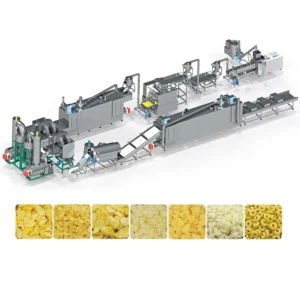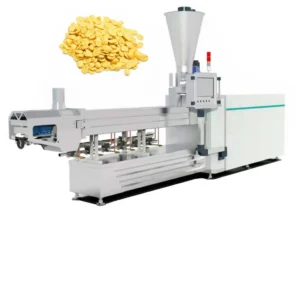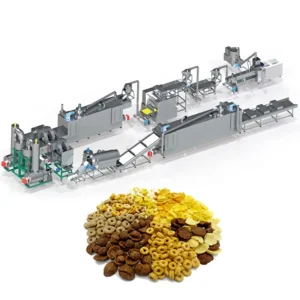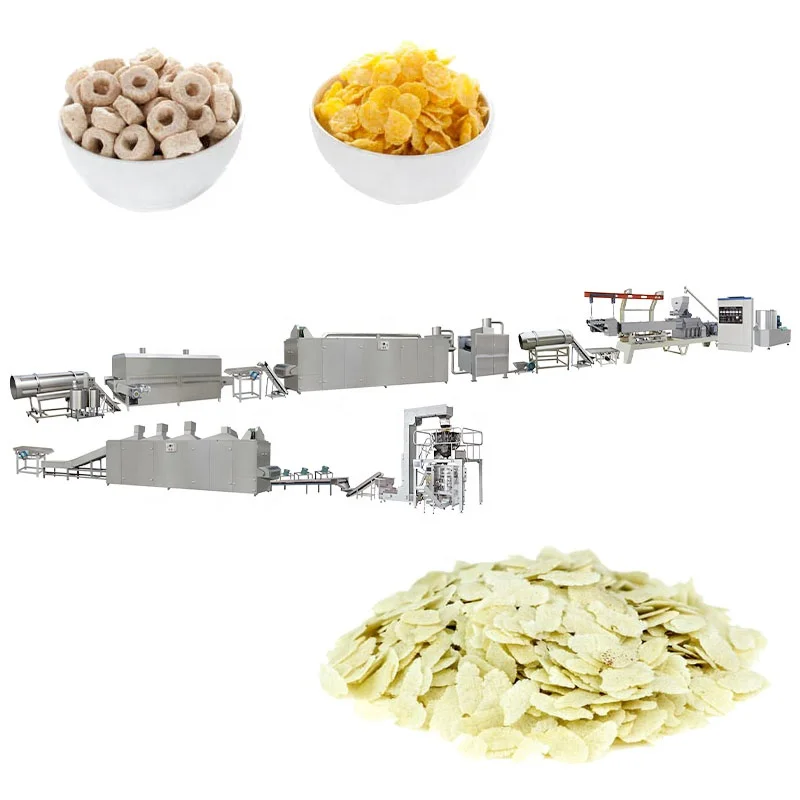
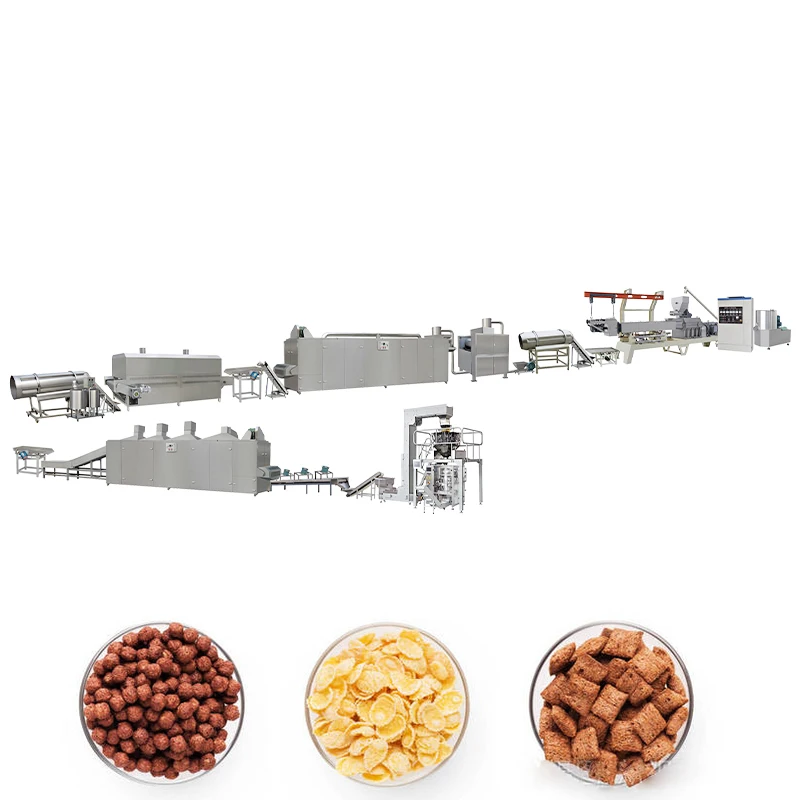
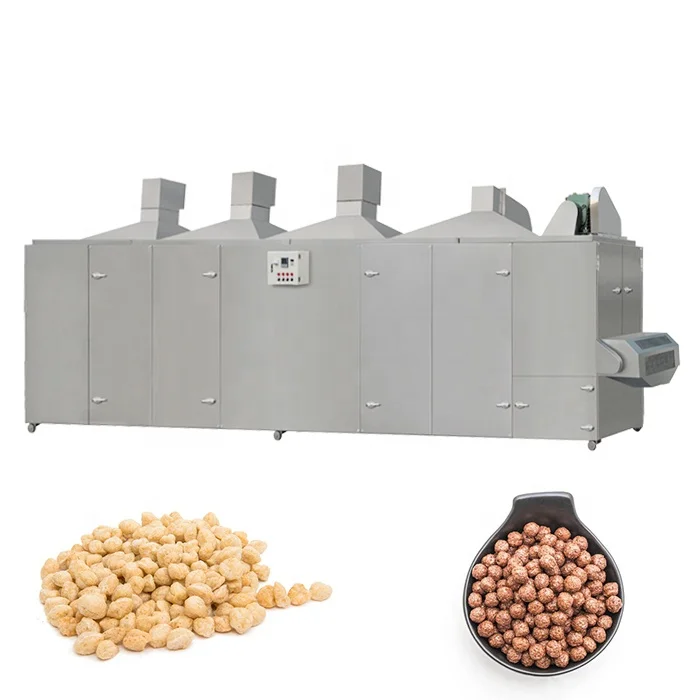

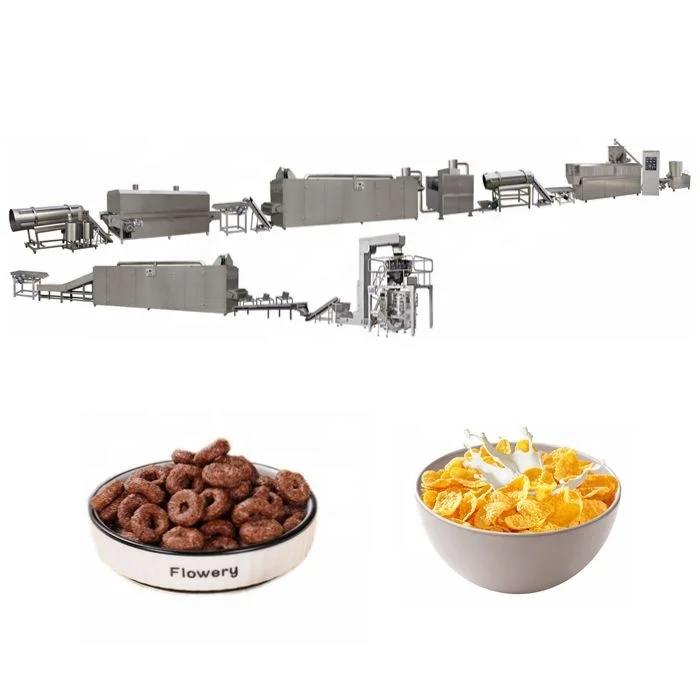

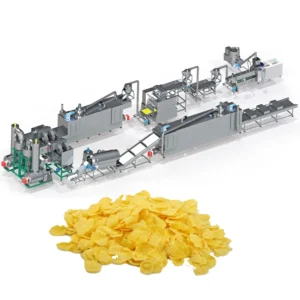
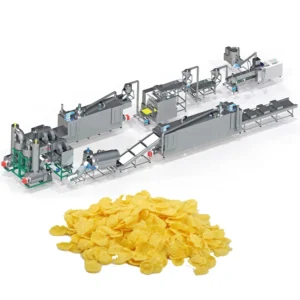
MT70 / MT85 / MT75 Corn Flakes Production Line — twin-screw extrusion, PLC-controlled flaking, hot air roasting
- Complete turnkey line from mixing and extruding through flaking, drying, roasting, sugar coating, and packing
- Screw configuration and die design matched to buyer’s raw material formulation for target flake density and texture
- Every station throughput-matched as one integrated project, with pre-shipment trial runs on customer raw material in our testing workshop
11293
Description
Throughput-Matched Line Engineering — Every station from mixer to packer is sized against the extruder’s verified output on your raw material, preventing the dryer or coater from becoming a hidden bottleneck.
Technical Specifications
| Parameter | Value |
|---|---|
| Product Type | Corn Flakes Production Line |
| Models Available | MT70, MT85, MT75 |
| Extruder Type | Twin Screw |
| MT70 Installed Power | 160 kW |
| MT70 Power Consumption | 120 kW |
| MT70 Output Capacity | 150–200 kg/h (basis not stated in source — confirm raw material formulation / moisture content) |
| MT70 Overall Dimensions | 41 × 1.5 × 2.2 m |
| MT85 Installed Power | 190 kW |
| MT85 Power Consumption | 140 kW |
| MT85 Output Capacity | 300–400 kg/h (basis not stated in source — confirm raw material formulation / moisture content) |
| MT85 Overall Dimensions | 43 × 1.5 × 3.2 m |
| MT75 Installed Power | 210 kW |
| MT75 Power Consumption | 150 kW |
| MT75 Output Capacity | 300–500 kg/h (basis not stated in source — confirm raw material formulation / moisture content) |
| MT75 Overall Dimensions | 45 × 1.5 × 3.5 m |
| Extruder Systems | Feeding, extruding, cutting, heating, gearing, controlling |
| Extruder Feature | Automatic lubricating and cooling function |
| Flaking Machine Control | PLC control system |
| Flaking Machine Drive | Hydraulic double-roller system with separate double-motor drive |
| Flaking Temperature Control | Infrared sensor for even temperature pipe control |
| Dryer Heating Source | Gas or Electric |
| Roasting Oven | Hot air roasting with vibrating pan, conciliation burner, dual circulating fans, cyclone dust removal |
| Coating System | Double tumble for sugar melting, elevator, coating drum, spraying nozzle |
| Line Control | PLC and MCC |
| Standards | CE, ISO |
Application Suitability
| Application | Material or Output |
|---|---|
| Natural corn flakes production | Corn powder, corn grits |
| Sugar-coated breakfast cereal | Corn, rice, wheat powder with sugar syrup coating |
| Multigrain flake variants | Oat, barley, wheat, rice powder blends |
| Shaped cereal pieces | Ball, tube, ring, star, wheel, heart shapes via extruder die adjustment |
What "300 kg/h" Actually Means When You Run Your Own Corn Grits
Line capacity is only valid when verified on the exact raw material formulation and moisture content you will feed into the hopper.
A corn flakes production line turnkey proposal often quotes a single output number, yet that figure shifts considerably when the corn grits arriving at your mill differ in particle size or moisture from the supplier’s test batch. I have watched lines stall because the flaking station could not keep pace when coarser grits required longer conditioning, or because the roasting oven lacked the thermal headroom to blister flakes properly at higher throughput. The extruder, dryer, flaking rolls, and roaster must each be specified against the same material baseline, or one station will quietly cap the entire line [NEED_CITE: material moisture impact on extrusion throughput and downstream drying load].
How a Corn Flakes Production Line Turnkey Layout Eliminates Station-Level Bottlenecks
When every piece of equipment in a corn flakes production line turnkey package comes from a single engineering source, throughput matching happens at the design stage rather than during commissioning. The extruder output sets the pace, and the dryer belt width, roasting oven volume, and coating drum diameter are all calculated to absorb that output without accumulation or starvation at any transfer point.
The Role of Pre-Shipment Trial Runs in Line Validation
Before any corn flakes production line turnkey system leaves the factory, running your specific corn or multigrain formulation through the extruder and flaking station in the testing workshop reveals issues that layout drawings cannot predict. Flake thickness, blistering behavior in the roaster, and sugar coating adhesion all depend on how your raw material responds to shear, moisture, and temperature profiles [NEED_CITE: twin-screw extrusion parameter effects on flake texture]. This trial run generates a report that accompanies the shipment, giving your commissioning team a documented starting point rather than a blank slate.
Reading the Power and Dimension Data Against Your Facility Constraints
The installed power figures — ranging from 160 kW on the MT70 to 210 kW on the MT75 — define the electrical infrastructure your facility must provide, including dedicated circuits and transformer capacity. Line lengths between 41 and 45 meters mean the floor plan must accommodate a straight-run or L-shaped layout with clear access on both sides for maintenance. The hydraulic flaking station draws concentrated power and requires stable hydraulic fluid temperature to maintain consistent roller gap, which in turn governs flake thickness uniformity across the batch. Infrared temperature sensors on the flaking rolls prevent uneven dough sheet behavior that would otherwise produce a mix of under-pressed and over-pressed flakes entering the dryer.
The Hidden Cost of Mismatched Dryer and Roaster Capacity
When the dryer or hot air roasting oven is undersized relative to the extruder, wet flakes pile up on transfer conveyors and cool before reaching the roasting chamber, resulting in uneven blistering and a texture that falls short of market expectations. Operators then slow the extruder to let the downstream stations catch up, effectively running below the capacity you paid for. This mismatch rarely appears in a quotation that lists each machine independently without a throughput reconciliation document [NEED_CITE: consequences of unbalanced line station capacity in food extrusion].
Why Source the Complete Line From One Responsibility Point
Screw configuration and die design are specified to your raw material formulation and target flake density, rather than copied from a generic build. The in-house testing workshop validates your corn, rice, or oat blend before shipment, producing a trial run report that becomes your commissioning baseline. Layout drawings are designed around your actual factory dimensions, and voltage and frequency are confirmed to your local standard before production begins. Every station — mixing, extruding, flaking, drying, roasting, coating, cooling, and packing — is engineered as one integrated project under CE and ISO standards.
Documentation & Verification
- Line layout and capacity calculation showing matched throughput at every station
- Screw and die configuration record matched to your corn or multigrain formulation
- Trial run report on your raw material from the in-house testing workshop
- Electrical schematic with voltage, frequency, and control language confirmation
- Factory test record documenting performance before dispatch
- CE declaration of conformity and ISO certificate
Installation, Commissioning & Support
- Foundation plan aligned to the 41–45 m line footprint and station load points
- Dedicated electrical circuits sized for up to 210 kW installed power on the MT75
- Phased assembly sequence from extruder through flaking, drying, and roasting stations
- First-run parameter setting using your trial run report as the commissioning baseline
- Operator training covering PLC interface, hydraulic flaking controls, and roaster burner management
- Wear parts list including screws, dies, and flaking roller surfaces with replacement intervals
Preparing Your Line Inquiry
To move from a general concept to a specific layout proposal, share your raw material type and particle size, target hourly output, and whether you plan to run natural flakes, sugar-coated variants, or both. Include your factory floor dimensions, ceiling height, and local voltage and frequency standard so the layout and electrical design align with your facility from the start. If you have existing upstream milling or downstream packing equipment, note the interface points so the line connects without modification.
Frequently Asked Questions
Q: How is line capacity verified on my actual corn or grain formulation?
A: Before shipment, your raw material runs through the extruder and flaking station in the testing workshop. The trial run measures actual throughput, flake thickness, and texture under controlled moisture and temperature conditions. You receive a documented report that becomes the baseline for on-site commissioning, ensuring the quoted capacity reflects your specific formulation rather than a generic test batch.
Q: How do you prevent the dryer or roaster from bottlenecking the extruder?
A: Each station’s capacity — dryer belt area, roasting oven volume, coating drum size — is calculated against the extruder’s verified output on your material. The throughput reconciliation document in your proposal shows matched flow rates at every transfer point, so no single station forces the extruder to run below its rated pace.
Q: What does the pre-shipment trial run cover?
A: The trial run tests your raw material through extrusion, flaking, and roasting to confirm screw configuration, die selection, roller gap, and temperature profiles. You receive a report documenting output rate, flake dimensions, blistering quality, and recommended operating parameters, giving your team a proven starting point on installation day.
Q: How is installation phased, and what training is included?
A: Installation follows a station-by-station sequence matching the line layout, beginning with the extruder and progressing through flaking, drying, roasting, and packing. Operator training covers PLC controls, hydraulic flaking adjustments, roaster burner settings, and routine maintenance schedules for wear parts such as screws and dies.
Q: What electrical and utility confirmations happen before production?
A: Voltage, frequency, and control language are confirmed to your local standard before manufacturing begins. The electrical schematic documents circuit requirements for the full line’s installed power, and utility planning covers gas or electric dryer options, compressed air for pneumatic controls, and water supply for the extruder cooling system.
Related products
-

Línea de Producción de Copos de Maíz Máquina de Producción de Cereales para el Desayuno Línea de Maquinaria para la Fabricación de Copos de Maíz
¥59,800.00 Select options This product has multiple variants. The options may be chosen on the product page -
Máquina para hacer copos de maíz Máquina para hacer puffs de maíz Línea de producción de alimentos para bocadillos
Price range: ¥500.00 through ¥1,200.00 Select options This product has multiple variants. The options may be chosen on the product page -
New High Efficiency Electric Corn Flakes Production & Manufacturing Machine
¥7,500.00 Select options This product has multiple variants. The options may be chosen on the product page -
Línea de producción de copos de maíz completa Máquina de procesamiento de cereales para el desayuno Componente central del motor Equipo de procesamiento de copos de maíz
¥19,000.00 Select options This product has multiple variants. The options may be chosen on the product page