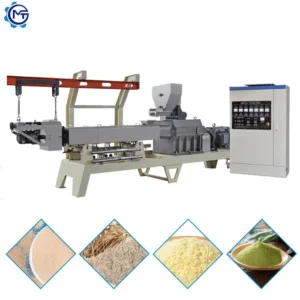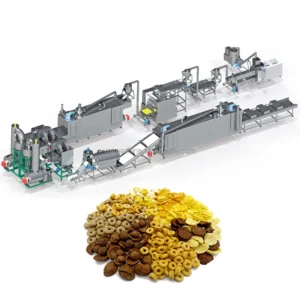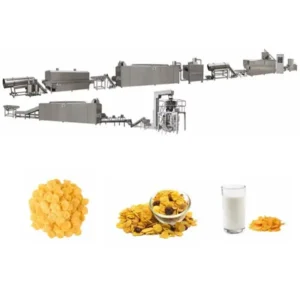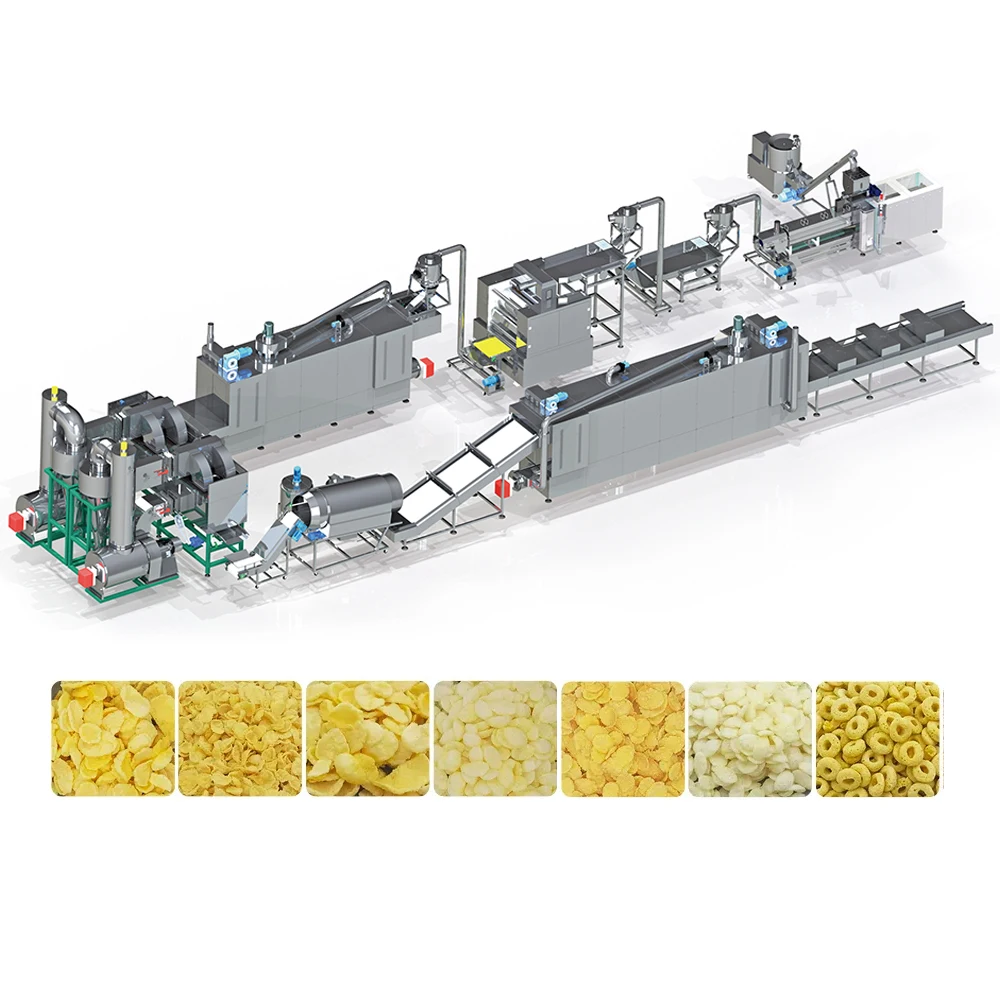


MT70 / MT85 / MT75 Corn Flakes Production Line, Twin Screw Extrusion, PLC & MCC Control — engineered as a complete turnkey system from batching through extrusion, flaking, drying, roasting, coating and packing.
- Throughput across every station is matched to prevent bottlenecks, with screw configuration and die design specified to your raw material and target flake density
- Flaking machine features hydraulic double-roller drive with infrared temperature control for uniform thickness
Delivered with in-house trial run on your actual formulation before shipment, ensuring verified output from day one.
Description
Turnkey line integration — every station from mixing to packing is throughput-matched on a single supplier scope, preventing the flaker bottleneck that commonly strands extruder output on cereal lines.
Technical Specifications
| Parameter | Value |
|---|---|
| Product Type | Corn Flakes Production Line (Twin Screw Extrusion) |
| Model Options | MT70 / MT85 / MT75 |
| Screw Type | Twin Screw |
| Installed Power (MT70) | 160 kW |
| Installed Power (MT85) | 190 kW |
| Installed Power (MT75) | 210 kW |
| Power Consumption (MT70) | 120 kW |
| Power Consumption (MT85) | 140 kW |
| Power Consumption (MT75) | 150 kW |
| Capacity (MT70) | 150–200 kg/hr (basis not stated in source — confirm raw material formulation / moisture content) |
| Capacity (MT85) | 300–400 kg/hr (basis not stated in source — confirm raw material formulation / moisture content) |
| Capacity (MT75) | 300–500 kg/hr (basis not stated in source — confirm raw material formulation / moisture content) |
| Overall Dimensions (MT70) | 41 × 1.5 × 2.2 m |
| Overall Dimensions (MT85) | 43 × 1.5 × 3.2 m |
| Overall Dimensions (MT75) | 45 × 1.5 × 3.5 m |
| Control System | PLC and MCC across extrusion line; PLC on flaking machine |
| Flaking Drive | Double motors with independent roller driving; hydraulic system |
| Temperature Control (Flaker) | Infrared sensor for even temperature pipe regulation |
| Dryer Heating Source | Gas or electric (selectable) |
| Hot Air Roasting Oven | Vibrating pan, conciliation burner, dual circulating fans, cyclone dust removal |
| Coating System | Double tumble sugar melter, elevator, coating drum, spray nozzle |
| Lubrication | Automatic lubricating system on extruder |
| Certification | CE, ISO |
Application Suitability
| Application | Material or Output |
|---|---|
| Natural corn flakes for retail breakfast cereal | Corn grits, maize flour |
| Sugar-coated flakes for food-service and retail | Corn, rice, wheat, oat, barley blends |
| Multi-grain flaked cereal | Wheat, oat, barley with corn base |
| Shaped puffed cereal snacks (rings, balls, stars, fruit loops) | Corn, rice, wheat flour via extruder die change |
| Fortified breakfast cereal production | Grain base with vitamin and mineral premix |
Why a Corn Flakes Production Line Turnkey Quoted at Nameplate Capacity Still Fails at Startup
The line only holds rated output when every downstream station can absorb the extruder discharge at the same pace.
I have stood in Latin American plants where the extruder ran fine but the flaking rolls could not keep up, forcing operators to throttle the screw speed down to match the roller gap throughput. The corn flakes production line turnkey was sold on extruder capacity alone. The dryer had insufficient residence time for the actual moisture load. The roaster blistered unevenly because the vibrating pan feed rate was never reconciled with upstream discharge. Each mismatch compounds: product sits in buffer hoppers losing temperature, starch retrogrades, and flake texture drifts outside what the market expects [NEED_CITE: starch retrogradation effects on flake texture during buffer hold]. Buying individual machines from separate vendors and bolting them together rarely resolves this because no single party owns the throughput calculation end to end.
How Screw Profile and Die Geometry Set the Flake Foundation
The twin screw extruder is where starch gelatinisation begins, and the screw configuration determines how much shear and residence time the corn or multi-grain formulation receives. A corn flakes production line turnkey must match screw element arrangement to the specific raw material — corn grits behave differently from an oat-barley blend at the same moisture level. Die opening size controls the extrudate diameter, which directly governs the pellet thickness arriving at the flaker rolls. If the pellet is too thick, the flaker cannot compress it to the target flake gauge without cracking edges.
Flaking Precision Determines Whether the Roaster Can Do Its Job
The flaking station uses a hydraulic double-roller system with independent dual-motor drive, meaning each roller maintains its own torque response rather than one dragging the other through a shared shaft. Infrared sensors monitor the temperature pipe continuously so the roller surface stays within the range where starch compresses rather than shatters. Uniform flake thickness here is what allows the hot air roasting oven to blister the surface evenly — a variation of even a fraction of a millimetre means some flakes scorch while others remain under-roasted [NEED_CITE: thermal uniformity requirements in cereal roasting ovens]. The conciliation burner paired with dual circulating fans and a cyclone dust removal device manages the heat distribution and particulate carryover that would otherwise deposit on downstream equipment.
Reading the Power and Dimension Specs Against Your Factory Reality
The installed power range from 160 kW on the MT70 to 210 kW on the MT75 tells you the electrical infrastructure required, but the power consumption figures — 120 kW to 150 kW — are what your transformer actually sustains during continuous operation. Matching these against local voltage and frequency before production begins avoids the situation where a motor overheats on 60 Hz when it was wound for 50 Hz. The overall dimensions, stretching up to 45 metres in line length for the MT75, dictate your building span and column spacing. Twin screw extrusion in cereal applications relies on a specific length-to-diameter ratio to achieve full gelatinisation of the starch matrix; cutting barrel sections short to fit a smaller room compromises the cooking profile and leaves raw centres in the pellet that the flaker cannot flatten cleanly. The automatic lubricating system on the extruder reduces planned downtime for grease intervals, which matters when a line runs extended shifts to meet contractual supply volumes.
The Hidden Cost of Mis-matched Coating and Drying Capacity
When the sugar coating drum is specified to the extruder’s nominal output but the preceding dryer has not removed enough moisture, the sugar syrup slides off the flake surface instead of adhering. I have seen this in plants producing sugar-coated corn flakes where the coating drum operator kept reducing line speed to compensate, effectively running the entire corn flakes production line turnkey at half its quoted capacity. The double tumble sugar melter and spray nozzle system can only perform if the incoming flakes have been dried and roasted to a consistent moisture point. Bottlenecks at the coating stage cascade backwards: the roaster over-holds product, the dryer backs up, and the extruder eventually trips on overload [NEED_CITE: cascade failure patterns in serial food processing lines]. Re-engineering the downstream section after installation costs far more than specifying matched throughput before the line is built.
Why Procurement Through a Single Line Integrator Matters Here
Every station on this line — batching, extrusion, flaking, drying, roasting, coating, cooling, and packing — is supplied under one scope, which means throughput calculations are reconciled before any steel is cut. The screw configuration and die design are specified against the buyer’s actual raw material formulation rather than pulled from a generic build library. An in-house testing workshop runs trial production on the customer’s own corn, rice, or multi-grain blend before the line ships, so pellet behaviour at the flaker and blister response in the roaster are observed and adjusted in advance. PLC and MCC control panels are configured with the target market’s voltage, frequency, and operator language confirmed in writing before assembly begins. Pre-sales layout engineering through on-site installation, commissioning, and ongoing wear part supply stays with one technical team from first inquiry through steady-state production.
Documentation & Verification
- Line layout and capacity calculation document reconciling every station’s throughput to your target output
- Trial run report produced on your specific corn or multi-grain formulation before shipment
- Screw and die configuration record detailing the exact build matched to your flake density target
- Electrical schematic with confirmed voltage, frequency, and PLC language for your market
- CE declaration of conformity and ISO certificate for customs and regulatory clearance
- Factory test record documenting continuous run behaviour at the tested throughput
Installation, Commissioning & Support
- Foundation and floor plan aligned to the MT75 line’s 45-metre length and utility connection points
- Dedicated electrical circuit sized for the 210 kW installed power draw with confirmed voltage and frequency
- Assembly sequence planned around the hydraulic flaker and roaster module integration
- First-run parameter setting covering extruder screw speed, flaker roll gap, and roaster temperature profile
- Operator training on PLC interface, MCC panel response, and automatic lubrication system checks
- Wear parts list covering screws, dies, and flaker roller surfaces with stocking recommendations
What We Need to Scope Your Line Correctly
Send your raw material specification — whether you are running pure corn grits, a multi-grain blend, or a fortified formulation with premix — along with the target moisture content at each stage. Confirm your local voltage and frequency, the control language your operators read, and the available floor length and ceiling height in the production building. If you have existing upstream milling or downstream packing equipment that must interface with this line, share the connection point specifications so the layout accounts for them.
Frequently Asked Questions
Q: How is line capacity verified against my specific raw material formulation before shipment?
A: We run trial production in the in-house testing workshop using your actual corn, rice, or multi-grain blend at the moisture levels you specify. Pellet behaviour at the flaker, blister response in the roaster, and coating adhesion are all observed and adjusted. A trial run report documents the results before the line is cleared for dispatch.
Q: How do you match throughput between the extruder, flaker, dryer, roaster and coating drum?
A: Each station’s capacity is calculated against the extruder’s actual discharge rate on your formulation, not its nameplate figure. The flaker roll width and speed, dryer residence time, roaster pan load, and coating drum volume are all reconciled in the line layout document so no single machine bottlenecks the output.
Q: What screw configuration and die design will be specified for my target flake density?
A: The screw element arrangement is selected based on the starch gelatinisation profile your specific raw material requires, and the die opening is sized so the extrudate arrives at the flaker at a pellet diameter that compresses cleanly to your target gauge. Both are recorded in the configuration document supplied with the line.
Q: How are voltage, frequency and PLC control language confirmed before production begins?
A: We request your site electrical specification during the inquiry stage and confirm voltage, frequency, phase, and operator interface language in writing. The electrical schematic and MCC panel build follow that confirmed document, preventing commissioning delays caused by motor or control mismatches at startup.
Q: What does on-site installation, commissioning and ongoing support include?
A: Our team handles placement of the extruder, hydraulic flaker, roaster, and coating system according to the approved layout, followed by parameter setting and operator training. A wear parts list covering screws, dies, and roller surfaces is supplied with stocking recommendations, and maintenance support continues through the production ramp-up period.
Related products
-
Línea de producción automática de copos de maíz en círculo de trigo para desayuno comercial
¥65,000.00 Add to cart -
Máquina extrusora de anillos de cereal de trigo crujiente con choco integral / Producción de cereales para el desayuno Corn Flakes y Fruit Loops
¥48,000.00 Select options This product has multiple variants. The options may be chosen on the product page -

Línea de producción de cereales de desayuno de copos de maíz automática de venta caliente
¥20,000.00 Select options This product has multiple variants. The options may be chosen on the product page -
Línea de producción de cereales para el desayuno Corn Flakes Máquina automática
¥8,000.00 Select options This product has multiple variants. The options may be chosen on the product page