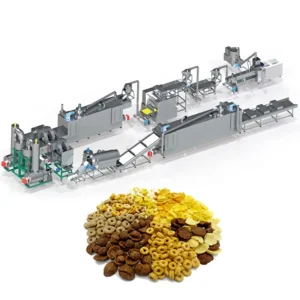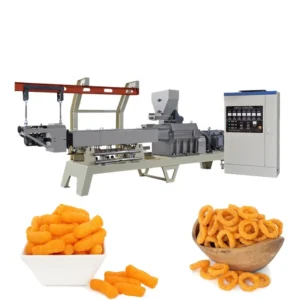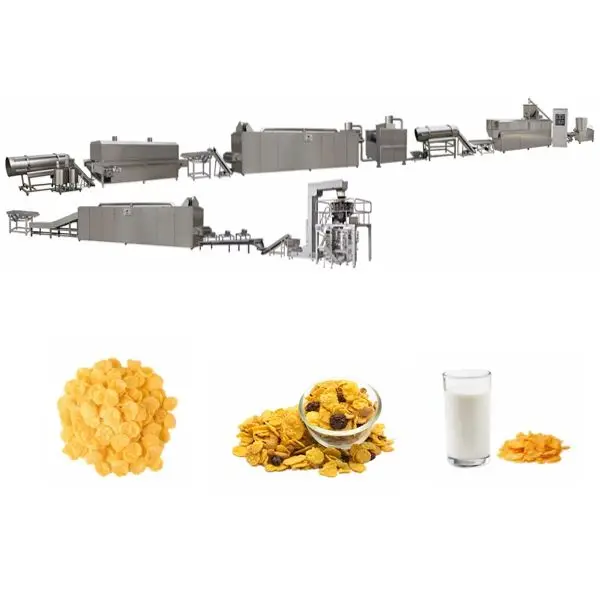


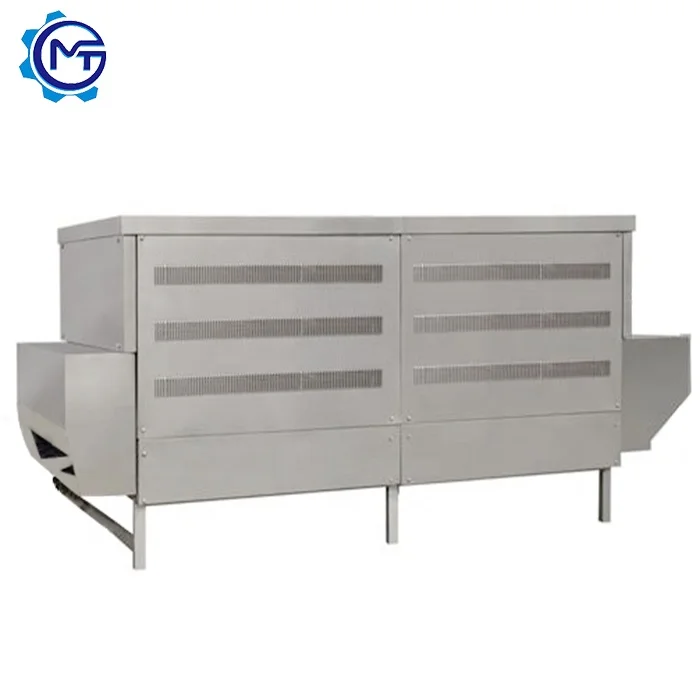

MT70 / MT85 / MT75 Corn Flake Extrusion Production Line, Twin-Screw, PLC & MCC Control — configured as a complete turnkey system from batching through extrusion, flaking, drying, roasting, coating to packing.
- Screw configuration and die design specified to your raw material blend and target flake density, with hydraulic double-roller flaking and infrared temperature control for uniform thickness
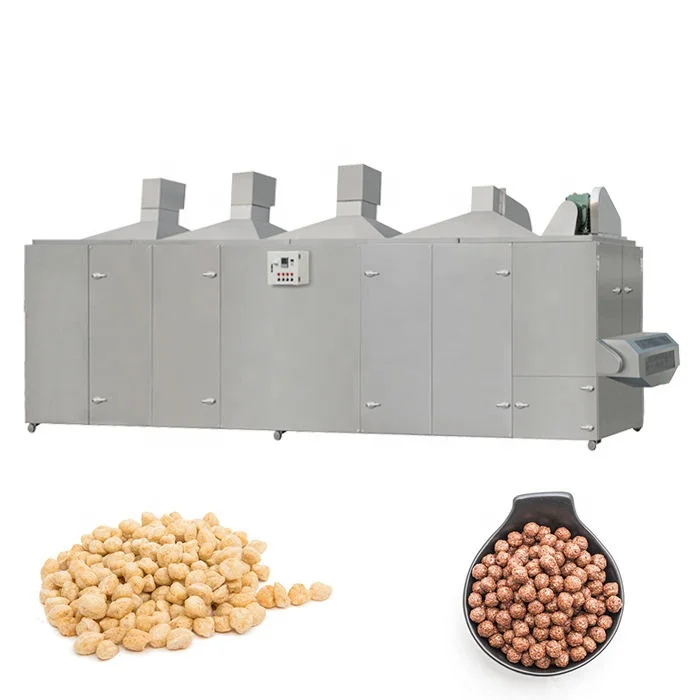
- Hot air roasting oven features dual circulating fans, conciliation burner and cyclone dust removal for consistent blistering and crispness across natural and sugar-coated variants
Every station is throughput-matched under one engineering team, backed by an in-house trial run on your actual raw material before shipment and full electrical documentation matched to your factory’s utility supply.
Description
Throughput-matched engineering — Every station from batching to packing is sized by one team so the flaking roll never waits on the extruder and the roaster never chokes on the dryer output.
Technical Specifications
| Parameter | Value |
|---|---|
| Product Type | Corn Flake Extrusion Production Line |
| Models Available | MT70, MT85, MT75 |
| Extruder Type | Twin-screw |
| Output Capacity | 100-500 kg/h (basis not stated in source — confirm raw material composition / moisture content / target flake specification) |
| Installed Power (MT70 / MT85 / MT75) | 160 kW / 190 kW / 210 kW |
| Power Consumption (MT70 / MT85 / MT75) | 120 kW / 140 kW / 150 kW |
| Overall Dimensions (MT70 / MT85 / MT75) | 41 × 1.5 × 2.2 m / 43 × 1.5 × 3.2 m / 45 × 1.5 × 3.5 m |
| Control System | PLC control with MCC integration |
| Flaking Machinery Drive | Double motors for separate roller driving; hydraulic system |
| Flaking Temperature Control | Infrared sensor for even temperature pipe control |
| Dryer Heating Source | Gas or Electric |
| Roasting Oven | Hot air roasting with vibrating pan, conciliation burner, two circulating fans, cyclone dust removal |
| Coating System | Double tumble for sugar melting, elevator, coating drum, spraying nozzle |
| Line Stations | Mixing → Extruding → Flaking → Drying → Hot Air Roasting → Sugar Coating (optional) → Cooling → Packing |
| Final Product Shapes | Natural corn flakes, sugar-coated corn flakes, ball, tube, stick, ring, fruit loop, star, wheel, flower, heart (via mould) |
| Raw Materials | Corn powder, rice, wheat, oat, barley powder and other cereals |
| Certifications | CE, ISO |
Application Suitability
| Application | Material or Output |
|---|---|
| Natural corn flake breakfast cereal | Corn powder, maize grits |
| Sugar-coated corn flakes | Corn powder with sugar glaze coating |
| Multi-grain breakfast flakes | Rice, wheat, oat, barley powder blends |
| Extruded cereal shapes | Ball, tube, ring, fruit loop, star, wheel, flower, heart via mould changeover |
| Grain-based porridge or instant cereal bases | Pre-gelatinised corn and mixed cereal flours |
What a Nominal Capacity Rating Leaves Out on a Corn Flakes Line
A number without a raw material recipe is not a capacity — it is a hope.
I have watched factory owners sign off on a cereal line rated for a certain hourly output, only to find that switching from plain corn flour to a blend with soy or oat shifts the dough viscosity enough to drop the real throughput. The extruder pushes product through, but the flakes come out too dense or too fragile for the roasting oven downstream. That gap between the brochure figure and the shop floor reality is where most breakfast cereal turnkey projects stall [NEED_CITE: extrusion throughput dependence on raw material moisture and composition]. A corn flakes production line turnkey should be quoted against the buyer’s actual formulation, not a laboratory reference recipe.
Layout Logic That Starts at the Roaster, Not the Extruder
Most breakfast cereal lines are spec’d from the front end forward — pick the extruder, then find a dryer that fits. On a corn flakes production line turnkey, the bottleneck usually sits at the hot air roasting oven. Flake surface blistering and crispness demand a specific residence time that cannot be rushed without scorching. We plan the roaster capacity first, then work backward to match the extruder output, the flaking roll speed, and the dryer dwell so that each station hands product to the next at the correct rate.
Why Phased Installation Matters Before the First Bag of Corn Arrives
Utility planning on a cereal extrusion line involves gas supply for the dryer and roaster, dedicated electrical circuits for the twin-screw motors, and exhaust ducting for the cyclone dust removal. If the phased installation schedule does not sequence gas line commissioning before the roaster arrives, the entire line sits idle. We map utility tie-in points on the layout drawing and align them with the construction contractor’s milestone chart so that mechanical installation and utility readiness converge on the same week [NEED_CITE: industrial food line utility sequencing standards].
Reading the Specs That Actually Govern Flake Quality
The twin-screw configuration on MT70, MT85, and MT75 determines shear history and starch gelatinisation degree, which in turn sets how the dough behaves under the flaking rolls. Hydraulic double-roller drive with separate motors keeps roll gap pressure even across the full width, so flake thickness stays consistent from edge to centre. Infrared sensor temperature control on the flaking machinery prevents the dough sheet from cooling below the point where it can be pressed without cracking. The PLC system coordinates feeder speed with extruder screw speed so that moisture variation in one batch does not cascade into density variation at the packing station.
The Cost of Skipping the Trial Run
When a line ships without a trial run on the buyer’s actual corn blend, the screw configuration is a guess. I once saw a producer run a new oat-corn mix through an extruder set up for pure maize — the flakes shattered during roasting and the entire first production lot was downgraded to animal feed. That kind of loss is preventable. A factory test on the buyer’s own raw material, documented in a trial run report, is the single most valuable step before the crate is nailed shut [NEED_CITE: pre-shipment food extrusion trial run protocols].
Why This Is Where We Build Cereal Lines
One engineering team sizes every station, so the dryer is never undersized relative to the extruder and the coating drum never overflows. Screw and die combinations are specified to the buyer’s flour blend, not copied from a generic build. An in-house testing workshop runs the actual recipe before shipment, producing a documented trial report. Pre-sales consultation carries through to on-site installation, commissioning, and operator training on the PLC interface. CE and ISO certification documentation is prepared as part of the shipping package, not requested as an afterthought.
Documentation & Verification
- Line layout drawing with station-by-station throughput calculation for your target flake output
- Screw and die configuration record matched to your specific corn or multi-grain formulation
- Trial run report from in-house testing workshop on your raw material before dispatch
- Electrical schematic with voltage and frequency confirmed against your factory supply
- CE declaration of conformity and ISO certificate included in customs documentation pack
Installation, Commissioning & Support
- Foundation plan accounts for the 41–45 m line length and vibrating pan loads on the roaster
- Dedicated circuits sized for 120–150 kW operating consumption depending on model selected
- PLC and MCC panels arrive pre-wired with language set to your operator preference
- First production run supervised on-site with screw speed and roll gap tuned to your recipe
- Operator training covers mould changeover for alternate cereal shapes and sugar coating drum operation
- Wear parts list includes screws, dies, and flaking roll surfaces with reorder lead times noted
Before You Send an Inquiry
To size the line correctly, share your raw material recipe including any soy, oat, or barley addition, your target daily output, and the finished flake thickness you need for your market. Tell us your factory voltage, frequency, and whether gas or electric drying is preferred. If you already have upstream milling or downstream packing equipment, send the interface specs so the layout can tie in cleanly.
Frequently Asked Questions
Q: How is output capacity verified on my specific raw material formulation before shipment?
A: We run your exact corn or multi-grain blend through the extruder in our in-house testing workshop, record flake density, thickness, and roast behaviour, and issue a trial run report. Only after you review and approve the results do we finalise the screw and die configuration for production.
Q: How do you ensure throughput is matched across every station so no single machine bottlenecks the line?
A: The layout starts with the roaster residence time requirement and works backward through dryer, flaking roll, and extruder. Each station is sized so its maximum transfer rate aligns with the next, documented in a station-by-station capacity calculation sheet provided with the quotation.
Q: What is included in the factory layout design and utility planning phase?
A: The drawing covers machine footprint, material flow path, gas line routing for dryer and roaster, electrical panel placement, and exhaust duct connections for the cyclone dust removal system. Utility tie-in points are marked so your contractor can prepare the site before equipment arrival.
Q: How is the installation commissioning schedule structured and what does operator training cover?
A: Installation follows a phased sequence — mechanical positioning first, then utility connection, then PLC power-up and dry run. Operator training covers start-up and shutdown, mould changeover for different cereal shapes, sugar coating drum adjustment, and routine screw and die inspection procedures.
Related products
-

Línea de Producción de Copos de Maíz Máquina de Producción de Cereales para el Desayuno Línea de Maquinaria para la Fabricación de Copos de Maíz
¥59,800.00 Select options This product has multiple variants. The options may be chosen on the product page -
New High Efficiency Electric Corn Flakes Production & Manufacturing Machine
¥7,500.00 Select options This product has multiple variants. The options may be chosen on the product page -
Cereales Copos de Maíz con Azúcar Máquina de Extrusión de Copos de Maíz Línea de Producción de Cereal para Desayuno
¥23,000.00 Select options This product has multiple variants. The options may be chosen on the product page -
Línea de producción de copos de maíz completa Máquina de procesamiento de cereales para el desayuno Componente central del motor Equipo de procesamiento de copos de maíz
¥19,000.00 Select options This product has multiple variants. The options may be chosen on the product page