

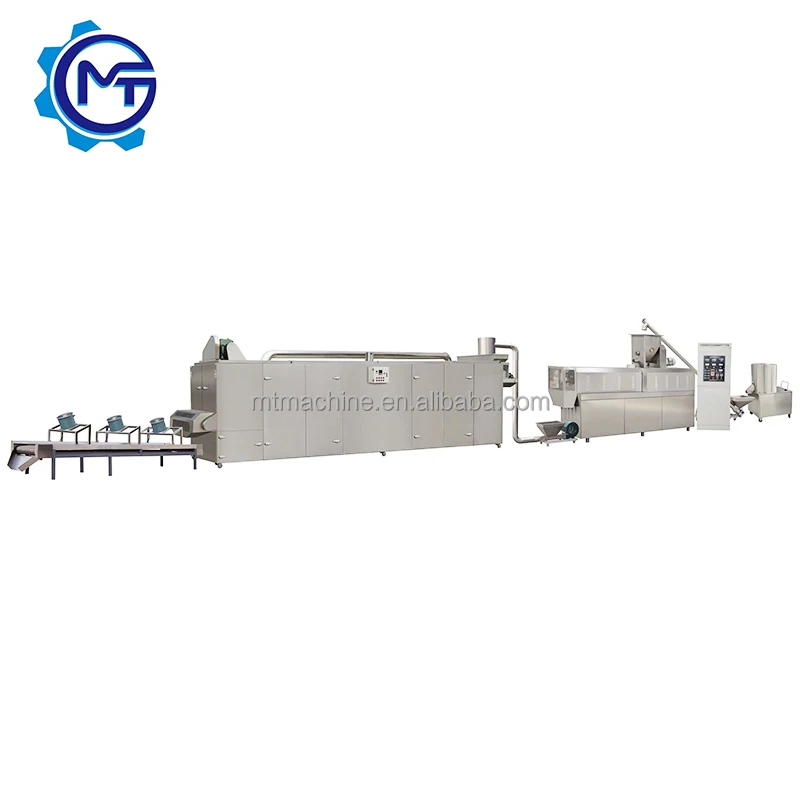
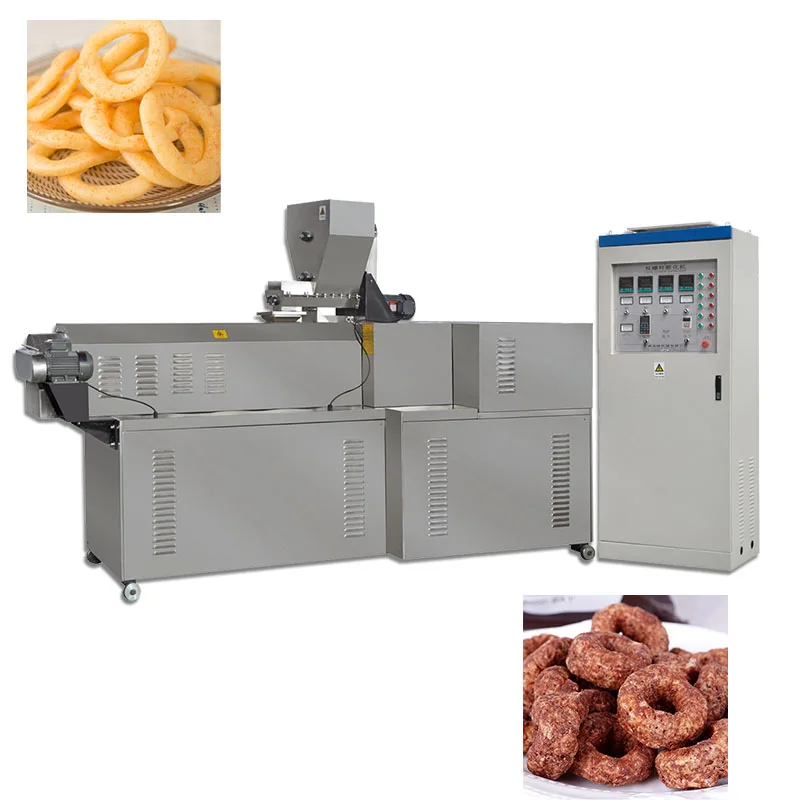
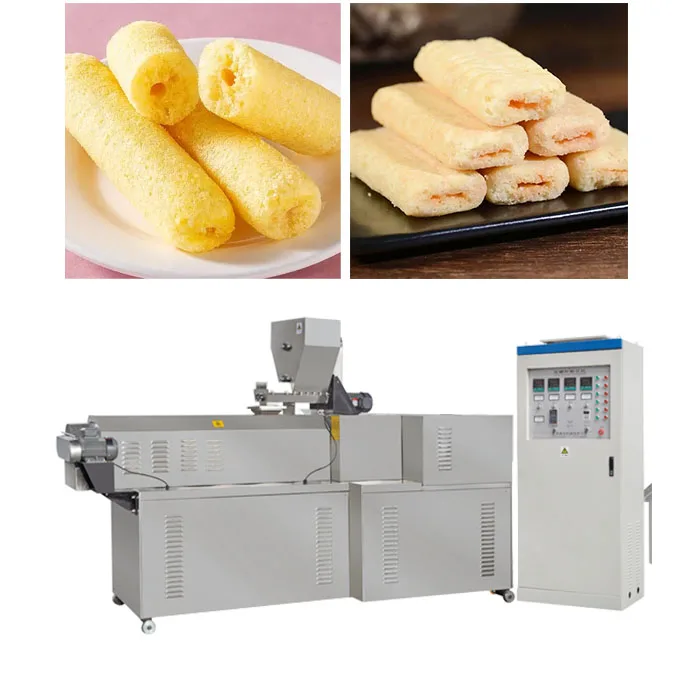
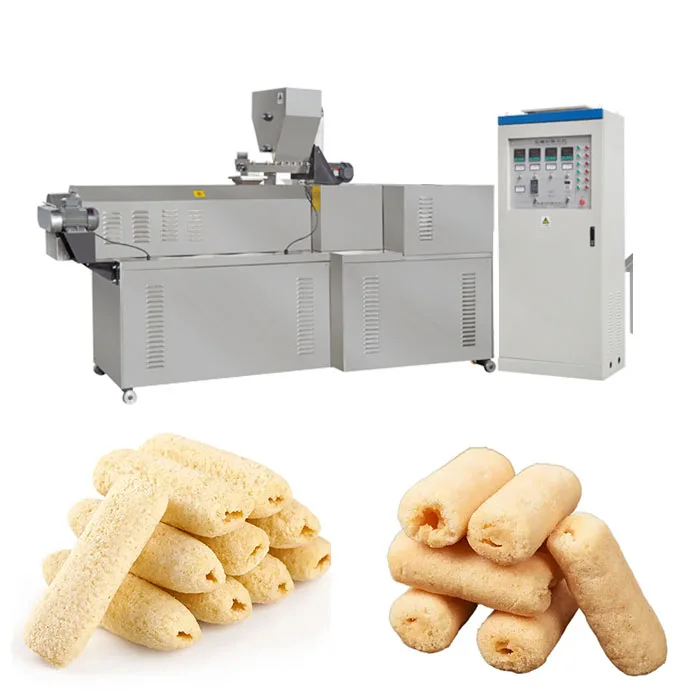
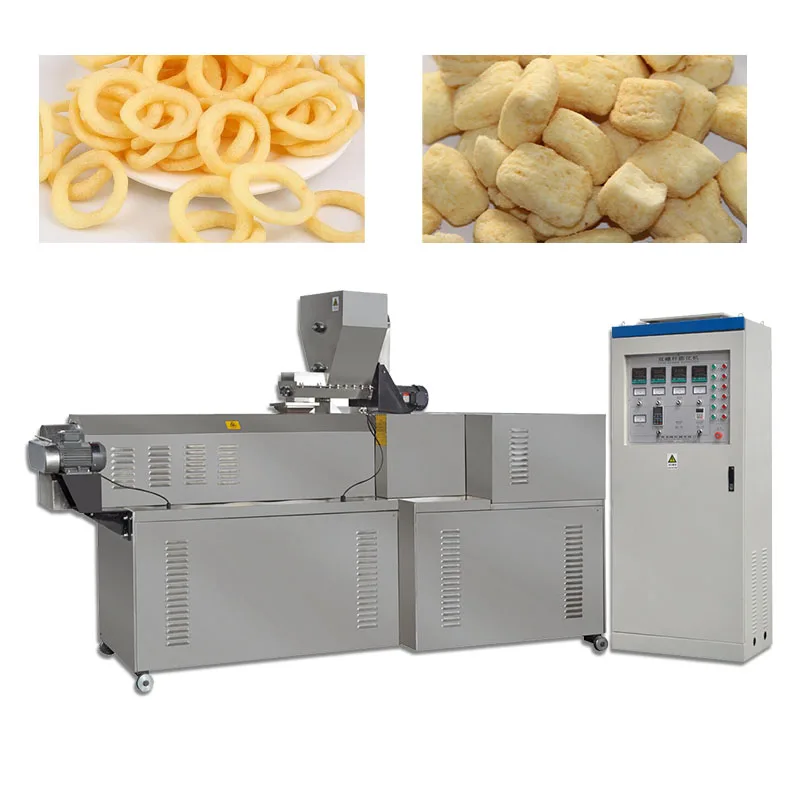
MT65 / MT70 / MT85 Corn Puffed Ball Snack Food Extrusion Line, Twin-screw, CE — complete turnkey layout from batching through extrusion, frying, seasoning to packing.
- Screw configuration and die design matched to your flour formulation, controlling moisture, shear and expansion for target ball, stick, ring or core-filled shapes
- Line stations capacity-matched under one supplier to eliminate inter-vendor bottlenecks
Trial runs on your raw material verify real output and product texture before the line ships, with full layout and electrical documentation confirmed to your site voltage.
Description
Throughput-matched integration — Every station on this corn puffed ball snack food extrusion line turnkey layout is capacity-balanced under one supplier, so the fryer and seasoner never starve while the extruder runs flat out.
Technical Specifications
| Parameter | Value |
|---|---|
| Model | MT65 / MT70 / MT85 |
| Product Type | Corn Puffed Ball Snack Food Extrusion Line |
| Screw Configuration | Twin-screw (Double-screw Extruder) |
| Installed Power | MT65 — 84 kW; MT70 — 132 kW; MT85 — 239 kW |
| Output Capacity | MT65 — 120–150 kg/h (basis to be confirmed); MT70 — 200–250 kg/h (basis to be confirmed); MT85 — 500–700 kg/h (basis to be confirmed) |
| Voltage & Frequency | Three-phase 380 V / 50 Hz; Single-phase 220 V (customizable per customer requirement) |
| Overall Dimensions (L×W×H) | MT65 — 21000×1200×2200 mm; MT70 — 23000×1500×2300 mm; MT85 — 28000×3500×2500 mm |
| Line Stations | Mixer → Double-screw Extruder → Multi-functional Cutting Shaper → Automatic Fryer → Eight-square Seasoner → Packing Machine |
| Raw Materials | Corn flour, rice powder, wheat flour, etc. |
| Product Shapes | Ball, stick, wheel, ring, tube, flower, animal shapes (via mould change) |
| Core-filling Capability | Yes (chocolate filled bar, cream filled pillow, rice cake, cereal bar, sheet snacks) |
| Standards | CE, ISO |
Application Suitability
| Application | Material or Output |
|---|---|
| Puffed snack production | Corn balls, shaped snacks from corn flour, rice powder, or wheat flour |
| Core-filled snack production | Chocolate bars, cream pillows, cereal bars using the same extruder platform with mould and process adjustments |
| Rusk and baked snack manufacturing | Extruded dough pieces cut and shaped before frying or baking |
Why "Nominal Capacity" Means Nothing Without Your Recipe
A corn puffed ball snack food extrusion line turnkey project quoted on paper capacity often stalls the moment the buyer’s actual flour blend hits the barrel. Real output only exists relative to a specific raw material at a specific moisture level.
I once watched a line in Bogotá sit idle for two days because the cutting station could not keep pace with the extruder once the local corn flour formulation changed the expansion ratio. The numbers on the quotation were correct; the throughput match between stations was not. Every corn puffed ball snack food extrusion line turnkey installation carries this risk when capacity is quoted in isolation [NEED_CITE: throughput matching methodology for extrusion-based snack lines]. The flour you source locally may gelatinise differently, expand more or less, and push the downstream cutting and frying stations outside their designed window.
How Screw Configuration Shapes the Final Snack
The twin-screw extruder at the heart of this line uses interchangeable moulds to produce ball, stick, ring, wheel, and animal shapes from a single platform. Screw element arrangement along the barrel determines how much shear the dough receives, which in turn controls starch gelatinisation and the expansion behaviour at the die face. Switching from a corn-dominant recipe to a rice-heavy blend typically requires a different screw profile to maintain consistent puff structure and surface texture.
Matching the Fryer and Seasoner to Actual Extruder Output
A corn puffed ball snack food extrusion line turnkey layout only holds its rated throughput when every downstream station can absorb what the extruder delivers. The multi-functional cutting shaper must cycle fast enough to handle the extrudate strand speed, and the automatic fryer must have sufficient dwell time and oil volume to finish each piece without backlog. The eight-square seasoner then needs enough tumble volume to coat uniformly at that flow rate. When one supplier provides all stations, these capacity interfaces are calculated before fabrication rather than discovered during commissioning [NEED_CITE: snack line throughput balancing principles].
Reading the Power and Dimension Data Correctly
Installed power ranges from 84 kW on the MT65 to 239 kW on the MT85, reflecting the motor and heating requirements at each capacity tier. The MT65 spans roughly 21 metres in length with a 1.2-metre width, suitable for compact workshops, while the MT85 extends to 28 metres and 3.5 metres wide, requiring a dedicated bay with adequate ceiling clearance. Voltage defaults to three-phase 380 V / 50 Hz but is configurable to single-phase 220 V or other standards, which must be confirmed before electrical panels are wired. The core-filling capability adds a co-extrusion die and filling pump to the line, allowing producers to run chocolate-filled bars or cream pillows without a separate machine investment.
What Happens When Stations Are Sourced Separately
Buying the extruder from one vendor and the fryer from another frequently results in a bottleneck that no single supplier owns. The extruder runs at full output while the fryer accumulates a queue, forcing operators to throttle back and run below capacity. I have seen this pattern repeat across Latin American snack plants where the original line was assembled from separate quotations [NEED_CITE: inter-vendor bottleneck patterns in snack food manufacturing]. The result is a line that never reaches the throughput the buyer paid for, with no single contractor responsible for the gap.
Why Sourcing the Full Line from One Supplier Changes the Equation
Every station from mixer to packing machine is specified together, so throughput calculations account for the actual product travelling between them. Screw configuration and die design are matched to the buyer’s raw material and target shape before production begins. An in-house testing workshop allows trial runs on the customer’s flour formulation, confirming texture and expansion before the line ships. Voltage, frequency, and control language are documented and confirmed during the specification phase, preventing wiring mismatches at the destination. Pre-sales engineering covers layout, utility planning, and phased installation scheduling under one project scope.
Documentation & Verification
- Line layout and capacity calculation showing throughput at every station for your product
- Trial run report on your corn or rice flour formulation verifying expansion and texture
- Electrical schematic with voltage and frequency confirmed against your site supply
- Screw and die configuration record documenting the elements installed for your recipe
- Wear parts list with spare screw and die availability for first replacement cycle
- CE declaration of conformity and ISO certificate for import clearance
Installation, Commissioning & Support
- Foundation and floor space planned around the MT65, MT70, or MT85 overall dimensions
- Dedicated electrical circuit sized to the installed power rating of the selected model
- Extruder barrel and screw assembly verified on site after shipping in protective crating
- First-run parameter setting covering barrel temperature zones, screw speed, and die pressure
- Operator training on mould changes for ball, stick, ring, and animal shapes
- Spare screw elements and die plates supplied for the initial maintenance interval
What to Include in Your Inquiry
Share the specific flour or powder blend you plan to run, including moisture content if known, along with the target product shape and whether core-filling is part of the range. Confirm your workshop dimensions and ceiling height so the line layout accounts for the footprint of the selected model. State your local voltage and frequency, plus the preferred control language for the operator interface.
Frequently Asked Questions
Q: How is the real output capacity verified against my raw material and recipe?
A: We run your actual flour formulation through the extruder in our testing workshop before the line ships. The trial run report documents expansion ratio, texture, and achievable throughput at your recipe’s moisture level, so the quoted capacity reflects your product rather than a generic benchmark.
Q: How do you ensure the fryer and seasoner capacity matches the extruder throughput?
A: All stations are specified under one project scope, so the fryer dwell volume and seasoner tumble capacity are calculated against the extruder’s verified output on your recipe. This eliminates inter-vendor gaps where one machine outpaces the next.
Q: What voltage, frequency and control language options are confirmed before shipment?
A: We confirm your site voltage and frequency during the specification phase and record it on the electrical schematic. Control language is set before the panels are wired, so the operator interface matches your team’s requirements from day one.
Q: Can I run a trial with my own flour formulation before the line ships?
A: Yes. Our in-house testing workshop is equipped for trial runs on customer-supplied raw material. You receive a trial run report showing product shape, density, and expansion behaviour before approving shipment.
Q: What is the installation, commissioning and operator training process on site?
A: An engineer arrives after the line is positioned to assemble the extruder, align the cutting shaper, and set initial process parameters. Operator training covers mould changes, temperature profiles, and routine maintenance on your specific model configuration.
Related products
-

Máquina para hacer pasteles de maíz de puff de acero inoxidable Máquinas de alimentos de bocadillos de maíz Máquina de snacks más vendida
¥8,560.00 Select options This product has multiple variants. The options may be chosen on the product page -

Nueva máquina automática para hacer snacks de harina de arroz inflado de acero inoxidable, alta productividad y multifuncional.
¥11,050.00 Select options This product has multiple variants. The options may be chosen on the product page -

Equipo de producción de extrusión de bocadillos de maíz inflado de alta productividad automático en nueva condición Máquina para hacer alimentos de bocadillos inflados
¥11,050.00 Select options This product has multiple variants. The options may be chosen on the product page -

Máquina Extrusora de Snacks de Maíz Pequeña de Puffs de Maíz de Doble Tornillo
¥100.00 Select options This product has multiple variants. The options may be chosen on the product page


