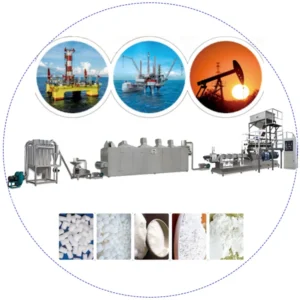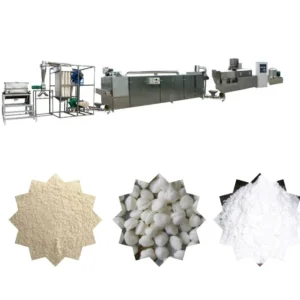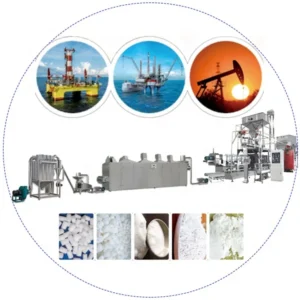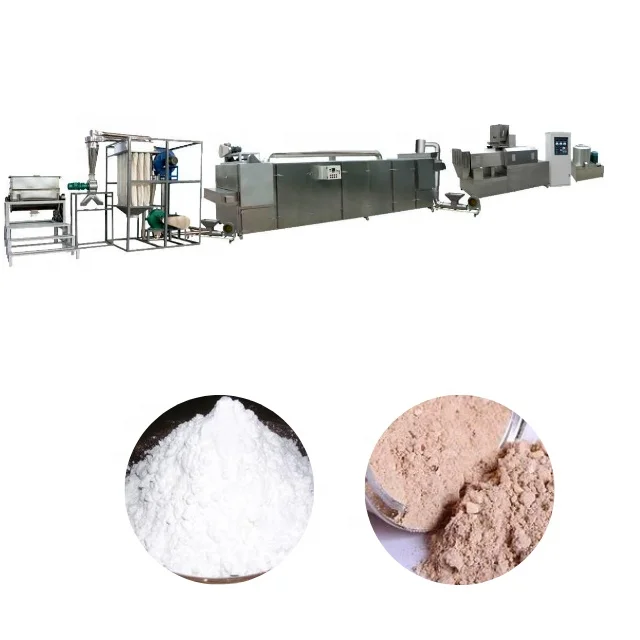


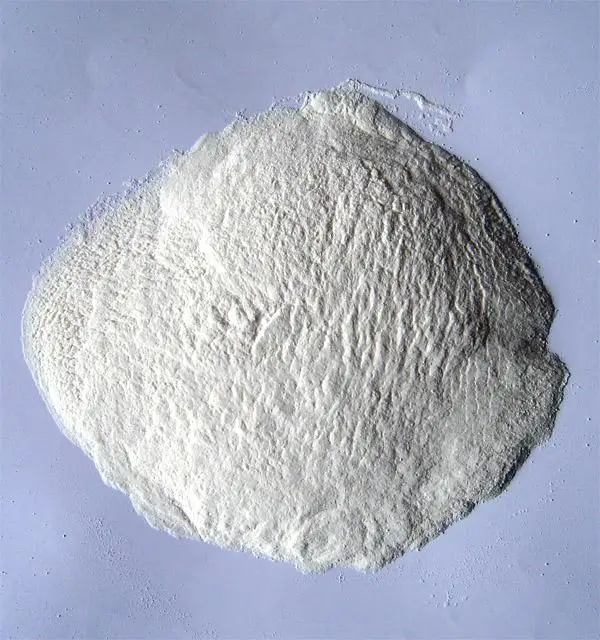
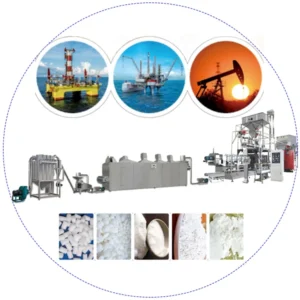
Modified Starch Processing Line, Twin-Screw, PLC & MCC Control — engineered as a complete turnkey project from batching through extrusion, cooling, grinding and packing, with every station throughput-matched to eliminate bottlenecks. Screw configuration and die design are specified to your raw material and target modification degree, whether producing food-grade additives or industrial starch for oil drilling and paper-making.
- Voltage, frequency and control language confirmed to site conditions before production
- In-house trial runs on your actual starch blend validate output before shipment
- Single supplier responsible for layout, installation, commissioning and operator training
Description
Integrated Project Delivery — Every station from batching to packing is engineered under one responsibility so the extruder, cooling conveyor, and grinder run at matched throughput rather than being assembled from disconnected vendors.
Technical Specifications
| Parameter | Value |
|---|---|
| Product Type | Twin-Screw Extrusion Modified Starch Processing Line |
| Screw Type | Twin-screw |
| Output Capacity | 100–1500 kg/h (basis not stated in source — confirm raw material type, moisture content and degree of modification) |
| Rated Power | 45–200 kW |
| Voltage & Frequency | 220–440 V, tri-phase (exact Hz to be confirmed per buyer market) |
| Control System | PLC and MCC |
| Line Stations | Mixing/batching → twin-screw extruder → cooling conveyor → pulse grinder → packing |
| Contact Materials | Food-grade stainless steel on product-contact parts; some conveyors with PVC |
| Heating Fuel Options | Gas, diesel, electricity, or steam (buyer to specify at quotation) |
| Standards | CE (since 2014), ISO certified |
Application Suitability
| Application | Material or Output |
|---|---|
| Food additive production for bakery and sauce manufacturers | Corn starch, wheat flour, potato starch with additive blends |
| Oil drilling fluid additive manufacturing | Industrial-grade starch blends for viscosity control |
| Paper-making additive processing | Pregelatinised starch from tuber and grain sources |
| Nutritional grain-based powder processing | Fortified starch and protein blends for infant formula or dietary supplements |
| Modified starch for convenience food | Pre-cooked and cross-linked starch from tapioca, corn, or wheat |
What "1000 kg per Hour" Really Means on Your Starch Blend
Line capacity must be verified on your actual raw material before the equipment ships, not quoted from a catalogue number.
I spent two weeks on-site in Southeast Asia re-tuning a modified starch processing line turnkey installation because the trial runs used pure corn starch, but the buyer’s real formulation blended in tapioca. The gelatinisation temperature shifted, expansion dropped, and the grinder choked on denser output. Throughput fell to roughly half of what the nameplate promised. [NEED_CITE: starch gelatinisation temperature variation by raw material source] When a line is quoted on nominal capacity without a trial on the buyer’s specific blend, the real output often diverges significantly from the proposal.
Throughput Matching Across Every Station
A modified starch processing line turnkey project succeeds or fails on whether every station keeps pace with the extruder. If the cooling conveyor cannot shed heat fast enough for the extruder’s output, starch retrogrades before grinding. If the pulse grinder is undersized, material backs up and the entire line stalls. We calculate effective capacity at each station based on the buyer’s target modification degree, then size the cooling conveyor length and grinder motor accordingly so no single station becomes the bottleneck.
Utility Planning Before the First Bolt Goes Down
Power draw across the extruder, dryer, grinder, and control cabinets must map to the site’s available supply. A modified starch processing line turnkey installation drawing 200 kW at peak load needs a dedicated transformer circuit — sharing a bus bar with other production lines causes voltage sag that trips the PLC mid-run. [NEED_CITE: industrial voltage sag impact on PLC-controlled extrusion lines] We confirm voltage, frequency, and phase with the buyer’s electrical contractor before production begins, then configure the MCC and all motor drives to match.
How Screw Configuration Decides Your Modification Degree
The twin-screw extruder in this line relies on screw element arrangement and die geometry to control shear, residence time, and pressure inside the barrel. For pregelatinised starch, longer residence time with moderate shear preserves granule structure. For cross-linked industrial starch, higher shear and tighter die clearance increase the degree of molecular breakdown. The screw combination is selected after reviewing the buyer’s raw material specification and target viscosity curve, not copied from a generic build. Die diameter and hole count are matched to the cooling conveyor speed so extrudate strands cool uniformly before entering the pulse grinder.
When the Wrong Configuration Costs You Weeks
An extruder running a generic screw profile on a modified starch blend often produces material that is either under-gelatinised or over-degraded. Under-gelatinised starch fails the buyer’s viscosity specification and gets rejected by the downstream food or industrial customer. Over-degraded starch loses functional properties and must be sold as low-value waste. [NEED_CITE: economic impact of off-spec modified starch batches] The grinder then struggles with inconsistent particle density, generating excessive fines that overload the dust collector. These problems only surface after installation, when reconfiguring the line delays production by weeks.
Why Source the Entire Line From One Supplier
Complete line engineering from batching through packing under one supplier means throughput calculations are consistent across every station. The screw configuration and die design are specified to the buyer’s raw material rather than pulled from a standard library. In-house trial runs on the buyer’s actual starch blend validate capacity and product quality before shipment. PLC and MCC programming covers the full line so start-up sequences, speed synchronisation, and fault diagnostics operate as one system. Documentation — from line layout to screw configuration records — is issued as a unified package rather than fragmented across multiple vendors.
Documentation & Verification
- Line layout drawing with throughput calculation at every station from batching to packing
- Trial run report on buyer’s actual starch blend conducted in the testing workshop before shipment
- Screw and die configuration record matched to the buyer’s formulation and modification target
- Electrical schematic with voltage, frequency, and control language confirmed to site conditions
- Factory test record verifying coordinated start-up across extruder, cooling conveyor, and grinder
Installation, Commissioning & Support
- Foundation plan sized to the extruder’s 1000–5000 kg line weight and vibration profile
- Dedicated power circuit configured for 45–200 kW draw at the confirmed voltage and frequency
- Modular station delivery with phased assembly sequence to fit workshop access constraints
- First-run parameter tuning on buyer’s raw material with PLC recipe storage for repeat batches
- Operator training covering screw element swaps, die changes, and pulse grinder screen replacement
- Wear parts list specifying screw segments, die plates, and grinder screens with interchange intervals
Preparing Your Project Brief
To move forward with a modified starch processing line turnkey proposal, we need your raw material specification including starch source and any additive percentages, your target modification degree or viscosity range, and the daily output volume you plan to sustain. Share your workshop dimensions, available electrical supply, and preferred control language so the layout and MCC programming align with site conditions from day one. If you have existing upstream mixing or downstream packing equipment, let us know so the new line interfaces correctly.
Frequently Asked Questions
Q: How is line capacity verified against my specific raw material and modification target?
A: We run trial extrusion on your actual starch blend in our in-house testing workshop before the line ships. The trial records throughput, product viscosity, and expansion behaviour under the proposed screw configuration. Results are documented in a trial run report shared with you before quotation finalisation, so the capacity figure reflects your real material rather than a generic benchmark.
Q: What is the phased installation and commissioning schedule for a complete modified starch plant?
A: Installation typically follows a sequence of foundation work, station positioning, utility connection, and control system integration. Commissioning begins with individual station dry runs, then progresses to full-line wet trials using your raw material. Operator training runs in parallel with the final commissioning phase so your team is confident at handover.
Q: How do you ensure throughput matching between the extruder, cooling conveyor and grinder?
A: Each station is sized based on the extruder’s effective output on your specific starch formulation, not its catalogue rating. The cooling conveyor length is calculated for the required heat removal rate, and the pulse grinder motor and screen area are matched so neither station creates a bottleneck at sustained production speed.
Q: Can the line handle both food-grade and industrial-grade starch production on the same equipment?
A: The extruder and grinder can process both categories, but product-contact materials and cleaning protocols differ. Food-grade runs require full stainless steel contact surfaces and validated wash-down procedures. If you plan to alternate, we configure the line with quick-change contact parts and separate documentation packages for each production mode.
Q: What operator training and documentation are included at handover?
A: Training covers PLC operation, screw and die configuration changes, pulse grinder maintenance, and fault diagnosis through the MCC interface. Documentation includes the operation manual, electrical schematic, screw configuration record, wear parts list, and the trial run report from your pre-shipment testing.
Related products
-
Máquina Automática de Fabricación de Almidón Modificado Línea de Producción de Procesamiento de Almidón para Perforación de Petróleo
¥30.00 Select options This product has multiple variants. The options may be chosen on the product page -
High-Efficiency Customizable Modified Starch Production Line – Automatic Corn Pellet Adhesive Making Equipment
¥65.00 Select options This product has multiple variants. The options may be chosen on the product page -
Modified Starch for Construction Adhesives Production – Custom Built Double Screw Extruder Line
¥65.00 Select options This product has multiple variants. The options may be chosen on the product page -
Modified and Pregelatinized Starch Processing Equipment – Pregelatinized Corn Cassava Modified Starch Puffing Machine
¥65.00 Select options This product has multiple variants. The options may be chosen on the product page