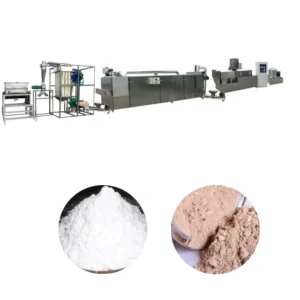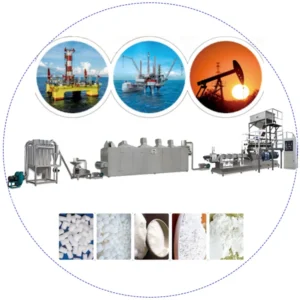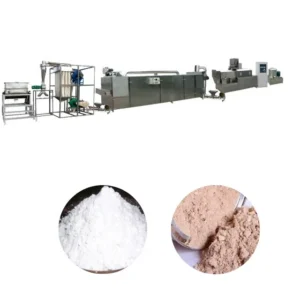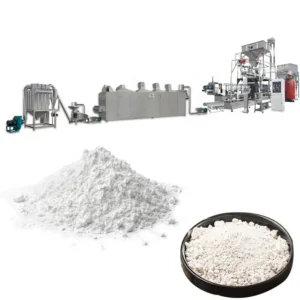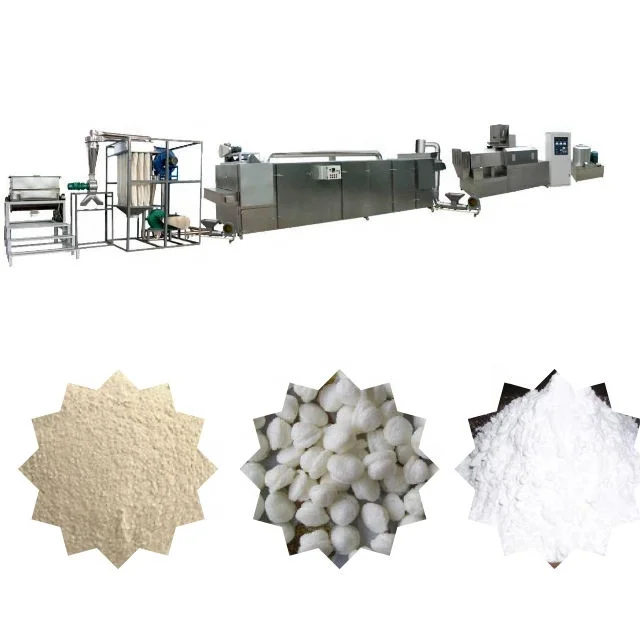




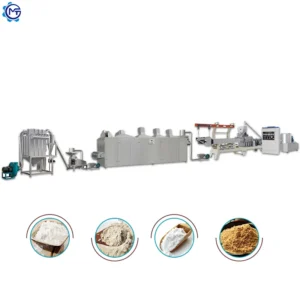
Modified Starch Extrusion Line, Twin-Screw, Food-Grade 304 Contact Parts — configured as a complete turnkey project from batching through extrusion, drying, conditioning and grinding. Screw profile and die geometry are matched to your raw starch source and target gelatinisation degree, with throughput balanced at every station to prevent bottlenecks. Multiple heating options available including electricity, gas, diesel or steam to suit site utilities.
- Pre-shipment trial runs on your actual raw material confirm real-world output before delivery.
Description
Turnkey Starch Line Integration — Every station from mixer to grinder is throughput-matched under one supplier, eliminating the hidden bottlenecks that surface only when a starch line is assembled from separate vendors and commissioned on site.
Technical Specifications
| Parameter | Value |
|---|---|
| Product Type | Modified Starch Extrusion Line |
| Screw Type | Twin screw |
| Capacity Range | 80–500 kg/h (basis not stated in source — confirm raw material / moisture / target starch type) |
| Raw Materials | Wheat flour, corn starch, potato starch |
| Line Stations | Mixer → Screw Conveyor → Twin Screw Extruder → Air Conveyor → Dryer → Air Conveyor → Conditioning → Conveyor → Grinder |
| Mixer Motor | 4.0 kW |
| Mixer Dimensions | 1.2 × 0.9 × 1.4 m |
| Screw Conveyor Motor | 1.1 kW |
| Screw Conveyor Output | 0–150 kg/h (source value — verify against manufacturer catalog) |
| Screw Conveyor Dimensions | 2.5 × 0.6 × 2.3 m |
| Extruder Barrel Material | 45 steel |
| Frame Material | Stainless steel 201 |
| Contact Material | Food grade stainless steel 304 |
| Control System | PLC / MCC (line-level detail available on request) |
| Energy Options | Electricity, gas, diesel, steam |
| Total Electrical Power | ~100 kW (electric heating); ~50–60 kW (gas/diesel heating) (source value — verify against manufacturer catalog) |
| Voltage & Frequency | Three phases 380V/50Hz; Single phase 220V/50Hz (customizable to local voltage) |
| Assembly State | Complete line |
| Standards | CE certified |
Application Suitability
| Application | Material or Output |
|---|---|
| Pregelatinized starch for food processing | Corn starch, potato starch at controlled moisture and gelatinization temperature |
| Modified starch for paper and textile sizing | Wheat flour and corn starch with adjusted barrel temperature profile |
| Nutritional and functional starch ingredients | Blended starches requiring precise shear and residence time in twin-screw extruder |
| Industrial-grade pregelatinized starch | High-amylose corn starch processed through matched drying and grinding stations |
What "80 to 500 kg/h" Actually Means on Your Starch
A capacity number without a raw material basis is a guess — we trial-run on your actual starch before the line ships.
I spent weeks on a cassava pregelatinization line in Nigeria last year where the extruder ran perfectly on the starch used at factory testing. The moment the buyer switched to their local corn starch, the gelatinization temperature dropped short, the output came out pale and undercooked, and two tonnes of material went to waste. The screw configuration and barrel temperature profile had never been matched to the actual feedstock. A modified starch processing line turnkey project only delivers its rated output when the throughput claim is anchored to a specific raw material, moisture level, and target degree of gelatinization [NEED_CITE: starch gelatinization temperature variation by raw material source].
Sequencing Every Station to One Throughput Target
A modified starch processing line turnkey is not simply an extruder with a dryer bolted on. The mixer output per batch, the screw conveyor feed rate, the extruder screw speed, the dryer belt length and air temperature, and the grinder throughput must all resolve to the same kilogram-per-hour figure. When one station lags, the entire line stalls or overfeeds downstream. This line is configured as a single sequence where each station is sized against the others, so material flow remains continuous from batching through final grinding.
Utility Planning Before the Foundation Is Poured
The choice between electric, gas, diesel, or steam heating changes the utility infrastructure the buyer must prepare. Electric heating draws roughly 100 kW total, requiring a dedicated transformer and three-phase supply at the specified voltage and frequency. Gas or diesel heating cuts electrical demand to approximately 50–60 kW but needs fuel storage, venting, and combustion air provisions on site. Steam integration demands a boiler sized to the dryer and conditioning station requirements [NEED_CITE: industrial steam boiler sizing for food processing lines]. Confirming these utility parameters before equipment production avoids costly rewiring or pipe rerouting after arrival.
Reading the Specs That Matter for Starch Extrusion
The twin-screw configuration allows independent control of shear, residence time, and temperature across multiple barrel zones — critical when gelatinization must occur within a narrow temperature window without degrading the starch polymer. Barrel material in 45 steel provides the wear resistance needed for continuous abrasive starch contact, while food-grade 304 stainless steel on all product contact surfaces meets hygiene requirements for food and nutritional applications. The PLC or MCC control system records barrel temperature profiles and screw speed settings for each production run, ensuring batch-to-batch consistency across different starch types. Mixer dimensions at 1.2 × 0.9 × 1.4 m with a 4.0 kW motor handle batch pre-conditioning before the screw conveyor meters material into the extruder at a controlled rate.
The Cost of a Mismatched Dryer or Grinder
When the dryer capacity is specified against a generic output figure rather than the actual extruder throughput on your starch, moisture removal falls short. Pregelatinized starch that enters the grinder with residual moisture clumps, screens blind, and the grinder motor overloads. The buyer then faces a choice between reducing line speed to match the dryer — surrendering the throughput they paid for — or replacing the dryer after installation. I have seen this mismatch force a complete line shutdown in humid tropical climates where ambient moisture compounds the drying deficit [NEED_CITE: effect of ambient humidity on industrial dryer performance in starch processing].
Why Source the Entire Line from One Supplier
Every station in this modified starch processing line turnkey project is designed, assembled, and tested together before shipment, so throughput matching is verified in the factory rather than discovered on the buyer’s floor. The screw configuration and die design are specified against the buyer’s raw material and target starch property, not copied from a generic build. An in-house testing workshop runs the buyer’s actual starch through the extruder before dispatch, catching gelatinization and density issues before they become on-site failures. Pre-sales line layout and capacity calculation documents map each station’s throughput so the buyer can verify the sequence before committing to production. On-site installation, commissioning, and operator training are handled by the same team that assembled the line, eliminating the blame-shifting that occurs when separate vendors supply individual machines.
Documentation & Verification
- Line layout drawing with throughput calculation at each station from mixer through grinder
- Trial run report produced on buyer’s specific starch raw material before shipment
- Screw and die configuration record matched to target pregelatinization or modification degree
- Electrical schematic with voltage and frequency confirmed to destination country grid standard
- CE declaration of conformity covering the complete assembled line
- Operation and maintenance manual with wear parts list for screws, dies, and dryer belts
Installation, Commissioning & Support
- Foundation plan provided showing footprint for full station sequence from mixer to grinder
- Dedicated three-phase circuit sized to 100 kW electric heating load or 50–60 kW gas/diesel option
- Line arrives in station modules with air conveyor ducting assembled on site by installation team
- First production run conducted on buyer’s starch with barrel temperature profile tuning and screw speed adjustment
- Operator training covers PLC interface, batch recipe storage, and emergency stop sequences across all stations
- Wear parts list includes twin-screw elements, die plates, and dryer belt sections with replacement intervals
What We Need to Configure Your Line
To prepare a line layout and capacity calculation for your modified starch processing line turnkey project, we need the specific starch type you will process, the target degree of gelatinization or modification, and your required output per hour on that material. Provide the local voltage and frequency at your facility, the available energy source for heating, and the workshop dimensions including ceiling height. If you have existing upstream batching or downstream packing equipment, share the interface specifications so the line can be matched to your current production flow.
Frequently Asked Questions
Q: How is line throughput verified against my specific starch raw material and moisture content?
A: Before shipment, the buyer’s actual starch is run through the twin-screw extruder in the testing workshop. Barrel temperature profile, screw speed, and die configuration are adjusted until the target gelatinization degree is achieved. A trial run report documenting throughput, product color, and moisture content at each station is provided so the buyer can confirm the line meets specifications before it leaves the factory.
Q: What is the phased installation and commissioning schedule for a complete starch line?
A: Station modules arrive sequentially — mixer and conveyor first, followed by extruder, then dryer and grinder. Mechanical assembly and utility connections are completed before electrical commissioning begins. The extruder is run on site with the buyer’s starch, and dryer temperature and grinder screen size are fine-tuned. Operator training runs alongside the first production shifts until the team is confident managing the PLC interface independently.
Q: How are upstream and downstream stations matched to extruder output?
A: The mixer batch cycle time and screw conveyor feed rate are calculated to sustain the extruder’s continuous throughput without starvation or overflow. Downstream, the dryer belt length and air temperature are sized so moisture removal keeps pace with extruder discharge. The grinder is selected to handle the dried starch volume at the target particle size without bottlenecking the line.
Q: What utility planning is required before equipment arrival?
A: The buyer must prepare a three-phase electrical supply at the confirmed voltage and frequency, with capacity for the selected heating option. If gas or diesel heating is chosen, fuel storage and venting infrastructure must be ready. Compressed air connections for pneumatic valves and air conveyors are mapped in the layout drawing provided before production begins.
Q: Is operator training included, and what does the commissioning handover cover?
A: The installation team trains operators on PLC or MCC control operation, batch recipe entry, screw speed and barrel temperature adjustment, and emergency shutdown procedures for each station. The handover includes the operation manual, wear parts list with replacement schedules, and the trial run report from the buyer’s starch. Ongoing maintenance support is available after commissioning is complete.
Related products
-
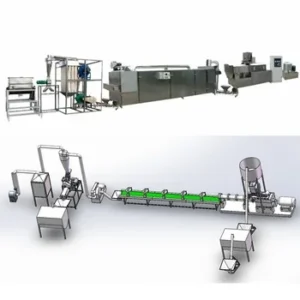
2025 Nuevo Diseño Almidón Modificado Gran Capacidad Uso Industrial Aditivos Alimentarios Componentes Principales Rodamiento de Motor
¥50.00 Select options This product has multiple variants. The options may be chosen on the product page -
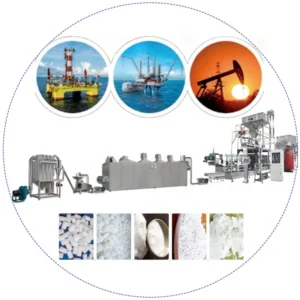
Línea de producción automática de almidón de tapioca modificado, molino de harina de acero inoxidable 304 y máquina de panadería
¥30.00 Select options This product has multiple variants. The options may be chosen on the product page -
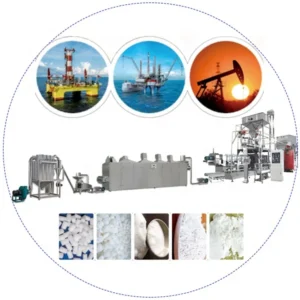
Pre-gelatinized Starch Production Line – Modified Starch Integrated Puffing Equipment
¥65.00 Select options This product has multiple variants. The options may be chosen on the product page -
Automatic Deep Processing Machine – Food Grade Modified & Pregelatinized Starch Manufacturing Line
¥65.00 Select options This product has multiple variants. The options may be chosen on the product page