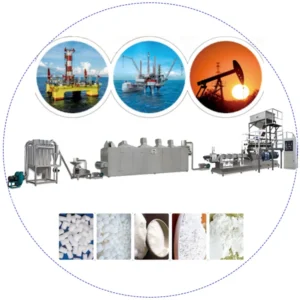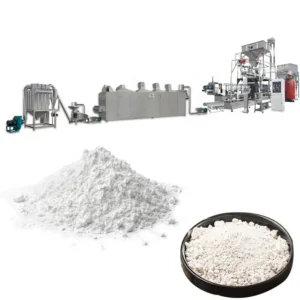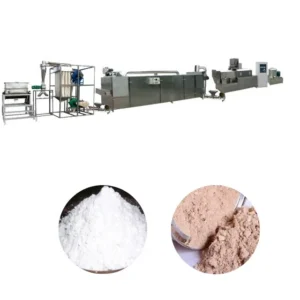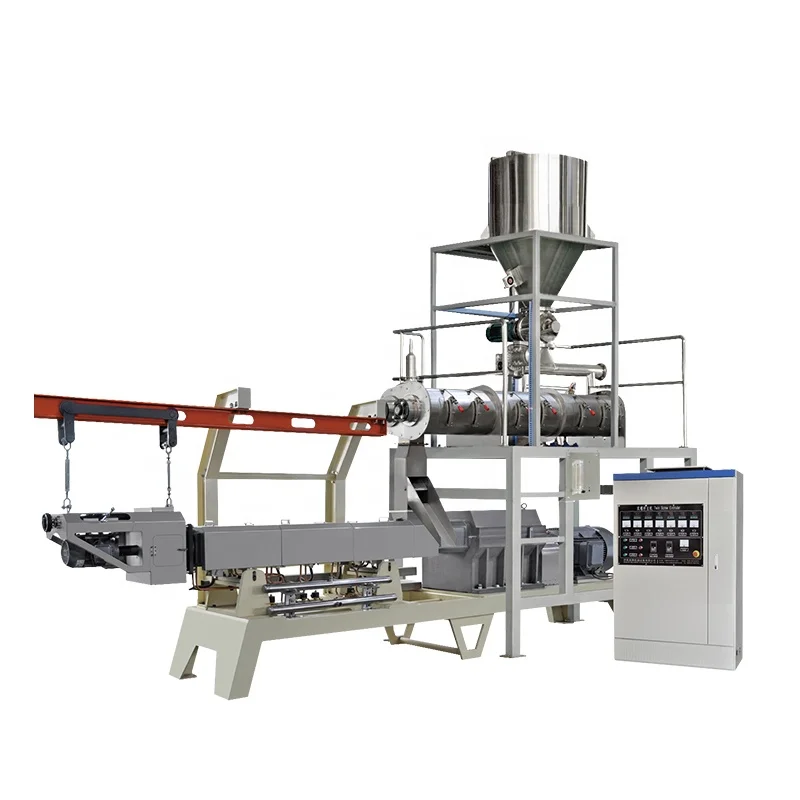


MT65 / MT70 / MT75 Modified Starch Extrusion Production Line, Twin-Screw, 380V 50Hz — configured for consistent starch modification across food and industrial grades.
- Throughput matched across mixing, extrusion, drying and pulse grinding stations under one supplier
- Screw configuration and barrel zones adapted to target modification degree and raw material characteristics
- Dryer with fuel, gas or electric heating and adjustable temperature profiles for precise moisture control
Layout, capacity calculation and trial run report on buyer’s raw material provided before shipment.
Description
Turnkey Line Integration — Throughput at every station from flour mixing to pulse grinding is calculated against the same raw material basis, preventing the extruder from outrunning the dryer or grinder on a modified starch production line turnkey.
Technical Specifications
| Parameter | Value |
|---|---|
| Product Type | Modified Starch Extrusion Production Line |
| Model | MT65 / MT70 / MT75 |
| Screw Type | Twin-screw |
| Installed Power | MT65: 110 kW; MT70: 160 kW; MT75: 190 kW |
| Power Consumption | MT65: 90 kW; MT70: 140 kW; MT75: 150 kW |
| Output Capacity | MT65: 100–150 kg/h (basis to be confirmed); MT70: 150–200 kg/h (basis to be confirmed); MT75: 300–350 kg/h (basis to be confirmed) |
| Overall Dimensions (L×W×H) | MT65: 40,000 × 1,500 × 2,200 mm; MT70: 41,000 × 1,500 × 2,200 mm; MT75: 43,000 × 1,500 × 3,200 mm |
| Voltage & Frequency | 380 V / 50 Hz, Three Phase (standard; other voltages configurable) |
| Line Stations | Flour Mixer → Screw Conveyor → Twin Screw Extruder → Air Conveyor → Roasting Oven → Air Conveyor → Pulse Grinder |
| Mixer Batch Capacity Options | 20–30 kg/batch, 70–80 kg/batch, or 170–180 kg/batch |
| Mixer Construction | Stainless steel 201 or 304 |
| Dryer Heating Options | Fuel, gas, or electric; adjustable temperature and dwell time |
| Pulse Grinder Mesh | 100–120 mesh, stainless steel contact parts, integrated dedusting |
| Grinder Drive Motor | 15 kW |
| Assembly State | Complete turnkey production line |
| Warranty | 1 year complete guarantee, life-time maintenance service |
| Certification | CE |
Application Suitability
| Application | Material or Output |
|---|---|
| Pregelatinised starch for food processing | Corn starch, cassava starch, rice starch |
| Denatured starch for textile sizing | Corn starch, potato starch |
| Modified starch for paper coating and corrugation | Cassava starch, wheat starch |
| Modified starch for oil drilling fluids | Corn starch, tapioca starch |
| Modified starch for construction additives | Corn starch, rice starch |
| Nutritional and infant formula powders | Rice, sesame, grain blends |
What "Rated Capacity" Leaves Out on a Starch Line
The number on the nameplate means nothing unless it names the raw material and moisture content behind it.
When buyers compare extrusion lines on output alone, they often miss that quoted figures were generated on one specific starch — usually corn at a fixed moisture level. Switch to cassava or rice starch and the gelatinisation temperature shifts, the residence time requirement changes, and the same screw speed that gave you consistent expansion on corn may leave you with under-cooked, uneven product [NEED_CITE: starch gelatinisation temperature variance across corn, cassava, and rice]. On a modified starch production line turnkey, this mismatch between the quoted figure and actual throughput shows up within the first production shift. I once watched a line lose an entire day of output because the screw profile had been set for corn while the buyer’s mill was feeding cassava — expansion collapsed, the dryer couldn’t keep up with the wetter discharge, and the grinder choked on agglomerates.
Barrel Zone Profile and Screw Element Sequencing
The twin-screw extruder is the point where raw starch undergoes thermo-mechanical conversion. Barrel zones are arranged so that feed sections stay cool enough to prevent premature gelatinisation while downstream zones reach the temperatures required for the target modification — oxidation, cross-linking, or pregelatinisation. Screw elements are sequenced with conveying segments for steady material advance, kneading blocks for shear intensity, and reverse elements where dwell time must increase without raising screw speed. Getting this configuration right on a modified starch production line turnkey is what separates a consistent product from one that varies batch to batch.
Dryer and Grinder Matching to Extruder Discharge
Starch exits the extruder at high moisture and must be dried to a target level before grinding. The multi-layer roasting oven uses adjustable temperature zones and variable chain speed so that dwell time matches the moisture load arriving from the extruder. If the dryer is undersized relative to extruder output, starch accumulates with residual moisture and the pulse grinder produces clumps instead of uniform powder. The grinder’s 100–120 mesh screen and integrated dedusting system are specified to handle the dried starch at the line’s designed throughput, not at some theoretical maximum [NEED_CITE: industrial starch powder fineness requirements by end-use sector].
Power Draw, Footprint, and Utility Planning
Installed power ranges across the three models reflect differences in motor size, dryer heating capacity, and grinder drive. Actual consumption figures are lower, which matters when sizing transformers and cable runs at the facility. Line length extends beyond 40 metres for all models, so the installation bay needs clear floor space plus access on both sides for maintenance. The MT75 stands taller at 3,200 mm compared to 2,200 mm for the smaller models, which affects overhead clearance for ductwork and air conveyor routing. Voltage is set at 380 V / 50 Hz three-phase as standard but must be confirmed against the destination site’s supply before the electrical cabinet is wired — arriving with the wrong voltage configuration can delay commissioning by weeks while replacement contactors and drives are sourced [NEED_CITE: voltage and frequency standards by export market].
The Cost of Skipping a Raw Material Trial
Lines configured on assumed starch behaviour often arrive at the buyer’s plant with a screw combination that was never tested on the actual feedstock. The result is a commissioning period spent chasing parameters — adjusting feed rate, barrel temperatures, and moisture addition in small increments while producing off-spec product that cannot be sold. In some cases the die geometry itself is wrong for the expansion ratio the target starch requires, meaning new tooling must be fabricated after the line is already installed. This is the hidden cost that never appears in the initial quotation [NEED_CITE: extrusion commissioning delays from untested screw configurations].
Why Procurement Should Cover the Full Line
A modified starch production line turnkey sourced from a single supplier means the mixer batch size, extruder throughput, dryer capacity, and grinder feed rate are all calculated together. The flour mixer options — 20–30 kg, 70–80 kg, or 170–180 kg per batch — are matched to the extruder model so that continuous feed is maintained without surge or starvation. The screw conveyor between mixer and extruder is sized for the same mass flow. Dryer heating method — fuel, gas, or electric — is selected based on site utility availability and energy cost at the destination. The pulse grinder is configured with stainless steel contact parts and a dedusting loop that handles the specific powder volume the line produces. Every documentation package includes a screw and die configuration record tied to the buyer’s raw material, a trial run report from the in-house testing workshop, and electrical schematics with confirmed voltage and control language. Installation support covers foundation layout for the 40+ metre line footprint, utility connection points for each station, and operator training on parameter adjustment for different starch types. Spare wear parts lists identify screw sections, die plates, grinder screens, and dryer chain components with part numbers so that first replacements can be ordered before the originals wear through.
Documentation & Verification
- Line layout and capacity calculation showing throughput balance across all seven stations
- Screw and die configuration record matched to your specific starch type and modification target
- Trial run report on your raw material from the in-house testing workshop before shipment
- Electrical schematic with confirmed voltage, frequency, and control panel language
- Factory acceptance test record with temperature profile and product samples
- CE declaration of conformity and ISO certificate for the complete line
Installation, Commissioning & Support
- Foundation plan for 40+ metre line length with anchoring points for extruder and grinder
- Dedicated power circuit sized for model-specific installed power up to 190 kW
- Modular station delivery with on-site alignment of air conveyors between extruder, dryer, and grinder
- First-run parameter setting on buyer’s raw material including barrel zone temperatures and screw speed
- Operator training covering screw combination changes for different starch modification types
- Wear parts list with part numbers for screws, dies, grinder screens, and dryer chain links
Preparing Your Inquiry
To configure a modified starch production line turnkey that actually holds its rated output on your material, share the starch source (corn, cassava, rice, or other), the target modification type, and your required daily production volume. Include your facility’s voltage and frequency, available heating fuel for the dryer, and the ceiling height of the installation bay. If you have existing upstream milling or downstream packing equipment, provide interface details so the line endpoints can be matched.
Frequently Asked Questions
Q: How is line capacity verified against my raw material?
A: Quoted output figures are based on specific starch types and moisture levels. Before final configuration, your raw material is run through the extruder in the in-house testing workshop. The trial report documents actual throughput, expansion ratio, and gelatinisation degree achieved, so the capacity figure you receive reflects your material, not a generic benchmark.
Q: How are screw and barrel settings chosen for different starch modifications?
A: Screw element sequencing and barrel zone temperatures are adjusted based on whether the target is pregelatinised, oxidised, or cross-linked starch. Kneading block intensity, residence time, and peak barrel temperature all change with the modification type. The configuration record supplied with the line documents every element position and temperature setpoint for your product.
Q: What electrical and control options are available for my market?
A: Standard supply is 380 V / 50 Hz three-phase, but voltage and frequency are confirmed before production to match destination requirements. Control panel language is set to the operator’s preference. Electrical schematics are delivered with the line so local electricians can trace every circuit during installation and future maintenance.
Q: Can the line handle multiple starch sources without reconfiguration?
A: The twin-screw extruder allows screw combination changes, and barrel zone temperatures are independently adjustable, so switching between corn, cassava, and rice starch is possible. However, each starch type requires its own documented screw configuration and temperature profile. The trial run process establishes these profiles before the line ships.
Q: How is throughput balanced between extruder, dryer, and grinder?
A: Each station is sized so that mass flow matches across the entire line. The mixer batch cycle, extruder feed rate, dryer dwell time, and grinder capacity are all calculated from the same production target. This prevents situations where the extruder produces faster than the dryer can handle or the grinder receives material still too wet for proper milling.
Related products
-
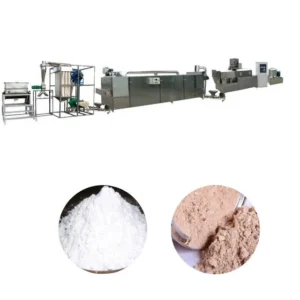
Cassava Corn Potato Flour Starch Production Line – Industrial Pregelatinized & Modified Extrusion Machinery
¥65.00 Select options This product has multiple variants. The options may be chosen on the product page -
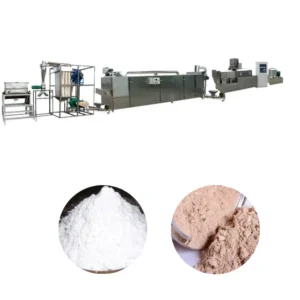
Línea de Producción de Almidón Modificado Línea de Procesamiento de Almidón Modificado Extrusora de Almidón Modificado
¥8,580.00 Select options This product has multiple variants. The options may be chosen on the product page -
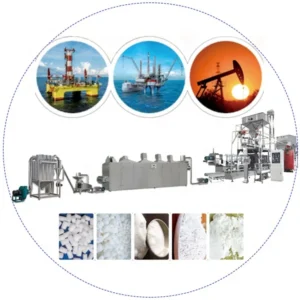
Automatic Industrial Adhesive Starch Modification Production Line – Pre-Gelatinization Extrusion Equipment
¥65.00 Select options This product has multiple variants. The options may be chosen on the product page -
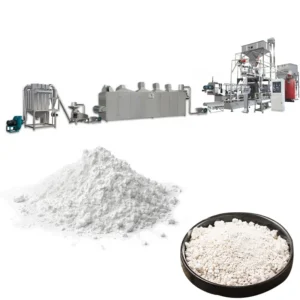
High-Efficiency Customizable Modified Starch Production Line – Automatic Corn Pellet Adhesive Making Equipment
¥65.00 Select options This product has multiple variants. The options may be chosen on the product page