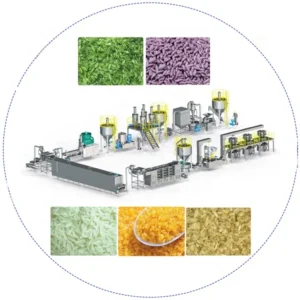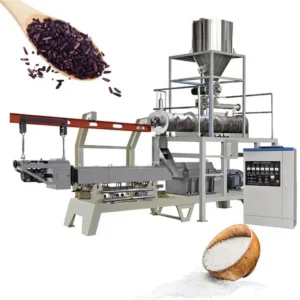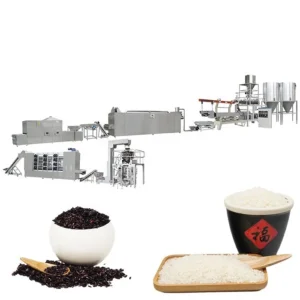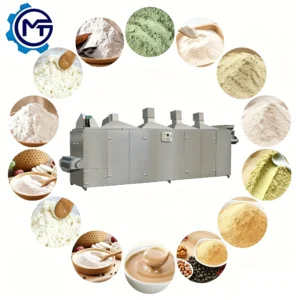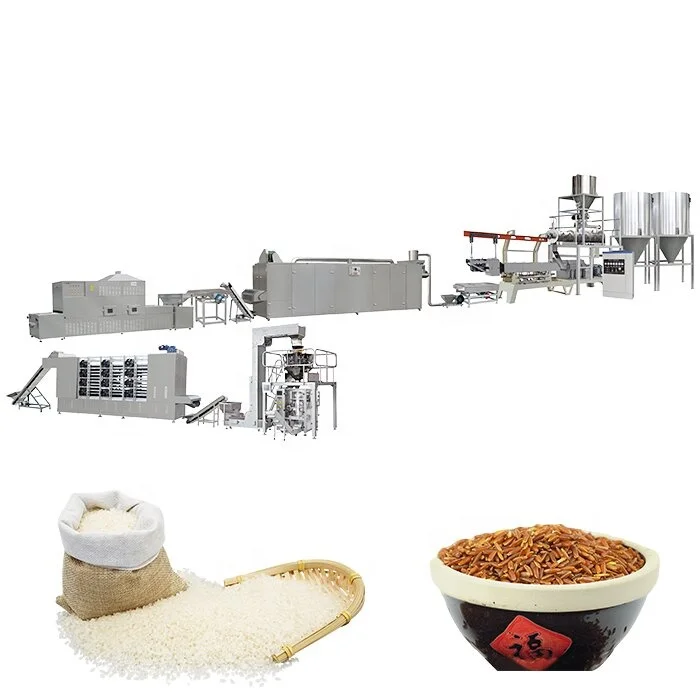
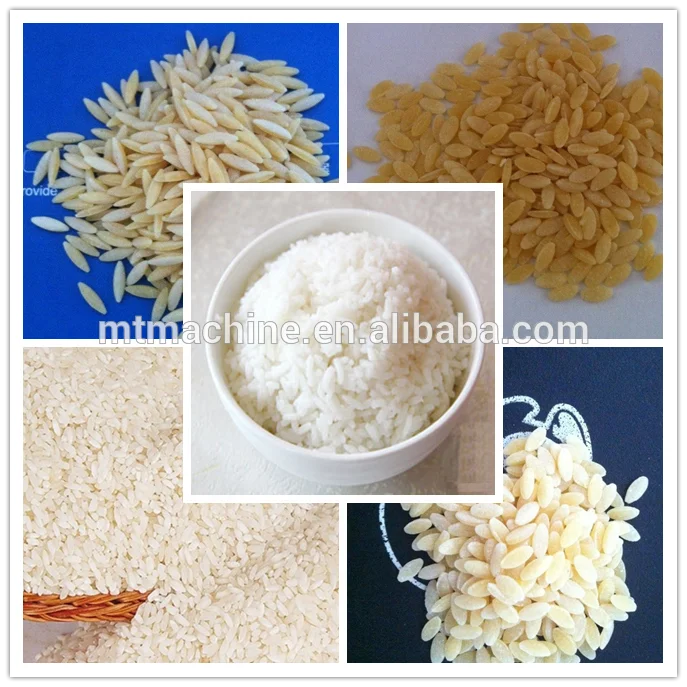
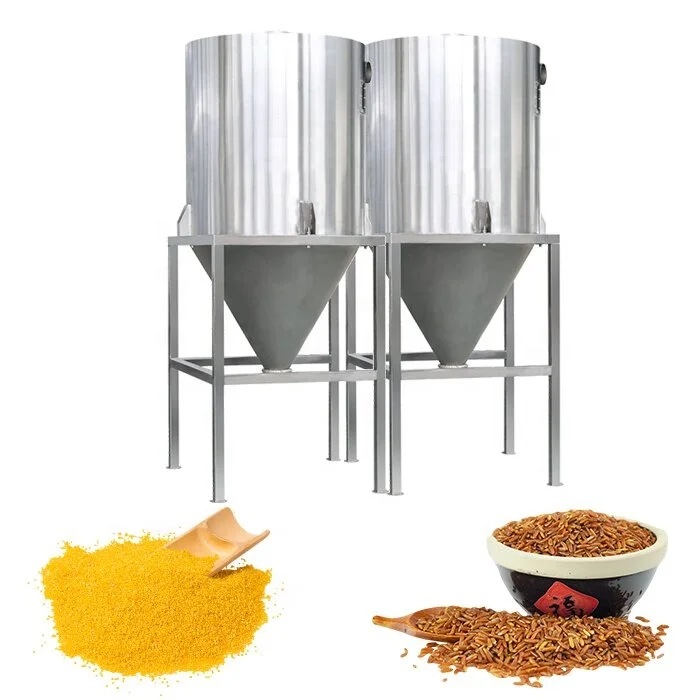
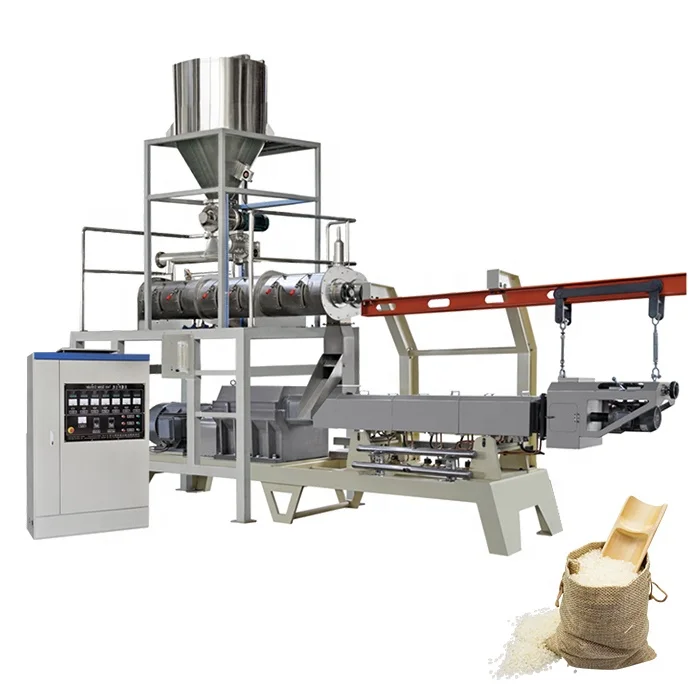
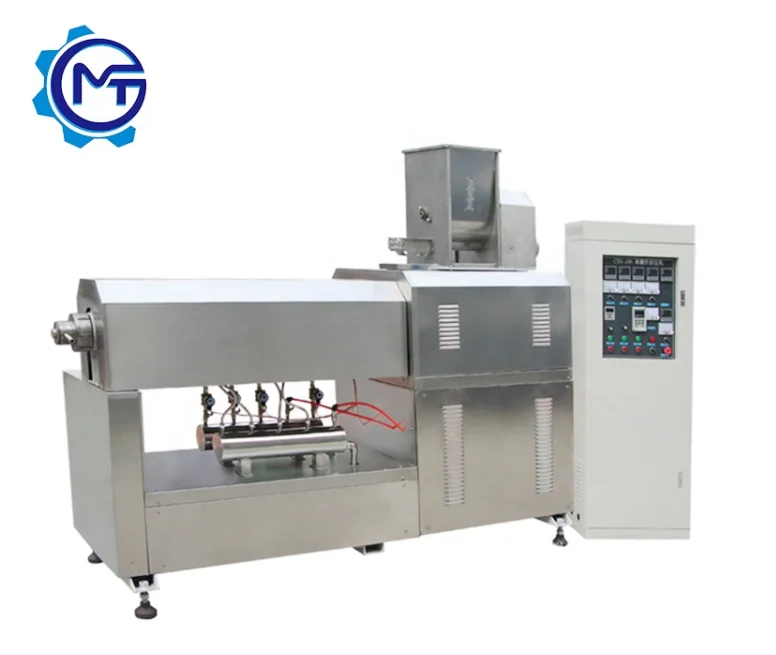
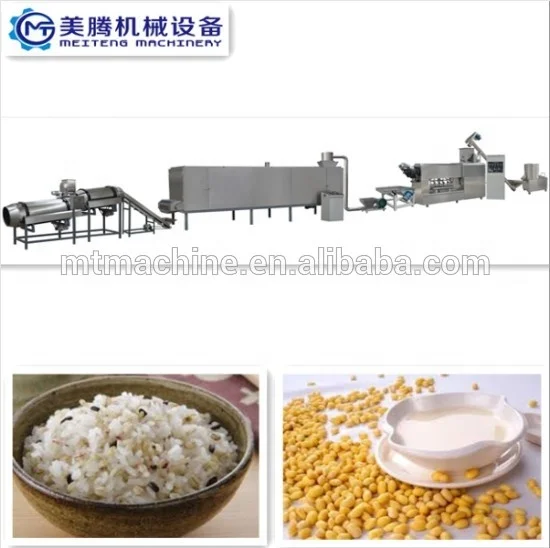
MT65 / MT70 / MT85 / MT75 / MT95 Fortified Rice Kernel Extrusion Production Line, Twin-Screw, 85–260 kW Installed Power — complete turnkey line from mixing and extrusion through multi-stage drying, roasting and packing, with throughput matched at every station. Screw configuration and die design specified to your raw material blend for consistent kernel shape, density and micro-nutrient retention. Frequency-controlled line speed across all stations allows flexible capacity adjustment.
- In-house trial run on your raw material before shipment, with documented screw and die configuration record and capacity verification report.
Description
Integrated Turnkey Line — A complete artificial and fortified rice extrusion line from batching to packing, with matched throughput at every station and on-site commissioning support.
Technical Specifications
| Parameter | Value |
|---|---|
| Model | MT65 / MT70 / MT85 / MT75 / MT95 |
| Product Type | Fortified Rice Kernel Extrusion Production Line |
| Screw Type | Twin-screw |
| Installed Power | 85 kW (MT65) / 120 kW (MT70) / 235 kW (MT85) / 180 kW (MT75) / 260 kW (MT95) |
| Power Consumption | 60 kW (MT65) / 85 kW (MT70) / 165 kW (MT85) / 135 kW (MT75) / 195 kW (MT95) |
| Output Capacity | 80–100 kg/h (MT65) / 100–120 kg/h (MT70) / 200–300 kg/h (MT85) / 300–500 kg/h (MT75) / 800–1000 kg/h (MT95) (basis not stated in source — confirm raw material blend, moisture content and pellet size) |
| Overall Dimensions (L×W×H) | 28 × 1.2 × 2.2 m (MT65) / 30 × 1.5 × 2.2 m (MT70) / 34 × 3.5 × 4.3 m (MT85) / 32 × 3.5 × 4.3 m (MT75) / 36 × 3.5 × 4.3 m (MT95) |
| Control System | Frequency speed control (PLC / MCC not explicitly stated in source) |
| Voltage & Frequency | Customizable to customer local voltage (exact values not stated in source — confirm before order) |
| Line Stations | Mixing, extruding, vibrating, low-temperature drying, cooling, high-temperature roasting, cooling, packing |
| Heating Source (Dryer) | Electric or gas |
| Screw Material | Special wear-resistant alloy (specific grade not stated in source) |
| Assembly State | Complete turnkey line |
| Lubrication | Automatic lubricating system |
| Cooling | Integrated cooling system |
| Standards | CE, ISO |
Application Suitability
| Application | Material or Output |
|---|---|
| Fortified Rice Kernel Production | Broken rice, rice bran, corn, millet, wheat, oats, buckwheat, beans, starch, vitamin and mineral premixes |
| Artificial Rice Manufacturing | Rice flour blends, starch-based formulations for retail and institutional markets |
| Nutritional Rice Programs | WFP-spec or government-spec fortified rice kernels with embedded micro-nutrients |
| Instant Rice Processing | Pre-cooked rice kernels requiring multi-stage drying and roasting |
Why "Rated Capacity" Doesn’t Tell the Whole Story
The capacity number on the quote sheet means nothing if it was tested on pure rice flour and your recipe includes whey protein isolate and calcium carbonate.
I’ve watched extrusion lines that ran smoothly during factory acceptance testing completely fall apart when the customer’s actual formulation hit the barrel. The gelatinization window shifts when you introduce protein fractions and mineral salts. The starch matrix behaves differently, expansion collapses, and what was supposed to be 300 kg/h of uniform kernels becomes a sticky, undercooked mess that plugs the die plate within hours. This is why a fortified rice kernel production line turnkey project must include trial runs on your specific raw material blend before the machines ever leave the factory floor. [NEED_CITE: starch gelatinization behavior with protein fortification in extrusion]
Throughput Matching Across Every Station
A fortified rice kernel production line turnkey project isn’t just an extruder with some conveyors bolted on. The dryer must handle the exact moisture load exiting the die. The roasting oven needs sufficient residence time to stabilize the kernel structure. The cooling conveyors must bring product temperature down before packing to prevent condensation inside the bags. When each station is sized independently by different vendors, you end up with a bottleneck somewhere — usually the dryer, which was quoted on ambient air conditions rather than the actual humidity load from your product.
Screw Configuration Dictates Product Geometry
The twin-screw configuration allows operators to adjust the screw element sequence and die geometry to control kernel shape, density, and cooking degree. Fortified rice kernels need a specific expansion ratio to mimic natural rice grain appearance while maintaining structural integrity during transport and cooking. The screw elements must generate enough shear to fully gelatinize the starch without over-expanding the product. Die design determines whether you get elongated grains or rounded pellets, and this choice affects downstream packing efficiency and market acceptance. [NEED_CITE: twin-screw extrusion die design for shaped food products]
Interpreting the Power and Capacity Range
The five model variants span from 85 kW installed power up to 260 kW, reflecting different production scales. The MT65 at the lower end suits pilot production or specialized nutritional programs with smaller batch requirements. The MT95 targets large-scale fortified rice programs where continuous operation and high throughput justify the larger footprint and utility consumption. The automatic lubricating system on all models reduces manual maintenance intervention during extended production runs. The integrated cooling system prevents barrel overheating that could degrade heat-sensitive vitamin premixes. Frequency-controlled line speed allows operators to fine-tune throughput without changing mechanical components.
The Hidden Cost of Unconfirmed Voltage and Frequency
When voltage and frequency aren’t locked down before production begins, you risk receiving motors and control panels that don’t match the local grid. A 380V 50Hz extruder shipped to a 440V 60Hz facility will run faster but draw incorrect current, potentially tripping breakers or burning out motor windings within weeks. Control systems programmed in a language the operators don’t read will lead to parameter errors that affect product quality. These problems don’t show up in the factory test because the machines run on the manufacturer’s local power supply. [NEED_CITE: industrial motor voltage and frequency mismatch consequences]
Why Procurement Happens Here
The entire fortified rice kernel production line turnkey project comes from one supplier, so throughput is calculated and matched from the batching system through extrusion, drying, roasting, and packing — no finger-pointing between vendors when a station underperforms. Screw configuration and die design are specified to your raw material formulation and target kernel geometry, not copied from a generic template. The in-house testing workshop allows trial runs on your actual recipe before shipment, catching gelatinization and expansion issues early. Twin-screw expertise across nutritional powders, fortified grains, and starch-based products means the engineering team understands how micro-nutrient premixes affect extrusion behavior. Pre-sales consultation covers line layout, utility planning, and phased installation scheduling rather than just quoting a machine list.
Documentation & Verification
- Line layout and capacity calculation showing throughput balance from batching through packing
- Screw and die configuration record matched to your raw material formulation and target kernel shape
- Trial run report on your actual raw material blend conducted in the testing workshop before shipment
- Electrical schematic with voltage, frequency, and control language confirmation for your installation site
- CE declaration of conformity and ISO certificate for regulatory compliance in your market
- Operation and maintenance manual with wear parts list and recommended replacement intervals
Installation, Commissioning & Support
- Foundation requirements based on the 28–36 meter line length and equipment weight distribution
- Dedicated electrical circuits sized for the 85–260 kW installed power range with voltage confirmation
- Modular assembly state allows containerized shipping and on-site reconnection of line stations
- First-run commissioning includes screw speed, barrel temperature, and dryer setting optimization for your recipe
- Operator training covers frequency speed control adjustment and automatic lubricating system monitoring
- Wear parts inventory includes replacement screw elements and die plates specific to your kernel configuration
- Daily maintenance protocols for the integrated cooling system and vibrating conveyors
What to Include in Your Inquiry
Provide your raw material formulation including the base grain type, protein fraction percentage, and vitamin-mineral premix composition. Specify your target daily output and whether you need the line configured for continuous three-shift operation or batch production. Confirm your local voltage, frequency, and preferred control panel language. Share your workshop floor dimensions and ceiling height so the line layout can account for the 2.2–4.3 meter equipment height range. Indicate whether you require sample production on your materials before the order is finalized.
Frequently Asked Questions
Q: How is line capacity verified on my actual raw material blend before shipment?
A: We conduct trial runs in the in-house testing workshop using your raw material formulation, including any protein fractions, mineral premixes, or specialty starches. The trial run report documents actual throughput, kernel density, gelatinization degree, and expansion ratio achieved under controlled conditions. This data becomes the baseline for the final line configuration and capacity guarantee, not a generic rating based on pure rice flour.
Q: How do you match throughput between the extruder, dryer and packing station to prevent bottlenecks?
A: Each station is sized based on mass balance calculations that account for moisture addition during extrusion, moisture removal during drying and roasting, and cooling time requirements. The dryer heating capacity and airflow are specified for the actual moisture load from your product, not ambient air assumptions. The packing station speed is set to handle peak extruder output plus a buffer for line start-up and shutdown transients.
Q: What voltage, frequency and control language options are confirmed before production?
A: Before the order enters production, we confirm your local grid voltage and frequency, then specify motors, transformers, and control panels accordingly. The control system interface language is set to match your operators’ requirements. Electrical schematics are provided for your approval, showing all component ratings and protection settings matched to your facility’s electrical infrastructure.
Q: How is screw and die configuration selected for fortified rice versus instant rice?
A: Fortified rice kernels require controlled expansion to mimic natural grain appearance while embedding micro-nutrients uniformly throughout the matrix. The screw element sequence generates specific shear and residence time to fully gelatinize starch without over-expansion. Die geometry determines kernel shape and size. Instant rice production may use different screw configurations optimized for higher moisture content and different cooking degree targets.
Q: What is the phased installation and commissioning schedule for a complete turnkey line?
A: Installation typically proceeds in phases: foundation preparation and utility connections, main extruder and dryer positioning, conveyor and auxiliary equipment connection, electrical and control system wiring, then dry commissioning without product. Wet commissioning follows using your raw materials, with parameter adjustment and operator training conducted simultaneously. Total on-site time varies with line size and site readiness conditions.
Related products
-
Máquina Automática de Fabricación de Polvo Nutricional Cereal de Arroz Seguro para Bebés
¥30.00 Select options This product has multiple variants. The options may be chosen on the product page -

Nueva máquina automática para la producción de polvo nutricional para la línea de producción de alimentos para bebés.
¥20.00 Select options This product has multiple variants. The options may be chosen on the product page -

Línea de producción de procesamiento de papilla en polvo de nutrición completa para bebés completamente automática para fábrica de nutrición infantil
¥9,500.00 Add to cart -

Línea de producción de polvo de reemplazo de comida para bebés segura, saludable y nutritiva en condiciones nuevas de alta productividad.
¥30.00 Select options This product has multiple variants. The options may be chosen on the product page