

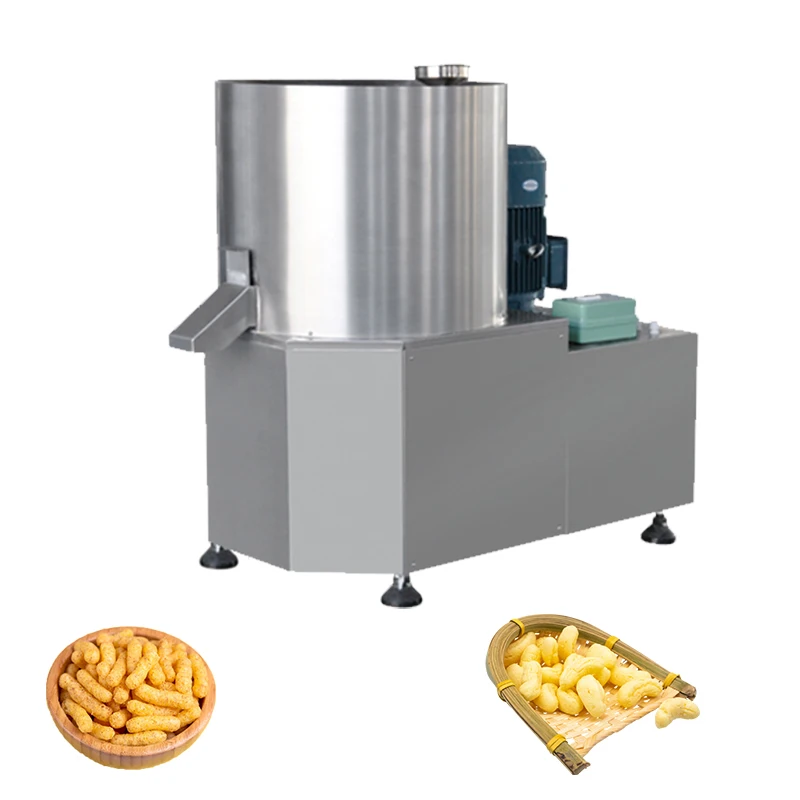
CE and ISO certified production, with complete documentation and wear parts support included.
Description
Screw & Die Matched to Formula — configuration set to your corn, rice or oat grind size and target snack density before the line ships.
Technical Specifications
| Parameter | Value |
|---|---|
| Model | MT70 / MT85 / MT75 |
| Product Type | Twin Screw Extrusion Puffed Snack Production Line |
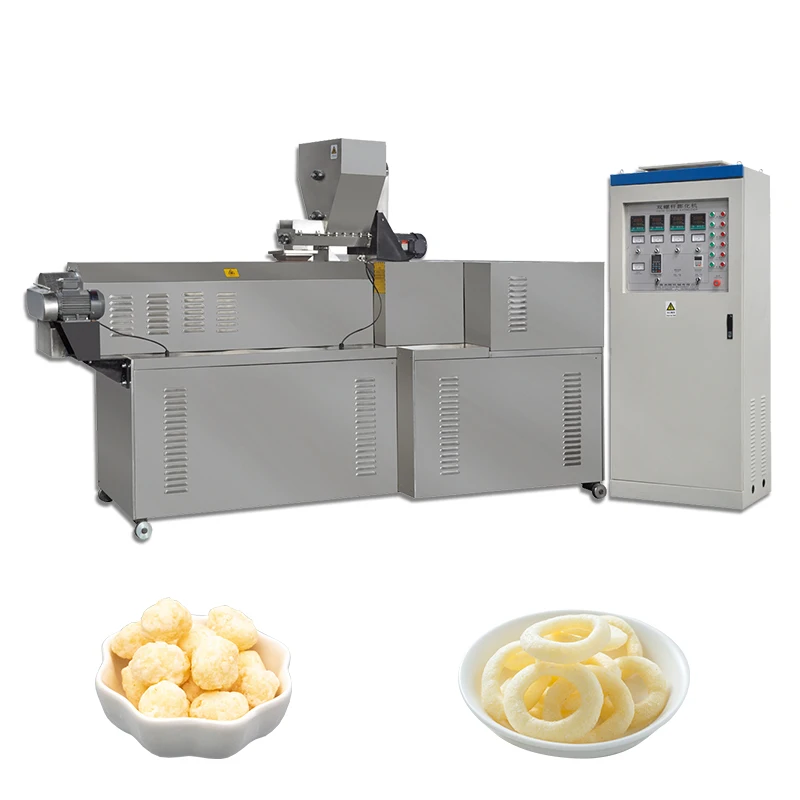
| Screw Type | Twin Screw |
| Installed Power | MT70: 130 kW / MT85: 180 kW / MT75: 220 kW |
| Power Consumption | MT70: 95 kW / MT85: 120 kW / MT75: 130 kW |
| Output Capacity | MT70: 100–120 kg/h (basis to be confirmed); MT85: 200–300 kg/h (basis to be confirmed); MT75: 300–500 kg/h (basis to be confirmed) |
| Overall Dimensions (L×W×H) | MT70: 21 × 1.5 × 2.2 m / MT85: 25 × 1.5 × 2.2 m / MT75: 28 × 1.5 × 2.2 m |
| Control System | PLC and MCC |
| Raw Materials | Corn, rice, wheat, oat, barley flour |
| Die Configuration | Interchangeable dies for ball, tube, stick, ring, fruit loop, star, wheel, flower, heart shapes |
| Heating Source (Dryer) | Gas or Electric |
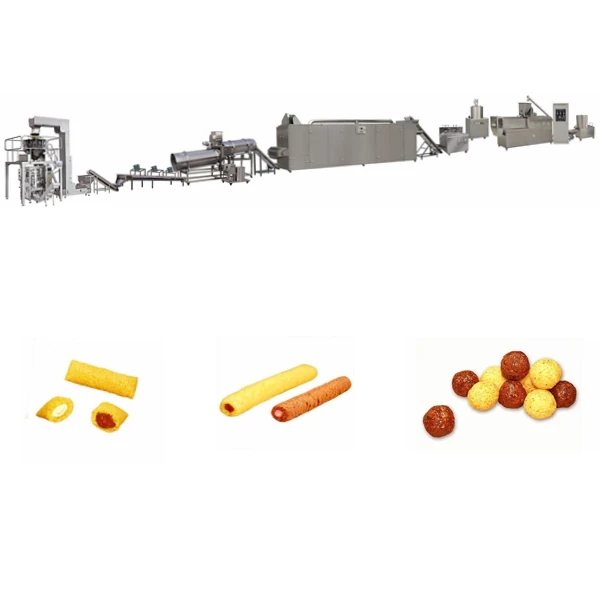
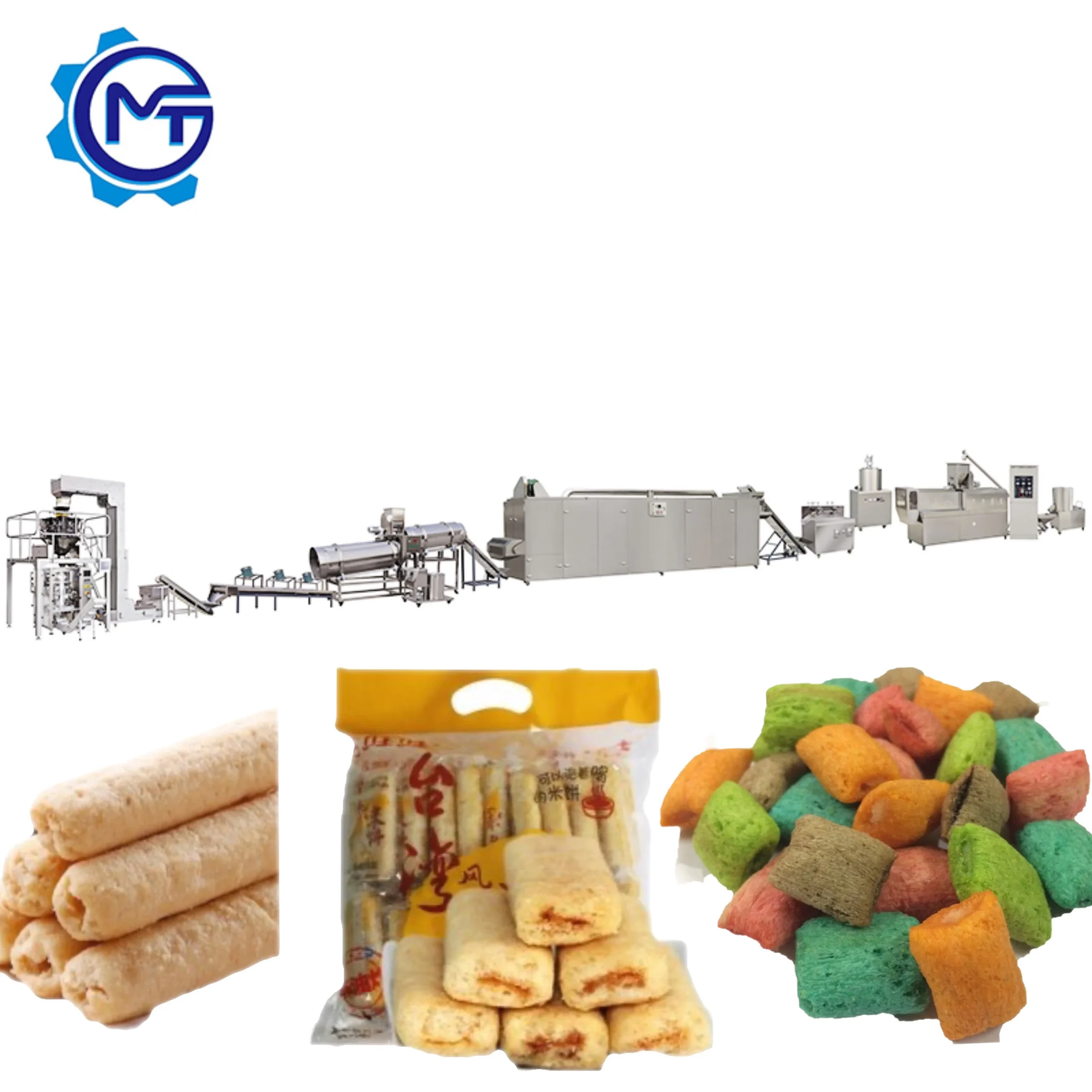
| Assembly State | Complete turnkey line from batching through packing |
| Screw Feature | Automatic lubricating and cooling function |
| Coating System | Double tumble sugar melting, elevator, coating drum, spraying nozzle |
| Certifications | CE, ISO |
Application Suitability
| Application | Material or Output |
|---|---|
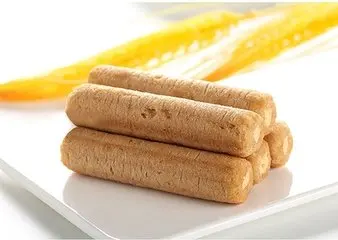
| Cheese ball and corn stick production | Corn flour and corn grits at controlled moisture |
| Multi-grain ring and fruit loop extrusion | Rice, wheat, oat and barley flour blends |
| Star, wheel and heart novelty shapes | Interchangeable dies on the same twin-screw platform |
| Core-filled or co-extruded snack formats | Dual-feed extrusion with center injection |
| Capacity expansion for existing snack lines | Die changeover and screw reconfiguration without new hardware |
Why Nominal Throughput Figures Mislead Buyers on a Puffed Snack Production Line Turnkey
A rated capacity is only valid for the specific raw material and moisture content used during the test.
I once saw a corn stick line spec sheet promise a steady hourly output, yet the buyer’s local corn flour was ground to a noticeably coarser particle size than the manufacturer’s trial sample. The screw profile was never adjusted. Output dropped sharply, the dryer backed up, and the coating drum could not keep pace. Every station downstream fell out of rhythm. Before you sign anything, confirm the puffed snack production line turnkey capacity against your actual formulation [NEED_CITE: raw material particle size and moisture effect on extrusion throughput].
Station-by-Station Throughput Alignment
A puffed snack production line turnkey only delivers its rated output when every station is sized to the extruder’s real throughput, not its nameplate figure. The mixing batch size must match the extruder hopper feed rate so the operator is never waiting on flour or starving the barrel. The dryer belt length and temperature profile must handle the full moisture load exiting the die. The coating drum volume must accommodate the seasoned output without overflow or uneven coverage. When these stations are sourced from separate vendors, mismatched capacities create hidden bottlenecks that no single spec sheet reveals.
Screw Profile and Die Geometry for Your Formula
The twin-screw configuration allows operators to rearrange screw elements — conveying, kneading, reverse-flight — in a sequence that matches the gelatinization behavior of the specific grain blend. Corn flour with high starch content demands a different shear profile than an oat-heavy mix with more fiber and fat. Die orifice diameter and land length control expansion ratio and surface texture. A die designed for a light, airy cheese ball will produce an under-expanded, dense stick if the same tooling is used for a different shape without reconfiguration [NEED_CITE: twin-screw extrusion screw element configuration and starch gelatinization].
Reading the Numbers That Matter
Installed power across the MT70 (130 kW), MT85 (180 kW) and MT75 (220 kW) reflects motor capacity available for shear and pressure inside the barrel. Actual power consumption — 95 kW, 120 kW and 130 kW respectively — shows the energy drawn during steady-state extrusion, which determines your utility cost per shift. The overall line length, ranging from 21 m to 28 m, tells you the floor space needed for extruding, drying, coating, cooling and packing in sequence. PLC and MCC control keeps barrel temperature zones, screw speed and feeder rate locked to a stored recipe, reducing batch-to-batch variation across shift changes.
The Hidden Cost of Skipping a Pre-Shipment Trial
When a line leaves the factory without running the buyer’s actual corn or rice flour, every assumption about expansion ratio, bulk density and coating absorption remains unverified. I have seen installations where the first production run yielded puffed pieces that were too dense for the local market’s expectation of a light, crunchy texture. Reworking the screw arrangement and die selection on-site adds weeks of downtime, and the dryer and flavoring drum settings must be re-tuned from scratch [NEED_CITE: impact of raw material variability on extruded snack texture and density].
Why a Single-Source Turnkey Build Reduces Integration Risk
Every station on this line — from batching through extrusion, drying, flavoring, cooling to packing — is specified under one supplier, so throughput matching is calculated before fabrication rather than negotiated after delivery. Screw configuration and die geometry are set to the buyer’s raw material profile, not copied from a generic build. The in-house testing workshop runs your corn, rice or oat formulation before shipment, producing a documented trial report. PLC and MCC control language, voltage and frequency are confirmed against the target facility’s utility supply before wiring begins. CE and ISO compliance covers the full line, not just the extruder in isolation.
Documentation & Verification
- Line layout drawing with throughput calculated across every station for your target capacity
- Screw element arrangement and die selection record matched to your flour type and grind size
- Trial run report on your raw material produced in the testing workshop before dispatch
- Electrical schematic confirming voltage, frequency and PLC language for your facility
- Wear parts list with part numbers for screws, dies and barrel liners specific to your model
Installation, Commissioning & Support
- Floor plan review confirming the 21–28 m line length fits your available bay with maintenance clearance
- Dedicated circuit sizing for the 130–220 kW installed power draw at your local voltage and frequency
- Sectional assembly of extruder barrel, dryer and coating drum with alignment verified on-site
- First-run parameter setting including barrel zone temperatures, screw RPM and feeder calibration
- Operator training on PLC recipe storage and die changeover procedures for multiple snack shapes
- Spare screw elements and dies shipped with initial order to cover the first replacement cycle
What We Need to Configure Your Line
Share your primary flour type, particle size and typical moisture content so we can select the screw profile and die geometry. Provide your daily production target and available shift hours so we can recommend the appropriate model and confirm station throughput. Confirm your facility’s voltage, frequency and preferred PLC language to finalize the electrical specification before production begins.
Frequently Asked Questions
Q: How is line capacity verified against my specific raw material and recipe formulation?
A: We run your actual corn, rice or oat flour through the twin-screw extruder in our testing workshop before shipment. The trial produces samples at different screw speeds and barrel temperatures, and we document expansion ratio, bulk density and texture. A full trial report accompanies the shipment so you know the realistic output before installation.
Q: How do you match throughput between extruder, dryer, and coating stations to avoid bottlenecks?
A: Each station is sized based on the extruder’s verified output on your raw material, not a generic nameplate figure. Dryer belt length and airflow are calculated for the moisture load exiting the die. The coating drum volume and spray rate are set to handle the full seasoned output without backlog or uneven coverage.
Q: What does the turnkey installation timeline look like from layout design to commissioning?
A: After layout approval and trial run confirmation, the line enters production with typical multi-week lead times. Equipment ships in sections, and our engineers handle on-site assembly, utility connection verification, first-run parameter tuning and operator training. The full process from inquiry to operational line follows a defined sequence with checkpoints at each stage.
Q: Can the line layout be customized to fit my existing factory footprint and utility layout?
A: The line spans 21 to 28 meters depending on model, and station spacing can be adjusted to accommodate columns, doors and existing utility drops. We review your floor plan during the proposal stage and produce a layout drawing that confirms equipment placement, maintenance access and material flow direction within your available space.
Q: How are spare wear parts supplied and when is the first replacement due?
A: A wear parts list with specific part numbers for screws, dies and barrel liners is included in the documentation package. The first replacement interval depends on your raw material abrasiveness and daily run hours, which we estimate during the trial run. Initial spare sets can ship with the main equipment to avoid production gaps.
Related products
-

Máquina de extrusión de alimentos de bocadillos de maíz inflado totalmente automática para la fabricación de barras de bocadillos de maíz inflado
¥8,500.00 Select options This product has multiple variants. The options may be chosen on the product page -

Nueva máquina automática para hacer snacks de harina de arroz inflado de acero inoxidable, alta productividad y multifuncional.
¥11,050.00 Select options This product has multiple variants. The options may be chosen on the product page -

Línea de procesamiento de bocadillos inflados completamente automática
¥8,500.00 Select options This product has multiple variants. The options may be chosen on the product page -

Línea de producción de palitos de bocadillo de maíz inflado automático Equipos en nueva condición
¥100.00 Select options This product has multiple variants. The options may be chosen on the product page


