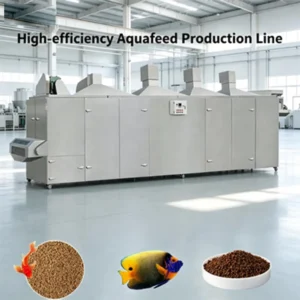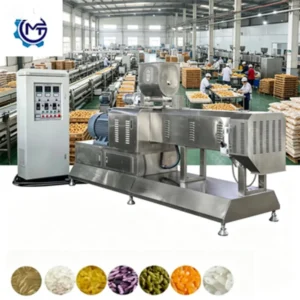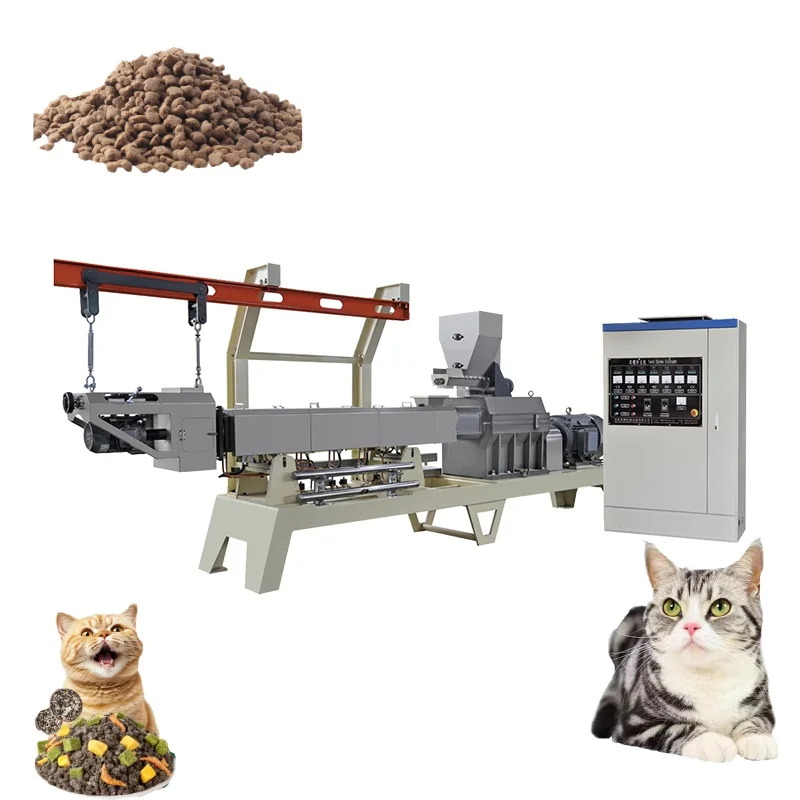


Turnkey Pet Food Extrusion Line, up to 3 tons per hour capacity, CE & ISO certified — designed for dry kibble and aquatic feed production. Screw configuration and die design are matched to your raw material and target kibble density, ensuring consistent expansion and texture through the extrusion barrel. Complete line integration from batching through extrusion to packing eliminates throughput bottlenecks between stations. In-house trial runs on your actual raw material are conducted before shipment, with a full report provided for process validation.
Description
Integrated Turnkey Engineering — Every station from batching to packing is sized against your raw material throughput, not catalog defaults, so the extruder, dryer and coating drum run without bottleneck.
Technical Specifications
| Parameter | Value |
|---|---|
| Product Type | Pet Food Extrusion Production Line |
| Applications | Dry kibble (dog, cat), floating & sinking aquatic feed (fish) |
| Output Capacity | Up to 3 t/h (basis not stated in source — confirm raw material, moisture, kibble size and density) |
| Control System | Available with PLC or MCC control (confirm before quotation) |
| Voltage & Frequency | Configurable to destination market (confirm before quotation) |
| Screw Type | Single or twin-screw configuration (confirm based on recipe) |
| Warranty | 1 year |
| Standards | CE, ISO (confirm per-machine certificate) |
Application Suitability
| Application | Material or Output |
|---|---|
| Dry dog and cat kibble | Corn, meat meal, fish meal, soy protein, vitamin premix |
| Floating fish feed | Fish meal, wheat flour, soybean meal, starch binder |
| Sinking aquatic pellets | High-protein blends with controlled gelatinisation |
| Breed-specific kibble formats | Recipe-adjusted screw and die configuration |
Why "Nominal Capacity" Fails on Real Pet Food Recipes
A line rated on corn grits will choke on a 40 % meat-meal recipe unless screw geometry is redesigned around that formulation.
Most pet food manufacturers I visit have at least one extruder sitting below its nameplate output. The cause is almost always a mismatch between the recipe’s fat and protein behaviour and the screw profile that was installed. High meat-meal ratios change how material feeds into the barrel, altering residence time and shear [NEED_CITE: twin-screw extrusion behaviour on high-protein pet food formulations]. When the original vendor quoted capacity on a starch-dominant test blend, the buyer discovers the shortfall only after commissioning, sometimes losing an entire production season before the screw set is reconfigured. Specifying a pet food making machine production line without first validating throughput on your exact formulation is the single most expensive oversight in this category.
Matching Extrusion Shear to Your Kibble Density Target
The texture and bulk density of dry kibble are governed by barrel temperature profile, screw speed and die geometry. A pet food making machine that runs a generic screw set will produce kibble that either expands too much — making it brittle and dusty — or too little, leaving a dense pellet that pets reject. Our engineers specify the screw elements and die aperture based on the starch-to-protein ratio in your recipe, then validate expansion in the testing workshop before the line ships.
Throughput Matching Across Every Station
An extruder that pushes material faster than the dryer can remove moisture creates a wet bottleneck downstream. On the coating side, an undersized flavouring drum means kibble waits in a surge bin, absorbing ambient humidity and losing crunch. The turnkey pet food extrusion line is designed as a single hydraulic and thermal balance — extruder output, dryer evaporation rate and coating drum residence time are calculated together, not selected from independent catalogues [NEED_CITE: industrial dryer capacity matching to extruder throughput in food processing].
Reading the Specification Sheet Like a Process Engineer
The screw length-to-diameter ratio determines how long material stays inside the barrel. A higher L/D gives more time for starch gelatinisation, which is essential when floating fish feed must hold a low density. Die aperture and face-cut speed together set the kibble’s final diameter and cut face smoothness — critical when the market expects a uniform appearance. Moisture content at the preconditioner inlet, typically adjusted between two and four percentage points above raw material baseline, controls expansion at the die face. Finally, PLC control with recipe memory ensures that once parameters are dialled in during the trial run, every subsequent batch repeats the same barrel temperature curve and screw speed.
The Cost of Skipping the Trial Run
I once watched a pet food line idle for five days after delivery because the buyer’s meat-meal supplier had changed the fat content since the quotation stage. The screws would not feed consistently, and the extruder surged between overload and starvation. That downtime — lost production, air-freight replacement parts, and two engineers on a return flight — costs far more than a pre-shipment trial run [NEED_CITE: unplanned downtime cost per hour in continuous food manufacturing]. A turnkey pet food extrusion line that leaves the factory without a documented test on the buyer’s actual raw material is a risk that compounds at every stage of commissioning.
Why Buyers Source This Line from Jinan
Meiteng builds the entire pet food making machine production line under one roof — batching, extrusion, drying, coating and packing — so throughput responsibility sits with a single supplier rather than being split across three vendors pointing blame at each other. Screw configurations and die designs are matched to your recipe in the testing workshop, generating a trial-run report before shipment. The facility operates CE-certified assembly and ISO-audited quality management. Electrical schematics, control language and voltage are confirmed against your site specifications before the cabinet is wired, avoiding commissioning delays. Ongoing support includes spare wear parts supply and remote process troubleshooting.
Documentation & Verification
- Line layout drawing showing throughput balance between extruder, dryer and coating drum
- Screw and die configuration record tied to your raw material and target kibble density
- Trial-run report on your recipe performed in the testing workshop before dispatch
- Electrical schematic confirming voltage, frequency and control language for your market
- CE declaration of conformity and ISO certificate for the line
Installation, Commissioning & Support
- Foundation drawing issued early so concrete pads match extruder and dryer footprints
- Dedicated electrical circuit sized for extruder main motor and dryer heating load
- Modular frame assembly designed for container shipping and on-site bolting
- First-run parameter setting performed by Meiteng engineers using trial-run report as baseline
- Operator training covers PLC recipe selection, screw changeover and daily barrel inspection
- Wear-parts list with lead times for screws, dies and seal rings included at handover
What to Share Before Requesting a Quotation
To configure a pet food making machine production line that actually holds capacity on your recipe, we need your raw material formulation with moisture and fat percentages, the kibble size and bulk density your market expects, your target daily output and shift pattern, and the voltage, frequency and control language at your plant. If you have an existing upstream mixer or downstream packing line, share the interface dimensions so the new extrusion section ties in without a surge bottleneck.
Frequently Asked Questions
Q: How is line capacity verified against my specific raw material and kibble format?
A: We run your actual recipe through the extruder in our testing workshop, measuring throughput, kibble density and expansion rate. The results are documented in a trial-run report that travels with the shipment, so the parameters set at the factory are the starting point at your site rather than an untested guess.
Q: How do you match extruder output to dryer and coating drum capacity?
A: Each station is sized on the same throughput calculation. Dryer evaporation rate is matched to the moisture the extruder adds, and coating drum residence time is matched to the kibble flow rate. No station is selected from a standalone catalogue — the line is engineered as one balanced system.
Q: What voltage, frequency and control language options are confirmed before shipment?
A: We confirm your site voltage, frequency and preferred control language during the specification stage and record them on the electrical schematic. The PLC and MCC panels are wired and labelled accordingly before factory testing, so no rewiring is needed when the line arrives.
Q: Can I send my raw material for a trial run before the line ships?
A: Yes. You ship a representative sample of your recipe to our testing workshop. We run it through the configured extruder, document output, density and expansion, and share the trial-run report. Any screw or die adjustments needed are completed before the machine leaves the factory.
Related products
-
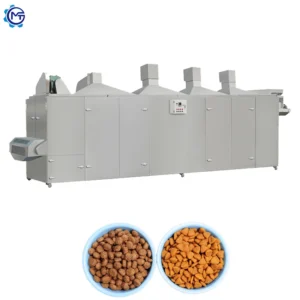
Equipo Premium para Procesamiento de Alimentos para Mascotas Máquina para Fabricar Alimento para Perros y Gatos
¥9,500.00 Select options This product has multiple variants. The options may be chosen on the product page -
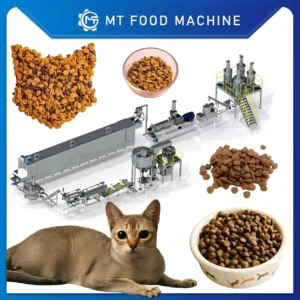
Línea de procesamiento de alimentos para perros de múltiples especies controlada por PLC con capacidad de 200-250kg/h y extrusora MT-70
¥35,000.00 Select options This product has multiple variants. The options may be chosen on the product page -
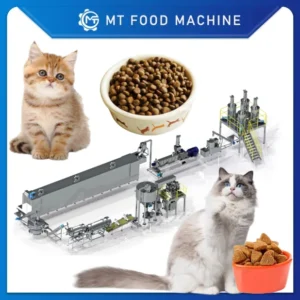
Marca Línea de Procesamiento de Comida para Gatos de Múltiples Especies Controlada por PLC de 2.5-3.0t/h¥55,000.00
Select options This product has multiple variants. The options may be chosen on the product page -
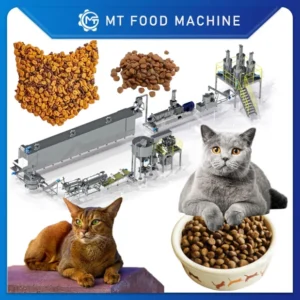
Línea de procesamiento de alimentos para gatos de múltiples especies controlada por PLC con capacidad de 250-300 kg/h
¥35,000.00 Select options This product has multiple variants. The options may be chosen on the product page