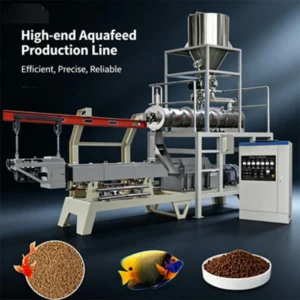


Complete Floating Fish Feed Production Line, Twin Screw, PLC Control, Food-Grade Stainless Steel — engineered for medium to large scale aquaculture operations producing floating and sinking pellets for koi, goldfish and freshwater species.
- Screw configuration and die design matched to your raw material formulation and target pellet buoyancy, controlling moisture, shear and expansion at every barrel zone.
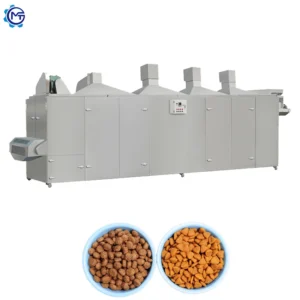
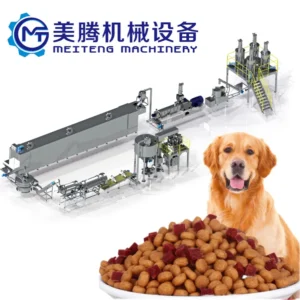
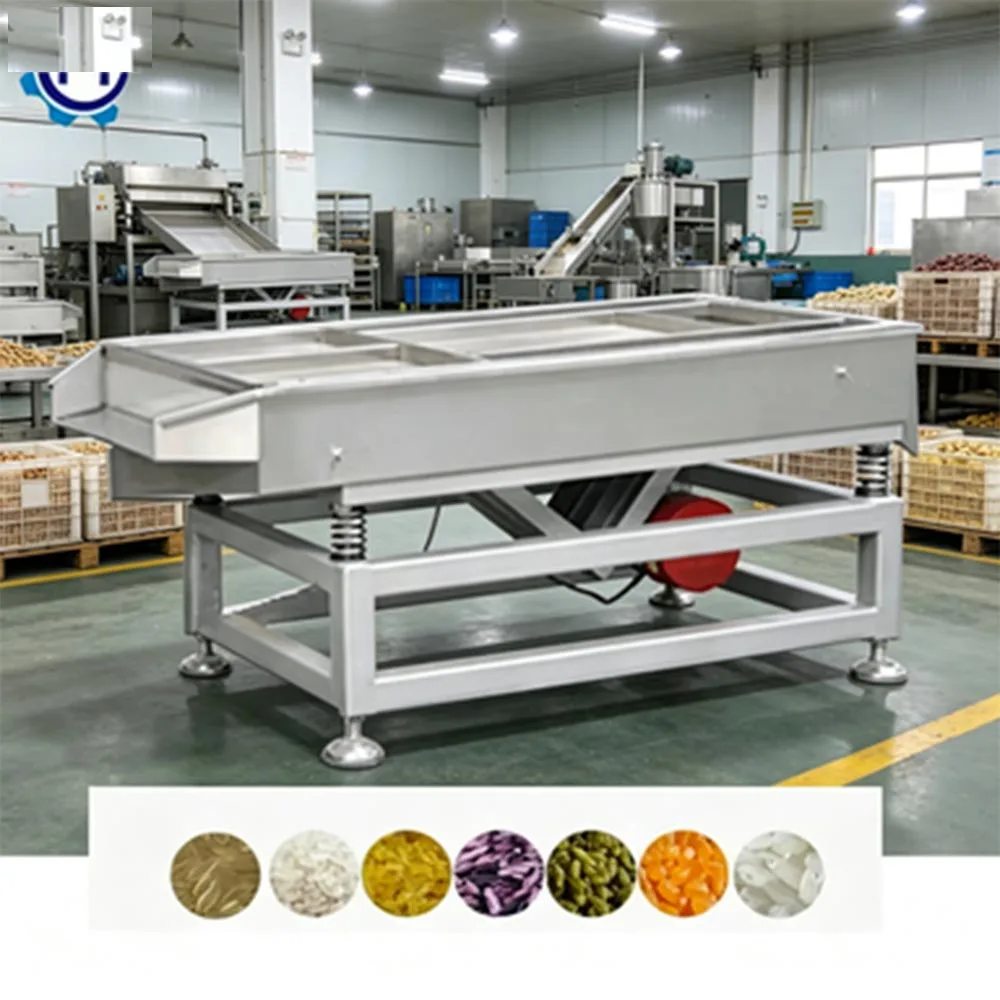
- Full line integration from mixer through extruder, dryer, coating drum and vibrating sieve with throughput matched across all stations.
Trial runs on your formulation are completed in our testing workshop before shipment, validating pellet size, density and buoyancy against your specifications.
Description
Throughput-Matched Line Design — every station from mixer to packing is sized to the extruder’s verified output on your actual formulation, not a catalog number.
Technical Specifications
| Parameter | Value |
|---|---|
| Product Type | Aquatic Feed Extrusion Production Line |
| Extruder Type | Twin Screw |
| Control System | PLC Automatic Control |
| Material Contact Parts | Food Grade 304 Stainless Steel |
| Pellet Type | Floating and Sinking |
| Raw Materials Supported | Fish Meal, Soybean Meal, Corn Powder, Compound Additives |
| Pellet Adjustability | Size, Hardness, Buoyancy |
| Target Species | Koi, Goldfish, Tropical Fish, Freshwater Fish |
| Line Stations | Raw Material Mixer, Extruder, Dryer, Seasoning Coating Machine, Vibrating Sieve, Conveyor Equipment |
| Output Capacity | Large scale continuous production (basis to be confirmed) |
| Voltage & Frequency | Configurable (basis to be confirmed) |
| Overall Dimensions | (basis to be confirmed) |
| Net Weight | (basis to be confirmed) |
| Rated Power | (basis to be confirmed) |
Application Suitability
| Application | Material or Output |
|---|---|
| Floating koi and goldfish feed production | Fish meal, corn powder, compound additives with high buoyancy requirement |
| Sinking pellet manufacturing for catfish and tilapia | Soybean meal, fish meal blends with controlled density for bottom feeding species |
| Ornamental and tropical fish feed processing | Fine-grain formulations requiring small pellet diameter and uniform color retention |
| Commercial aquaculture feed expansion projects | Continuous mass production for large pond and cage farming operations |
Why Nominal Capacity Means Nothing Without Your Raw Material Formula
An aquatic feed production line turnkey package only delivers its rated output when every station is configured for your specific formulation and pellet target.
A producer orders a line rated for a certain hourly output based on a standard corn-heavy recipe, then switches to a high fish-meal formulation that changes material flow and shear behavior inside the barrel. The extruder struggles to maintain throughput, and the dryer runs half-empty because the upstream output has dropped. The conveyor between the dryer and coating drum sits idle for stretches. These mismatches surface only after installation, when the buyer is already committed [NEED_CITE: extruder throughput variance with high-protein formulations]. I have watched this scenario play out in workshops where a client brought in a high fresh-meat recipe, and the screw intake simply could not keep pace — the downstream dryer and cooling sections were effectively spinning air.
Screw Configuration Decides Whether Your Pellet Floats or Sinks
The buoyancy of the finished pellet is not an afterthought — it is engineered through the relationship between screw profile, barrel temperature gradient, and die geometry. For floating pellets intended for surface-feeding species like koi and goldfish, the screw must generate sufficient shear and residence time to achieve full starch gelatinisation while trapping air cells that reduce pellet density. Sinking pellets for catfish and bottom feeders require a different compression ratio and die face design to produce denser output. This aquatic feed production line turnkey system pairs its twin-screw configuration with die selections matched to the target species.
Dryer and Coating Capacity Must Track the Extruder Output
A twin-screw extruder running at capacity produces a continuous stream of wet, hot pellets that must enter the dryer within a narrow time window. If the dryer bed area or airflow cannot handle the volume, pellets clump and moisture content stays above the storage threshold. Downstream, the seasoning coating machine needs a steady feed rate — too little material and the drum tumbles empty, wearing the coating unevenly. Every station on this line is specified so that the aquatic feed production line turnkey layout eliminates these dead zones and keeps material moving at each transfer point.
What the Specification Sheet Actually Tells You About Production Quality
The twin-screw design provides the mechanical shear and thermal input necessary for complete starch gelatinisation across a wide range of protein-to-starch ratios. Food grade 304 stainless steel on all material contact surfaces prevents corrosion from the chloride and lipid content common in fish meal formulations, and it meets the hygiene expectations of export-market buyers. The PLC automatic control system allows operators to store recipes for different pellet sizes and buoyancy targets, so switching from a floating koi recipe to a sinking tilapia recipe involves loading saved parameters rather than manual trial and error [NEED_CITE: PLC recipe management in continuous extrusion lines]. The vibrating sieve at the end of the line removes undersize and broken pellets before packing, which matters for buyers whose retail customers judge feed quality by visual uniformity.
What Happens When Stations Are Sized by Assumption Instead of Calculation
When a dryer is selected from a catalog rather than matched to the extruder’s actual wet output, the line develops a constraint that no amount of operator adjustment can fix. Pellets exit the dryer above the target moisture level, leading to mold growth in stored bags. A coating drum that is too small relative to the extruder output means seasoning contact time drops, and the final product arrives at the farm with uneven flavor distribution. These problems compound over weeks of production and show up as customer complaints, not as machine alarms [NEED_CITE: post-extrusion moisture management in aquatic feed manufacturing]. The cost of replacing a mismatched dryer or drum after installation far exceeds the time spent verifying throughput calculations before the order is finalized.
How This Line Is Built and Delivered
Every station is sourced from one supplier, so the mixer, extruder, dryer, coating drum, sieve, and conveyors arrive with verified interface points rather than requiring the buyer to engineer connections between separate vendors. The screw and die set is selected based on the buyer’s raw material sample and target pellet specification, not pulled from a standard shelf configuration. An in-house testing workshop runs the buyer’s actual formulation before the line ships, generating a trial report that documents pellet size, density, and buoyancy. The electrical schematic confirms voltage, frequency, and control language before production begins, preventing commissioning delays caused by mismatched power supply or unlabeled interfaces. Installation includes on-site assembly, parameter tuning with local raw materials, and operator training on the PLC recipe system.
Documentation & Verification
- Line layout and throughput calculation showing matched capacity at each station for your formulation
- Trial run report on your raw material confirming pellet size, density, and buoyancy before dispatch
- Screw and die configuration record specific to your target pellet type and raw material blend
- Electrical schematic with confirmed voltage, frequency, and control language for your facility
- CE declaration of conformity and ISO certificate for export documentation requirements
- Wear parts list with reorder references for screws, dies, and barrel liners
Installation, Commissioning & Support
- Foundation and floor plan prepared to the confirmed overall dimensions and weight distribution of your line
- Dedicated electrical circuit installed to the confirmed rated power and voltage specification before arrival
- Line arrives in shipping modules and is assembled on-site by a commissioning engineer
- First-run parameter tuning performed with your local raw material to verify pellet buoyancy and output rate
- PLC interface set to your preferred language with operator training on recipe storage and changeover
- Spare screw elements, dies, and barrel liners included at delivery with documented reorder procedure
What We Need to Configure Your Line
Share your raw material formulation — including the percentage of fish meal, starch source, and any additives — along with the target pellet diameter and whether you need floating, sinking, or both. Confirm your workshop floor space and ceiling height so the layout can be drafted to your actual building. Provide your local voltage and frequency, and let us know the control language your operators need on the PLC interface.
Frequently Asked Questions
Q: How is line capacity verified on my specific raw material formulation and target pellet size before shipment?
A: Your raw material sample is run through our in-house testing workshop on a twin-screw extruder with the screw and die set selected for your target pellet. We document pellet size, density, buoyancy, and throughput in a trial run report that you receive before the line ships, so you know the output is achievable on your actual formulation.
Q: How do you ensure throughput is matched across the dryer, coating drum and conveyor to prevent bottlenecks?
A: Each station is sized based on the extruder’s verified output on your specific raw material, not a generic catalog rating. We calculate the wet pellet volume entering the dryer, the seasoning contact time required in the coating drum, and the conveyor transfer rates, then specify each component so material flows continuously without idle stretches or material backup.
Q: What is included in the on-site installation, commissioning schedule and operator training programme?
A: Our engineer arrives at your facility to assemble the line, connect utilities to the confirmed electrical schematic, and run your local raw material through each station. Operators are trained on the PLC recipe system, pellet changeover procedures, and daily maintenance routines for the twin-screw assembly, dryer, and coating drum.
Q: How are screw configuration and die design selected for floating versus sinking pellet production?
A: Floating pellets require a screw profile and barrel temperature gradient that achieve full starch gelatinisation while retaining air cells for low density. Sinking pellets need higher compression and a different die geometry for dense output. We select the screw elements and die face based on your target species and verify buoyancy during the pre-shipment trial run.
Q: What spare wear parts are included at delivery and what is the reorder lead time?
A: The initial delivery includes a set of spare screw elements, dies, and barrel liners matched to your configuration. The wear parts list in your documentation provides reorder references. Typical lead times for replacement parts are several weeks, and we recommend ordering before your first scheduled changeout to avoid production gaps.
Related products
-
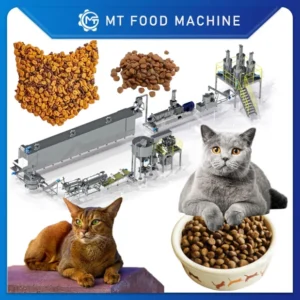
Línea de procesamiento de alimentos para gatos de múltiples especies controlada por PLC con capacidad de 250-300 kg/h
¥35,000.00 Select options This product has multiple variants. The options may be chosen on the product page -
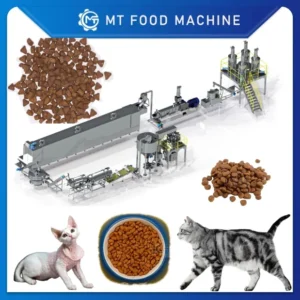
Marca Línea de Procesamiento de Comida para Gatos Multiespecies Controlada por PLC de 1.5-2.0t/h¥45,000.00
Select options This product has multiple variants. The options may be chosen on the product page -
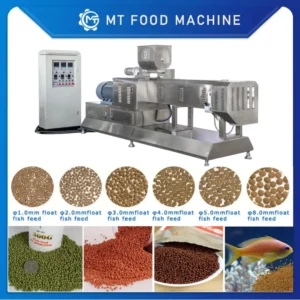
Línea de procesamiento de alimento para peces de alta capacidad de 4-5t/h para producir alimento para peces
¥65,000.00 Select options This product has multiple variants. The options may be chosen on the product page -
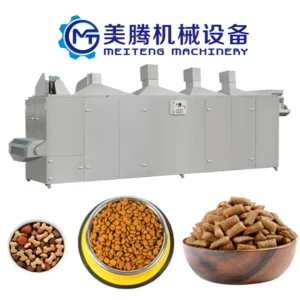
MT85 500kg/h Multi-Purpose Pet Food Processing Line for Dogs Cats Birds Fish & More-380V 50Hz Three Phase 45KW
¥65,000.00 Select options This product has multiple variants. The options may be chosen on the product page