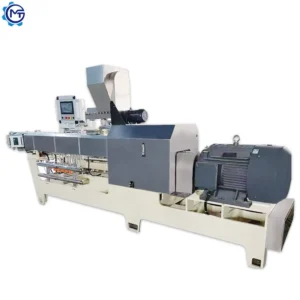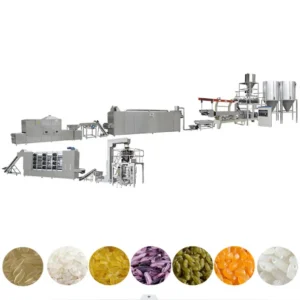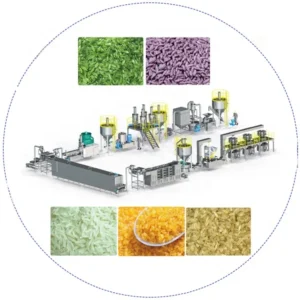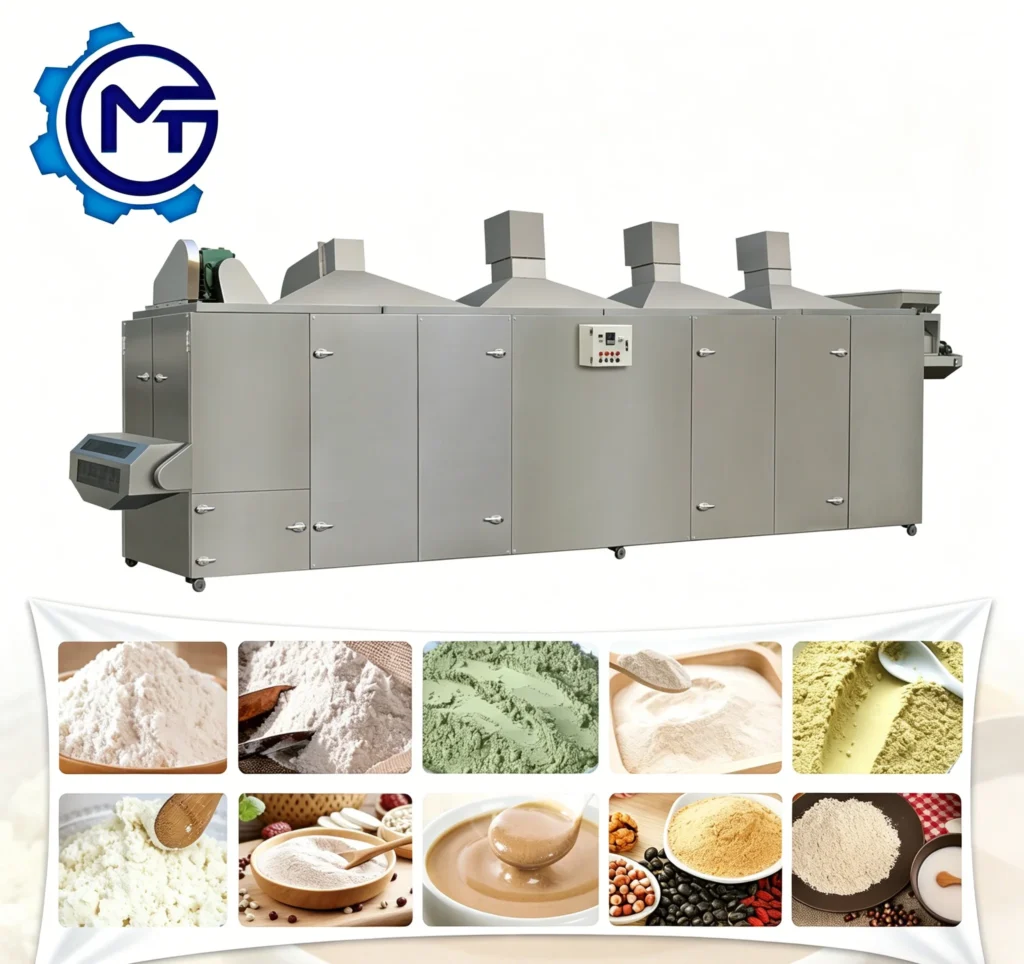


Nutritional Powder Processing Line, 200–500 kg/h, Food-Grade 304 SS, PLC Touch Control — engineered for baby food and fortified grain powder production from rice, corn, beans and multi-grain blends. Twin-screw extrusion with matched barrel temperature profile, screw configuration and die design ensures precise starch gelatinisation and target powder density across varied formulations. Flexible electric, gas or steam heat source integrates with existing plant utilities.
- Complete turnkey line from batching through extrusion, drying, milling and packing under one supplier, with throughput capacity-matched at every station to eliminate bottlenecks
- In-house testing workshop conducts trial runs on your actual raw material before shipment, validating output and product specification
Description
Capacity-matched stations — Every stage from grain blending through extrusion to milling and packing is sized as one integrated unit, preventing the bottlenecks that emerge when a nutritional powder line is assembled from separate vendors.
Technical Specifications
| Parameter | Value |
|---|---|
| Product Type | Baby Food Nutrition Powder Extrusion Processing Line |
| Output Capacity | 200–500 kg/h (basis not stated in source — confirm raw material formulation, moisture content and target density) |
| Construction Material | Food-Grade 304 Stainless Steel |
| Control System | Touch Control Panel with Digital System |
| Heat Source Options | Electric / Gas / Steam |
| Raw Material Compatibility | Rice, Corn, Beans, Various Grains |
| Automation Level | Full Automatic |
| Warranty | 1 Year |
| After-Sales Support | Overseas Engineer Service |
| Screw Type / L:D Ratio | (basis to be confirmed) |
| Die Configuration | (basis to be confirmed) |
| Voltage & Frequency | (basis to be confirmed) |
| Overall Dimensions | (basis to be confirmed) |
| Rated Power | (basis to be confirmed) |
Application Suitability
| Application | Material or Output |
|---|---|
| Infant nutrition powder production | Rice-based and multi-grain formulations for baby food porridge |
| Fortified nutritional powder for institutional programmes | Blended grain and legume recipes with added micronutrients |
| Commercial breakfast porridge powder | Corn, rice and bean blends milled to instant-dissolve particle size |
| Value-added cereal processing | Single-grain or mixed-grain raw material diversified into powder format |
What "200–500 kg/h" Actually Means on Your Grain Blend
A nutritional powder processing line turnkey rated on white rice will behave differently when your recipe includes 20% quinoa or chickpea flour.
Capacity figures quoted on a single reference grain rarely survive contact with a real formulation. The starch gelatinisation window shifts when you introduce higher-protein or higher-fat components, and the extruder screw profile that works on pure corn grits may leave your blend under-cooked and prone to clumping in the cup. I learned this the hard way commissioning a baby food line in the Middle East — the factory trial ran perfectly on standard rice, but the customer’s actual recipe included a significant quinoa proportion that changed the shear requirement entirely. [NEED_CITE: starch gelatinisation behaviour across different grain and legume flours]
Throughput Matching Across the Full Line
A nutritional powder processing line turnkey project fails most often not at the extruder but at the stations upstream and downstream. When the dryer cannot remove moisture fast enough, the extruder must slow down to prevent wet product reaching the mill. When the mill cannot handle peak output, the entire line backs up. Every station on this line is specified against the same target throughput and the same raw material blend, so the mixer feeds the extruder at a consistent rate, the dryer residence time matches the extruder output moisture, and the milling and packing stations keep pace without accumulation buffers masking a bottleneck.
Screw Configuration and the Gelatinisation Window
The twin-screw configuration is selected to match your specific grain blend rather than copied from a generic build. Barrel temperature zones, screw element sequencing and moisture injection points are all set to bring your particular formulation through its gelatinisation range at the correct residence time. This matters especially when recipes shift between high-starch rice-dominant blends and higher-fibre, higher-protein formulations containing beans or pseudo-cereals. Each blend has a different viscosity curve inside the barrel, and the screw elements must generate enough shear to complete gelatinisation without degrading heat-sensitive nutrients. [NEED_CITE: twin-screw extrusion parameter effects on cereal-based nutritional powders]
Heat Source Selection and Plant Utility Planning
Die Design, Moisture Control and Final Powder Behaviour
The die plate geometry and post-extrusion drying profile together determine whether the extrudate fractures cleanly in the mill or smears into uneven particles. A die with too-small an opening on a high-moisture blend creates back-pressure that forces the extruder motor to work harder, while insufficient drying leaves residual moisture that causes caking during storage. The heat source — electric, gas or steam — is configured to your plant’s existing utility infrastructure so that the dryer can maintain the required temperature curve without requiring a separate boiler installation. Getting this right during the design phase avoids weeks of trial-and-error adjustment after the line is installed on your factory floor.
When Line Stations Are Sized Separately
Purchasing an extruder from one vendor and a dryer from another often results in a mismatch that only becomes visible during commissioning. The dryer supplier rates their equipment on ambient air and generic moisture loads, while the extruder supplier assumes ideal downstream conditions. The gap between those assumptions shows up as inconsistent powder moisture content, uneven particle size after milling, and a line that never reaches its nameplate output. These problems compound over time as wear on screws and dies gradually shifts the extruder’s output characteristics further away from the dryer’s original design point. [NEED_CITE: throughput mismatch consequences in multi-vendor food processing lines]
Why Source the Complete Line from One Supplier
Every station — batching, extrusion, drying, milling, packing — is engineered and tested as a single system, so throughput calculations are based on your actual recipe rather than generic reference materials. Screw configuration and die geometry are documented and matched to your grain blend before production begins. An in-house testing workshop runs your raw material through the assembled line before shipment, producing a trial report that confirms output characteristics against your specification. Electrical schematics, voltage ratings and control panel language are confirmed against your plant’s power supply and operator requirements before the control cabinets are wired. Pre-sales engineering consultation carries through to on-site installation, commissioning and ongoing maintenance support.
Documentation & Verification
- Line layout and station-by-station capacity calculation for your grain blend
- Screw element sequence and die geometry record matched to target powder density
- Trial run report on your actual raw material conducted before shipment
- Electrical schematic with voltage, frequency and control language confirmation
- Food-grade 304 stainless steel material certificates for contact surfaces
- Operation and maintenance manual with wear parts replacement schedule
Installation, Commissioning & Support
- Floor loading and utility connection plan matched to the line’s full footprint and heat source selection
- Dedicated electrical circuit specification based on confirmed voltage, frequency and total rated power
- Modular station delivery allowing phased assembly in facilities with limited access
- On-site screw configuration fine-tuning using your production raw material during commissioning
- Touch-panel operator training covering recipe changeover and process parameter adjustment
- Wear parts list covering screws, dies and mixer blades with recommended replacement intervals
What to Include with Your Enquiry
To receive an accurate line configuration, specify your target grain blend and proportions, the desired powder particle size and moisture content after packing, and your daily production target. Confirm the voltage, frequency and phase available at your facility, and note whether your operators require a specific control panel language. If you have existing upstream or downstream equipment that the new line must integrate with, include those details as well.
Frequently Asked Questions
Q: How is the output capacity verified, and on which raw material formulation is it based?
A: Output capacity is verified through a trial run in the testing workshop using your actual grain blend and moisture specification. The trial run report documents throughput, extrudate density and gelatinisation degree at each station, so the confirmed capacity reflects your recipe rather than a generic reference grain.
Q: Is a trial run conducted on my raw material before shipment?
A: Yes. Your grain blend is run through the assembled line in the testing workshop before dispatch. The resulting trial run report covers output rate, powder moisture content, particle size distribution and gelatinisation percentage, giving you confirmed performance data before the equipment leaves the factory.
Q: How is throughput matched across extruder, dryer, milling and packing stations?
A: Each station is specified against the same target throughput and your specific raw material formulation. Capacity calculations account for moisture addition during extrusion, removal during drying, volume reduction during milling and packing speed, so no single station constrains the others.
Q: What voltage and control language options are available?
A: Voltage, frequency and phase are confirmed against your facility’s power supply before production begins. The touch-panel control system can be configured in your preferred operator language, and the electrical schematic is provided for your local electrician to verify before installation.
Q: What does on-site commissioning include, and how are spare parts handled?
A: On-site commissioning covers station alignment, utility connection verification, screw configuration adjustment on your production material, and operator training on recipe changeover procedures. A wear parts list with replacement intervals is provided at handover, and spare screws, dies and seals are available for ongoing supply.
Related products
-

Línea de Extrusión y Secado de Polvo de Nutrición para Bebés de 500kg/h Totalmente Automática con Control PLC
¥9,500.00 Add to cart -

Línea de Producción Automática Instantánea de Polvo Máquina Extrusora de Polvo Nutricional
¥10,000.00 Select options This product has multiple variants. The options may be chosen on the product page -
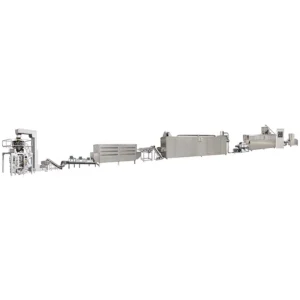
Línea de producción de polvo de reemplazo de comida para bebés nutritivo en condiciones nuevas de alta productividad
¥30.00 Select options This product has multiple variants. The options may be chosen on the product page -
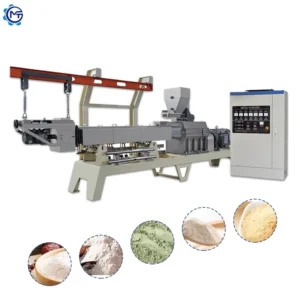
CE cerelac Máquina de producción de línea de elaboración de papilla instantánea para bebés
¥35,000.00 Select options This product has multiple variants. The options may be chosen on the product page