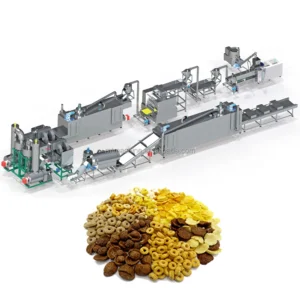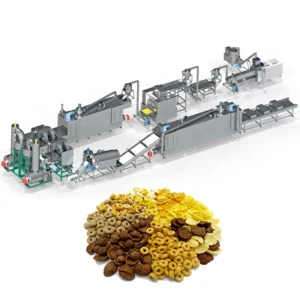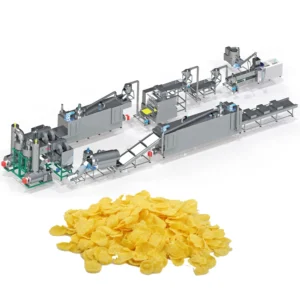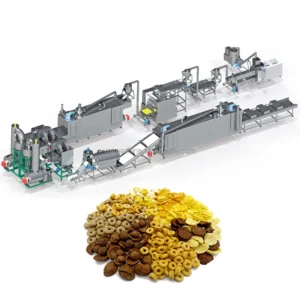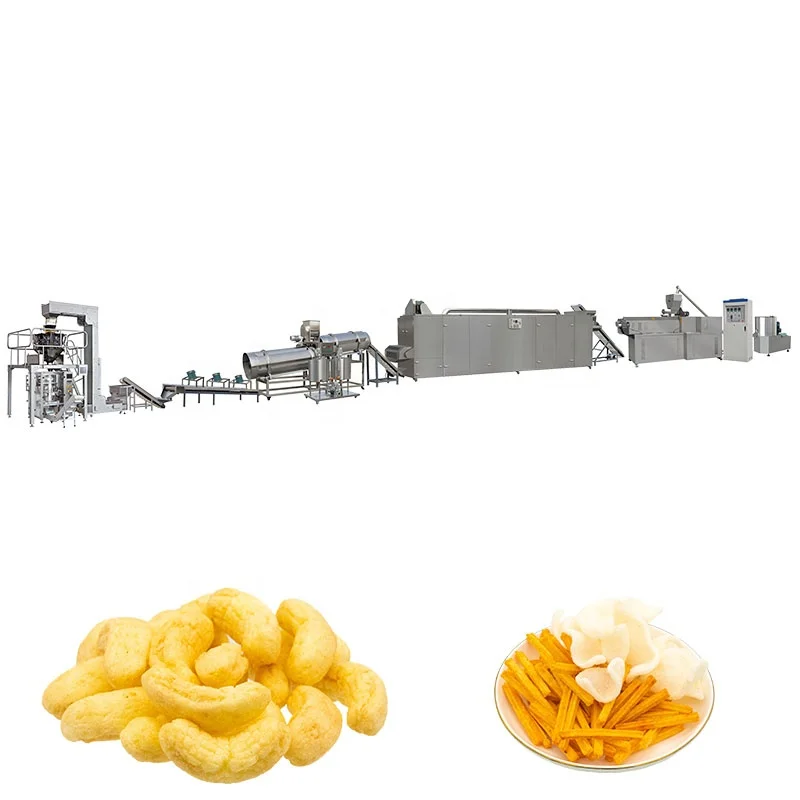
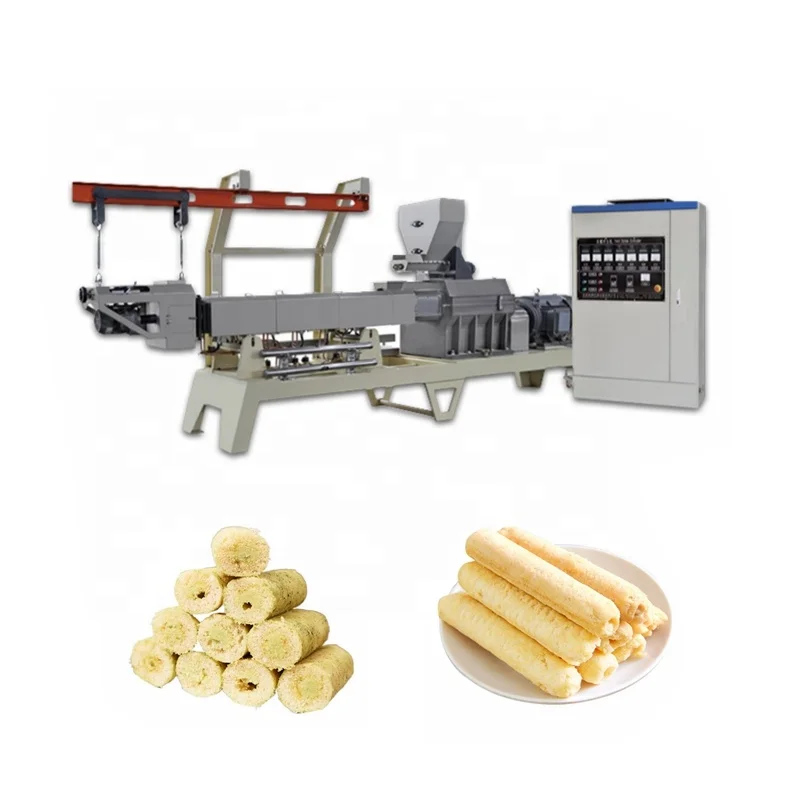
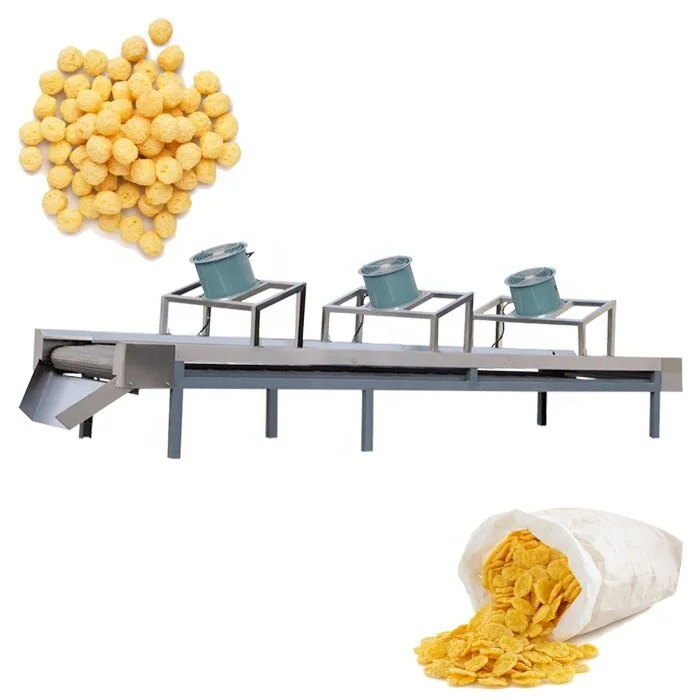
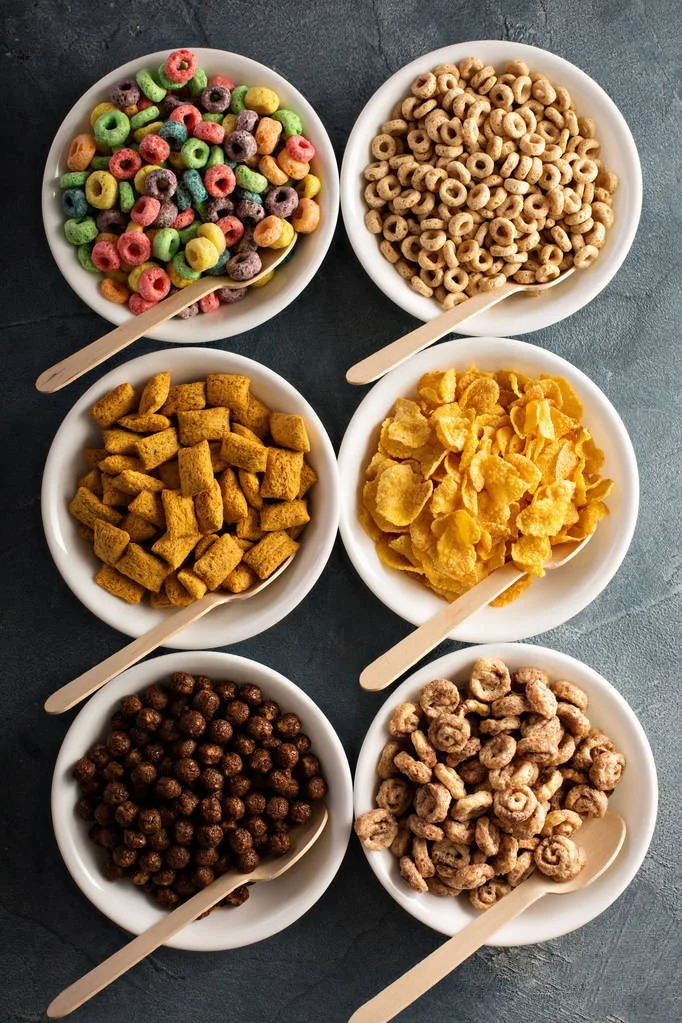

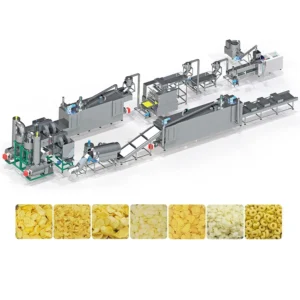
MT-75 Corn Flakes Production Line, Twin Screw Extruder, PLC Control — engineered as one integrated turnkey project with throughput matched across every station from mixing through extrusion, flaking, roasting, coating and packing.
- Screw configuration and die design specified to your grain formulation, controlling moisture and shear for target flake density and expansion
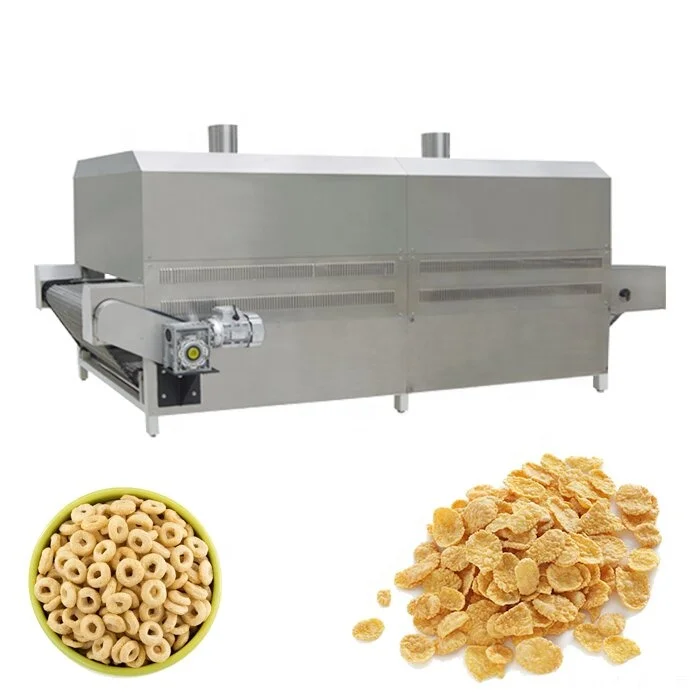
- Hydraulic flaking station with infrared temperature control ensures consistent thickness, while hot-air roasting delivers uniform bubble formation and crispy texture
- Complete line layout, in-house trial runs on your raw material before shipment, and phased commissioning with operator training included for confident start-up
Description
Integrated Throughput Matching — Every station from the MT-75 extruder through the flaking rollers and hot-air roasting oven is calculated as one continuous system, so the line holds its rated output on your actual grain blend rather than stalling at a downstream bottleneck.
Technical Specifications
| Parameter | Value |
|---|---|
| Product Type | Corn Flakes Production Line (Twin Screw Extrusion Line) |
| Model | MT-75 |
| Extruder Screw Type | Twin Screw |
| Output Capacity | 200–300 kg/hr (basis not stated in source — confirm raw material, moisture content and flake format) |
| Voltage Options | 220V / 380V (frequency to be confirmed — 50 Hz or 60 Hz) |
| Control System | PLC and MCC integration across line |
| Extruder Working Sections | Feeding, extruding, cutting, heating, gearing, controlling |
| Extruder Lubrication | Automatic lubricating and cooling function |
| Screw Material | Wear-resistant alloy treatment |
| Dryer Heating Source | Gas or Electric (selectable) |
| Flaking Machine Drive | Double motors, separate roller drive |
| Flaking Machine Pressure | Hydraulic system for double rollers |
| Flaking Temperature Control | Infrared sensor for even temperature pipe regulation |
| Roasting Oven Type | Hot air roasting oven |
| Roasting Oven Circulation | Dual separate circulating fans with cyclone dust removal |
| Coating System | Double tumble drum, elevator, coating drum, spraying nozzle |
| Unsweetened Process Flow | Mixing → Extruding → Flaking → Drying → Hot Air Roasting → Cooling → Packing |
| Sweetened Process Flow | Mixing → Extruding → Flaking → Drying → Hot Air Roasting → Sugar Spraying → Sugar Coating → Drying → Cooling → Packing |
| Machinery Test Report | Provided |
| Video Outgoing Inspection | Provided |
| Warranty | 1 Year (including core components) |
| Standards | CE, ISO |
Application Suitability
| Application | Material or Output |
|---|---|
| Traditional corn flakes | Degerminated corn grits, unsweetened or sugar-coated |
| Multigrain breakfast flakes | Blends of corn, rice, wheat, oat and barley |
| Fortified cereal flakes | Grain base with added vitamin and mineral premix |
| Sweetened retail flakes | Corn or multigrain base with sugar spraying and tumble coating |
| Food-service cereal supply | Bulk-packed flakes for hotel and institutional breakfast programs |
Why Nominal Capacity Figures Mislead Cereal Buyers
A corn flakes production line turnkey quoted at a round capacity number tells you nothing about what happens when your specific grain blend — with its own starch profile, fiber content and moisture level — enters the extruder barrel.
I spent years attending European trade shows handing out brochures before I understood this firsthand. Last year a Nordic customer arrived at our workshop expecting to run a high-fiber whole-grain formulation. The trial pellet we had prepared used standard corn grits, and the expansion ratio and flake thickness were completely wrong for their recipe. We reworked the screw combination and die plate, but it cost nearly three weeks of delay. Since then, I ask every buyer to ship a sample of their actual raw material before we finalize any configuration [NEED_CITE: raw material variability and extrusion screw design]. The MT-75 line addresses this by validating throughput on your grain blend in the testing workshop before the line ships.
Phased Installation and Utility Sequencing for the Full Line
A complete corn flakes production line turnkey project involves gas lines for the dryer, dedicated electrical circuits for the flaking station motors, and compressed air for the pneumatic actuators on the coating drum. When these utilities are not mapped during the layout phase, installation stalls while contractors reroute piping on-site.
Our engineering team generates a utility plan that sequences each connection to the line’s commissioning schedule. The gas-fired dryer section is typically installed first because it requires the longest cure time for its refractory lining, followed by the extruder and flaking station on a shared platform, and finally the roasting oven and coating drums in the downstream cooling zone.
Throughput Matching Between Extruder, Flaker and Roasting Oven
The hydraulic flaking station with its double-motor roller drive can process material at a rate matched to the MT-75 extruder output, so pellets do not queue and cool before reaching the nip point. Downstream, the hot-air roasting oven uses two separate circulating fans and a cyclone dust removal device to maintain uniform bubble formation across the full bed depth [NEED_CITE: hot air roasting uniformity in cereal flake processing].
If the roasting section is undersized, flakes exit with uneven moisture and the surface blisters that give corn flakes their characteristic crispness fail to develop consistently. Every station in this line is sized so that the mass flow leaving one section equals the accepted feed rate of the next.
Screw Configuration, Die Design and Moisture Control in Flake Extrusion
Twin-screw extrusion allows operators to adjust the screw element sequence — conveying, kneading, and reverse-flight sections — to control residence time and shear input. For a high-fiber whole-grain recipe, additional kneading blocks improve starch gelatinization without over-expanding the pellet, which would produce a flake that crumbles under roller pressure.
The die plate aperture and moisture content at the barrel inlet jointly determine pellet density. Lower moisture and a smaller die opening increase mechanical energy input per unit mass, yielding a denser pellet that survives the flaking nip without shattering. The PLC control on this line logs barrel temperature at each heating zone, allowing operators to reproduce successful recipes batch after batch. Infrared sensors on the flaking rollers compensate for temperature drift during long production runs, keeping flake thickness within specification.
The Hidden Cost of Mismatched Downstream Equipment
When a flaking station cannot keep pace with the extruder, pellets cool and harden in the buffer conveyor, producing flakes with visible white cores that signal incomplete gelatinization. A roasting oven with insufficient airflow leaves moisture gradients across the flake bed, so some pieces emerge pliable while others are scorched [NEED_CITE: moisture gradient effects on breakfast cereal texture].
These defects surface only during sustained production runs, not during the brief demonstrations common at trade fairs. Buyers who assembled lines from separate vendors often discover the bottleneck weeks after commissioning, when they are already committed to a delivery schedule with retail customers.
Why Procure This Line From a Single Project Supplier
The MT-75 line is engineered as one project rather than assembled from independent machine orders. Throughput at every station — extruder, dryer, flaker, roasting oven, coating drum — is calculated against the same mass-balance model, so no single section constrains the others.
Screw elements and die plates are specified to the grain formulation you send us, not copied from a generic catalog build. Before shipment, we run your actual raw material through the extruder and flaker in the testing workshop and document expansion ratio, pellet density and flake thickness in a trial report you receive before the crate is sealed.
Voltage, frequency, control panel language and PLC screen text are confirmed during the design phase, so the electrician on your site does not discover a 400 V motor on a 480 V supply on day one. CE and ISO documentation travels with the shipment, clearing customs without last-minute requests for supplementary paperwork.
Documentation & Verification
- Line layout drawing with throughput calculation for every station on your grain recipe
- Screw element sequence and die plate drawing matched to your raw material sample
- Factory trial run report recording expansion, pellet density and flake thickness
- Electrical schematic confirming voltage, frequency and control language before dispatch
- CE declaration of conformity and ISO certificate included in shipping documents
- Wear parts list identifying screw segments, die plates and roller shells for first-year planning
Installation, Commissioning & Support
- Foundation plan accounts for extruder vibration isolation and flaking station hydraulic load
- Dedicated circuit sizing for flaking double motors and roasting oven circulating fans confirmed at design stage
- Line arrives in modular sections for phased rigging through standard factory door openings
- First-run parameter log captures barrel temperatures, roller gap and roasting air speed for recipe repeatability
- Operator training covers screw combination changes and die plate swaps for new flake formats
- Recommended spare inventory includes kneading blocks, die inserts and infrared sensor replacements
Preparing Your Project Brief
To move from a general inquiry to a firm line layout, we need your target flake format (sweetened or unsweetened), the grain blend you intend to run, and a sample shipment of your raw material for workshop trials. Share your available floor space with ceiling height, local voltage and frequency, and the control language your operators read. If you plan to phase the installation around existing equipment, describe the upstream mixer and downstream packing line already in place so the layout accounts for tie-in points.
Frequently Asked Questions
Q: How is line capacity verified against my specific grain formulation and moisture content?
A: Before shipment we run your raw material sample through the MT-75 extruder and flaking station in our testing workshop. We document expansion ratio, pellet density and flake thickness at the target output rate, then adjust screw elements and die aperture if results fall outside your specification. The trial report accompanies the line documentation.
Q: What utility planning is required for the complete roasting and drying section?
A: The gas-fired dryer and hot-air roasting oven each need dedicated gas supply lines with pressure regulation, exhaust ducting to the building exterior, and electrical circuits for circulating fans and the cyclone dust removal motor. We provide a utility connection schedule listing flow rates, pipe diameters and circuit ratings during the layout phase.
Q: How are the extruder, flaker and coating drum throughput-matched?
A: Each station is sized using a single mass-balance calculation based on your recipe moisture and target flake weight. The flaking station hydraulic system and double-motor roller drive accept the full extruder discharge rate, while the coating drum volume and tumble speed are matched to the roasted flake flow so sugar distribution stays even.
Q: What does the phased installation schedule look like for a full line?
A: Installation typically proceeds from upstream to downstream: extruder and dryer first, then the flaking station, followed by the roasting oven and coating system. Each phase includes utility connection, mechanical alignment and a short test run before the next section is positioned, reducing the risk of rework.
Q: What spare parts inventory is recommended for the first year?
A: The wear parts list we ship with the line identifies screw segments, die plates, flaking roller shells and infrared sensors. For continuous operation we recommend stocking one full set of kneading blocks, two spare die plates and replacement sensor elements, enough to cover scheduled changeovers without emergency air freight.
Related products
-
Máquina automática de fabricación de copos de maíz de 500 kg/h Nueva condición Alta productividad Línea de procesamiento de cereales dulces para el desayuno Desde la fábrica
¥8,500.00 Select options This product has multiple variants. The options may be chosen on the product page -
Máquina Extrusora de Cereal para Desayuno de 200kg/h Venta Caliente Línea de Producción de Copos de Maíz
¥30,000.00 Select options This product has multiple variants. The options may be chosen on the product page -
Cereales Copos de Maíz con Azúcar Máquina de Extrusión de Copos de Maíz Línea de Producción de Cereal para Desayuno
¥23,000.00 Select options This product has multiple variants. The options may be chosen on the product page -
Máquina Automática para Hacer Copos de Maíz Línea de Producción de Procesamiento de Cereales para el Desayuno Copos de Maíz
¥500.00 Select options This product has multiple variants. The options may be chosen on the product page