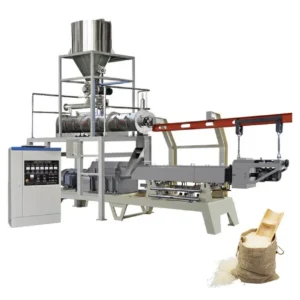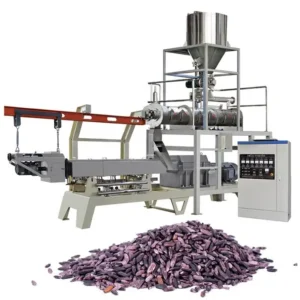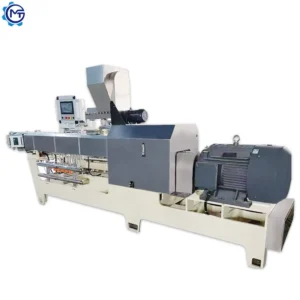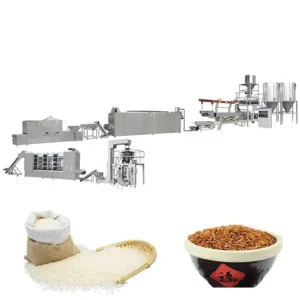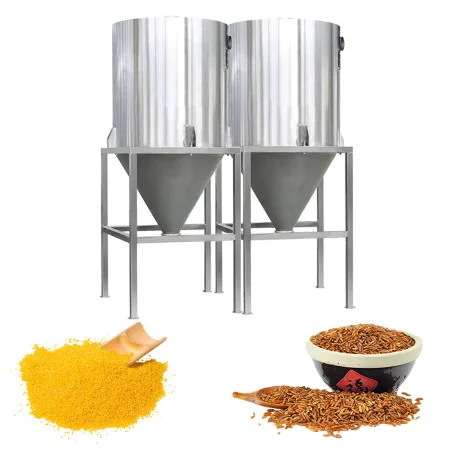

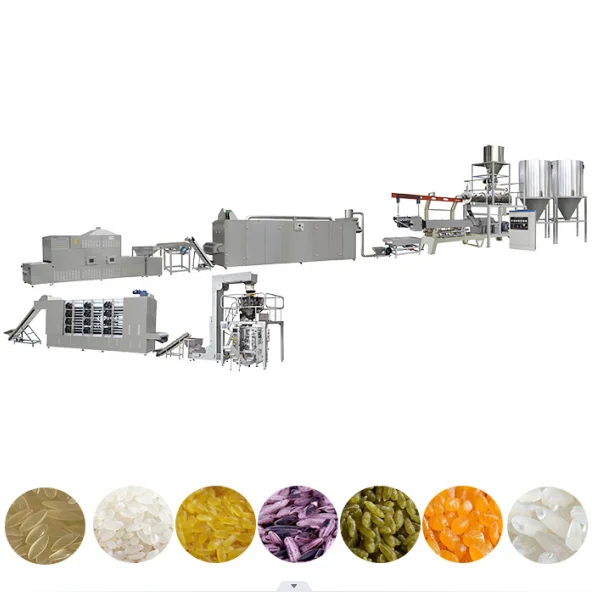
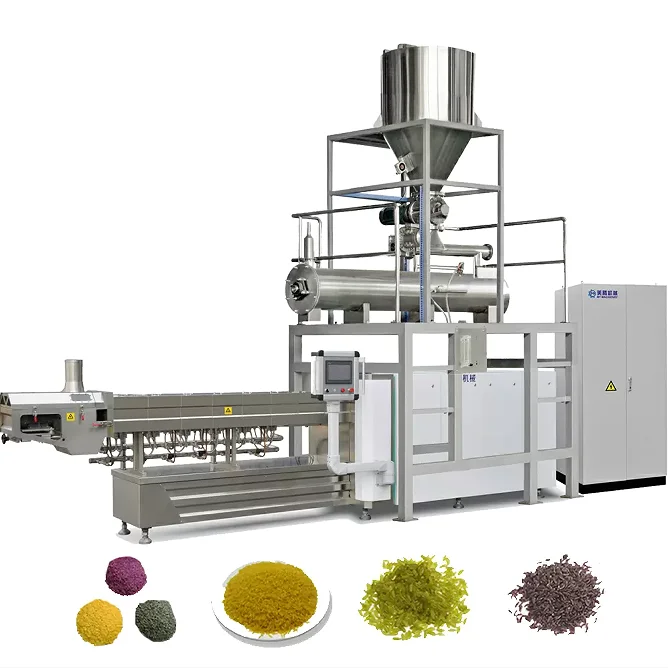
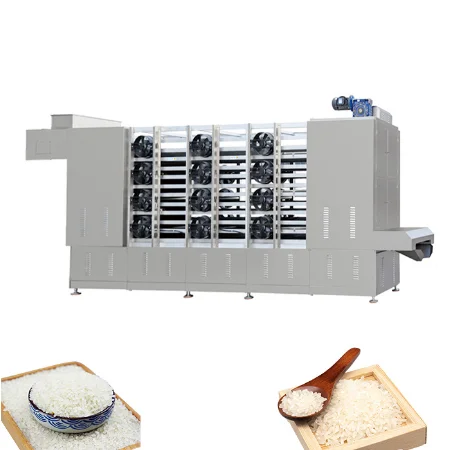
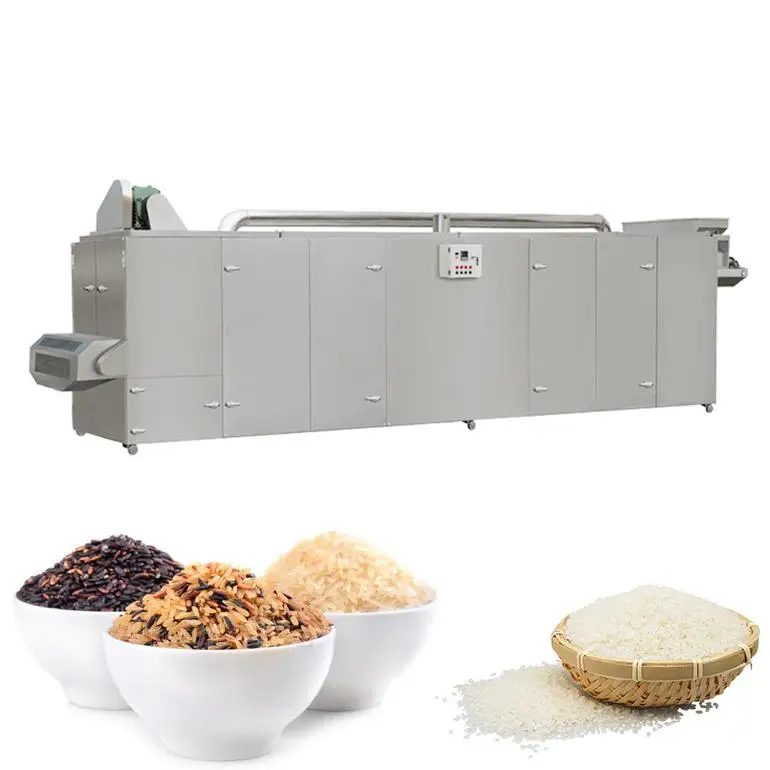
MT65 / MT70 / MT85 / MT75 / MT95 Fortified Rice Extruder Production Line, Twin-Screw, Complete Turnkey — engineered as a whole-line project with throughput matched across every station from mixing to packing.
- Screw configuration and die design specified to your raw material formulation and target kernel density
- In-house testing workshop runs trial batches on your actual ingredients before shipment
Layout, capacity calculation and commissioning schedule delivered as one integrated project under single-supplier responsibility.
Description
Integrated Throughput Engineering — every station from batching through roasting and packing is matched to the extruder’s actual output on your specific raw material formulation.
Technical Specifications
| Parameter | Value |
|---|---|
| Product Type | Fortified Rice Extruder Production Line |
| Model | MT65 / MT70 / MT85 / MT75 / MT95 |
| Installed Power | MT65: 85 kW; MT70: 120 kW; MT85: 235 kW; MT75: 180 kW; MT95: 260 kW |
| Power Consumption | MT65: 60 kW; MT70: 85 kW; MT85: 165 kW; MT75: 135 kW; MT95: 195 kW |
| Output Capacity | MT65: 80–100 kg/h; MT70: 100–120 kg/h; MT85: 200–300 kg/h; MT75: 300–500 kg/h; MT95: 800–1000 kg/h (basis not stated in source — confirm raw material formulation and moisture content) |
| Overall Dimensions (L×W×H) | MT65: 28 × 1.2 × 2.2 m; MT70: 30 × 1.5 × 2.2 m; MT85: 34 × 3.5 × 4.3 m; MT75: 32 × 3.5 × 4.3 m; MT95: 36 × 3.5 × 4.3 m |
| Screw Type | Twin-screw |
| Control System | Frequency speed controlling, high automation |
| Line Stations | Mixing, Extruding, Vibrating, Low-temperature drying, Cooling, High-temperature roasting, Cooling, Packing |
| Feeding System | Single or double screw feeding, selectable according to material |
| Drying Oven Heating Source | Electric or gas |
| Drying Oven Feature | Circulation drying process, frequency motor controls mesh belt speed |
| Lubrication | Automatic lubricating and cooling |
| Assembly State | Complete production line (turnkey) |
| Certification | CE, ISO |
Application Suitability
| Application | Material or Output |
|---|---|
| Fortified rice kernel production for institutional nutrition programmes | Broken rice and rice bran blended with added vitamins and minerals |
| Artificial rice from alternative grain bases | Corn, millet, wheat, oats, buckwheat and starch-based formulations |
| Nutritional instant rice for retail or relief distribution | Rice flour with bean, oat and starch additives for quick-cook properties |
| Value-added conversion of rice processing by-products | Rice bran and broken rice reconstituted into whole-kernel shaped grains |
Why "Rated Capacity" Means Nothing Without Your Raw Material
A fortified rice extruder production line turnkey only delivers its nameplate output when every station is tuned to your actual formulation.
I spent weeks on a site in the Middle East watching a line stall at the drying station because the extruder pushed out more than the oven could handle. The contractor had sourced each machine separately and never verified throughput continuity. The extruder ran at its rated speed, the drying belt jammed with product backlog, and the packing station sat idle waiting for cooled kernels. The rated output on paper meant nothing on the factory floor [NEED_CITE: throughput matching across extrusion line stations]. When a buyer evaluates a fortified rice extruder production line turnkey, the first question should never be about the extruder’s maximum speed. It should be about how the entire line behaves when fed with their specific broken rice, starch blend, and micronutrient premix at their target moisture content.
Throughput Continuity from Mixing to Packing
Every station on this line is sized to pass product forward without accumulation or starvation. The vibrating feeder meters extruded kernels onto the drying belt at a controlled rate, and the low-temperature drying stage removes surface moisture before the kernels enter the high-temperature roasting zone. The second cooling stage then stabilises kernel temperature before packing, preventing condensation inside sealed bags.
Screw Configuration Matched to Kernel Density Targets
The twin-screw extrusion system allows adjustment of screw element sequencing and die geometry to control how much the starch matrix expands during extrusion. For fortified rice kernels, the goal is minimal expansion — the product must resemble natural rice in size, density, and cooking behaviour. The die design and barrel temperature profile are set during the pre-shipment trial run using your raw material, so the kernel density target is established before the line leaves the factory rather than discovered during commissioning [NEED_CITE: twin-screw die design and expansion control for reconstituted grains].
Reading the Power and Capacity Data
The five models span from MT65 at 85 kW installed power to MT95 at 260 kW, with power consumption ranging from 60 kW to 195 kW during operation. The gap between installed and consumed power reflects the headroom available for harder formulations or higher moisture loads. Output capacities are listed per model, but these figures depend on raw material formulation, moisture content, and target kernel density — values that must be confirmed through a trial run on your actual ingredients before they can be treated as reliable production targets. The MT75 and MT95 models require a notably larger footprint at 32 m and 36 m line length respectively, which affects workshop layout planning and utility routing.
When the Wrong Drying Configuration Costs You Weeks
A drying oven with insufficient belt area or incorrect temperature zoning will either leave kernels too moist — causing clumping and mould risk during storage — or over-dry them, producing cracks that break during packing and transport. When the dryer is sourced separately from the extruder, there is no single party responsible for matching the moisture removal rate to the extruder’s output speed. The result is a commissioning period measured in weeks of product waste and schedule delay rather than days of parameter fine-tuning [NEED_CITE: moisture control in extruded rice kernel production].
What Makes This Line Different Under One Roof
The entire fortified rice extruder production line turnkey is built and tested as a single system rather than assembled from independent vendors. The screw configuration and die design are specified to your raw material and target kernel shape, not copied from a generic build. The in-house testing workshop runs your actual formulation before shipment, producing a trial run report that documents kernel density, expansion ratio, and moisture content at each station. Electrical schematics confirm voltage, frequency, and control language for your target market before production begins. The automatic lubricating and cooling system on the extruder supports continuous operation without manual intervention during shifts, reducing unplanned stops during the critical ramp-up period after commissioning.
Documentation & Verification
- Line layout drawing showing throughput calculation between extruder, dryer and packing station
- Trial run report on your broken rice and starch formulation conducted before shipment
- Screw and die configuration record specifying element sequence matched to your kernel density target
- Electrical schematic with voltage, frequency and control language confirmed for your market
- CE declaration of conformity and ISO certificate for the complete line
- Operation and maintenance manual covering all stations from mixing to packing
Installation, Commissioning & Support
- Foundation and utility layout based on your selected model’s dimensions, up to 36 m line length
- Dedicated power circuit planning per model’s installed power requirement, from 85 kW to 260 kW
- Frequency-controlled drying belt speed adjustment during commissioning to match your kernel moisture target
- First-run parameter setting using your trial run report as the baseline configuration
- Operator training covering screw element inspection, die cleaning and automatic lubrication system checks
- Wear parts list with reorder schedule for screws, dies and mesh belt sections
What We Need to Scope Your Line
To configure a fortified rice extruder production line turnkey that matches your facility, we need your base ingredient breakdown including starch content and moisture level, your target daily output in finished kilograms, and your workshop dimensions including ceiling height for the larger models. Specify your local voltage and frequency standard, preferred control language, and whether your drying preference is electric or gas heating. If you can send a sample of your raw material, we will run it through the testing workshop before finalising the line configuration.
Frequently Asked Questions
Q: How is line capacity verified against our specific raw material formulation?
A: We run your actual broken rice, starch blend and micronutrient premix through our in-house testing workshop before the line ships. The trial produces a documented report covering kernel density, expansion ratio, moisture content and throughput rate at each station, so the capacity figure is based on your material, not a generic benchmark.
Q: How is throughput matched between the extruder, drying oven and packing station?
A: Each station is engineered as part of one system. The vibrating feeder, drying belt area, roasting zone length and cooling conveyor are all sized to handle the extruder’s output without product backlog or idle time. This prevents the bottlenecking that occurs when machines are sourced from separate vendors.
Q: What voltage, frequency and control language options are confirmed before production?
A: Electrical schematics are prepared after you confirm your local voltage and frequency standard. Control interface language is set to match your operator team. These specifications are locked in the production documents before manufacturing begins, avoiding commissioning delays caused by mismatched electrical systems.
Q: What does the pre-shipment trial run cover and what report do we receive?
A: The trial run uses your supplied raw material to produce fortified rice kernels on the configured line. You receive a report documenting screw and die settings, barrel temperature profile, kernel dimensions, density measurements, moisture readings at each drying stage and the verified throughput rate.
Q: What is the on-site installation and commissioning schedule for a complete line?
A: Installation follows a phased sequence from mixing station through to packing, with utility connections verified at each stage. Commissioning uses the trial run report as the starting configuration, then fine-tunes parameters to your actual site conditions. Operator training covers daily operation, routine maintenance and wear part replacement across all stations.
Related products
-
Máquina Automática de Fabricación de Polvo Nutricional Cereal de Arroz Seguro para Bebés
¥30.00 Select options This product has multiple variants. The options may be chosen on the product page -
Línea de producción de extrusión de polvo de nutrición de arroz orgánico para bebés de la marca MT, aprobada por CE, con capacidad de 500 kg/h y grado automático.
¥9,500.00 Add to cart -

Línea de Producción Automática Instantánea de Polvo Máquina Extrusora de Polvo Nutricional
¥10,000.00 Select options This product has multiple variants. The options may be chosen on the product page -
Máquina automática de hacer harina de arroz en polvo de nutrición para bebés de la marca MT de pequeña escala con capacidad de producción de 500 kg/h y control PLC.
¥9,500.00 Add to cart