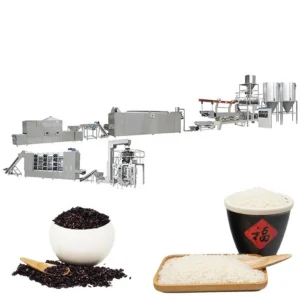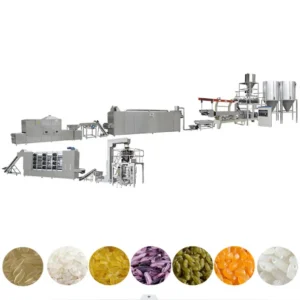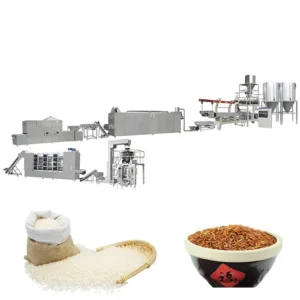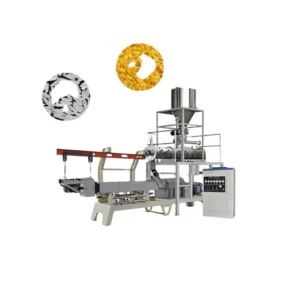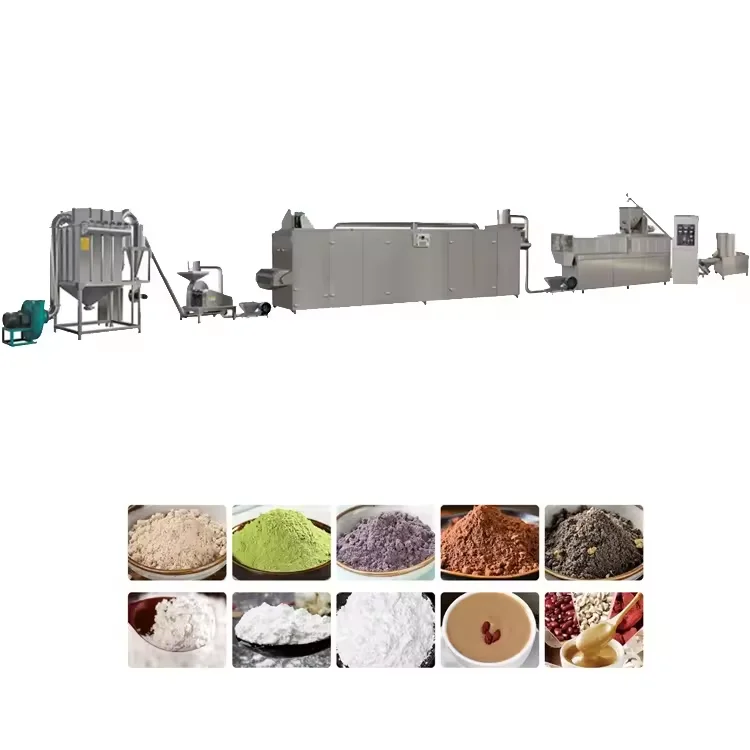


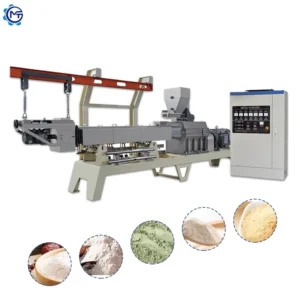
MT65, MT70, MT75, MT85 Nutritional Powder Processing Line, Twin-Screw, PLC & MCC Control — complete turnkey system from batching through extrusion, drying, pulse crushing to packing.
- Screw configuration and die design specified to your raw material (rice flour, corn flour, wheat flour) and target powder density
- Multi-layer drying oven with selectable heating source and adjustable dwell time for precise moisture control
- Throughput matched across every station so no single unit bottlenecks the line
- Voltage, frequency and control language confirmed to your local grid before production
In-house testing workshop runs your actual raw material before shipment, ensuring the line meets your product specification from day one.
Description
Throughput-Matched Turnkey Design — Every station in this nutritional powder processing line is calculated against your raw material profile before the first machine is built, preventing hidden bottlenecks between extruder, dryer, and crusher.
Technical Specifications
| Parameter | Value |
|---|---|
| Product Type | Nutritional Powder Processing Line |
| Models Available | MT65, MT70, MT75, MT85 |
| Screw Type | Twin-screw |
| Installed Power (MT65 / MT70 / MT75 / MT85) | 84 kW / 160 kW / 190 kW / 210 kW |
| Power Consumption (MT65 / MT70 / MT75 / MT85) | 59 kW / 120 kW / 140 kW / 150 kW |
| Output Capacity (MT65) | 120–150 kg/h (basis not stated in source — confirm raw material type and moisture content) |
| Output Capacity (MT70) | 150–200 kg/h (basis not stated in source — confirm raw material type and moisture content) |
| Output Capacity (MT75) | 200–250 kg/h (basis not stated in source — confirm raw material type and moisture content) |
| Output Capacity (MT85) | 300–400 kg/h (basis not stated in source — confirm raw material type and moisture content) |
| Overall Dimensions (L × W × H) | MT65: 20000 × 1500 × 2200 mm; MT70: 21000 × 1500 × 2200 mm; MT75: 23000 × 1500 × 3200 mm; MT85: 25000 × 1500 × 3500 mm |
| Voltage & Frequency | 380V, 50Hz, Three Phase (configurable per site requirement) |
| Control System | PLC and MCC (source value — verify against manufacturer catalog) |
| Mixer Batch Capacity Options | 20–30 kg / 70–80 kg / 170–180 kg per batch |
| Mixer Power Options | 4 kW / 7.5 kW / 15 kW |
| Mixer Contact Material | 304 Stainless Steel |
| Dryer Type | Multi-layer drying oven (fuel, gas, or electric heating options) |
| Dryer Drive | Double pitch roller chain drive, round-trip drying |
| Pulse Crusher Capacity | ~200 kg/h (basis not stated in source — confirm raw material and target particle size) |
| Pulse Crusher Power | 11 kW |
| Pulse Crusher Dimensions | 3000 × 900 × 2200 mm |
| Pulse Crusher Weight | 1500 kg |
| Line Stations | Flour mixing → Extruding → Frying/Drying → Pulse crushing → Packing |
| Standards | CE (certified since 2014), ISO certified |
Application Suitability
| Application | Material or Output |
|---|---|
| Infant formula and baby food supplement production | Rice flour, corn flour, wheat flour blends with added micronutrients |
| Fortified food and nutrition programme supply | Grain-based powders blended with vitamin and mineral premixes |
| Therapeutic and functional food processing | High-protein or high-fiber grain formulations requiring controlled gelatinisation |
| Artificial rice and grain-based nutritional supplements | Corn grits and rice flour reformed into uniform, quick-cooking granules |
| Breakfast cereal ingredient processing | Whole grain and mixed flour extrusion for downstream flaking or coating |
What "Nominal Capacity" Hides in a Nutritional Powder Line
A nutritional powder processing line turnkey is only as reliable as its slowest station, and that station is almost never the extruder.
When an extruder is quoted at a headline output number, buyers often assume the rest of the line will keep pace. In practice, the drying oven and pulse crusher have their own throughput limits shaped by moisture content, fat level, and target particle size of your specific formulation. I have seen a line stall for weeks because the dryer could not evaporate moisture fast enough from a high-fat nutritional blend, leaving semi-wet powder backing up at the crusher inlet. That kind of mismatch is invisible on a quotation sheet that only lists extruder capacity [NEED_CITE: throughput matching principles in multi-station food processing lines]. A proper nutritional powder processing line turnkey proposal calculates dwell time, belt loading, and evaporation rate at the dryer, then sizes the crusher and conveyor accordingly — before any steel is cut.
Screw Configuration Dictates Powder Uniformity
The twin-screw extruder at the heart of this line uses a screw configuration and die design matched to your raw material blend and target powder density. Rice flour gelatinises at a different temperature and shear profile than corn flour or wheat flour, so the barrel temperature zones and screw element arrangement must reflect the specific starch composition you are processing. This is the core reason a nutritional powder processing line turnkey must be specified against an actual formulation rather than a generic recipe.
Why the Dryer Is the Real Bottleneck Station
The multi-layer drying oven uses a double pitch roller chain drive for round-trip material travel, giving operators control over both belt speed and temperature across multiple zones. Heating source options include fuel, gas, or electric, selected based on your facility’s utility profile and local energy cost structure. Dwell time and temperature together determine final moisture content, which directly affects how the pulse crusher performs downstream and whether the finished powder meets shelf-life specification [NEED_CITE: moisture content targets for shelf-stable nutritional powders].
Reading the Specs Beyond the Headline Numbers
The installed power across the four extruder models ranges from 84 kW on the MT65 to 210 kW on the MT85, with actual consumption figures lower at each tier, reflecting motor load under typical operating conditions. Mixer batch capacity options span from 20–30 kg up to 170–180 kg per batch, allowing the batching station to be matched to the extruder’s feed rate rather than forcing operators into manual compromise. The 304 stainless steel contact surfaces in the mixer meet food-grade requirements for infant formula and therapeutic food production. Pulse crusher power sits at 11 kW with dimensions of 3000 × 900 × 2200 mm, a footprint that must be accounted for in the line layout alongside the extruder’s own footprint, which stretches up to 25 metres on the MT85 configuration.
The Hidden Cost of Skipping a Pre-Shipment Trial
Running a new formulation on a line that has never processed it before is a gamble that rarely pays off at the first start-up. Without a pre-shipment trial on your actual raw material, operators face weeks of adjustment after installation, tweaking screw speed, barrel temperature, and dryer settings while producing off-spec powder that cannot be sold. In one project involving a high-fat nutritional blend, the material’s poor flow characteristics were only discovered during a workshop trial, which revealed the need for a different screw conveyor design between the mixer and extruder hopper. Skipping that step would have meant the buyer’s factory floor becoming the test bench [NEED_CITE: importance of factory acceptance testing in food machinery procurement].
Why This Supplier Approach Differs
Complete line supply from a single source means throughput is matched at every station — mixer batch size, extruder output, dryer evaporation rate, and crusher capacity are all calculated together, not quoted as independent catalogue items. Screw and die configuration is specified against your raw material analysis report rather than copied from a previous build, which matters when switching between rice-based and corn-based nutritional formulations. The in-house testing workshop allows trial runs on your actual material before shipment, producing a documented report that becomes part of the delivery package. Pre-sales consultation covers line layout and utility planning, and on-site commissioning includes operator training specific to the PLC and MCC control system installed on your line.
Documentation & Verification
- Line layout drawing showing throughput calculation at each station from mixer through packing
- Screw and die configuration record matched to your raw material blend and target particle size
- Trial run report conducted on your actual formulation in the testing workshop before dispatch
- Electrical schematic with voltage, frequency, and control language confirmed for your local grid
- CE declaration of conformity and ISO certificate included with shipment documentation
- Operation and maintenance manual with wear parts list specific to your extruder model
Installation, Commissioning & Support
- Foundation and floor loading plan provided based on the selected model’s dimensions and weight, including the 1500 kg pulse crusher
- Dedicated power circuit sizing guidance aligned with the extruder’s installed power requirement and local voltage specification
- Modular line delivery with staged assembly sequence to accommodate workshop access constraints
- First-run parameter logging for barrel temperature zones, screw speed, and dryer dwell time to establish baseline recipes
- Operator training on PLC and MCC interface covering recipe recall, alarm response, and daily calibration checks
- Wear parts list for screws, dies, and chain drive components with recommended replacement intervals
- Routine maintenance schedule covering mixer bearing lubrication, dryer chain tension, and crusher screen inspection
Preparing Your Line Inquiry
To build an accurate nutritional powder processing line turnkey proposal, share your raw material analysis including moisture content, fat percentage, and starch composition. Specify your target daily output and the particle size range you need from the pulse crusher. Confirm your facility’s voltage, frequency, and preferred control language so the electrical system is configured before production begins. If you have existing upstream batching or downstream packing equipment, provide the interface dimensions and throughput so the new line stations connect without modification.
Frequently Asked Questions
Q: How is line throughput matched across all stations, not just the extruder?
A: Each station’s capacity is calculated against your raw material profile and target moisture content. The mixer batch size is set to feed the extruder continuously, the dryer belt speed and dwell time are calculated from the extrusion output moisture level, and the pulse crusher is sized to handle the dried material flow without accumulation. No station is quoted from a catalogue number alone.
Q: Can a trial run be done on my raw material before shipment?
A: Yes, raw material samples are processed in the in-house testing workshop before the line ships. The trial confirms screw configuration, barrel temperature profile, and dryer settings against your actual formulation, and a documented report with the results is included in the delivery package so commissioning starts from a known baseline.
Q: How are voltage, frequency, and control language confirmed for my target market?
A: Electrical specifications are confirmed during the proposal stage against your facility’s grid supply. The control system language, PLC interface labels, and MCC documentation are set to match your operator team’s requirements before the panels are wired, avoiding rework or delayed commissioning after the line arrives on site.
Q: What does the phased installation and commissioning schedule look like?
A: Equipment arrives in modular sections and is assembled station by station, starting with the mixer and extruder foundation. Once mechanical assembly is complete, electrical connections are made and the PLC is powered up for dry testing. Wet commissioning follows using your raw material, with operators trained on recipe management, alarm handling, and daily maintenance during the supervised production run.
Q: What documentation is included with the turnkey line delivery?
A: The documentation package contains a line layout with throughput calculations, screw and die configuration records, a trial run report on your material, electrical schematics with confirmed voltage and frequency, CE and ISO certificates, and a model-specific operation manual with a wear parts list and maintenance schedule.
Related products
-
Máquina Automática de Fabricación de Polvo Nutricional Cereal de Arroz Seguro para Bebés
¥30.00 Select options This product has multiple variants. The options may be chosen on the product page -
Línea de producción de pasta de maíz instantánea industrial Equipos de procesamiento de polvo nutricional Máquina de polvo de nutrición para reemplazo de comidas
¥65.00 Select options This product has multiple variants. The options may be chosen on the product page -
Línea de Producción de Alimentos Saludables para Bebés Equipos de Polvo Nutricional para Suplementos Alimenticios para Bebés para Maquinaria de Procesamiento de Harina
¥8,500.00 Select options This product has multiple variants. The options may be chosen on the product page -
CE cerelac Máquina de producción de línea de elaboración de papilla instantánea para bebés
¥35,000.00 Select options This product has multiple variants. The options may be chosen on the product page