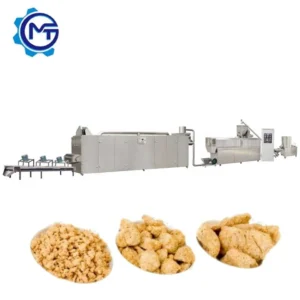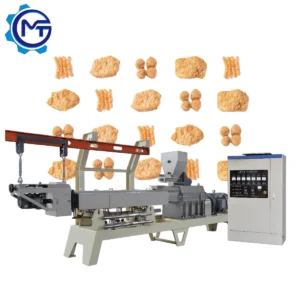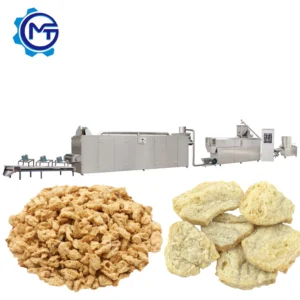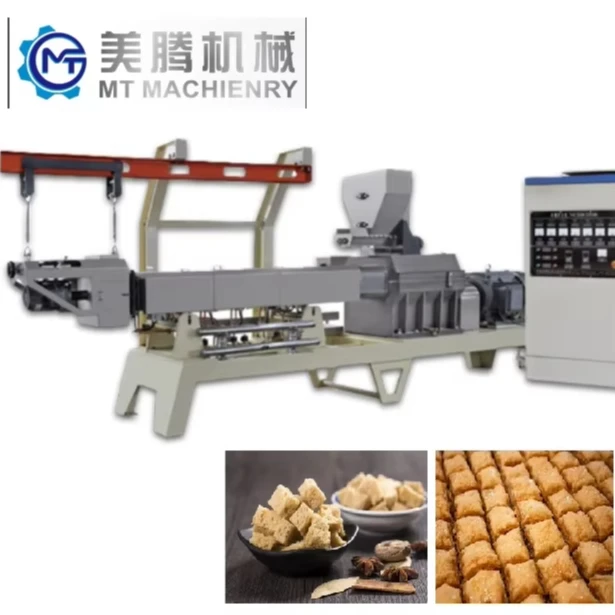



MT65 / MT70 / MT75 / MT85 Twin Screw Extruder Production Line for TVP, 84–210 kW installed power, interchangeable die configuration — engineered as a complete turnkey project from batching to cooling.
Screw configuration and die design are specified to your defatted soya flour or low-temperature soya flakes, with moisture, shear and barrel temperature profile controlled to achieve target texture and expansion. Multi-layer dryer with selectable energy source and adjustable time is throughput-matched to the extruder, preventing downstream bottlenecks.
- Line layout, capacity calculation, trial run report on your raw material, electrical schematic and commissioning support provided as part of the integrated project scope.
Description
Thermally Balanced Extrusion & Drying Stages — screw configuration and die geometry specified to the buyer’s defatted soya flour or soya flakes, validated on customer-supplied raw material before the line leaves the factory.
Technical Specifications
| Parameter | Value |
|---|---|
| Model | MT65 / MT70 / MT75 / MT85 |
| Product Type | Twin Screw Extruder Production Line for Texturized Vegetable Protein (TVP) |
| Screw Type | Twin screw |
| Installed Power | 84 kW (MT65) / 160 kW (MT70) / 190 kW (MT75) / 210 kW (MT85) |
| Power Consumption | 59 kW (MT65) / 120 kW (MT70) / 140 kW (MT75) / 140 kW (MT85) |
| Output Capacity | 100–150 kg/h (MT65, basis not stated in source) / 150–200 kg/h (MT70, basis not stated) / 150–200 kg/h (MT75, basis not stated) / 250–300 kg/h (MT85, basis not stated) |
| Main Motor Power | 22 kW / 30 kW / 45 kW (mapping to be confirmed per model) |
| Overall Dimensions (L×W×H) | 40000×1200×2200 mm (MT65) / 41000×1500×2200 mm (MT70) / 43000×1500×3200 mm (MT75) / 45000×1500×3500 mm (MT85) |
| Rotary Cutting Motor | 0.75 kW |
| Feeding Motor | 0.75 kW |
| Heating Power | 10 kW / 14 kW (mapping to be confirmed per model) |
| Screw Length | 1050 mm / 1520 mm (mapping to be confirmed per model) |
| Mixer Type | Vertical, stainless steel 304 mixing ruler |
| Mixer Power Options | 4 kW / 7.5 kW / 15 kW |
| Mixer Capacity Options | 20–30 kg / 70–80 kg / 170–180 kg |
| Dryer Drive | Double pitch roller chain, round-trip drying |
| Dryer Energy Source | Fuel / gas / electricity (buyer selectable) |
| Key Features | Interchangeable dies, adjustable dryer temperature and time, CE and ISO certified manufacturing |
Application Suitability
| Application | Material or Output |
|---|---|
| TVP / TSP soya chunks production | Defatted soya flour, low-temperature soya flakes |
| Vegetarian beef and meat analogue manufacturing | Soya protein blends, soybean dregs |
| Soya nuggets for food-service and retail | Defatted soya flour with moisture conditioning |
| Plant-based protein blocks for deep-freeze meals | Peanut dregs, mixed plant protein bases |
| Reconfigured cereal and puffed snack formats | Grain-based raw materials (via screw and die adjustment) |
Why "Nominal Capacity" Fails on Plant-Based Protein Lines
Your actual raw material determines the real throughput, not a brochure figure.
A plant based meat processing line turnkey quoted at a fixed output number assumes a specific flour grade, moisture content, and protein ratio. Swap the defatted soya flour for a different supplier’s batch, or introduce low-temperature soya flakes into the mix, and the extruder barrel pressure profile shifts. The texture comes out denser or the expansion collapses entirely. I have seen production teams spend two full days reconfiguring screw elements on-site because the trial material back at the factory was not the same as what arrived in the container [NEED_CITE: raw material variability impact on extrusion output consistency].
Matching Screw Geometry to Protein Behaviour
Twin-screw extrusion for texturized vegetable protein depends heavily on how the screw elements handle shear and residence time. The MT65 through MT85 range covers progressively larger barrel diameters and screw lengths up to 1520 mm, giving longer conditioning zones for higher-protein raw materials that need extended thermo-mechanical treatment. A plant based meat processing line turnkey must begin with screw element selection matched to whether the feedstock is fine defatted soya flour or coarser soya flakes, because the melt viscosity and gelatinisation onset differ substantially between the two.
Dryer Throughput Must Track the Extruder Output
Extrusion is only one station. If the multi-layer dryer cannot hold the moisture removal rate the extruder demands, the line bottlenecks and product sits wet on the conveyor, losing the fibrous structure that defines convincing meat analogues. The dryer on this line uses a double pitch roller chain drive with round-trip drying passes, and the energy source — fuel, gas, or electricity — is selected to match local utility costs and availability. Temperature and residence time are adjustable so the drying curve follows the specific TVP format being produced, whether dense soya chunks or lighter nuggets [NEED_CITE: drying curve requirements for textured plant protein products].
Reading the Power and Dimension Data
Installed power across the range spans from 84 kW on the MT65 to 210 kW on the MT85, but actual power consumption sits lower — between 59 kW and 140 kW — because heating zones cycle and the main motor rarely runs at full load continuously. The line footprint stretches up to 45 metres in length, so the facility must accommodate a straight-run layout with clearance for the air conveyor and cooling machine at the discharge end. Mixer capacity options from 20–30 kg up to 170–180 kg batch size allow the batching station to feed the extruder without surge or starvation, which matters when soya flour bridging in the hopper can interrupt the protein matrix forming inside the barrel.
The Cost of Mismatched Stations Downstream
When the extruder and dryer are sourced from separate vendors, neither party takes responsibility for the transfer point. Wet TVP accumulates, surface moisture seals the outer layer while the core remains under-dried, and the final product crumbles during rehydration. On a plant based meat processing line turnkey assembled as one project, the air conveyor transfer rate, dryer belt speed, and cooling machine airflow are calculated against the extruder discharge rate so the product moves continuously without queuing at any station [NEED_CITE: throughput balancing across extrusion and drying stages in food processing].
Why This Line Is Engineered as One Project
Every station from the vertical mixer through the cooling machine is specified under a single supplier scope, which means throughput calculations and utility planning are done once, not negotiated between vendors. The screw configuration and die design are matched to the buyer’s raw material and target TVP format before production begins. An in-house testing workshop runs trial batches on customer-supplied defatted soya flour or soya flakes, generating a texture and expansion record before the line ships. CE-certified manufacturing since 2014 and ISO-certified processes underpin the build quality. Pre-sales engineering through on-site commissioning and operator training keeps accountability with one team from layout drawing to first production run.
Documentation & Verification
- Line layout and capacity calculation showing throughput balance across mixer, extruder, dryer, and cooler
- Screw and die configuration record matched to your defatted soya flour or soya flakes
- Trial run report on customer-supplied raw material from the in-house testing workshop
- Electrical schematic with voltage and frequency confirmation for your facility
- Operation and maintenance manual covering wear part replacement intervals
- CE declaration of conformity and ISO certificate included with shipment
Installation, Commissioning & Support
- Facility must accommodate up to 45-metre straight-run footprint with 3.5-metre headroom clearance for the MT85 configuration
- Dedicated power circuit required matching confirmed voltage and frequency before the main motor is energised
- Line ships in modular sections with plastic film and wooden case protection for container loading
- On-site commissioning includes barrel temperature profiling and die gap adjustment for your raw material
- Operator training covers screw element changeover procedures and dryer temperature scheduling
- Wear parts list supplied with recommended spare screw elements and die plates for the first replacement cycle
What We Need to Move Forward
To size the right extruder model and configure the line stations, we need your raw material specification — whether defatted soya flour, low-temperature soya flakes, or a blend — along with the target TVP format and your daily production target. Share your facility voltage and frequency so the electrical schematic matches local supply, and let us know the available floor space and ceiling height to confirm the layout fits. If you can ship a sample batch of your raw material, we will run a trial in the testing workshop and send back the texture and expansion data before you commit.
Frequently Asked Questions
Q: How is output capacity verified on my specific raw material rather than quoted as a nominal figure?
A: We run your defatted soya flour or soya flakes through the extruder in our in-house testing workshop before shipment. The trial produces a report documenting actual throughput, expansion ratio, and texture at the screw configuration we specify for your material, so you see real data rather than a generic capacity number.
Q: What does the turnkey scope cover across the full line?
A: The scope runs from the vertical mixer and screw conveyor through the twin screw extruder, air conveyor, multi-layer dryer, and cooling machine — all specified and supplied as one project. Layout drawings, utility planning, commissioning, and operator training are included under a single supplier accountability.
Q: How do you prevent the dryer from bottlenecking the extruder?
A: Dryer belt speed, round-trip pass count, and temperature profile are calculated against the extruder discharge rate for your specific TVP format. The double pitch roller chain drive and adjustable residence time ensure moisture removal keeps pace so product never queues wet between stations.
Q: Can the line switch between soya nuggets, chunks, and flakes?
A: Yes. The extruder accepts interchangeable die plates, and screw element arrangements are adjusted for each format. A changeover involves swapping the die, reconfiguring the screw elements per the recorded setup sheet, and adjusting dryer temperature for the new product density.
Q: What documentation arrives with the line for installation planning?
A: You receive a line layout drawing with utility connection points, an electrical schematic confirming voltage and frequency, the screw and die configuration record for your material, a trial run report, and an operation manual with wear part replacement schedules.
Related products
-
Planta de Extrusión de Proteína de Soja Texturizada Línea de Producción de Procesamiento de Proteínas Máquina para Fabricar TVP
¥30.00 Select options This product has multiple variants. The options may be chosen on the product page -
Máquina de Extrusión de Carne Vegetariana de Alta Humedad
¥9,500.00 Select options This product has multiple variants. The options may be chosen on the product page -
High Productivity Single Screw Extruder Machine New Condition Textured Soya Meat & Soy Protein Like Meat Making Machine
Price range: ¥20.00 through ¥30.00 Select options This product has multiple variants. The options may be chosen on the product page -
Línea de Procesamiento de Carne Vegetariana de Proteína de Soja de Alta Capacidad
¥9,500.00 Select options This product has multiple variants. The options may be chosen on the product page