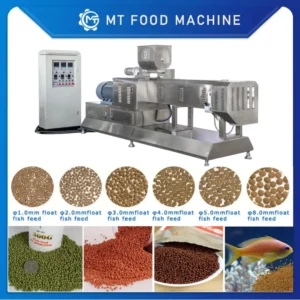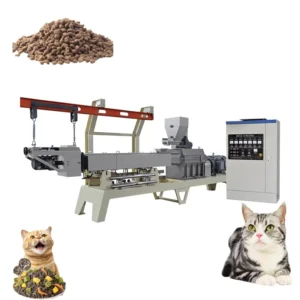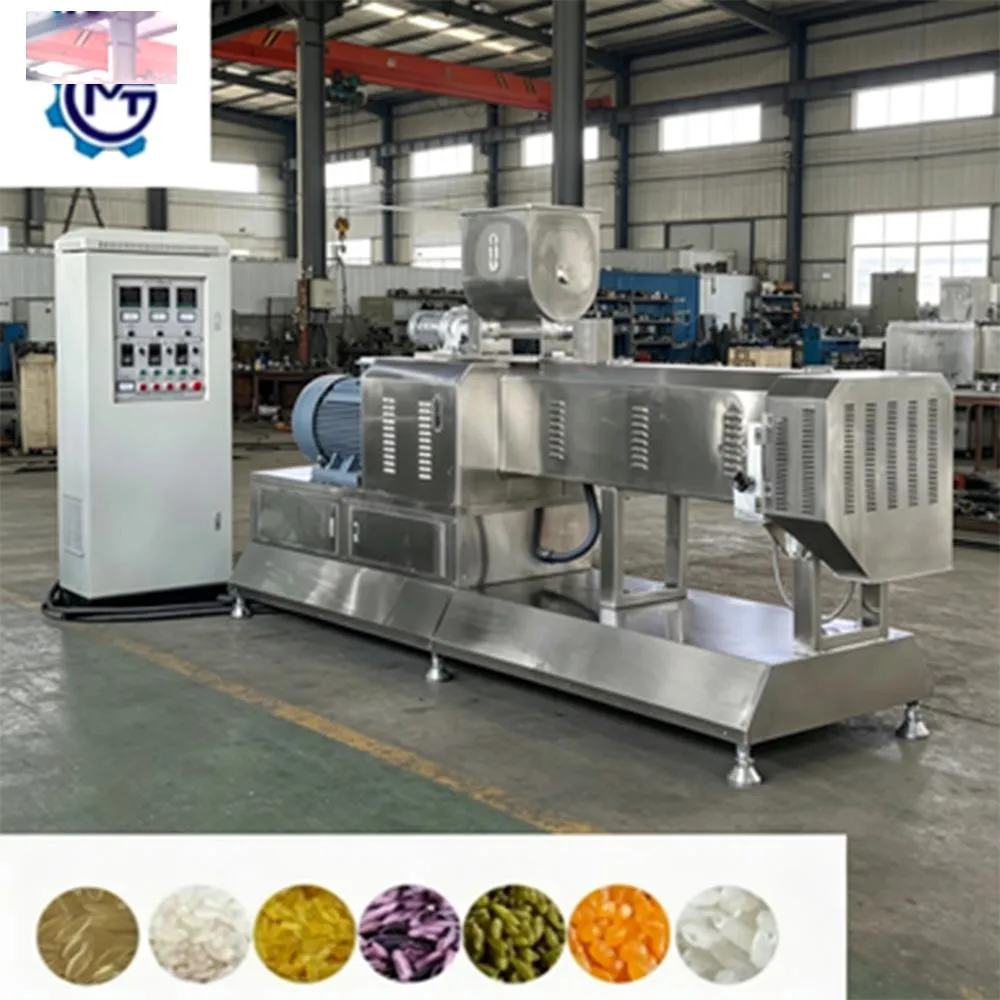
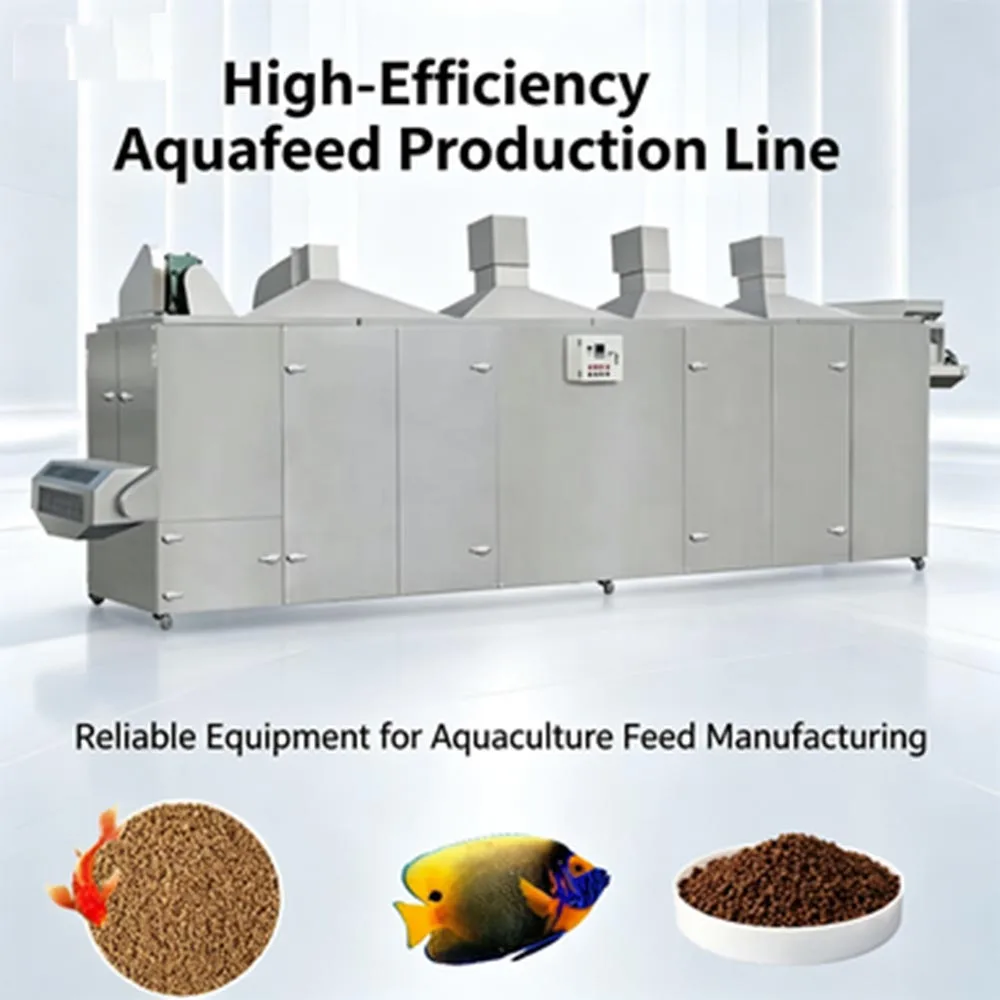


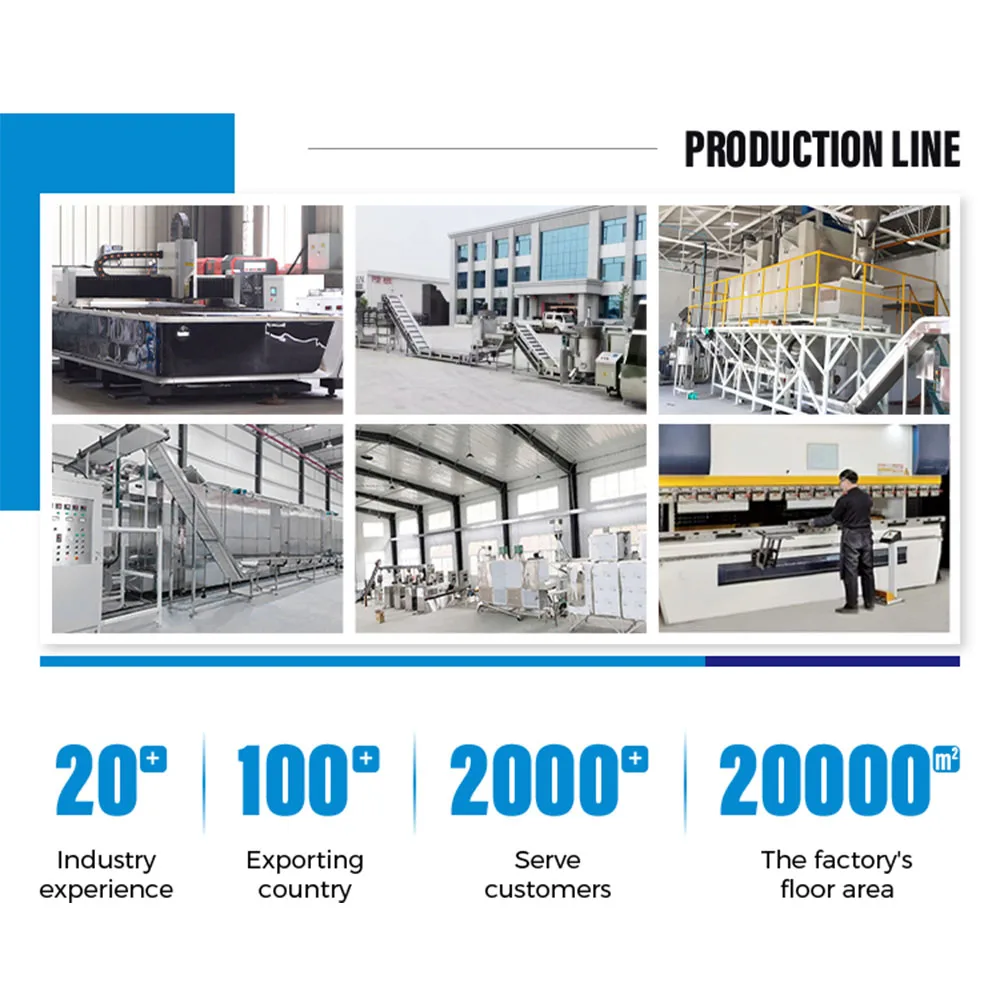
Twin Screw Fish Feed Extruder Production Line, PLC Control, Food-Grade 304 SS — configured for floating and sinking aquatic pellet manufacturing with matched throughput from mixing through drying to coating.
Screw configuration and die design are specified to your raw material formulation and target buoyancy, ensuring uniform pellet density under high temperature and pressure extrusion.
- Full continuous line with intelligent PLC control across all stations
- Pellet size, hardness, and buoyancy adjustable via screw and die selection
- In-house trial runs on your actual raw material before shipment validate output against specification
Description
Screw Configuration Matched to Your Raw Material — trial runs on your actual fish meal and compound additives define the extruder geometry before the twin screw fish feed extruder turnkey production line ships.
Technical Specifications
| Parameter | Value |
|---|---|
| Product Type | Twin Screw Fish Feed Extruder Production Line |
| Screw Type | Twin screw |
| Control System | Intelligent PLC automatic control system |
| Contact Material | Food-grade 304 stainless steel |
| Production Mode | Full continuous automatic production |
| Pellet Adjustability | Size, hardness, buoyancy (floating and sinking) |
| Line Stations | Raw material mixer, extruder, dryer, seasoning coating machine, vibrating sieve, conveyor equipment |
| Output Capacity | Medium to large scale (basis to be confirmed) |
| Assembly State | Complete matched production line |
| Certification | CE, ISO |
Application Suitability
| Application | Material or Output |
|---|---|
| Floating fish feed for koi and goldfish | Fish meal, corn powder, compound additives |
| Sinking pellet production for freshwater species | Soybean meal, fish meal, binding agents |
| Tropical fish feed in varied pellet sizes | Soybean meal, corn powder, nutritional additives |
| Catfish and tilapia aquaculture feed | Plant protein blends, fish meal, premix |
Why Buoyancy Specs Get Ignored Until It Is Too Late
A twin screw fish feed extruder turnkey production line must deliver the exact pellet density your market expects, yet most quotations never address the raw material formulation that determines it.
Floating or sinking behaviour is decided by screw configuration and die geometry, not by the extruder model alone.
I once watched a commissioning crew in Bangladesh dump an entire batch of catfish feed into a pond, only to see half of it floating when the contract specified sinking pellets. The extruder was fine. The screw elements had been configured for a standard fish meal formula, but the buyer was running a high-fibre local blend with soybean cake and rice bran. The density dropped, the pellets refused to sink, and the farmer rejected the shipment. That formulation mismatch never surfaced because no trial run happened on the buyer’s actual raw material before the equipment left the factory [NEED_CITE: raw material variability in aquaculture feed formulations].
Barrel Temperature Zones and Starch Gelatinisation
The twin-screw extrusion process relies on a precise thermal profile across multiple barrel zones to achieve full starch gelatinisation. With a twin screw fish feed extruder turnkey production line, each heating zone can be independently controlled through the PLC system, allowing operators to set different temperatures from the feed inlet to the die plate. Corn powder and soybean meal respond differently to heat input, and the barrel profile must match the starch content of the specific formulation being run on that shift.
Die Selection and Pellet Buoyancy Control
Buoyancy in aquatic feed comes down to the expansion ratio at the die face, which is governed by die hole diameter, land length, and the moisture content of the dough as it exits the barrel. Floating pellets require rapid expansion and a lower density matrix, while sinking pellets need restricted expansion and higher compression through the die. The die geometry is selected based on the target species and feeding behaviour, and that selection must be validated against the buyer’s actual formulation during pre-shipment testing [NEED_CITE: die design parameters for extruded aquatic feed].
Screw Element Arrangement and Residence Time
The sequence of conveying, kneading, and reverse screw elements inside the barrel determines how long the material stays under heat and shear. A twin screw fish feed extruder turnkey production line configured for sinking pellets will typically use more shear-intensive kneading blocks to compress the matrix, while a floating pellet setup favours gentler conveying elements that preserve air pockets. Getting this arrangement wrong means the pellets either disintegrate in water within minutes or refuse to soften at all, both of which result in feed rejection at the farm level.
What Happens When the Dryer Is Undersized
A common failure in assembled aquatic feed lines is an extruder running at full capacity while the dryer cannot keep up, forcing operators to either slow the entire line or push wet pellets into the coating drum. Wet pellets that enter the flavouring station clump together, the coating powder sticks unevenly, and the final moisture content exceeds storage limits. The twin screw fish feed extruder turnkey production line avoids this by matching the dryer bed area and airflow capacity to the extruder output, so every station runs at the same throughput without manual throttling.
The Hidden Cost of Generic Screw Configurations
When screw elements are copied from a catalogue build rather than matched to the buyer’s raw material, the problems do not appear on the factory floor — they appear weeks later when the customer’s own production starts. Pellets may crack during storage, float when they should sink, or produce excessive fines that clog the vibrating sieve. I have seen lines where the operator spent every shift adjusting barrel temperatures just to hold basic pellet integrity, because the screw profile was never designed for the specific protein and fibre content in their formula [NEED_CITE: screw configuration impact on extruded pellet integrity].
Why Procurement Consolidation Matters for Aquatic Feed Lines
Every station matched under one supplier. The mixer batch size, extruder throughput, dryer capacity, and coating drum volume are calculated together, so no single station becomes a bottleneck during continuous operation.
Screw and die configuration tied to your formulation. The element arrangement and die plate geometry are specified after reviewing your raw material composition and target pellet buoyancy, not pulled from a standard build sheet.
Pre-shipment trial runs on your actual raw material. Your fish meal, soybean meal, and compound additives are run through the extruder in the testing workshop, and the trial run report documents the pellet density, expansion ratio, and sinking rate before the line is packed.
PLC control across the full line. The intelligent automatic control system coordinates every station from mixing through screening, reducing manual intervention during continuous production shifts.
Food-grade 304 stainless steel on all contact surfaces. Every component that touches the feed material — from the mixer bowl to the dryer mesh belt — resists corrosion from the high-moisture, high-salt environment typical of aquatic feed production.
Documentation & Verification
- Line layout confirming throughput matching from mixer through vibrating sieve
- Screw and die configuration record matched to your aquatic feed formulation
- Trial run report documenting pellet buoyancy on your raw material before dispatch
- Electrical schematic with voltage and frequency confirmation for your facility
- CE declaration of conformity and ISO certificate for customs clearance
- Operation manual covering PLC parameter settings for floating and sinking pellet modes
Installation, Commissioning & Support
- Foundation requirements mapped to the full line footprint including extruder and dryer stations
- Electrical supply specification for PLC cabinet and each motor across the production line
- Assembly sequence for matched stations from raw material mixer to discharging conveyor
- First-run parameter setting for barrel zones and screw speed on your specific formulation
- Operator training on switching between floating and sinking pellet die configurations
- Wear parts list covering screw elements, die plates, and dryer belt segments
What We Need to Configure Your Line
To size the twin screw fish feed extruder turnkey production line for your operation, share your raw material formulation including the protein and fibre percentage of your primary ingredients. Specify which pellet sizes and buoyancy types you need to produce, along with the target daily output in tonnes. Confirm the voltage and frequency at your facility, the available floor space and ceiling height, and whether you require the line to interface with existing upstream grinding or downstream bagging equipment.
Frequently Asked Questions
Q: How is line capacity verified against my specific raw material formulation and pellet size?
A: Capacity is confirmed through a trial run using your actual fish meal, soybean meal, and additives in our testing workshop. The extruder runs your formulation through the specified screw and die configuration, and we measure throughput, pellet density, and buoyancy. The trial run report documents the verified output before we finalise the line layout and quotation.
Q: How do you ensure floating vs. sinking buoyancy meets my market specification?
A: Buoyancy is controlled through screw element arrangement, die geometry, and barrel temperature profile. We configure the twin screw fish feed extruder turnkey production line based on your target density range, then validate sinking rate and float stability during the pre-shipment trial run on your raw material, adjusting the die and screw setup until the specification is met.
Q: What screw configuration and die design will be selected for my formulation?
A: The screw element sequence — conveying, kneading, and reverse elements — is specified based on the protein, starch, and fibre content of your raw material blend. Die hole diameter and land length are chosen to achieve your target pellet size and expansion ratio. Both are documented in the configuration record provided before shipment.
Q: How is throughput matched between extruder, dryer, and coating stations to prevent bottlenecks?
A: Each station is sized during the line layout phase so that the extruder output, dryer evaporation capacity, and coating drum volume all align. The twin screw fish feed extruder turnkey production line operates as one continuous system, and no single station forces the others to slow down or idle during standard production runs.
Q: What trial runs are performed on my raw material before the line ships?
A: We run your supplied raw material through the configured extruder and record pellet diameter, density, moisture content, expansion ratio, and sinking or floating behaviour. The PLC parameters for barrel temperature, screw speed, and feed rate are logged. The complete trial run report accompanies the shipment so your team can replicate the settings during on-site commissioning.
Related products
-
Línea de procesamiento de alimento para peces de múltiples especies con capacidad de 300-600kg/h para producir alimento para peces
¥45,000.00 Select options This product has multiple variants. The options may be chosen on the product page -
MT85 500kg/h Multi-Purpose Pet Food Processing Line for Dogs Cats Birds Fish & More-380V 50Hz Three Phase 45KW
¥65,000.00 Select options This product has multiple variants. The options may be chosen on the product page -
Línea de procesamiento industrial de producción de alimento para peces acuáticos flotantes y hundidos con extrusora automática de doble tornillo de ahorro de energía.
¥65.00 Select options This product has multiple variants. The options may be chosen on the product page -
Marca Línea de Procesamiento de Comida para Gatos de Múltiples Especies Controlada por PLC de 2.5-3.0t/h¥55,000.00
Select options This product has multiple variants. The options may be chosen on the product page