

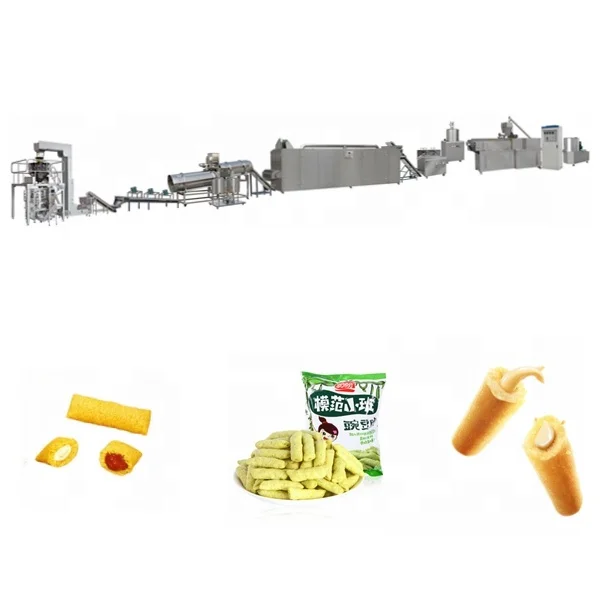
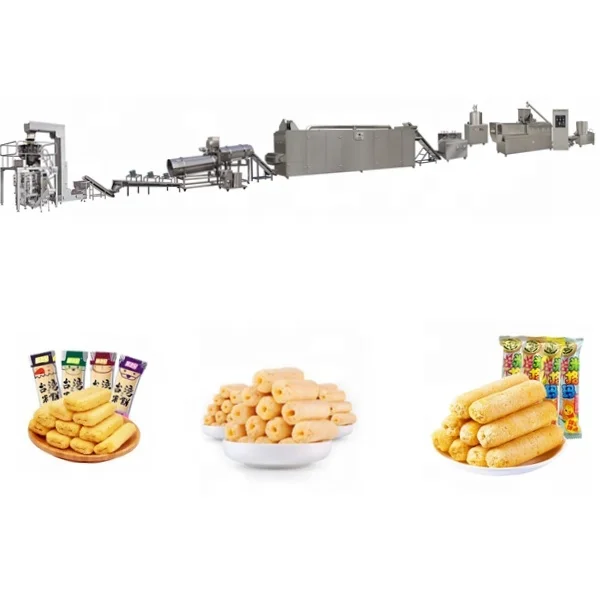
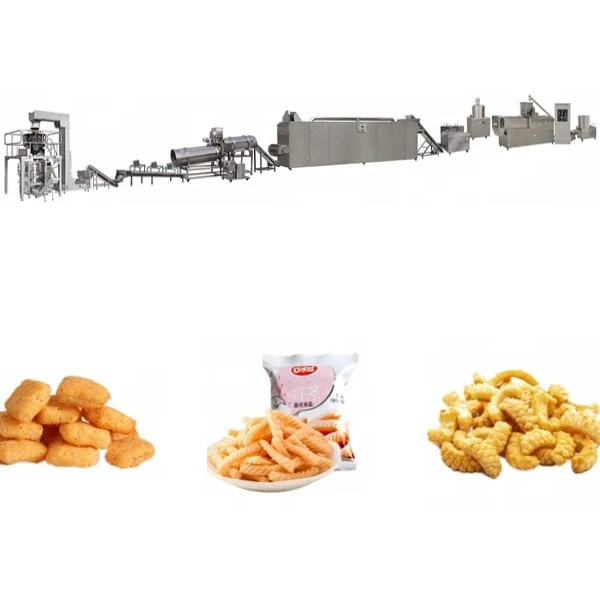
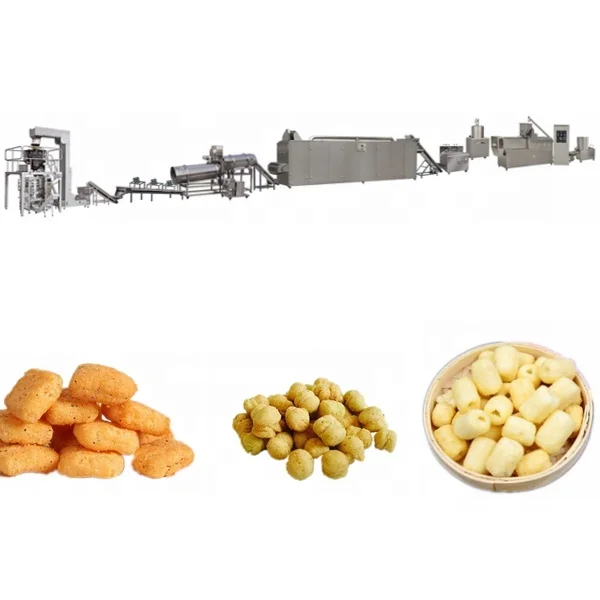
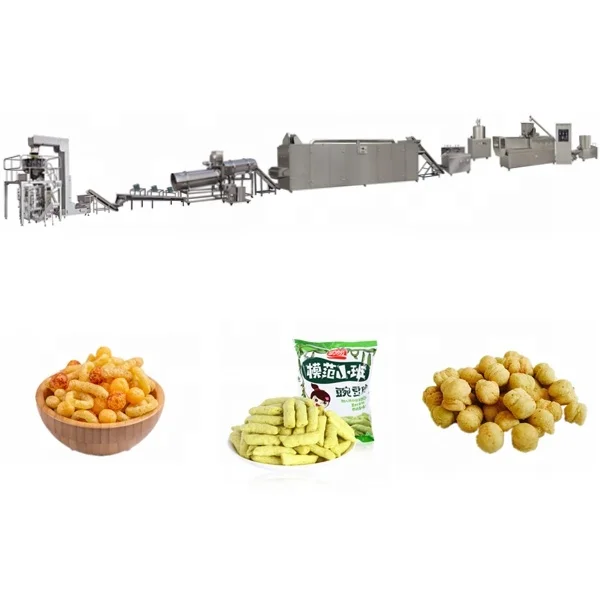
Puffed Snack Production Line, Twin-Screw Extruder, PLC Control — configured for corn sticks, core-filled snacks and rice cakes with matched throughput from mixer through drying and packing.
Screw configuration and die design are specified to the buyer’s raw material and target texture, with barrel temperature and moisture profile tuned for consistent expansion and density across cereal-based formulations.
- Energy source selectable per station (electricity, gas, diesel, steam) to align with local utility conditions
- Trial runs conducted on customer-supplied raw material before shipment, with full documentation package included
Description
Turnkey Line Accountability — Every station from mixer to packing is sized and verified on your actual cereal blend before the line ships, eliminating the mismatch that stalls production at the dryer or flavoring drum.
Technical Specifications
| Parameter | Value |
|---|---|
| Product Type | Puffed Snack Production Line |
| Extruder Type | Twin-screw extruder (double screw) |
| Control System | PLC and MCC automated control |
| Voltage & Frequency | 3-phase 380V/50Hz, single-phase 220V/50Hz (customizable to local voltage) |
| Power Consumption | ~100 kW (electric heating); 50–60 kW (gas or diesel heating) (basis not stated in source — confirm line configuration and dryer type) |
| Contact Material | Food-grade stainless steel 201/304 |
| Energy Options | Electricity, gas, diesel, or steam selectable per station |
| Line Stations | Mixer → extruder → vibrating cooler → roasting/drying machine → packing machine |
| Screw & Die Configuration | Matched to raw material and target product |
| Flavoring System | Sugar, oil, and powder seasoning; semi-automatic or automatic options |
| Assembly State | Complete turnkey line |
| Certification | CE, ISO |
Application Suitability
| Application | Material or Output |
|---|---|
| Puffed corn snack sticks | Corn grits, corn flour, cornmeal blends |
| Core-filled snack bars | Chocolate-filled or cream-filled pillows from rice and wheat flour |
| Rice cakes and cereal bars | Rice, brown rice, millet, buckwheat |
| Artificial or fortified rice | Rice flour blends with micronutrient premix |
| Sheet snacks and 2D/3D pellets | Corn, potato starch, wheat starch combinations |
Why "Rated Capacity" Means Nothing Without Your Raw Material
A puffed snack production line turnkey is only as reliable as the trial run conducted on the grain blend you will actually feed into the hopper.
Lines quoted at a nominal output figure frequently stall within the first week of commissioning because the corn grits or rice flour available locally behave differently from the material used during factory testing. Moisture content, starch composition, and particle size all shift the expansion ratio and the density of the extruded stick. When throughput drops, the extruder pushes product faster than the dryer can handle it, and the flavoring drum receives uneven loads. I have watched shifts lose entire batches to hardened lumps on the conveyor because someone sized the line on a brochure number rather than on a sample of the buyer’s own corn [NEED_CITE: material-dependent extrusion behaviour and throughput verification].
Throughput Balancing Across Every Station
The extruder is only one link in the chain. A puffed snack production line turnkey must balance the mixer output, the extruder throughput, the vibrating cooler residence time, the dryer capacity, and the flavoring drum speed so that no station starves or overflows. When these are sized independently, bottlenecks appear at the weakest link — usually the dryer or the seasoning drum — and operators start manually clearing conveyors. This line is configured as a single system where each station’s capacity is calculated against the same raw material assumption and target product specification.
Screw Configuration Dictates the Snack Texture
The twin-screw extruder uses a modular screw arrangement that can be rearranged to alter shear intensity, residence time, and pressure profile inside the barrel. A corn snack stick requires a different screw sequence from a cream-filled pillow because the expansion and surface finish expectations differ. The die plate geometry further controls the cross-section and wall thickness of the extrudate. Both the screw configuration and die design are specified after reviewing the buyer’s raw material sample and target product, not copied from a generic build [NEED_CITE: twin-screw configuration principles for snack extrusion].
Reading the Specifications That Matter
The PLC and MCC control system maintains barrel temperature zones, screw speed, and feeder rates within tight bands, which is critical when switching between corn-based sticks and rice-based pillows on the same line — each recipe demands a distinct temperature profile along the barrel. The choice between electric, gas, diesel, or steam heating for the dryer station affects both operating cost and moisture removal rate; gas-fired dryers typically deliver faster heat-up but require local gas line approval. Food-grade stainless steel 201/304 contact surfaces prevent iron contamination that would discolour light-coloured rice snacks. Voltage customization — 380V/50Hz or 220V/50Hz as a baseline, adjustable to local supply — avoids the commissioning delays that occur when a control panel wired for one grid arrives at a factory running another [NEED_CITE: voltage and frequency standards by export market].
The Cost of Mismatched Stations
When a buyer purchases an extruder without confirming that the downstream dryer and flavoring drum can keep pace, the result is product buildup on conveyors, surface moisture that prevents seasoning adhesion, and hardened scrap that must be discarded. I once saw a snack producer add a twin-screw extruder to an existing line and discover during commissioning that the original rotary dryer could not handle the increased moisture load — the sticks left the dryer soft and collapsed within hours. The entire dryer had to be replaced before the line could run continuously.
Why Source the Full Line Here
This line is supplied as a complete system from batching through packing, so throughput matching is the supplier’s responsibility rather than a negotiation between separate vendors. The screw configuration and die design are specified to your raw material and target product format, not borrowed from a generic template. An in-house testing workshop runs your actual cereal blend before shipment, generating a trial report that confirms expansion, density, and texture. Twin-screw expertise spans puffed sticks, core-filled pillows, cereal bars, and fortified rice — applications with very different shear and moisture requirements. Pre-sales engineering covers the full line layout, and on-site commissioning includes operator training so your team can adjust recipes independently from day one.
Documentation & Verification
- Line layout drawing showing throughput calculation at each station for your target capacity
- Trial run report on your supplied corn or rice blend confirming expansion and density
- Screw and die configuration record documenting the module arrangement for your product
- Electrical schematic with confirmed voltage, frequency, and control language before production
- Factory acceptance test record covering all stations running in sequence
- Operation and maintenance manual with wear parts list for screws, dies, and dryer belts
Installation, Commissioning & Support
- Foundation and floor space planning based on the confirmed line layout and station footprint
- Dedicated power circuit sized for the ~100 kW electric heating load or gas line connection for dryer
- Station-by-station assembly with mechanical and electrical alignment checked against the layout drawing
- First-run parameter setting for barrel temperature zones, screw speed, and dryer residence time
- Operator training covering recipe changes, screw configuration swaps, and daily cleaning procedures
- Wear parts supply plan covering screws, die plates, and dryer belt segments for the first replacement cycle
What We Need to Size Your Line
To configure a layout that holds its rated output on your material, provide the specific cereal blend you plan to run, the target product format and dimensions, and your daily production requirement. Include your local voltage and frequency, preferred control language, and available workshop dimensions so the layout fits your building. If you already operate upstream milling or downstream packaging equipment, share those specifications so the line interfaces cleanly.
Frequently Asked Questions
Q: How is line capacity verified before the equipment ships?
A: Your raw material sample is run through the twin-screw extruder and downstream stations in the testing workshop. The trial produces actual product at the proposed throughput, and the expansion ratio, density, and texture are measured against your specification. A trial run report documents the results and the exact screw configuration used.
Q: How are screw configuration and die design matched to a specific snack format?
A: The screw module sequence is selected based on the starch content, moisture level, and target expansion of your product. A high-expansion corn stick needs a different shear profile from a dense, cream-filled pillow. The die opening geometry is designed to produce the cross-section and wall thickness your market expects.
Q: What voltage and control language options are confirmed before production?
A: The electrical schematic is reviewed with you before manufacturing begins. Standard options include 3-phase 380V/50Hz and single-phase 220V/50Hz, but the system is configurable to match your local grid. The PLC interface language is set to your preference so operators can navigate recipes and alarms without translation delays.
Q: How is throughput balanced between the extruder, dryer, and packing stations?
A: Each station is sized against the same raw material assumption and target output. The dryer capacity is calculated to handle the moisture load leaving the extruder, and the flavoring drum speed is matched to the conveyor feed rate. This prevents product accumulation and the scrap that results from uneven drying or seasoning.
Q: What does on-site installation and commissioning include?
A: Engineers assemble each station, align conveyors, connect utilities, and run the full line on your raw material. Operators are trained on recipe changes, screw swaps, and daily maintenance. Commissioning continues until the line consistently produces product within your density and texture specification.
Related products
-

Full Automatic Puffed Corn Snack Food Extruder Puffed Snack Corn bar Making Machine
¥8,500.00 Select options This product has multiple variants. The options may be chosen on the product page -

Automatic Puff Corn Snack Stick Production Line Equipment New Condition Machines
¥100.00 Select options This product has multiple variants. The options may be chosen on the product page -

Twin Screw Extruder for Cheese Puffs Food Stainless Steel Simple Puffed Rice Snack Machine
¥8,500.00 Select options This product has multiple variants. The options may be chosen on the product page -

Automatic Corn Flake Processing Line Corn Coco Pops Breakfast Cereals Snacks Making Machinery
¥7,500.00 Select options This product has multiple variants. The options may be chosen on the product page


