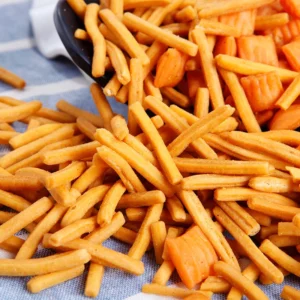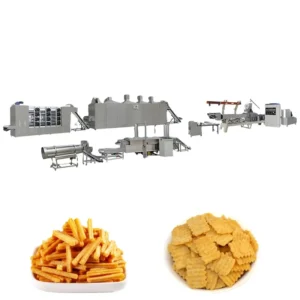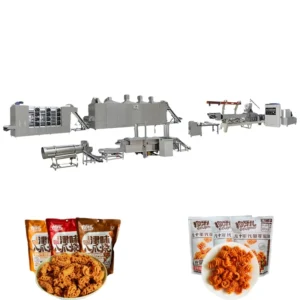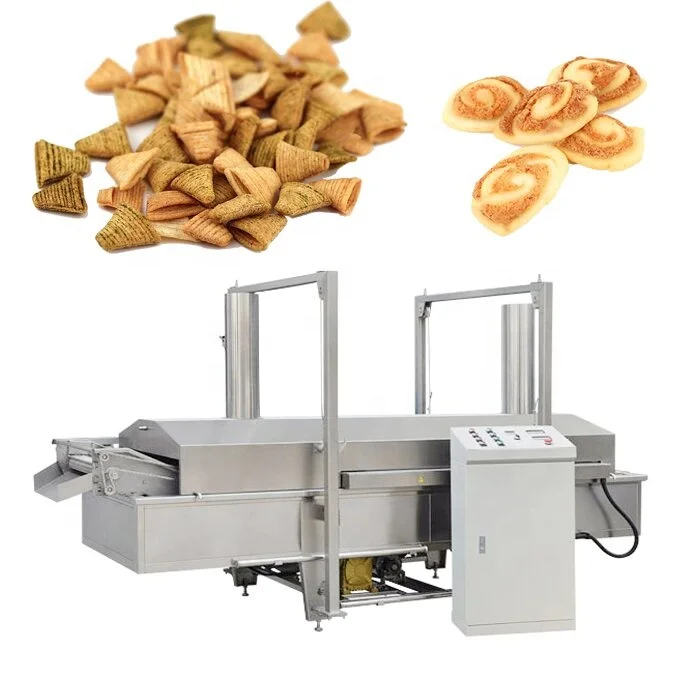
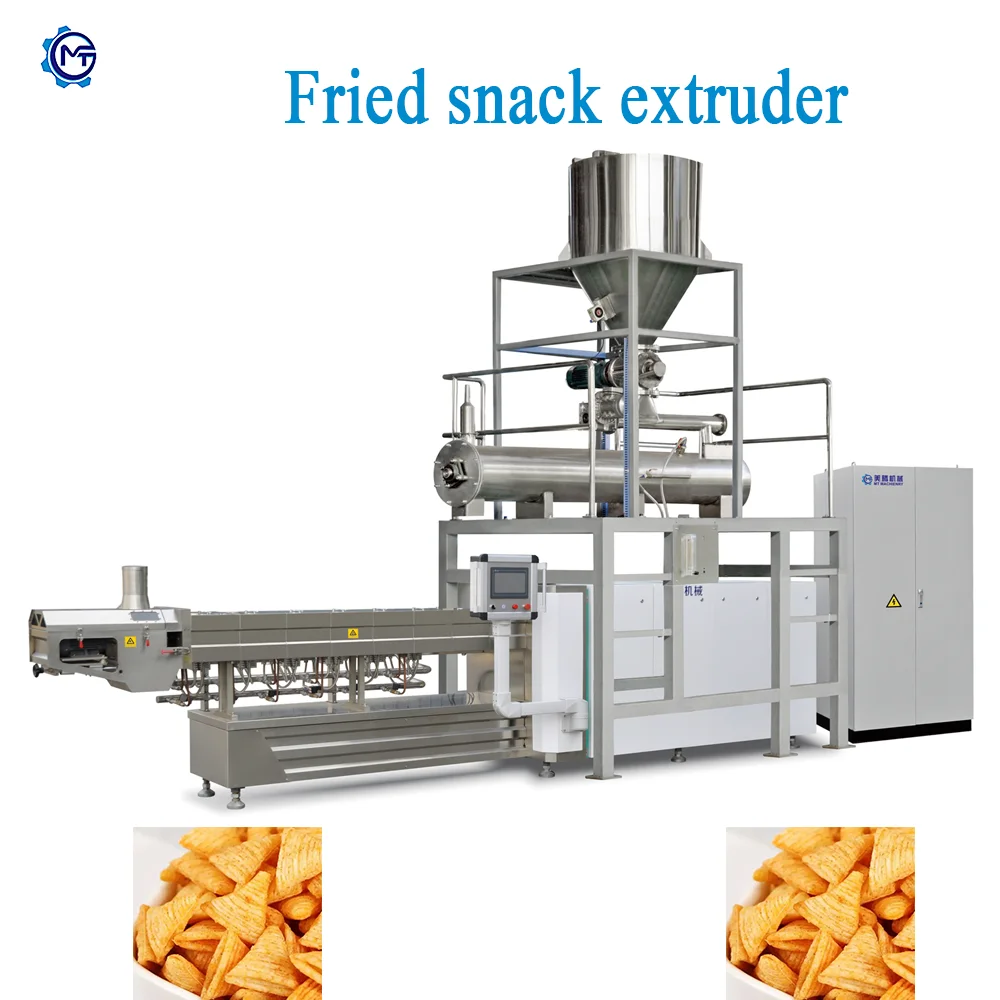
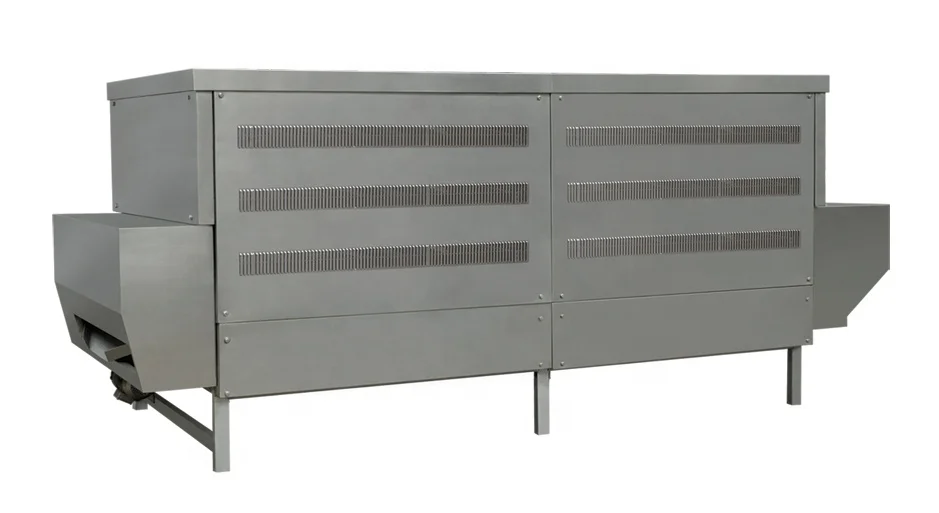

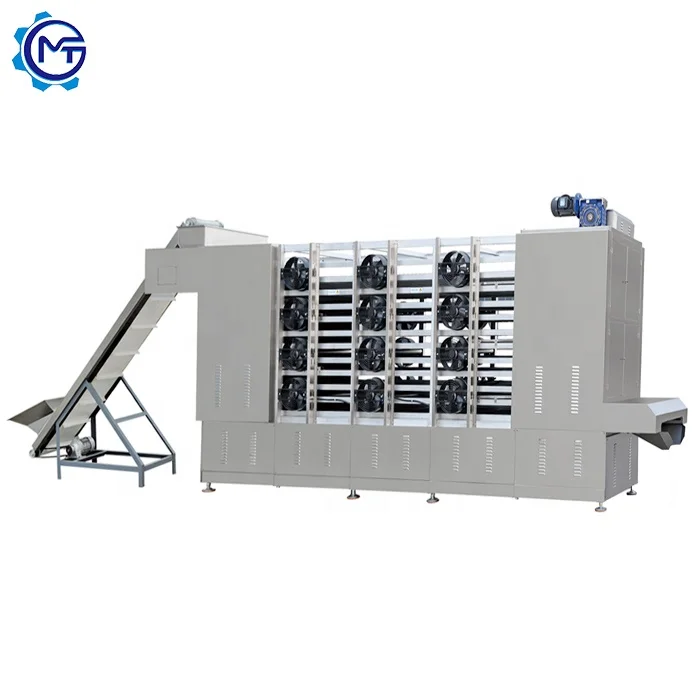

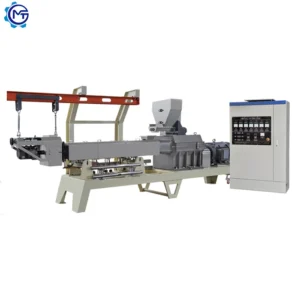
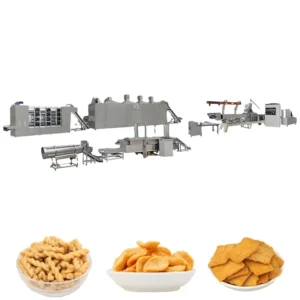
MT65, MT70, MT85, MT75, MT95 Twin-Screw Extrusion Snack Production Line with Continuous Fryer, 142–370 kW Installed Power — configured for fried bugles, tortilla chips, and rice crust snacks across five capacity tiers.
- Twin-screw extrusion with screw and die configuration matched to flour-based formulations and target snack density
- Continuous fryer temperature range 0–260 °C, integrated inline with extruder output to maintain steady-state production
- Complete line stations from powder mixer through extrusion, frying, flavoring, and drying under one supplier
Delivered as a turnkey project with line layout, throughput matching across every station, and trial runs on your actual raw material in our in-house testing workshop before shipment.
Description
Integrated Line Engineering — Every station from the powder mixer through the twin-screw extruder, continuous fryer, and flavoring drum is specified as one matched package, so real throughput holds steady on your actual flour formulation rather than peaking at one bottleneck station.
Technical Specifications
| Parameter | Value |
|---|---|
| Product Type | Twin-Screw Extrusion Snack Production Line with Continuous Fryer |
| Model Options | MT65 / MT70 / MT85 / MT75 / MT95 |
| Extruder Type | Twin-Screw |
| MT65 Installed Power | 142 kW |
| MT65 Actual Power Consumption | 100 kW |
| MT65 Output | 120–150 kg/h (basis to be confirmed) |
| MT65 Overall Dimensions | 22000 × 1200 × 2200 mm |
| MT70 Installed Power | 185 kW |
| MT70 Actual Power Consumption | 130 kW |
| MT70 Output | 200–250 kg/h (basis to be confirmed) |
| MT70 Overall Dimensions | 24000 × 1500 × 2400 mm |
| MT85 Installed Power | 240 kW |
| MT85 Actual Power Consumption | 180 kW |
| MT85 Output | 300–500 kg/h (basis to be confirmed) |
| MT85 Overall Dimensions | 26000 × 1500 × 2300 mm |
| MT75 Installed Power | 245 kW |
| MT75 Actual Power Consumption | 185 kW |
| MT75 Output | 400–500 kg/h (basis to be confirmed) |
| MT75 Overall Dimensions | 26000 × 1500 × 2800 mm |
| MT95 Installed Power | 370 kW |
| MT95 Actual Power Consumption | 280 kW |
| MT95 Output | 800–1000 kg/h (basis to be confirmed) |
| MT95 Overall Dimensions | 30000 × 1500 × 2800 mm |
| MT70 Extruder Main Motor | 30 kW |
| MT70 Extruder Dimensions | 2800 × 830 × 1875 mm |
| Powder Mixer Tank Volume | 150 kg per batch |
| Powder Mixer Rotary Speed | 385 rpm |
| Powder Mixer Mixing Time | 10 min per batch |
| Powder Mixer Power | 4 kW |
| Continuous Fryer Temperature Range | 0–260 °C |
| Continuous Fryer Dimensions | 4500 × 1350 × 2350 mm |
| Flavoring Line Output | 400 kg/h (basis to be confirmed) |
| Flavoring Line Power | 1.5 kW |
| Construction Material | Food-Grade Stainless Steel |
| Certification | CE, ISO |
| Warranty | 1 Year |
Application Suitability
| Application | Material or Output |
|---|---|
| Fried bugles and corn chip production | Corn flour and corn grits formulations |
| Tortilla chip and triangle chip extrusion | Wheat flour and corn blends |
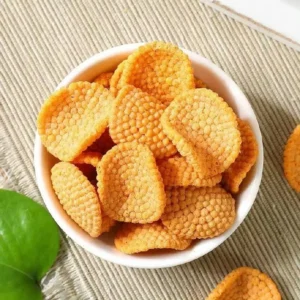
| Rice crust snack processing | Rice flour and starch-based recipes |
| Shaped pasta-based fried snacks | Semolina and durum wheat flour |
| Small fish crisps and golden horn snacks | Composite grain flour with seasoning |
Why Nominal Output Figures Mislead Snack Buyers
A fried snack production line turnkey is only as fast as its slowest matched station.
When a buyer sees a capacity figure on an extruder spec sheet, that number rarely accounts for what happens downstream. I have watched snack producers receive an extruder rated for a certain hourly output, only to discover the fryer cannot keep up on their specific corn grits blend, leaving half-formed product waiting on conveyor belts while oil temperature drops between batches. The fried snack production line turnkey you evaluate must be calculated against your actual raw material moisture, target shape, and frying absorption rate, not against a generic test grain. [NEED_CITE: throughput calculation methods for extruded and fried snack lines]
Matching Extruder Shear to Flour Gelatinisation
The twin-screw extruder in this line handles flour-based formulations by controlling shear and barrel temperature profile through screw configuration. For bugles and corn chip shapes, the degree of starch gelatinisation directly determines how well the product expands when it hits hot oil. Screw elements and die geometry are specified to your particular flour blend so that pellet density remains consistent across production runs, which is the foundation of any reliable fried snack production line turnkey.
Continuous Fryer Integration and Oil Temperature Stability
The continuous fryer operates across a temperature range up to 260 °C, and its capacity is sized to absorb the full extruder output without batch interruptions. When product enters the oil at a steady rate, temperature recovery stays within a narrow band, preventing the colour inconsistency and uneven oil absorption that plague lines where the fryer was sourced separately. This steady-state frying is what keeps bugles crisp and triangle chips uniformly golden from the first minute to the last hour of a shift. [NEED_CITE: continuous frying oil temperature recovery requirements for extruded snacks]
Reading the Power and Dimension Data
Installed power versus actual power consumption tells you what the line draws under load versus what the utility connection must support at peak start-up. On the MT70, for example, the 185 kW installed figure covers simultaneous motor starts across mixer, extruder, and fryer, while the 130 kW actual consumption reflects steady production. The overall dimensions — 24 metres long by 1.5 metres wide for the MT70 — define the minimum straight-line floor space, but real installation requires clearance for maintenance access on both sides of the twin-screw barrels and above the fryer hood for exhaust ducting.
The Hidden Cost of Mismatched Frying Capacity
When a fryer is undersized relative to extruder output, operators compensate by slowing the extruder or letting product accumulate before frying — both of which degrade texture. Pellets that sit too long before entering hot oil absorb ambient moisture and fry unevenly, producing a mix of blistered and pale chips in the same batch. I have seen this exact scenario force a snack manufacturer into two weeks of on-site parameter tuning after commissioning, time that should have been spent ramping up to commercial output instead of troubleshooting oil absorption. [NEED_CITE: effects of pre-fry dwell time on extruded pellet moisture and fry uniformity]
What Makes This Sourcing Decision Different
A complete fried snack production line turnkey from one supplier means the powder mixer batch cycle, the twin-screw extruder throughput, the fryer belt speed, and the flavoring drum rotation are all calculated together before production starts. Screw and die configurations are documented against your specific flour formulation, not copied from a generic build. An in-house testing workshop runs your actual raw material before shipment, generating a trial run report that confirms product shape, density, and fry behaviour. Electrical schematics arrive with voltage, frequency, and control language confirmed for your facility, so commissioning begins with power-on rather than transformer procurement.
Documentation & Verification
- Line layout drawing showing matched throughput across mixer, extruder, fryer, and flavoring drum stations
- Screw and die configuration record matched to your flour blend and target chip density
- Trial run report from in-house testing workshop using your raw material before shipment
- Electrical schematic with confirmed voltage, frequency, and control panel language for your site
- CE declaration of conformity and ISO certificate included with shipping documentation
Installation, Commissioning & Support
- Floor plan review confirming utility drop points for the MT70 line’s 185 kW installed power requirement
- Fryer exhaust ducting layout matched to the 4500 mm fryer length and local ventilation codes
- Twin-screw barrel alignment and die seating verified during on-site commissioning
- First production run supervised with oil temperature, extruder RPM, and fryer belt speed documented
- Wear parts list covering screws, dies, and fryer belt segments for first-year replacement planning
- Operator training covering batch changeover between bugles, triangle chips, and rice crust shapes
What We Need to Configure Your Line
To prepare an accurate layout and capacity calculation, share your target product shapes, the flour or grain formulation you plan to run, and your intended hourly output. We also need your facility voltage and frequency, available floor space with ceiling height, and whether you will be connecting this fried snack production line turnkey to existing upstream mixing or downstream packing equipment.
Frequently Asked Questions
Q: How is line output verified against my specific flour formulation and target snack shape?
A: Before we finalise the quotation, we run your actual raw material through the twin-screw extruder and continuous fryer in our in-house testing workshop. The trial run report documents product shape fidelity, expansion ratio after frying, oil absorption rate, and colour consistency. These results determine the screw configuration, die selection, and fryer temperature profile specified for your line.
Q: How do you ensure the fryer capacity matches the extruder output without creating a bottleneck?
A: Each line model is configured so the continuous fryer belt speed and oil volume are calculated against the extruder’s confirmed output on your specific formulation. The fryer dimensions and heating capacity are selected to maintain oil temperature recovery within a narrow band at full extruder throughput, preventing the colour variation that occurs when product queues before frying.
Q: What voltage, frequency, and control language options are available for the installation country?
A: Voltage and frequency are confirmed during the specification stage before production begins, and the electrical schematic reflects your local supply standard. Control panel language is set to your operator preference. This prevents commissioning delays caused by transformer mismatches or untranslated HMI screens after the equipment arrives at your facility.
Q: Is a trial run on my raw material performed before shipment, and what does the report cover?
A: Yes. The trial run uses your supplied flour blend or grain formulation and produces sample product through every station from mixing to frying. The report records screw speed, barrel temperature profile, die pressure, fryer oil temperature, final product weight, expansion ratio, and sensory evaluation. You receive this documentation before the line ships.
Q: What is included in on-site installation, commissioning, and operator training for the full line?
A: Our engineers handle mechanical assembly, utility connections, and initial parameter tuning across all stations. Commissioning includes supervised production runs with your raw material until output meets the trial run benchmarks. Operator training covers daily start-up and shutdown procedures, screw and die changeover for different snack shapes, fryer oil filtration routines, and basic troubleshooting for common faults.
Related products
-
Double Screw Extruder Corn Flour Puffs Snack Nacho Chips Tortilla Doritos Making Machine Savory Snack Production Line
¥50.00 Select options This product has multiple variants. The options may be chosen on the product page -
Industrial Wheat Flour Snacks Processing Equipment – Stainless Steel Fried Food Production Line
¥65.00 Select options This product has multiple variants. The options may be chosen on the product page -
Doritos Chips Making Extruder Fried Corn Bugles Crispy Chips Process Machine Frying Salad Sticks Pellet Snacks Production Line
¥100.00 Select options This product has multiple variants. The options may be chosen on the product page -
New Automatic Bugles Puff Snack Production Line Price Corn Chips Making Machine Fried Maize Machine High Productivity Large
¥8,570.00 Select options This product has multiple variants. The options may be chosen on the product page