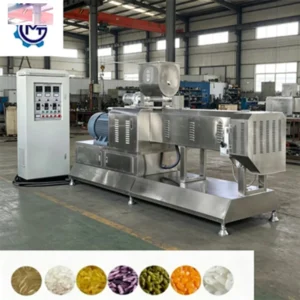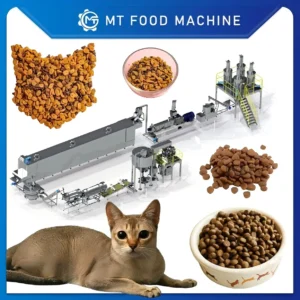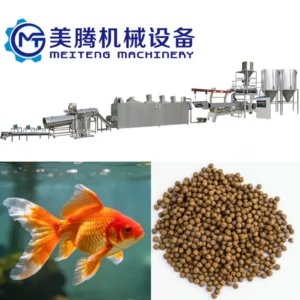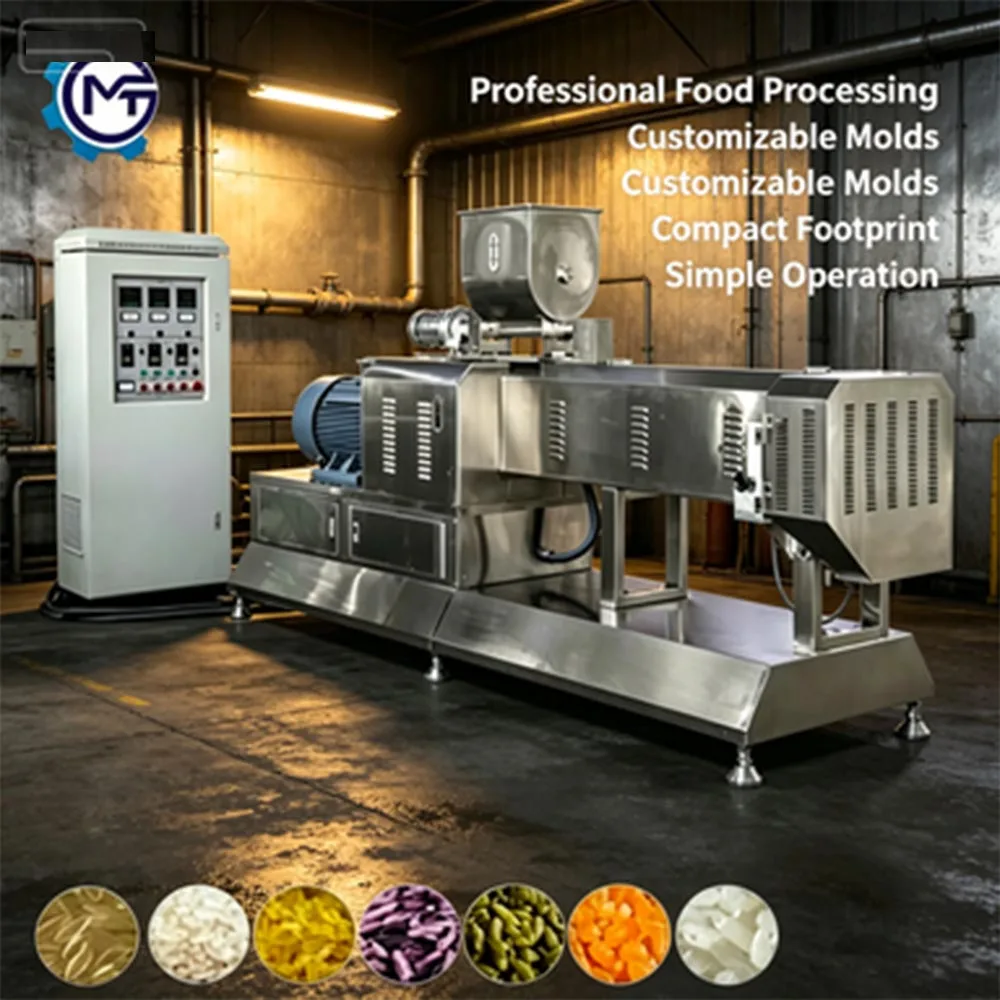


Twin-Screw Aquatic Feed Extrusion Production Line, PLC Control, Floating & Sinking Pellets — designed for continuous industrial fish feed manufacturing across koi, goldfish, tropical, and freshwater species.
Screw configuration and die geometry are matched to your raw material formulation, controlling pellet density and buoyancy through high-temperature, high-pressure ripening. Every station — mixer, extruder, dryer, coating drum — is throughput-matched under one supplier to eliminate cross-vendor bottlenecks.
In-house trial runs on your actual formulation verify pellet specification before the line leaves our factory.
Description
Matched Throughput Across Stations — Every machine from the raw material mixer through the extruder, dryer, and coating drum is sized so no single unit bottlenecks your aquatic feed output.
Technical Specifications
| Parameter | Value |
|---|---|
| Product Type | Twin-Screw Aquatic Feed Extrusion Production Line |
| Extruder Type | Twin-screw |
| Control System | Intelligent PLC automatic control |
| Material Contact Parts | Food-grade 304 stainless steel |
| Machine Body Material | Food-grade 304 stainless steel |
| Line Stations | Raw material mixer, extruder, dryer, seasoning/coating machine, vibrating sieve, conveyor equipment |
| Pellet Types Supported | Floating and sinking fish feed pellets |
| Pellet Adjustability | Size, hardness, buoyancy adjustable per breeding requirements |
| Applicable Raw Materials | Fish meal, soybean meal, corn powder, compound additives |
| Process Conditions | High temperature and high pressure ripening |
| Assembly State | Complete matched production line (turnkey configuration) |
| Operating Mode | Full continuous automatic production |
| Output Capacity | (basis to be confirmed — dependent on raw material formulation and pellet size) |
| Rated Power (kW) | (basis to be confirmed — per extruder model) |
| Voltage & Frequency | (basis to be confirmed — per target market) |
| Overall Dimensions (L×W×H) | (basis to be confirmed — per line layout) |
| Screw Diameter | (basis to be confirmed — per selected extruder model) |
| L:D Ratio | (basis to be confirmed — per screw configuration) |
| Standards | CE, ISO |
Application Suitability
| Application | Material or Output |
|---|---|
| Floating fish feed for koi and goldfish | Fish meal, soybean meal, corn powder with compound additives |
| Sinking pellets for freshwater aquaculture | Soybean meal and corn-based formulations requiring higher density |
| Tropical ornamental fish feed | Fine-grind raw materials with color-enhancing additives |
| Commercial aquaculture feed mass production | Continuous long-time operation on mixed protein and starch formulations |
| Turnkey feed plant projects | Full line integration from batching through screening and discharge |
Why "500 kg per Hour" on Paper Falls Apart at Your Factory
The only capacity number that matters is the one measured on your exact formulation.
I once configured an aquatic feed line for a Middle Eastern client who sourced local fish meal that behaved nothing like the standard test material. The extruder was rated for a certain throughput, but on his raw blend the actual output dropped by roughly half. The screw combination and die geometry had been set for a generic build rather than his specific ingredients. Since that project, every line I plan goes through a trial run on the buyer’s own raw material before we finalize the configuration. When you evaluate an aquatic feed extrusion production line, the first question should never be "what is the maximum output" but "what does it produce on my recipe at my target pellet size." [NEED_CITE: variability in fish meal protein and fat content across regional suppliers]
Screw Geometry and Buoyancy Control
The twin-screw extruder at the heart of this aquatic feed extrusion production line uses high-temperature, high-pressure ripening to gelatinize starch and denature protein uniformly throughout the pellet cross-section. Buoyancy is determined by the degree of expansion as the melt exits the die, which in turn depends on screw pitch, compression ratio, and barrel temperature profile. Floating pellets require a higher expansion ratio achieved through specific screw element sequencing, while sinking pellets need denser compression with reduced shear. The screw configuration is not a fixed catalog part but is recalculated each time the target pellet density or raw material blend changes.
Matching Dryer and Coating Capacity to Extruder Output
A common failure in feed plant engineering is sizing the extruder correctly while underspecifying the downstream dryer or coating drum. The dryer must remove enough moisture from every pellet before it reaches the screening station, and the coating drum must apply fat or attractant evenly at the line speed the extruder sets. On this turnkey fish feed plant, every station is throughput-matched so that wet pellets never queue up waiting for dryer space and coated pellets never pile up before the vibrating sieve. [NEED_CITE: moisture removal rates for extruded aquatic pellets at varying pellet diameters]
How L:D Ratio and Die Selection Shape Your Pellet
The length-to-diameter ratio of the screw barrel determines how long the raw material stays inside the extrusion zone. A longer L:D ratio gives more residence time for starch gelatinization and protein texturization, which is critical when processing high-fiber or high-fat formulations common in aquaculture. The die plate, meanwhile, governs pellet diameter and surface finish. Multiple die inserts allow the same extruder to switch between pellet sizes for fry feed and grow-out feed without changing the barrel. The combination of screw profile and die geometry is recorded in the configuration document so that repeat orders produce identical pellet characteristics.
The Cost of Skipping a Pre-Shipment Trial Run
When a line ships without a trial on your specific raw material, product development starts only after installation. That means your first weeks of production are spent adjusting screw speeds, barrel temperatures, and moisture injection rates while burning raw material on sub-standard pellets. Operators learn the machine by trial and error instead of following a validated parameter set. Buyers who have experienced this describe it as commissioning the line twice — once to make it run, and again to make it run well. [NEED_CITE: commissioning delays caused by untested raw material formulations in extrusion projects]
Why Source This Line from a Single Supplier
Every station from the raw material mixer to the vibrating sieve is designed under one engineering team, so throughput calculations account for the actual transfer losses between machines rather than assuming ideal conditions. Screw and die configurations are specified against your formulation, not copied from a generic template. The in-house testing workshop runs your raw material before the line leaves the factory, producing a trial report that documents pellet buoyancy, density, and molding rate. Pre-sales consultation continues through on-site installation, commissioning, and operator training, so the team that configured the line is the same team that starts it up at your facility.
Documentation & Verification
- Line layout drawing showing station spacing and throughput matching for your aquatic feed formulation
- Screw and die configuration record specifying element sequence for floating or sinking pellet targets
- Trial run report on your raw material documenting pellet density, buoyancy, and surface finish
- Electrical schematic with voltage, frequency, and PLC language confirmed for your market
- CE declaration of conformity and ISO certificate for customs and regulatory submission
- Operation and maintenance manual covering daily inspection points and wear part replacement intervals
Installation, Commissioning & Support
- Foundation plan matched to line dimensions and extruder vibration load for stable continuous operation
- Dedicated power circuit sized to the PLC-controlled extruder motor and dryer heating elements
- Modular station delivery allowing phased unloading in facilities with limited overhead clearance
- On-site screw and die installation verified against the pre-shipment trial configuration record
- Operator training on buoyancy adjustment through barrel temperature and screw speed parameters
- Wear parts list covering screws, dies, and cutter bearings with recommended stock quantities
What We Need to Configure Your Line
To specify an aquatic feed extrusion production line that holds its rated output on your actual ingredients, share your raw material formulation including protein and starch percentages, target pellet diameter range, and whether you need floating, sinking, or both pellet types. Let us know your available workshop footprint, ceiling height, and local voltage and frequency so the electrical package matches your grid from day one.
Frequently Asked Questions
Q: How is the output capacity of the aquatic feed extrusion production line verified before delivery?
A: We run a trial extrusion on your specific raw material blend in our testing workshop. The resulting trial report documents actual throughput, pellet buoyancy, density, and surface finish at your target pellet size. Only after you review and approve these results do we finalize the screw and die configuration for production and shipment.
Q: How do you switch between floating and sinking pellets on the same line?
A: Floating and sinking pellets require different screw element sequences and die geometries to control expansion ratio and density. We provide a configuration record for each pellet type so operators can change screw elements and die inserts following documented procedures, adjusting barrel temperature zones accordingly through the PLC interface.
Q: How is throughput balanced between the extruder, dryer, and coating drum?
A: Each station is sized based on the extruder’s verified output on your formulation. The dryer residence time and coating drum volume are calculated to handle the full extruder discharge without queuing, so no single machine becomes a bottleneck during continuous production runs.
Q: Can you test our raw material before we commit to a purchase order?
A: Yes. Send a representative sample of your raw material blend to our testing workshop. We extrude it under controlled conditions and provide a trial report covering pellet density, buoyancy, molding rate, and measured throughput, giving you production data before the line is built.
Q: What electrical and control options are confirmed before production starts?
A: Voltage, frequency, and PLC display language are confirmed during the specification stage. The electrical schematic is included in the documentation package, and the control system is programmed in your preferred language so operators can navigate recipes and alarms from the first day of commissioning.
Related products
-
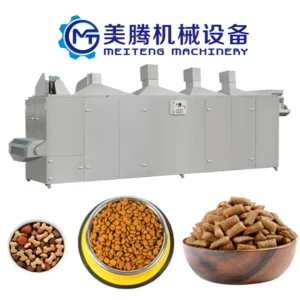
MT85 500kg/h Multi-Purpose Pet Food Processing Line for Dogs Cats Birds Fish & More-380V 50Hz Three Phase 45KW
¥65,000.00 Select options This product has multiple variants. The options may be chosen on the product page -
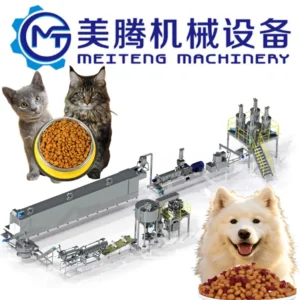
MT High Capacity Pet Food Extrusion Production Line for Dogs Cats Birds Fish Cattle and More (150kg/h-3T/h)
¥35,000.00 Select options This product has multiple variants. The options may be chosen on the product page -
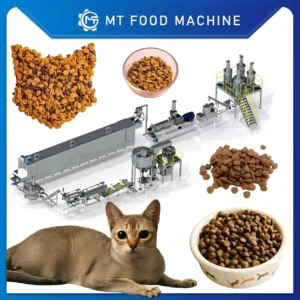
200-250kg/h Capacity PLC Controlled Multi-Species Dog Food Processing Line with MT-70 Extruder
¥35,000.00 Select options This product has multiple variants. The options may be chosen on the product page -
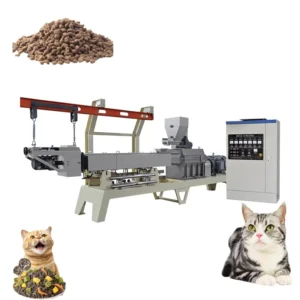
Premium Pet Food Processing Equipment Dog Cat Feed Making Machine
¥9,500.00 Select options This product has multiple variants. The options may be chosen on the product page