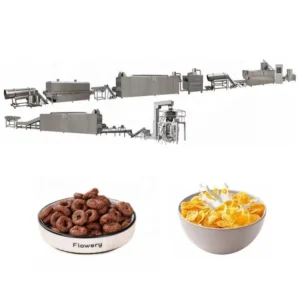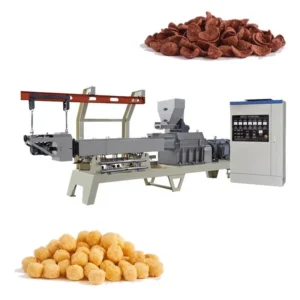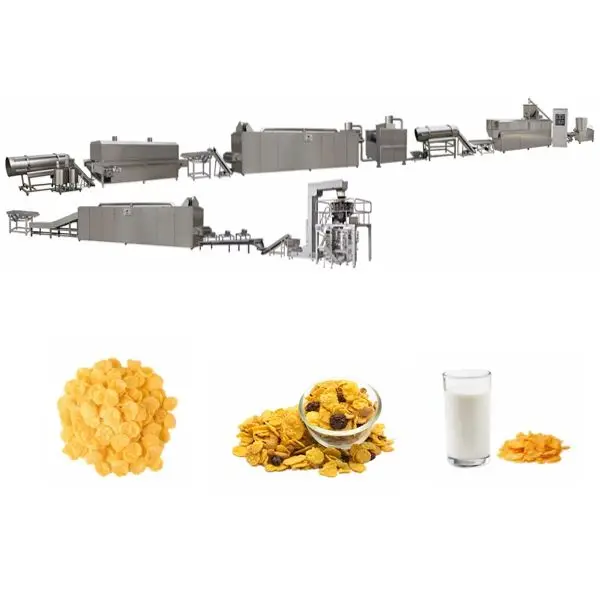


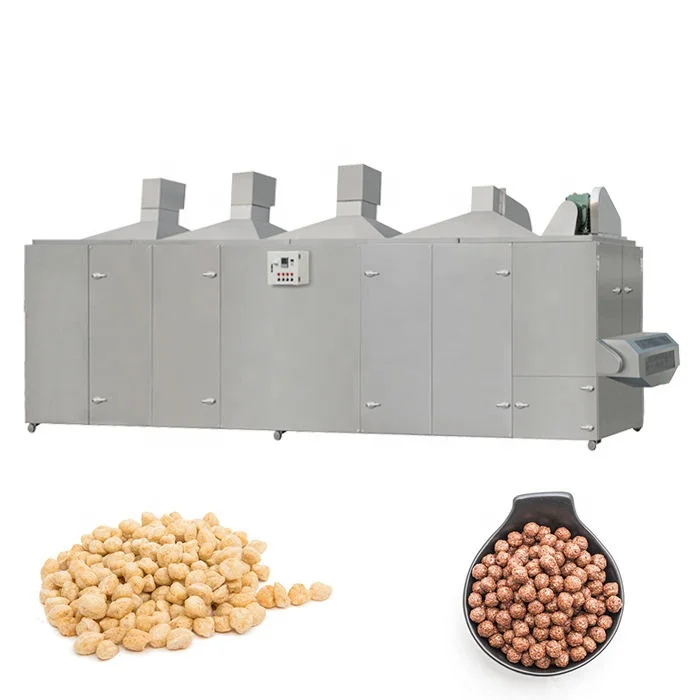
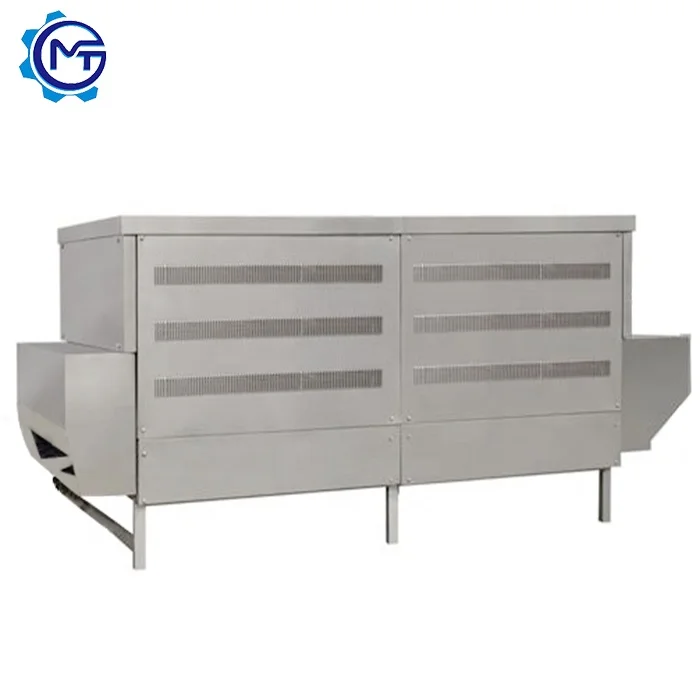

MT70 / MT85 / MT75 Corn Flake Production Line, Twin-Screw Extruder, PLC Control — complete turnkey solution covering mixing, extruding, flaking, drying, roasting, coating and packing. Screw configuration and die design are matched to your cereal raw material and target flake density, with every station throughput-balanced to prevent bottlenecks. In-house trial runs on your specific corn or cereal blend are conducted before shipment, ensuring product quality and line performance from day one.
- Natural and sugar-coated corn flake variants
- Hot air roasting with cyclone dust removal
- Hydraulic double-roller flaking with infrared temperature control
Description
Throughput-Matched Stations — Every unit in this corn flake production line turnkey is sized to the same capacity band so the extruder, flaker, dryer and roaster never force each other to idle.
Technical Specifications
| Parameter | Value |
|---|---|
| Product Type | Corn Flake Production Line |
| Available Models | MT70 / MT85 / MT75 |
| Installed Power | MT70 160 kW / MT85 190 kW / MT75 210 kW |
| Power Consumption | MT70 120 kW / MT85 140 kW / MT75 150 kW |
| Capacity | MT70 150–200 kg/h, MT85 300–400 kg/h, MT75 300–500 kg/h (basis not stated in source — confirm raw material and moisture content) |
| Overall Dimensions | MT70 41 × 1.5 × 2.2 m / MT85 43 × 1.5 × 3.2 m / MT75 45 × 1.5 × 3.5 m |
| Screw Type | Twin Screw |
| Control System | PLC control system |
| Flaking Machinery Drive | Double motors for separate roller driving; hydraulic system for double rollers |
| Flaking Temperature Control | Infrared sensor |
| Dryer Heating Source | Gas or Electric |
| Roasting Oven | Hot air roasting with vibrating pan, conciliation burner, dual circulating fans, cyclone dust removal |
| Coating System | Double tumble for sugar melting, elevator, coating drum, spraying nozzle |
| Natural Corn Flake Line Flow | Mixing → Extruding → Flaking → Drying → Hot Air Roasting → Cooling → Packing |
| Sugar Coated Line Flow | Mixing → Extruding → Flaking → Drying → Hot Air Roasting → Sugar Spraying → Sugar Coating → Drying → Cooling → Packing |
| Raw Materials | Corn, rice, wheat, oat, barley powder |
| Final Product Shapes | Ball, tube, stick, ring, fruit loop, star, wheel, flower, heart (by adjusting mould) |
| Standards | CE, ISO |
Application Suitability
| Application | Material or Output |
|---|---|
| Natural corn flakes for breakfast cereal retail | Corn grits or corn flour at controlled moisture |
| Sugar-coated corn flakes | Corn base with sugar syrup glazing in coating drum |
| Multi-grain breakfast cereal rings and balls | Blends of rice, wheat, oat and barley powder |
| Fortified cereal flakes for institutional nutrition programmes | Corn or rice base with added vitamin and mineral premix |
| Textured cereal snacks in star, wheel or heart shapes | Corn or wheat flour with mould changes on the extruder |
Why "300 kg/h" Means Nothing Without the Moisture Number
A corn flake production line turnkey is only as fast as its slowest matched station, and that speed depends on what you actually feed it.
I have watched lines stall because the buyer’s corn flour was ground finer than the spec sheet assumed, pulling extrusion moisture into a range where the flakes refused to blister properly in the roaster. The rated output looked fine on paper, but actual throughput dropped because the drying and roasting stages could not keep up with wetter, denser pellets leaving the flaker [NEED_CITE: raw material particle size and moisture interaction in twin-screw extrusion]. When the whole line comes from one supplier, every station is calculated against the same raw material profile, so the flaker, dryer and roaster are not guessing at what the extruder sends downstream.
How Screw Configuration Controls Flake Density
The twin-screw extruder at the front of this corn flake production line turnkey uses a screw configuration and die design specified to the buyer’s raw material and target flake density. Corn grits behave differently from oat or barley blends in terms of gelatinisation temperature and melt viscosity inside the barrel, so the screw pitch, kneading block arrangement and barrel heating zones are adjusted before the machine is built. This determines whether the pellet leaving the die will flatten into a thin, crisp flake or a thicker, denser one that requires longer roasting.
Throughput Matching Across Every Station
A line assembled from separate vendors often has an extruder that outpaces the dryer or a roaster that cannot handle peak flaker output. In this corn flake production line turnkey, the extruder, dryer, flaking machinery and roasting oven are all selected within the same capacity band. The PLC-controlled flaking machinery uses a hydraulic double-roller system with infrared temperature sensing to maintain consistent flake thickness, and the hot air roasting oven runs dual circulating fans with a cyclone dust removal device so surface blistering stays uniform even at the upper end of the throughput range [NEED_CITE: throughput balancing in multi-stage cereal processing lines].
Reading the Spec Sheet Against Your Actual Grain
Installed power figures such as 160 kW on the MT70 and 210 kW on the MT75 frame the electrical infrastructure you need to plan, but the more consequential number for daily operation is power consumption — 120 kW and 150 kW respectively — because that determines the transformer sizing and running cost at your facility. The flaking machinery’s hydraulic roller drive and infrared sensor keep flake thickness within a narrow band, which directly affects how evenly the roasting oven can blister the surface. The roasting oven’s conciliation burner and two separate circulating fans work together with the vibrating pan to move flakes through a consistent heat profile, reducing the chance of under-roasted centres or scorched edges. Switching from natural to sugar-coated output only requires adding the sugar spraying and coating drum stages; the front-end extrusion and flaking parameters remain unchanged, so changeovers do not demand a full line recalibration.
What Happens When the Flaker Is Undersized
If the flaking machinery cannot keep pace with extruder output, semi-cooked pellets pile up, cool unevenly and produce flakes that shatter during roasting rather than blister. The hydraulic double-roller system on this line is sized to the same throughput band as the extruder, but a buyer who adds capacity on the extrusion end without recalculating the flaker and dryer will see yield loss that no spec sheet warned about [NEED_CITE: downstream bottleneck effects on cereal flake yield].
Why This Line Is Built as One Project
Every station from batching through packing is supplied and laid out by a single engineering team, so throughput calculations are not handed off between vendors. Screw configuration and die design are documented against the buyer’s specific corn, rice or multi-grain blend before the extruder is assembled. An in-house testing workshop runs trial production on the customer’s actual raw material before shipment, catching particle size or moisture issues that would otherwise surface during on-site commissioning. Voltage, frequency and control language are confirmed during the specification stage, so the PLC panel speaks the operator’s language from day one. Wear parts lists covering screws, dies and roller surfaces are provided at delivery, meaning the first scheduled replacement does not trigger an emergency search.
Documentation & Verification
- Line layout and capacity calculation showing throughput at every station from mixer to packer
- Trial run report on your corn or cereal blend conducted in the testing workshop before dispatch
- Screw and die configuration record matched to your target flake density and shape
- Electrical schematic with voltage and frequency confirmed for your destination market
- CE declaration of conformity and ISO certificate for import clearance
- Operation and maintenance manual with illustrated wear parts list
Installation, Commissioning & Support
- Foundation plan accounts for the MT75 line footprint of 45 m length and vibration loads at the flaking station
- Dedicated circuit sizing based on confirmed installed power up to 210 kW and local voltage
- Equipment ships in modular sections for phased assembly aligned with your construction schedule
- First-run parameter setting covers barrel temperature profile, roller gap and roaster fan speed
- Operator training on PLC interface, mould change procedure and sugar coating drum operation
- Wear parts supply covering twin screws, die plates and flaking roller surfaces
What We Need to Size Your Line
To lay out a corn flake production line turnkey that holds its rated output, share your raw material type and particle size distribution, target daily output, and workshop length and ceiling height. Let us know the local voltage and frequency standard, the control language your operators prefer, and whether you want to run a trial on your own grain blend before the equipment ships.
Frequently Asked Questions
Q: How is the stated line capacity verified against my raw material?
A: The capacity figures in the spec sheet are based on standard test conditions. Before we finalise the configuration, we run your actual corn, rice or multi-grain blend through the in-house testing workshop and record real throughput, moisture and flake density. The trial run report becomes part of your documentation package so you know exactly what to expect at commissioning.
Q: How do you prevent bottlenecks between the extruder, flaker and roaster?
A: Every station is selected within the same capacity band during the layout stage. We calculate the extruder output against the dryer residence time, the flaker roller throughput and the roasting oven fan capacity so no single machine forces the others to idle or overflow.
Q: Can we run a trial on our specific cereal blend before the line ships?
A: Yes. Our testing workshop can process your raw material on the twin-screw extruder and downstream equipment before production is finalised. This trial confirms screw configuration, die selection and flake thickness settings, and the results are documented in a report you receive before shipment.
Q: What electrical and control options are confirmed before production begins?
A: We confirm voltage, frequency, plug type and control panel language during the specification stage. The PLC system is configured to match your local electrical standard and operator preferences, and the electrical schematic is included in your documentation package for approval before manufacturing starts.
Q: What does the installation and training process look like on site?
A: Equipment arrives in modular sections. Our engineers supervise assembly, connect utilities according to the confirmed schematic, run the first production batch and train your operators on the PLC interface, mould changes and routine maintenance including screw, die and roller surface replacement schedules.
Related products
-
Kelloggs Corn Flakes Breakfast Cereal Normal Making Machine Breakfast Cereal Extruder Production Line
¥30,000.00 Select options This product has multiple variants. The options may be chosen on the product page -
Complete Corn Flakes Production Line Breakfast Cereal Processing Machine Core Motor Component Cornflakes Processing Equipment
¥19,000.00 Select options This product has multiple variants. The options may be chosen on the product page -

Small Scale Breakfast Cereal Manufacturing Machine for Corn Flakes Process Line
¥45,000.00 Select options This product has multiple variants. The options may be chosen on the product page -
Sweet Corn Flakes Maize Breakfast Cereal Full-automatic Food Grade Stainless Steel Heat Exchanger Mixer Fryer Processing Line
¥8,000.00 Add to cart