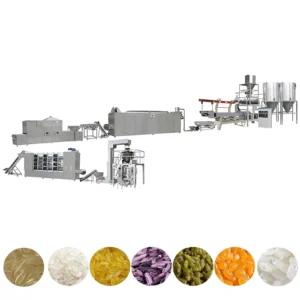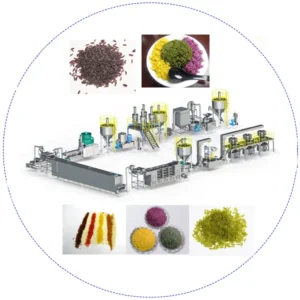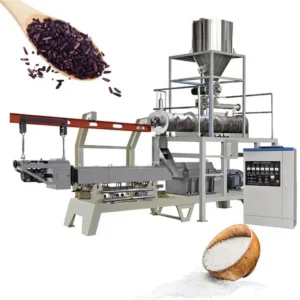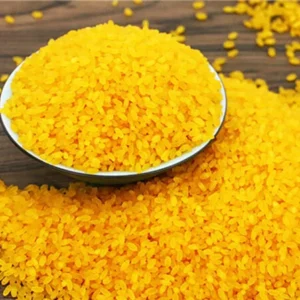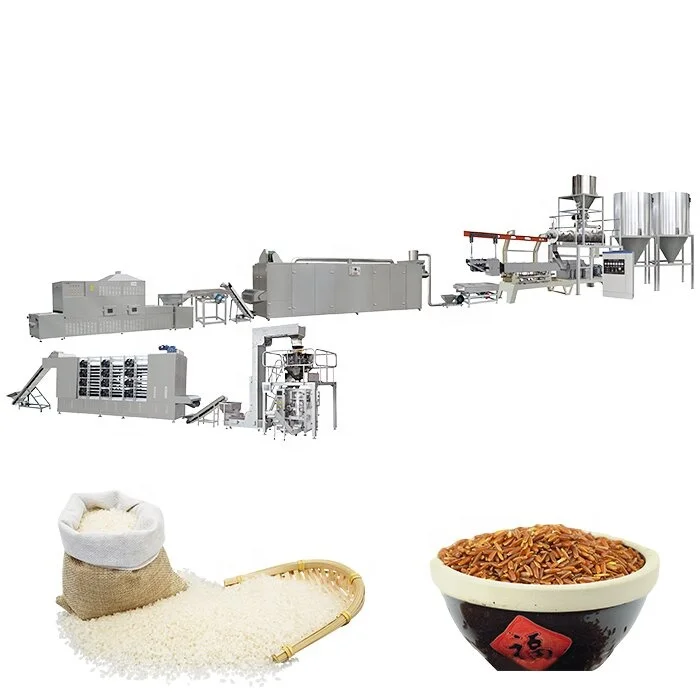


MT65 / MT70 / MT85 / MT75 / MT95 Fortified Artificial Rice Extrusion Line, Twin-screw, PLC Control — engineered for complete nutritional rice processing from batching through extrusion to packing.
- Screw configuration and die design matched to your specific raw material — broken rice, corn, millet, or bean flour — ensuring target kernel shape and density
- Throughput balanced across mixing, drying, cooling and packing stations to eliminate bottlenecks
- In-house trial runs on customer raw material completed before shipment, with full test report delivered
Description
Throughput-Matched Turnkey Design — every station from batching to packing is balanced to your raw material, so the extruder never waits on the dryer or the cooler bottlenecks the line.
Technical Specifications
| Parameter | Value |
|---|---|
| Model | MT65 / MT70 / MT85 / MT75 / MT95 |
| Product Type | Fortified Artificial Rice Extrusion Line |
| Screw Type | Twin-screw |
| Installed Power | 85 kW (MT65) / 120 kW (MT70) / 235 kW (MT85) / 180 kW (MT75) / 260 kW (MT95) |
| Power Consumption | 60 kW (MT65) / 85 kW (MT70) / 165 kW (MT85) / 135 kW (MT75) / 195 kW (MT95) |
| Output Capacity | 80–100 kg/h (MT65, basis not stated in source) / 100–120 kg/h (MT70, basis to be confirmed) / 200–300 kg/h (MT85, basis to be confirmed) / 300–500 kg/h (MT75, basis to be confirmed) / 800–1000 kg/h (MT95, basis to be confirmed) |
| Overall Dimensions (L×W×H) | 28 × 1.2 × 2.2 m (MT65) / 30 × 1.5 × 2.2 m (MT70) / 34 × 3.5 × 4.3 m (MT85) / 32 × 3.5 × 4.3 m (MT75) / 36 × 3.5 × 4.3 m (MT95) |
| Control System | PLC / MCC with frequency speed control |
| Feeding System | Single or double screw feeding, matched to material uniformity |
| Screw Material | Wear-resistant alloy with special surface treatment |
| Lubrication | Automatic lubricating and cooling system |
| Drying Oven Heating Source | Electric or gas, configurable per site utility |
| Drying Oven Feature | Circulation drying with frequency-controlled mesh belt speed |
| Line Stations | Mixing → Extruding → Vibrating → Low-temperature Drying → Cooling → High-temperature Roasting → Cooling → Packing |
| Voltage & Frequency | Customized to local standard |
| Assembly State | Complete turnkey line |
| Certification | CE (since 2014), ISO |
Application Suitability
| Application | Material or Output |
|---|---|
| Fortified rice kernels for nutrition programmes | Broken rice and rice bran blended with vitamin and mineral premix |
| Artificial rice from coarse grains | Corn, millet, wheat, oats, and buckwheat flour as base ingredients |
| High-protein nutritional rice | Bean flour and starch blends with added micronutrients |
| Instant rice for convenience food markets | Pre-gelatinised starch and rice flour combinations |
| Multi-grain rice analogues | Composite blends of cereal and legume flours |
What "Rated Capacity" Really Means on a Fortified Artificial Rice Production Line Turnkey Project
Nominal output figures assume a specific raw material recipe and moisture level that may not match yours.
I once stood in a workshop watching a line rated for a certain throughput choke the moment the operator switched from plain rice flour to a blend loaded with whey protein isolate. The material viscosity changed entirely, the screw fill factor dropped, and the die pressure swung outside the working window. It took three days of adjusting screw speed, feed ratio, and barrel temperature zones before the extruded kernels held their shape and density. Capacity numbers on a spec sheet mean very little until the machine runs your exact formulation. [NEED_CITE: material rheology and extruder throughput correlation in food processing]
How Screw Configuration Shapes the Rice Kernel
The twin-screw extrusion process gives operators independent control over shear, residence time, and pressure at each barrel zone. For a fortified artificial rice production line turnkey project, the screw element sequence — conveying, kneading, and reverse elements — is selected based on how much starch gelatinisation the target kernel requires. A high-amylose rice flour needs a different kneading block arrangement than a corn-dominant blend. The die orifice diameter and land length then determine whether each kernel exits as a long grain or short grain shape with the correct surface texture.
Why Throughput Matching Matters More Than Extruder Size
A common mistake is sizing the extruder generously and then discovering the downstream dryer cannot remove moisture fast enough. On a nutritional rice line, the low-temperature drying stage must reduce kernel moisture gradually to prevent surface cracking, while the high-temperature roasting stage develops colour and shelf stability. If the drying oven belt length and airflow are undersized relative to extruder output, kernels accumulate, moisture stays high, and the packing station receives product outside specification. Every station on this line is calculated against the same throughput target so material flows continuously without intermediate buffering or starvation. [NEED_CITE: continuous food processing line throughput balancing principles]
Reading the Specification Sheet with a Process Engineer’s Eye
Installed power and actual power consumption tell different stories. The MT85 draws up to 235 kW at peak but typically runs around 165 kW during steady-state extrusion, with the difference accounted for by start-up heating and load variation when feed composition shifts. The automatic lubricating and cooling system keeps the screw shaft bearings within operating temperature during long production runs, which matters especially when running high-protein formulations that generate additional frictional heat inside the barrel. The frequency-controlled feeding system — available as single or double screw — maintains a consistent feed rate; the double screw variant is specified when the raw material blend contains components with different bulk densities that tend to segregate in a single-screw hopper. Voltage and frequency are configured to the destination site before production begins, so the motor, heater bands, and PLC all match the local grid from the first day of commissioning.
The Cost of Skipping Pre-Shipment Verification
When a line ships without a trial run on the buyer’s actual formulation, all process development happens on the factory floor after installation. Commissioning stretches from days into weeks, the buyer’s raw material inventory is consumed during tuning, and the first saleable batch is delayed. Worse, if the screw configuration proves wrong for a high-legume or high-fibre blend, replacement screw elements must be manufactured and shipped — adding further downtime while the line sits idle. These are avoidable costs that compound quickly when a project is on a tight launch schedule. [NEED_CITE: industrial extrusion commissioning delays and their cost impact]
Why Buyers Source This Line Here
The testing workshop runs your actual raw material through the extruder before the line leaves the factory, so screw configuration, die selection, and barrel temperature profile are confirmed against your recipe — not guessed from a generic build. Every supporting station — mixer, dryer, roaster, cooler, and packing system — is specified as part of one project with throughput calculated across the entire chain. The electrical schematic is reviewed with the buyer to lock in voltage, frequency, and control language for the destination market before the cabinet is wired. CE and ISO certifications are maintained on file, with documentation prepared for customs and local regulatory submission. Post-commissioning support covers operator training on the specific PLC interface and a documented wear parts list so the first screw and die replacement can be ordered before it is needed.
Documentation & Verification
- Line layout drawing showing throughput calculation for every station on your artificial rice line
- Trial run report completed on your raw material formulation in the testing workshop
- Screw and die configuration record matched to your target kernel shape and density
- Electrical schematic with confirmed voltage, frequency, and PLC language for your site
- Operation and maintenance manual with illustrated troubleshooting procedures
- Wear parts list with part numbers and recommended replacement intervals
Installation, Commissioning & Support
- Foundation plan provided based on the line footprint, up to 36 m length for the MT95 configuration
- Dedicated power circuit requirements specified to match installed load, up to 260 kW for the MT95
- Equipment ships in modular sections for container loading and on-site reassembly
- First-run commissioning includes barrel temperature profiling and screw speed optimisation on your material
- Operator training covers PLC menu navigation, feeding rate adjustment, and emergency shutdown procedures
- Spare screw elements and die plates stocked based on your production volume forecast
- Scheduled maintenance intervals documented for the automatic lubrication system and dryer belt tension
What We Need to Configure Your Line
To build a layout that fits your facility and your recipe, share the base ingredient list with approximate blend ratios, the target kernel dimensions and cooking characteristics, and your planned hourly output. We also need the available floor space with ceiling height, the local supply voltage and frequency, and the preferred control interface language. If you have existing upstream milling or downstream packing equipment, let us know the model and capacity so the new line can be matched to it.
Frequently Asked Questions
Q: How is actual output capacity verified before the line ships?
A: Each model carries a nominal output range, but real throughput depends on your raw material composition and moisture content. We run your formulation in the testing workshop, document the stable output rate, and include this in the trial run report. The line configuration is then adjusted if needed before production begins.
Q: How do different base ingredients affect screw and die selection?
A: Broken rice, corn flour, and bean flour each have distinct starch gelatinisation temperatures and melt viscosity. The screw element sequence and die land length are chosen to deliver the correct shear and pressure for your specific blend, ensuring the extruded kernel holds its shape through drying and roasting.
Q: How do you prevent bottlenecks between the extruder and downstream stations?
A: The dryer belt length, roaster capacity, and cooler airflow are all calculated against the extruder’s verified output on your material. This prevents material backlog at any station and keeps moisture reduction and temperature profiles within the target range for consistent kernel quality.
Q: What electrical and control preparations are made for export markets?
A: Before the control cabinet is wired, we confirm your site voltage, frequency, and preferred PLC display language. The electrical schematic reflects these choices and is provided for your local electrician to review. This avoids rewiring delays during on-site commissioning.
Q: What happens during the pre-shipment trial run?
A: Your raw material is processed through the extruder and supporting stations in our testing workshop. We record screw speed, barrel temperatures, feed rate, die pressure, and final kernel properties. The trial run report is shared with you, and any configuration changes are made before the line is packed for shipment.
Related products
-
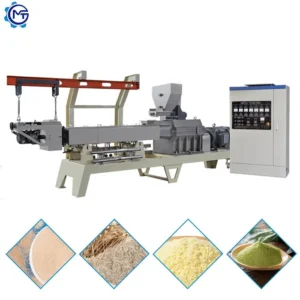
High Productivity New Condition Safe Healthy and Nutritious Baby Food Meal Replacement Powder Production Line
¥30.00 Select options This product has multiple variants. The options may be chosen on the product page -

Industrial Automatic 500kg/h Baby Cereal Nutrition Powder Extruder Manufacturing Process Line
¥8,238.27 Add to cart -

High Precision Automatic 500kg/h Baby Food Nutrition Powder Rice Extrusion Processing Line
¥8,238.27 Add to cart -

Automatic Iron Fortified Baby Rice Cereal Nutrition Powder Making Machine 500kg/h PLC Controlled
¥8,238.27 Add to cart