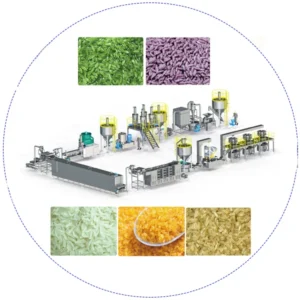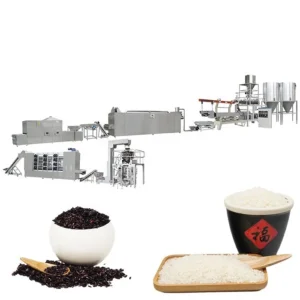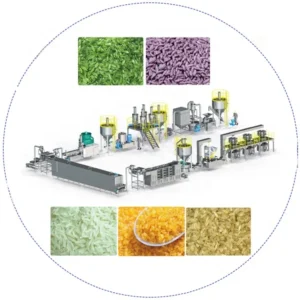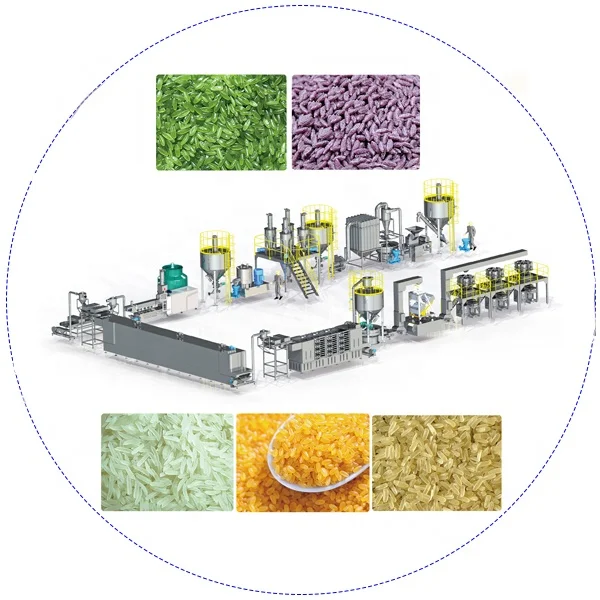


MT65 / MT70 / MT85 / MT75 / MT95 Fortified Rice Processing Line, Twin-Screw Extrusion, PLC Control — complete turnkey system from batching through extrusion, drying, roasting, and packing.
- Screw configuration and die design matched to your raw material blend — broken rice, corn, oats, or starch — ensuring kernel density, shape, and nutritional retention meet market specification
- Line throughput balanced across every station to eliminate bottlenecks between extruder output and dryer or packing capacity
- Frequency-controlled automation with automatic lubrication for stable continuous operation
Trial runs on your actual raw material in our testing workshop before shipment, so product validation starts at factory — not after installation.
Description
Integrated Extrusion Lines — complete throughput matching from batching through packing eliminates the bottleneck risk when stations are sourced from separate vendors.
Technical Specifications
| Parameter | Value |
|---|---|
| Product Type | Fortified Rice Processing Line |
| Model | MT65 / MT70 / MT85 / MT75 / MT95 |
| Installed Power | MT65: 85 kW / MT70: 120 kW / MT85: 235 kW / MT75: 180 kW / MT95: 260 kW |
| Power Consumption | MT65: 60 kW / MT70: 85 kW / MT85: 165 kW / MT75: 135 kW / MT95: 195 kW |
| Output Capacity | MT65: 80–100 kg/h, MT70: 100–120 kg/h, MT85: 200–300 kg/h, MT75: 300–500 kg/h, MT95: 800–1000 kg/h (basis to be confirmed) |
| Overall Dimensions (L×W×H) | MT65: 28 × 1.2 × 2.2 m / MT70: 30 × 1.5 × 2.2 m / MT85: 34 × 3.5 × 4.3 m / MT75: 32 × 3.5 × 4.3 m / MT95: 36 × 3.5 × 4.3 m |
| Screw Type | Twin screw |
| Control System | Frequency speed controlling with high automation |
| Line Stations | Mixing, Extruding, Vibrating, Low Temperature Drying, Cooling, High Temperature Roasting, Cooling, Packing |
| Heating Source (Dryer) | Electric or Gas |
| Lubrication | Automatic lubricating and cooling system |
| Feeding System | Single or double screw feeding system selectable based on material |
| Assembly State | Complete production line |
Application Suitability
| Application | Material or Output |
|---|---|
| Artificial rice kernel production | Broken rice and rice flour reprocessed into uniform grains |
| Fortified rice for nutritional programs | Rice flour blended with added vitamins and minerals |
| Multi-grain rice analogues | Corn, millet, wheat, oats, buckwheat, and bean flours |
| Starch-based nutritional rice | Modified starch and rice bran formulated into kernel shapes |
| Fortified infant rice cereal base | Fine flour with micro-nutrient premix extruded into small kernels |
What the Stated Output Capacity Leaves Out on Your Actual Flour Blend
A line rated at 300 kg/h on standard rice flour may deliver substantially less when your formulation includes high-starch or high-fiber additives.
When a buyer sources a Fortified Rice Processing Line turnkey package, the nameplate capacity is usually established on a reference material — typically refined rice flour at controlled moisture. If the real feedstock is broken rice milled on-site with variable particle size, or a blend loaded with oat bran and bean flour, the viscosity inside the barrel changes and the extruder cannot push the same volume through the die. I once stood on a factory floor in Southeast Asia watching a line stall at barely half its rated throughput because the local broken rice carried more native starch than the laboratory sample we had tested. That experience is why every configuration we ship goes through an in-house trial run on the buyer’s actual raw material before crating [NEED_CITE: trial run validation before equipment shipment]. The throughput figure in the table is a reference — your specific blend determines the real number.
Throughput Matching Across Every Station in the Line
A Fortified Rice Processing Line turnkey project fails when one station runs faster than the next. The extruder may push 300 kg/h of wet kernel, but if the low-temperature dryer can only handle 200 kg/h, the excess accumulates on the vibrating conveyor and moisture content drifts upward. Each station in this line — mixing, extruding, vibrating, drying, cooling, roasting, and packing — is sized so the material flow remains continuous without surge or starvation. The frequency-controlled drive on the extruder allows fine adjustment of screw speed to match downstream capacity, while the mesh belt speed on the dryer is independently adjustable to hold the target moisture in the finished kernel.
Screw and Die Configuration Matched to Your Formulation
The twin-screw extruder in this line does not run a generic screw profile. The screw element sequence — conveying, kneading, and reverse elements — is selected based on the gelatinisation behaviour of the buyer’s specific flour blend. Broken rice with higher amylose content requires a different shear profile than a corn-and-millet mix [NEED_CITE: starch gelatinisation behaviour in twin-screw extrusion]. The die plate is machined to produce the target kernel length and cross-section so the extruded grain visually matches the natural rice the market expects. Mould changeover is straightforward when the buyer produces multiple kernel shapes for different product tiers.
Reading the Power and Dimension Data Against Your Factory Reality
The installed power figures — ranging from 85 kW on the MT65 to 260 kW on the MT95 — cover the full line, not the extruder alone. Buyers planning electrical infrastructure should note that the dryer heating source is selectable between electric and gas, which shifts the electrical load considerably. The overall line length reaches 36 m on the MT95, with a width of 3.5 m and height of 4.3 m, so ceiling clearance and floor length must be confirmed before layout finalisation. The automatic lubricating and cooling system reduces manual greasing intervals, which matters on the larger models where bearing access is tighter. Selecting between single and double screw feeding depends on whether the premix includes fine vitamin powders that tend to bridge in a standard hopper.
The Cost of Ignoring Raw Material Variability Before Shipment
Lines arrive on-site and the commissioning engineer discovers the local flour absorbs water differently from the test sample. Expansion drops, kernels crack during drying, and the finished product fails the density check the buyer’s market demands. Reworking the screw combination after installation means weeks of lost production while replacement elements are shipped internationally [NEED_CITE: lead time for replacement extruder screw elements]. Density drift in fortified rice also means the micronutrient content per gram shifts, which can cause a batch to fail the nutritional label specification. An in-house trial run on the buyer’s actual raw material catches these variables before the line leaves the factory.
Why Buyers Source This Line as a Single Turnkey Package
Every station is engineered and built under one supplier, so the extruder output, dryer belt speed, and packing rate are calculated together rather than negotiated across three vendors. Screw configuration and die design are specified to the buyer’s raw material blend and target kernel shape, not copied from a catalogue default. The in-house testing workshop runs the buyer’s flour before shipment, so product development begins before installation rather than after. Pre-sales consultation covers line layout and utility planning, and on-site commissioning includes operator training on the frequency-controlled automation. Wear parts — screw elements, die plates, dryer mesh belts — are documented and stocked so the first replacement does not become an emergency.
Documentation & Verification
- Line layout and capacity calculation showing throughput matching across every station for your kernel specification
- Screw and die configuration record matched to your flour blend and target rice kernel dimensions
- In-house trial run report on your actual raw material with moisture and expansion data before dispatch
- Electrical schematic with voltage, frequency, and control language confirmed to your site conditions
- Operation and maintenance manual covering lubrication intervals and dryer belt tensioning procedures
Installation, Commissioning & Support
- Foundation leveling to within tolerance across the full 28–36 m line length depending on model selected
- Dedicated electrical circuit sized to the model’s installed power, from 85 kW up to 260 kW
- Modular station delivery allowing phased assembly within the 2.2–4.3 m ceiling height envelope
- First-run parameter setting on your raw material including barrel temperature profile and screw speed
- Operator training on frequency-controlled drive adjustment and automatic lubrication system monitoring
- Wear parts list with part numbers for screw elements, die plates, and dryer mesh belts for reorder
What We Need to Configure Your Line Accurately
To prepare a layout and quotation that holds up at commissioning, we need to know the primary flour or blend you will run — broken rice, corn, multi-grain, or a starch-based mix — along with the vitamin or mineral premix ratio. Confirm your daily output target in kilograms and the number of operating shifts. Provide your workshop length, width, and clear ceiling height so the line footprint fits without compromise. State the local voltage and frequency, and whether gas or electric heating is preferred for the dryer. If you can ship a sample of your actual raw material, we will run a trial in our testing workshop and include the results with the proposal.
Frequently Asked Questions
Q: How is the output capacity in kg/h determined for my specific flour formulation?
A: The table values are reference figures. We run your actual raw material — including any vitamin premix and moisture level — through the extruder in our testing workshop and measure real throughput, expansion, and kernel density. The trial report becomes the baseline for your line configuration.
Q: What screw and die adjustments are needed when switching between broken rice and multi-grain blends?
A: Different flours gelatinise at different shear levels. We specify the screw element sequence and die aperture for each formulation the buyer plans to run. Changeover involves swapping screw sections and the die plate, which is documented in the configuration record supplied with the line.
Q: How does the dryer capacity stay matched to the extruder when production rate changes?
A: The low-temperature dryer uses an adjustable mesh belt speed and circulation airflow. When the extruder frequency drive is adjusted upward, the belt speed is increased proportionally to maintain the target moisture content in the finished kernel without over-drying or under-drying.
Q: Can I send my raw material for a trial run before placing the order?
A: Yes. We run your flour blend in the in-house testing workshop, record expansion ratio, kernel density, and moisture data, and share the trial report. This lets you evaluate product quality and confirm throughput before committing to the full line purchase.
Related products
-
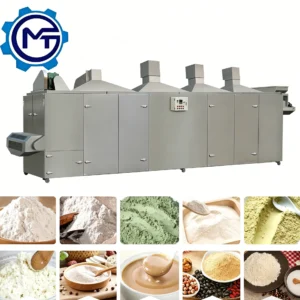
CE Approved MT Brand Organic Baby Rice Nutrition Powder Extrusion Production Line with 500kg/h Capacity and Automatic Grade
¥9,500.00 Add to cart -

Industrial Automatic 500kg/h Baby Cereal Nutrition Powder Extruder Manufacturing Process Line
¥8,238.27 Add to cart -
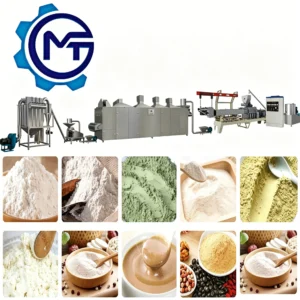
Organic Gluten Free Baby Rice Nutrition Powder Automatic 500kg/h Production Processing Line
¥8,238.27 Add to cart -
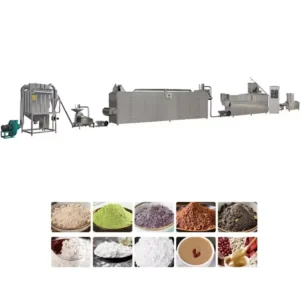
Healthy Baby Food Production Line Nutritional Powder Equipment for Baby Food Supplements for Flour Processing Machinery
¥8,500.00 Select options This product has multiple variants. The options may be chosen on the product page