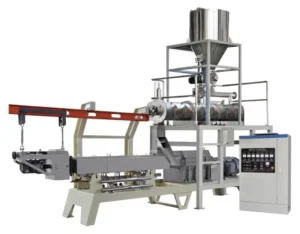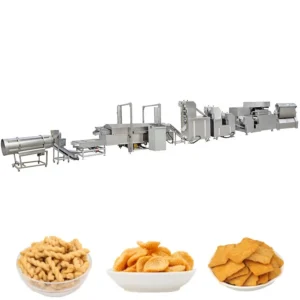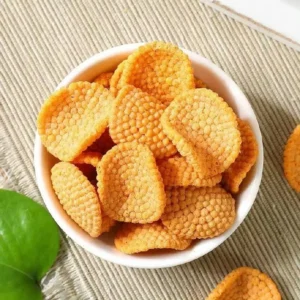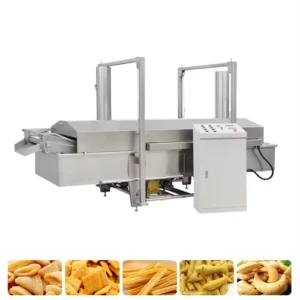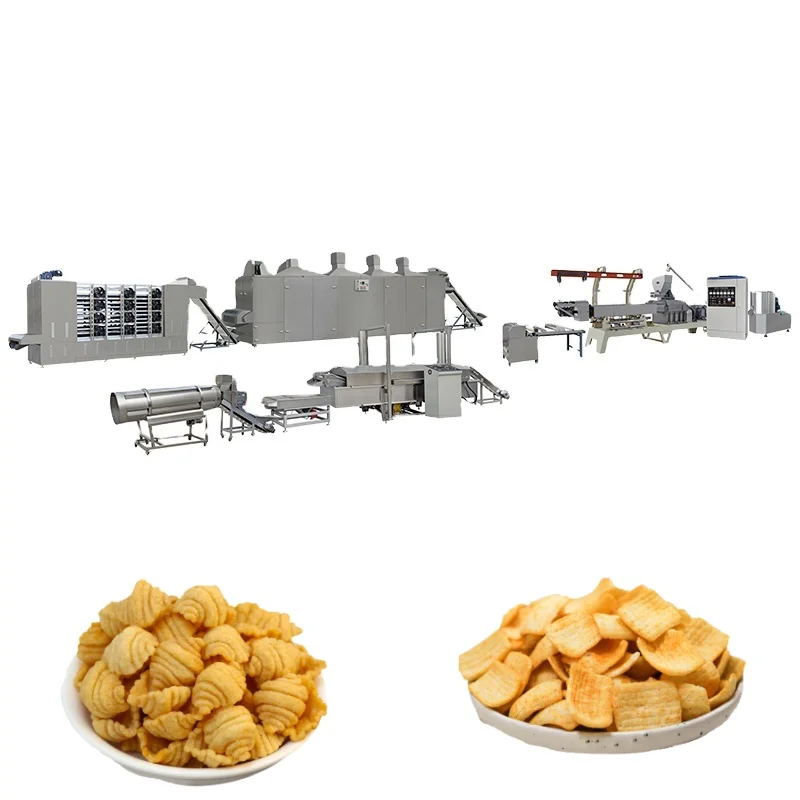


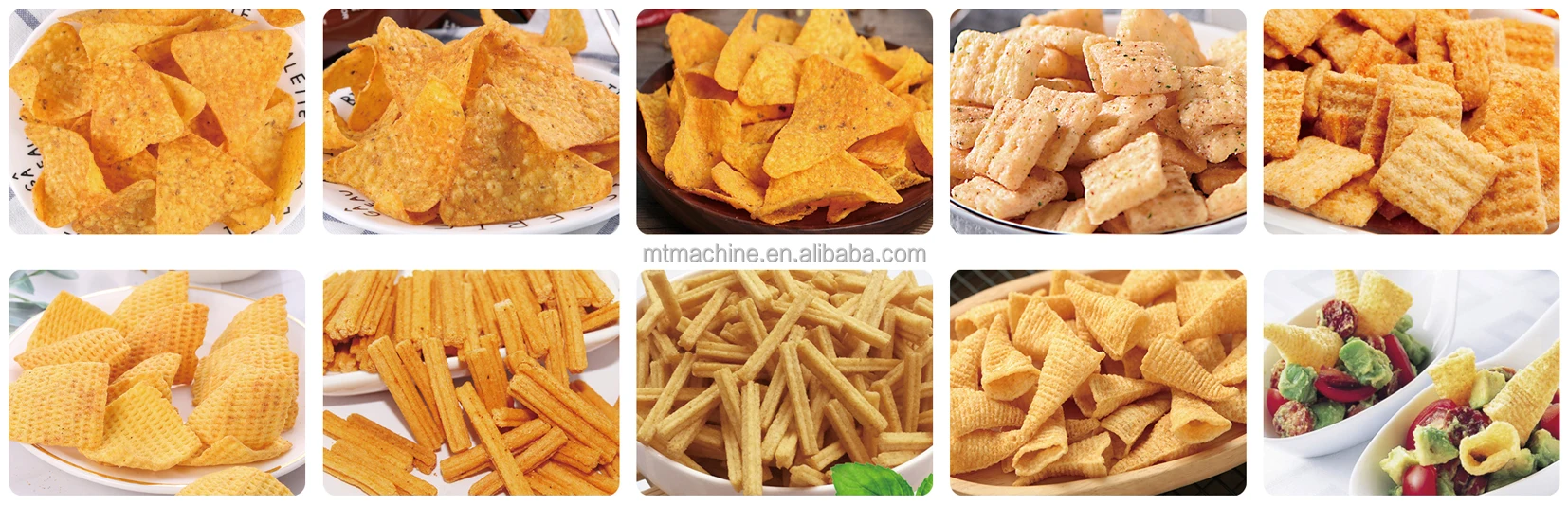


MT-65 / MT-70 / MT-85 / MT-75 / MT-95 Fried Snack Food Extrusion Production Line, Twin-Screw, PLC & MCC Control — configured as a complete turnkey project from batching through frying to packing.
- Co-rotating twin-screw extruder with sectional screw modules and die design matched to raw material formula and target snack shape, ensuring consistent expansion and density across bugles, corn chips, and pellet chips.
- Line throughput matched station-by-station — mixer, extruder, cutter, fryer, and seasoning — so no single machine bottlenecks output.
- Fryer with 600 mm stainless steel belt and automatic temperature control, available in electric, gas, or diesel heating.
- Voltage, frequency, and control language confirmed before production to prevent on-site commissioning delays.
Trial runs on your raw material in our in-house testing workshop before shipment, with full documentation including screw configuration record, capacity calculation, and CE declaration.
Description
Throughput-Matched Line Architecture — Every station from mixer to fryer is calculated against the next, preventing the extruder from outrunning the drying or frying capacity on a fried snack food extrusion production line turnkey project.
Technical Specifications
| Parameter | Value |
|---|---|
| Product Type | Fried Snack Food Extrusion Production Line |
| Models Available | MT-65 / MT-70 / MT-85 / MT-75 / MT-95 |
| Screw Type | Co-rotating twin-screw, sectional modules |
| Screw Material | Stainless steel (food-contact sections) |
| Main Motor Power (MT-65) | 100 kW |
| Main Motor Power (MT-70) | 130 kW |
| Main Motor Power (MT-85) | 180 kW |
| Main Motor Power (MT-75) | 185 kW |
| Main Motor Power (MT-95) | 280 kW |
| Output Capacity (MT-65) | 120–150 kg/h (basis not stated in source — confirm raw material and moisture content) |
| Output Capacity (MT-70) | 200–250 kg/h (basis not stated in source — confirm raw material and moisture content) |
| Output Capacity (MT-85) | 300–500 kg/h (basis not stated in source — confirm raw material and moisture content) |
| Output Capacity (MT-75) | 400–500 kg/h (basis not stated in source — confirm raw material and moisture content) |
| Output Capacity (MT-95) | 800–1000 kg/h (basis not stated in source — confirm raw material and moisture content) |
| Mixer Power | 4 kW / 7.5 kW / 15 kW (model-dependent) |
| Cutting Machine Power | 1.47 kW |
| Cutting Machine Dimensions | 2500 × 600 × 1100 mm |
| Fryer Belt Width | 600 mm stainless steel mesh belt |
| Fryer Energy Options | Electricity / fuel gas |
| Drying Method | Gas / electric / diesel heating |
| Overall Dimensions (MT-65) | 22000 × 1200 × 2200 mm |
| Overall Dimensions (MT-70) | 24000 × 1500 × 2200 mm |
| Voltage & Frequency | 3ph 380V 50Hz / 3ph 380V 60Hz / 3ph 415V 60Hz / 3ph 220V 60Hz |
| Control System | PLC and MCC (configurable per order) |
| Shape Versatility | Sticks, square sheet, rib chips, diamond chips, wavy chips, pillow shapes, bugles (via die and mould change) |
| Standards | CE, ISO |
| Warranty | 1 year complete warranty plus lifetime maintenance |
Application Suitability
| Application | Material or Output |
|---|---|
| Corn chip and bugle production | Corn powder, corn starch blended with wheat flour |
| Potato-based fried pellet chips | Potato starch, potato powder with corn starch carrier |
| Extruded ribbon and wavy chips | Wheat flour base with modified starch additives |
| Pillow-shape and diamond-cut snacks | Corn and rice flour blends at controlled moisture |
| Fortified snack shapes for nutrition programmes | Grain flour premixed with vitamin and mineral sachets |
Why Nominal Output Figures Mislead Snack Plant Buyers
A fried snack food extrusion production line turnkey quotation often lists a single capacity number, but that figure means nothing without the raw material formula and moisture content behind it.
I once set up a fried puffed ball line for a client who ran higher-moisture corn grits than our standard trial material. The extruder pushed product at rated speed, but the fryer could not evaporate the extra water fast enough. Output fell to roughly half the quoted capacity, and the balls came out dense instead of crisp. We spent two weeks adjusting screw speed, barrel temperatures, and fryer belt speed to recover. That experience sits behind every line we configure now — the capacity number on the spec sheet must reflect the buyer’s actual ingredients, not a laboratory ideal [NEED_CITE: how raw material moisture affects extrusion throughput and fryer residence time].
Throughput Matching Across Every Station
A fried snack food extrusion production line turnkey project fails when one station runs faster than the next. The mixer batch cycle, the extruder screw speed, the cutter stroke rate, and the fryer belt travel must all resolve to the same kilograms-per-hour figure. We calculate each station against the one downstream so that product moves continuously without pile-ups at the fryer infeed or starvation at the seasoning drum.
Die and Screw Configuration for Target Snack Geometry
The co-rotating twin-screw extruder uses sectional screw modules that can be rearranged along the shaft. For a corn chip requiring high shear and short residence time, we concentrate kneading blocks near the die. For a pillow-shape snack needing gentle gelatinisation, we spread them out. Die plate aperture and cutter blade profile together define the final chip outline — rib, wavy, diamond, or bugle — and each shape demands its own moisture and expansion window [NEED_CITE: twin-screw sectional configuration principles for starch-based snack extrusion].
Barrel Temperature Profile and Starch Gelatinisation Control
Starch in corn or potato flour must reach full gelatinisation inside the barrel before the dough exits the die. The barrel is divided into multiple heating and cooling zones. If zone three runs too hot, the dough skins over early and expansion at the die face becomes uneven. If zone four runs too cool, residual starch granules survive and create hard spots in the fried chip. We map each zone to the specific flour blend so the expansion ratio stays consistent batch after batch.
Motor Power, Screw Diameter, and Line Footprint
Motor ratings range from 100 kW on the MT-65 to 280 kW on the MT-95, directly tied to the torque needed for higher-viscosity doughs at larger throughputs. The screw diameter dictates how much shear energy transfers per revolution; a larger diameter handles stiff potato-starch doughs without stalling. Line length stretches beyond 22 metres even on the smallest model because the fryer and cooling conveyors need physical residence time — there is no shortcut around belt length when you need to cool fried chips before seasoning.
The Hidden Cost of Skipping Pre-Shipment Trials
When a line ships without a trial run on the buyer’s flour blend, all parameter tuning happens on the factory floor after installation. That means production downtime, wasted raw material, and potentially weeks of off-spec product reaching the packing station. Voltage mismatches compound the problem — a 60 Hz motor running on 50 Hz supply turns slower, dropping extruder output and throwing off the cutter timing relative to the extrudate speed [NEED_CITE: motor frequency mismatch effects on extruder and cutter synchronization].
Why Buyers Choose This Turnkey Approach
Every station — mixer, extruder, cutter, fryer, seasoning drum, cooler, packer — comes from a single supplier, so throughput numbers originate from one set of calculations rather than stitched-together vendor claims. Screw configuration and die geometry are specified against the buyer’s raw material, not copied from a generic build. An in-house testing workshop runs the buyer’s actual flour blend before the line ships, producing a documented trial report. CE and ISO documentation is prepared as part of the export package. On-site installation covers utility hookup, first-run parameter setting, and operator training for the PLC interface.
Documentation & Verification
- Line layout drawing with station-by-station throughput calculation for your snack format
- Screw and die configuration record matched to your flour blend and target chip shape
- Trial run report on your raw material from the in-house testing workshop before dispatch
- Electrical schematic with voltage, frequency, and PLC language confirmed per your facility
- CE declaration of conformity and ISO certificate supplied as export-ready documents
Installation, Commissioning & Support
- Foundation plan showing load points for the 22-to-30-metre line footprint and fryer anchor bolts
- Dedicated power circuit sizing for the main extruder motor up to 280 kW plus fryer heating elements
- Modular station delivery allowing phased assembly in workshops with limited overhead clearance
- First-run commissioning covering barrel zone temperatures, screw speed, fryer belt rate, and seasoning drum timing
- Operator training on the PLC screen including recipe storage for multiple snack shapes
- Wear parts list covering screw elements, die plates, cutter blades, and fryer belt links with reorder codes
Requesting a Line Configuration
Share your target snack shape, the flour or starch blend you plan to run, and the daily output you need from the packing end. Include your facility voltage and frequency, the language your operators read, and whether your existing packing line imposes a maximum feed rate. If you can send a sample of your raw material, we can schedule a trial run before finalising the quotation.
Frequently Asked Questions
Q: How is the line layout planned and throughput matched across every station?
A: We calculate the batch cycle of the mixer, the kg/h output of the extruder at your specific formula, the cutter stroke rate for your chip shape, and the fryer belt speed needed for proper oil contact time. Each station is then sized so none bottlenecks the next. The final layout drawing shows these matched figures for your review before production begins.
Q: Can you do a trial run on our raw material before shipment?
A: Yes. We ask for a sample of your flour blend and run it through the extruder and fryer in our testing workshop. The trial report documents screw speed, barrel zone temperatures, die pressure, fryer oil temperature, and the measured output rate along with photos of the finished chip, giving you verified parameters before the line arrives at your plant.
Q: What voltage, frequency, and control language options are confirmed before production?
A: The line supports 3-phase 380V 50Hz, 380V 60Hz, 415V 60Hz, and 220V 60Hz. We confirm your exact supply with the electrical schematic before manufacturing. The PLC interface language is set to your operator preference — English, Spanish, Arabic, or other languages — so the screen is readable on day one of commissioning.
Q: How is on-site installation and operator training scheduled?
A: Once the line arrives, our engineers follow a phased schedule: station positioning, utility connection, no-load test, then wet run with your raw material. Operator training covers the PLC recipe system, daily cleaning points, screw and die changeover procedure, and fryer oil management. Training duration depends on the number of operators and shift patterns you run.
Q: What spare wear parts are included, and how are replacements supplied?
A: The initial shipment includes a wear parts set — screw elements, die plates, cutter blades, and fryer belt links — matched to your configuration. Each part carries a reorder code printed on the wear parts list. Replacements are machined to the same specification and shipped via express so your line does not sit idle waiting for standard logistics.
Related products
-
Hot Selling Full Automatic Fried Dough Wheat Flour Bugles Snacks Frying Machine Fried Puffed Food Bugles Snack Production Line
¥7,349.41 Select options This product has multiple variants. The options may be chosen on the product page -
Double Screw Extruder Corn Flour Puffs Snack Nacho Chips Tortilla Doritos Making Machine Savory Snack Production Line
¥50.00 Select options This product has multiple variants. The options may be chosen on the product page -
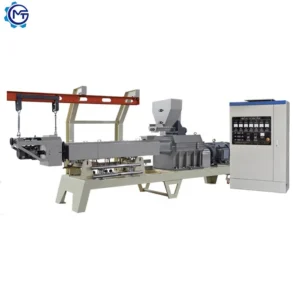
Industrial Fully Automatic Stainless Steel Deep Fried Line – Snack Factory Miscellaneous Grains Special Processing Equipment
¥65.00 Select options This product has multiple variants. The options may be chosen on the product page -
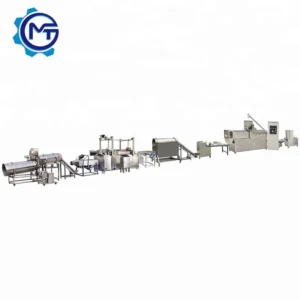
Fried Puffs Snack Food Making Machine Whole Line Solution Design by Factory Price Crispy Snack Machine
¥20.00 Select options This product has multiple variants. The options may be chosen on the product page