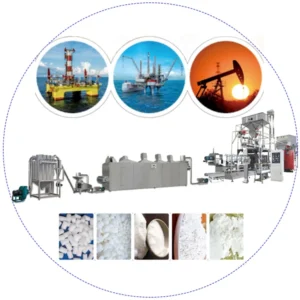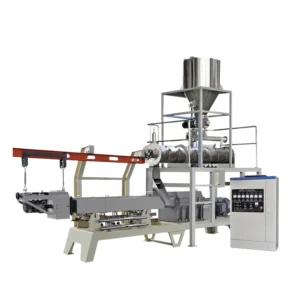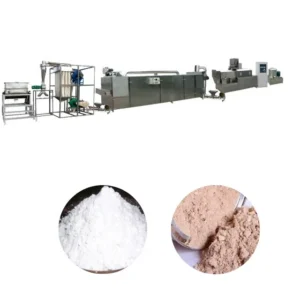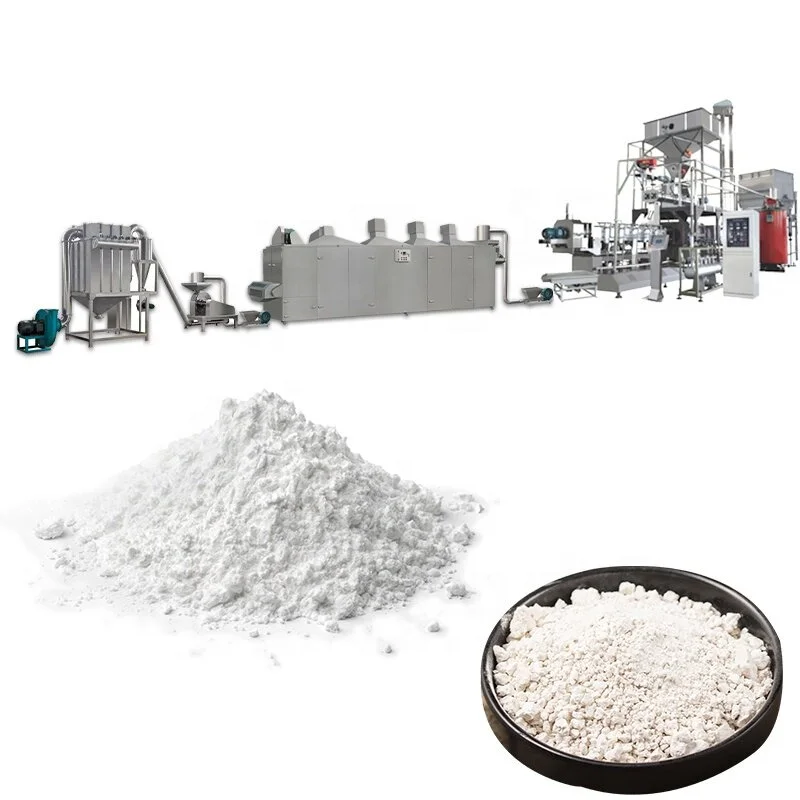
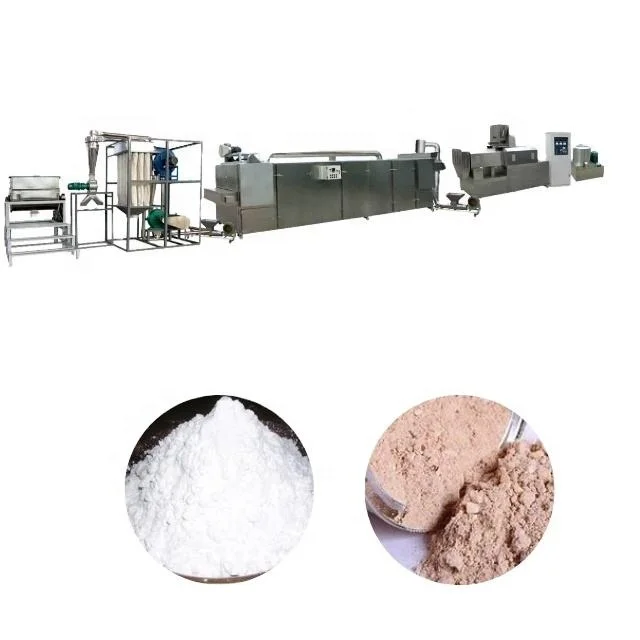
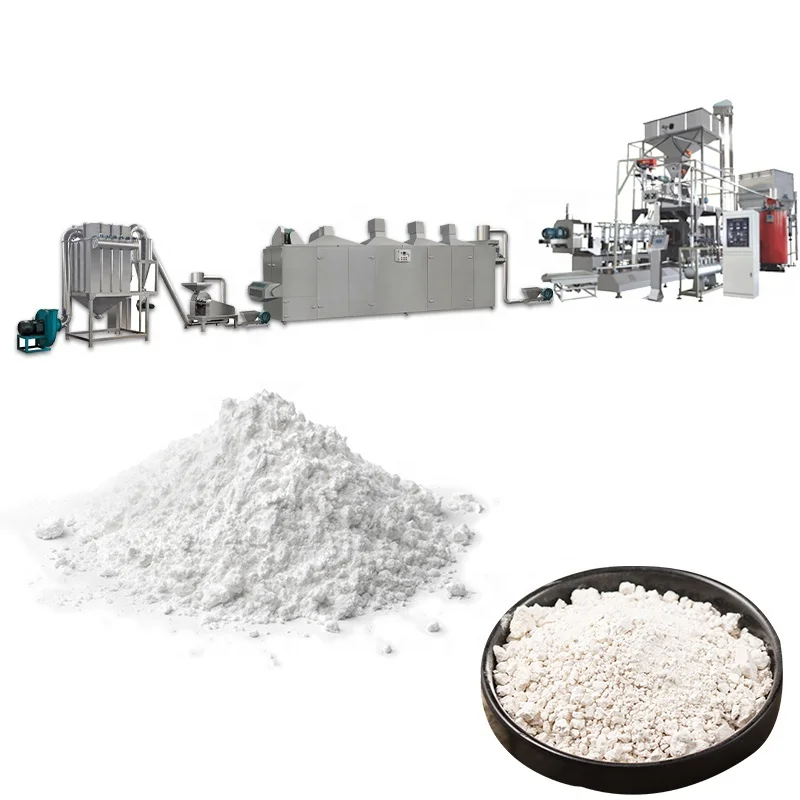
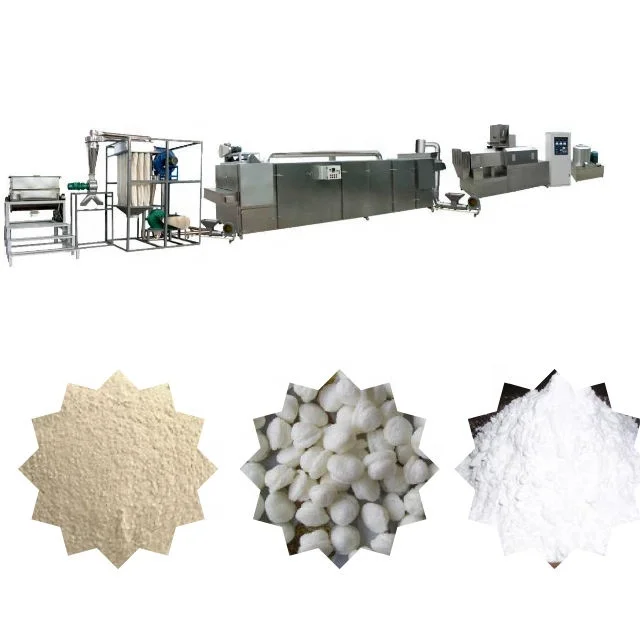
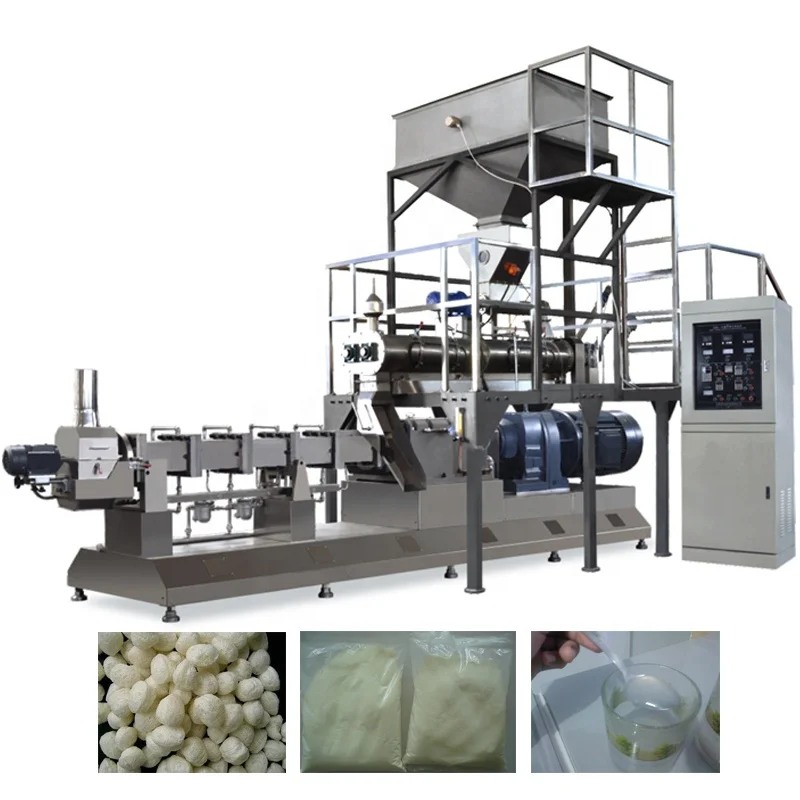

Line layout, capacity calculation, screw configuration record, and on-site commissioning with operator training are delivered under single-supplier accountability from design through production ramp-up.
Description
Matched throughput across every station — extruder output, dryer residence time, and grinder feed rate are calculated as one system so the modified starch processing line turnkey delivers what the nameplate says.
Technical Specifications
| Parameter | Value |
|---|---|
| Product Type | Twin Screw Extruder Production Line for Modified Starch and Pre-Gelatinized Starch |
| Model | MT65 / MT70 / MT70C / MT75 |
| Installed Power | 84 kW (MT65) / 160 kW (MT70) / 190 kW (MT70C) / 200 kW (MT75) |
| Power Consumption | 59 kW (MT65) / 120 kW (MT70) / 140 kW (MT70C) / 145 kW (MT75) |
| Output Capacity | 100–150 kg/h (MT65) / 150–200 kg/h (MT70) / 200–250 kg/h (MT70C) / 250–300 kg/h (MT75) (basis to be confirmed) |
| Overall Dimensions (L×W×H) | 41,000×1,500×2,200 mm (MT65, MT70) / 41,000×1,500×3,200 mm (MT70C) / 45,000×1,500×3,500 mm (MT75) |
| Screw Type | Twin-screw |
| Barrel Material | 45# steel |
| Outer Sealing Plate | Stainless steel 201 or 304 |
| Control System | PLC / MCC (configurable) |
| Mixer Capacity | 20–30 kg/time / 70–80 kg/time / 170–180 kg/time |
| Mixer Power | 4 kW / 7.5 kW / 15 kW |
| Mixer Voltage | 380V 50Hz Three Phase (confirm target market voltage) |
| Dryer Type | Multi-layer oven, electric (fuel oil / gas options available) |
| Dryer Temperature Range | 0–200 °C |
| Dryer Configuration | 3-layer 5 m / 5-layer 5 m / 5-layer 7 m / 7-layer 10 m / 5-layer 12 m |
| Grinder Type | Pulse grinder with cyclone discharge and dust collector |
| Line Stations | Mixing → Extrusion → Drying → Grinding |
| Warranty | 1 year, lifetime maintenance |
Application Suitability
| Application | Material or Output |
|---|---|
| Pre-gelatinized starch for food thickeners and instant products | Native corn, potato, or tapioca starch processed through controlled gelatinization |
| Modified starch with improved freeze-thaw stability | High-amylose or waxy starch targeted at frozen food applications |
| Starch with adjusted thermal viscosity and film-forming properties | Industrial-grade or food-grade native starch requiring physical property modification |
| Starch modification for improved gel strength and transparency | Specialty starches destined for confectionery, sauce, or coating formulations |
Why "250 kg/h" Means Nothing Without the Drying Context
Throughput is only real when the dryer and grinder keep pace with the extruder.
I learned this the hard way commissioning a pre-gelatinized starch line in Iraq. The extruder was pushing product at the nameplate rate, but the dryer had been sized for a standard moisture evaporation load. The client was running a high-amylose corn starch that held more internal moisture during gelatinization. Product left the dryer above spec, clogged the grinder, and backed the entire line up to the extruder discharge. Three weeks of parameter adjustments later, we had it running — but the lesson stuck. A modified starch processing line turnkey must account for the specific raw material and its moisture behavior, not a generic assumption. [NEED_CITE: moisture retention variability across native starch types during extrusion gelatinization]
Screw Geometry That Follows Your Starch Type
Every native starch responds differently to shear and heat inside the barrel. Waxy maize gelatinizes at a lower temperature and requires a gentler screw profile to avoid breaking the granule structure too early, while high-amylose corn demands higher shear to achieve the same degree of modification. The screw configuration and die design on these MT65 through MT75 models are specified after reviewing the buyer’s raw material and target property shift — whether that is gelatinization temperature, thermal viscosity stability, or freeze-thaw performance. Getting this wrong means the extruder runs, but the product does not meet the functional specification the market expects.
Dryer Residence Time Is Part of the Extrusion Equation
The multi-layer dryer options range from a compact 3-layer 5 m configuration up to a 5-layer 12 m layout, available with electric, fuel oil, or gas heating. Choosing the right one depends on the extruder output, the moisture entering the dryer, and the target moisture at discharge. A modified starch processing line turnkey that pairs a high-output extruder with an undersized dryer will produce wet product that gums up the pulse grinder and creates inconsistent particle size in the finished powder. The dryer is not a standalone station — it is the second half of the gelatinization process.
Reading the Specifications for Starch Behavior
The twin-screw design across all four models provides the mixing intensity and residence time control that single-screw extruders struggle to deliver for starch modification. Barrel length options span 1,050 mm to 1,699 mm, giving the process engineer room to adjust the L/D ratio for starches that need longer gelatinization dwell. Installed power ranges from 84 kW on the MT65 to 200 kW on the MT75, reflecting the motor capacity needed to maintain screw speed under the viscous load of gelatinizing starch. The pulse grinder downstream uses cyclone discharge with an integrated dust collector to produce a uniform particle size while containing fine powder that would otherwise contaminate the production environment. Mixer capacities scale from 20 kg to 180 kg per batch, and selecting the right mixer size prevents a bottleneck at the front of the line where starch and any additive blends are prepared before feeding the extruder. [NEED_CITE: relationship between L/D ratio and starch gelatinization completeness in twin-screw extrusion]
What Happens When Stations Are Mismatched
When a buyer assembles a modified starch line from separate vendors, the extruder supplier quotes a capacity, the dryer supplier quotes a different basis, and the grinder supplier assumes yet another feed rate. The result is a line that technically runs but never reaches the throughput anyone paid for. I have seen this on projects where the grinder was sized for a coarser product than the starch actually required, leading to constant screen blockages and unplanned downtime every shift. The grinder operator ends up throttling the feed, which backs material into the dryer, which then discharges product above moisture spec. The whole chain suffers because no single party calculated throughput end to end. [NEED_CITE: throughput mismatch consequences in multi-vendor food processing lines]
Why Sourcing the Full Line from One Supplier Matters Here
Every station on these lines — mixer, twin-screw extruder, multi-layer dryer, pulse grinder — is throughput-matched during the layout phase so capacity holds from batching to final grind. Screw configuration and die design are not copied from a generic build; they are specified to the buyer’s raw starch type and target modification properties, documented before production begins. A trial run on the buyer’s actual raw material is conducted in the in-house testing workshop before shipment, so gelatinization degree and moisture behavior are confirmed on real stock, not assumed from a datasheet. Electrical schematics, voltage, and control language are confirmed against the buyer’s site power supply before the panel is wired, preventing commissioning delays. CE and ISO certification cover the line, and on-site installation includes operator training specific to the starch type being processed.
Documentation & Verification
- Line layout showing throughput matching from mixer through extruder, dryer, and grinder
- Screw and die configuration record specified to your raw starch and target modification
- Trial run report on your actual raw material from the in-house testing workshop
- Electrical schematic with voltage and frequency confirmed for your site
- Factory test record documenting full-line run before crate packing
Installation, Commissioning & Support
- Foundation planning based on the line footprint up to 45,000 mm length and 3,500 mm height
- Dedicated power circuit sized for up to 200 kW installed capacity across the full line
- Modular station assembly with mechanical and electrical connections verified on-site
- First-run parameter setting for screw speed, barrel temperature, and dryer zones matched to your starch
- Operator training covering PLC or MCC control interface in the confirmed language
- Wear parts list covering screws, dies, and grinder screens with recommended replacement intervals
What to Prepare Before Requesting a Quote
To configure the line correctly, we need to know the native starch type you plan to process and the specific modification property you are targeting — whether that is gelatinization temperature, thermal viscosity, or freeze-thaw stability. Provide your site voltage and frequency so the electrical system is built to match, and share your available floor space and ceiling height to determine which dryer configuration fits. If you can supply a sample of your raw material, we will run a trial in the testing workshop before finalizing the screw and die specification.
Frequently Asked Questions
Q: How is the output capacity of this modified starch processing line turnkey verified?
A: Capacity figures for each model are based on specific raw material and moisture conditions that must be confirmed for your project. We conduct a trial run on your actual starch in the testing workshop before shipment and document the achieved throughput, gelatinization degree, and moisture at each station in a written report.
Q: How do you match screw configuration to different starch types?
A: High-amylose starches require higher shear and longer barrel residence to gelatinize fully, while waxy starches need gentler profiles. We review your raw material data sheet and target property — viscosity, freeze-thaw stability, film-forming — and document the screw element arrangement and die geometry before production.
Q: What determines which dryer configuration is selected?
A: The dryer is chosen based on extruder output, incoming product moisture, and your target discharge moisture. Options range from a 3-layer 5 m oven to a 5-layer 12 m unit with electric, gas, or fuel oil heating. The correct configuration ensures the grinder receives product within its operating moisture range.
Q: Is a trial run performed before the line ships?
A: Yes. We run your raw material through the extruder and dryer in the testing workshop and record screw speed, barrel temperatures, moisture at dryer discharge, and final particle size from the grinder. The trial run report is shared with you before crating so any adjustments are made before dispatch.
Q: What does on-site commissioning include?
A: Our team handles mechanical assembly, electrical connection verification, and first-run parameter tuning for your specific starch. Operator training covers PLC or MCC operation, temperature and speed adjustment, routine cleaning, and wear part replacement procedures on the actual equipment installed at your facility.
Related products
-
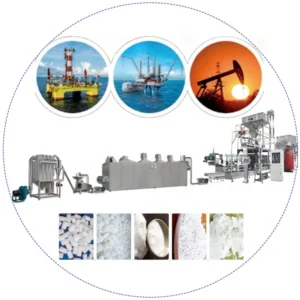
Automatic Modified Tapioca Starch Production Line 304 Stainless Steel Flour Mill and Bakery Machine
¥30.00 Select options This product has multiple variants. The options may be chosen on the product page -
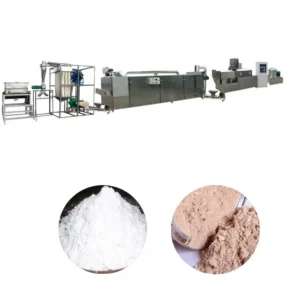
Automatic Modified Starch Making Machine Oil Drilling Starch Processing Production Line
¥30.00 Select options This product has multiple variants. The options may be chosen on the product page -
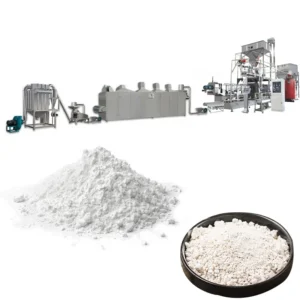
API Standard Pregelatinized Starch Line for Oilfield Drilling Fluid. High Yield Modified Starch Equipment
¥65.00 Select options This product has multiple variants. The options may be chosen on the product page -
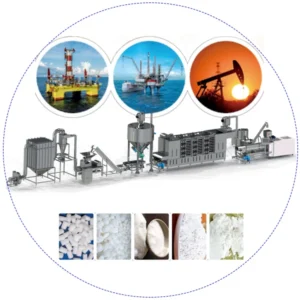
Modified Starch Production Line for Industrial Drilling Twin Screw Extruder Large Output Modified Starch Manufacturing Machine
¥50.00 Select options This product has multiple variants. The options may be chosen on the product page