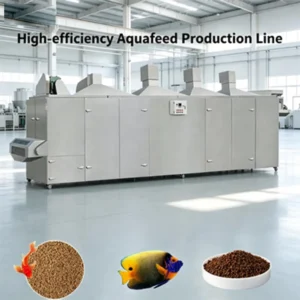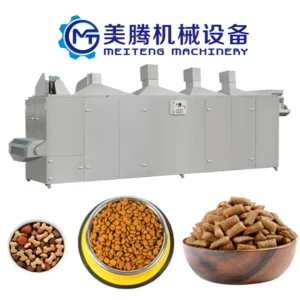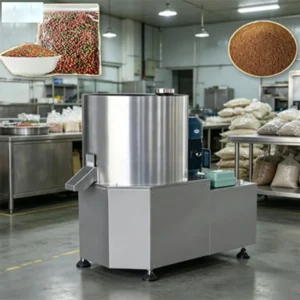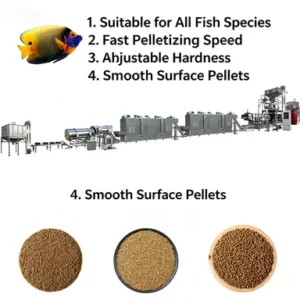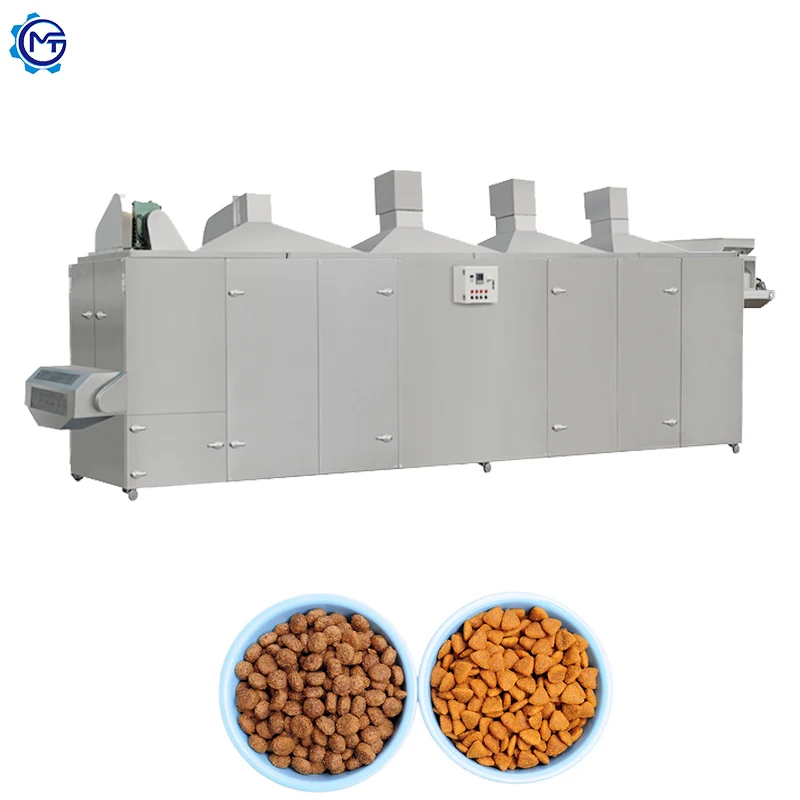


Twin Screw Pet Food Extrusion Line, PLC & MCC Control, 1-Year Warranty — engineered for dry kibble and aquatic feed production with screw configuration and die design matched to your raw material formulation and target density. In-house trial runs validate expansion, texture and output on your actual ingredients before shipment.
- Complete turnkey line from batching through extrusion, drying, coating and packing under one supplier
- Throughput matched across every station to eliminate bottlenecks
- Automated PLC and MCC control for consistent process parameters
Every line ships with a trial run report on your raw material, screw and die configuration record, and electrical schematic with voltage confirmation — so commissioning starts without surprises.
Description
Integrated Engineering — Every station from batching through packing is specified under one roof, ensuring throughput matches your target kibble density rather than forcing the extruder to compensate for a bottleneck downstream.
Technical Specifications
| Parameter | Value |
|---|---|
| Product Type | Twin Screw Pet Food Extrusion Line |
| Extruder Configuration | Twin-screw, co-rotating |
| Output Capacity | Up to 3 tons per hour (basis not stated in source — confirm raw material formulation, moisture content, kibble size and density) |
| Control System | PLC and MCC automated control |
| Applications | Dry dog and cat kibble, floating and sinking aquatic feed |
| Line Stations | Batching, mixing, extrusion, drying, coating, cooling, packing (confirm scope of supply) |
| Voltage & Frequency | Configurable to site specification (basis to be confirmed) |
| Documentation | Process flow drawing included |
| Certification | CE, ISO |
| Warranty | 1 year |
Application Suitability
| Application | Material or Output |
|---|---|
| Dry dog kibble production | Corn, meat meal, soy protein, bone meal, vitamin premix |
| Dry cat kibble production | Poultry meal, fish meal, starch, taurine supplement blends |
| Floating aquatic feed | Soybean meal, wheat flour, fish meal, oil coating |
| Sinking aquatic feed | High-protein concentrate, gelatinised starch, mineral premix |
Why Nominal Capacity Numbers Mislead Pet Food Buyers
A pet food production line turnkey solution only delivers its quoted output if the screw configuration and dryer capacity are engineered around the actual formulation you run through it.
Many buyers discover after commissioning that the line stalls well below the brochure number because the kibble recipe demands more residence time in the barrel, or the dryer cannot keep pace with the extruder discharge rate. When throughput drops, raw material accumulates upstream and moisture-sensitive ingredients degrade [NEED_CITE: impact of residence time on starch gelatinisation in twin-screw extrusion]. I have walked onto sites where a brand-new line was running at half its nameplate figure simply because the die geometry was copied from a generic build that had never seen the customer’s meat-meal-heavy recipe.
Matching Barrel Geometry to Your Recipe
The screw profile, barrel section count, and shear zones must correspond to the fat and starch ratio in your formulation. A recipe heavy in animal protein behaves very differently under compression than a corn-dominant mix, and the barrel temperature profile has to reflect that reality. The pet food production line turnkey approach here specifies screw elements after reviewing your ingredient list and target expansion ratio, not before.
Die Selection and Kibble Density Control
The die orifice count, land length, and cutter speed determine whether the kibble floats, sinks, or meets a specific bulk-density target. Floating aquatic feed requires rapid expansion at the die face, while dense sinking pellets need a longer land and controlled cooling rate [NEED_CITE: die land length and expansion ratio relationship in food extrusion]. Every die in this line is documented against your product sheet so replacements match the original geometry exactly.
Reading the Numbers That Matter
The twin-screw configuration provides self-wiping action that prevents residue build-up when running high-fat pet food recipes — something a single-screw design struggles to manage without frequent shutdowns. The PLC and MCC control system logs barrel temperature and screw speed for every batch, giving you traceability that generic relay-based panels cannot offer. Capacity figures above must be validated on your specific raw material blend, because moisture content and particle size shift throughput noticeably. Voltage and frequency confirmation is required before electrical cabinets are wired, eliminating on-site rewiring delays that routinely push commissioning back by weeks.
The Hidden Cost of an Unmatched Line
When the extruder is sized correctly but the dryer or coating drum is not, the entire line waits on its slowest station. I have seen producers lose entire production runs because a coating drum could not apply fat evenly at the extruder’s discharge rate, leaving kibble that failed shelf-life tests within days [NEED_CITE: fat migration and rancidity in dry pet food storage]. Specifying every station under a single engineering scope prevents this mismatch before the line is built.
Why This Scope of Supply Works
Every station — batching, mixing, extrusion, drying, flavouring, cooling, packing — is specified and supplied as one coordinated system, so throughput calculations account for real transfer losses between machines rather than optimistic standalone figures. The in-house testing workshop runs your actual raw material before shipment, producing a trial report that confirms expansion, density, and texture against your market specification. Screw and die configuration records travel with the machine, meaning future replacements are exact duplicates rather than approximations. Electrical schematics are finalised only after voltage and frequency are confirmed for the destination site. Operator training covers parameter adjustment for recipe changes, not just button-pushing, so your team can adapt to new formulations without waiting for a service visit.
Documentation & Verification
- Line layout with throughput calculations matched across every station from mixer to packer
- Trial run report on your raw material confirming kibble density and expansion before dispatch
- Screw element and die configuration record matched to your specific formulation
- Electrical schematic with confirmed voltage and frequency for destination site
- CE declaration of conformity and ISO certificate for import clearance
- Wear parts list with recommended spare quantities for first-year operation
Installation, Commissioning & Support
- Foundation and utility plan covering water, steam, and electrical loads for the PLC and MCC panels
- Power supply confirmation for local voltage and frequency before cabinet wiring begins
- Modular station layout allowing phased installation in workshops with limited overhead clearance
- On-site parameter tuning against your raw material with technician-led recipe trials
- Operator training on screw speed, barrel temperature, and die changeover procedures
- Documented wear parts schedule for screws, dies, and cutter blades based on your formulation abrasiveness
What to Prepare Before Requesting a Quotation
Share your target kibble size range, raw material formulation with approximate moisture levels, daily production volume, and the local voltage and frequency standard. If you have an existing mixer or packing station you intend to keep, provide its throughput data so the pet food production line turnkey layout can be matched around it rather than duplicated.
Frequently Asked Questions
Q: How is line capacity verified on my actual raw material before shipment?
A: Your formulation is run through the twin-screw extruder in the in-house testing workshop. Expansion ratio, kibble density, and texture are measured and documented in a trial report. Adjustments to screw configuration or die geometry are made at this stage so the line ships with settings already matched to your recipe.
Q: How do you match throughput across extruder, dryer, coating and packing stations?
A: Each station is sized based on the extruder discharge rate and the residence time your formulation requires. The layout document shows calculated throughput at every transfer point, preventing bottlenecks that occur when machines are sourced from separate vendors without coordinated capacity planning.
Q: What is included in the turnkey scope from layout to commissioning?
A: The scope covers line layout, utility planning, electrical schematic, on-site installation, parameter tuning with your raw material, and operator training. The PLC and MCC control system is configured to your site voltage and preferred language before the cabinets leave the factory.
Q: How are screw and die configurations selected for different kibble sizes?
A: Screw element sequence and die orifice geometry are chosen based on your raw material’s starch-to-protein ratio and the target bulk density. Configuration records are supplied so replacement parts reproduce the exact original profile, maintaining product consistency across production runs.
Q: What wear parts support is provided after commissioning?
A: A wear parts list is included with recommended spare quantities for screws, dies, and cutter blades based on your formulation’s abrasiveness. Parts are manufactured to the same specification as the originals and can be dispatched from the factory stock.
Related products
-
Durable Stainless Steel Twin Screw Extruder Floating Sinking Aquatic Fish Feed Processing Production Equipment
¥65.00 Select options This product has multiple variants. The options may be chosen on the product page -
MT70 100-200kg/h Dog & Cat Pet Food Processing Line with 380V 50Hz Three Phase Power
¥35,000.00 Select options This product has multiple variants. The options may be chosen on the product page -

1.0-1.2t/h High Capacity Multi-Species Fish Feed Processing Line to Produce Fish Food
¥45,000.00 Select options This product has multiple variants. The options may be chosen on the product page -
Full Automatic Pet Feed Production Line Large Twin Screw Grain Extrusion Machine
¥9,500.00 Select options This product has multiple variants. The options may be chosen on the product page