

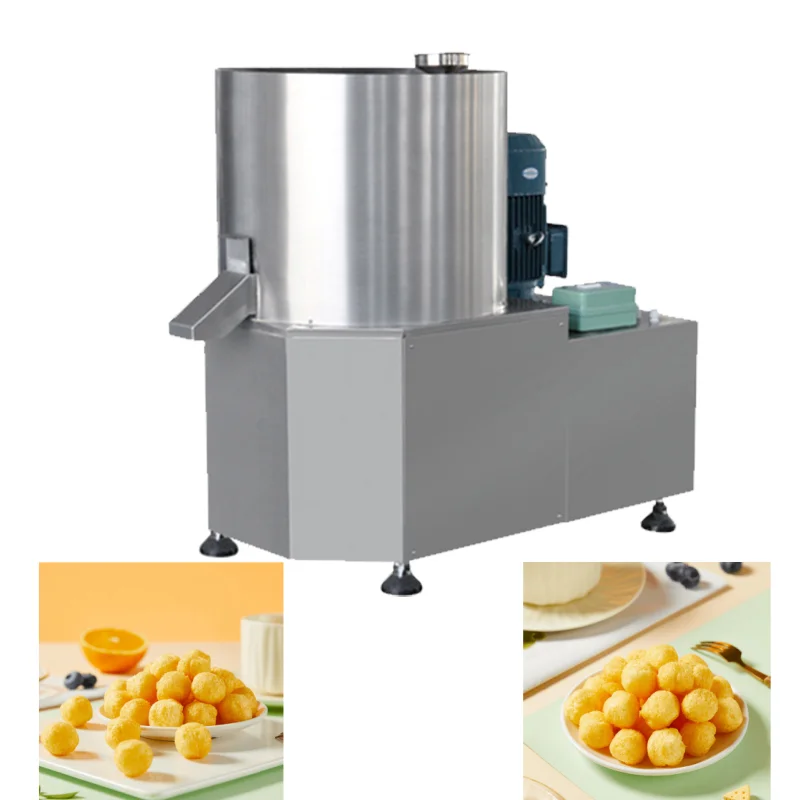
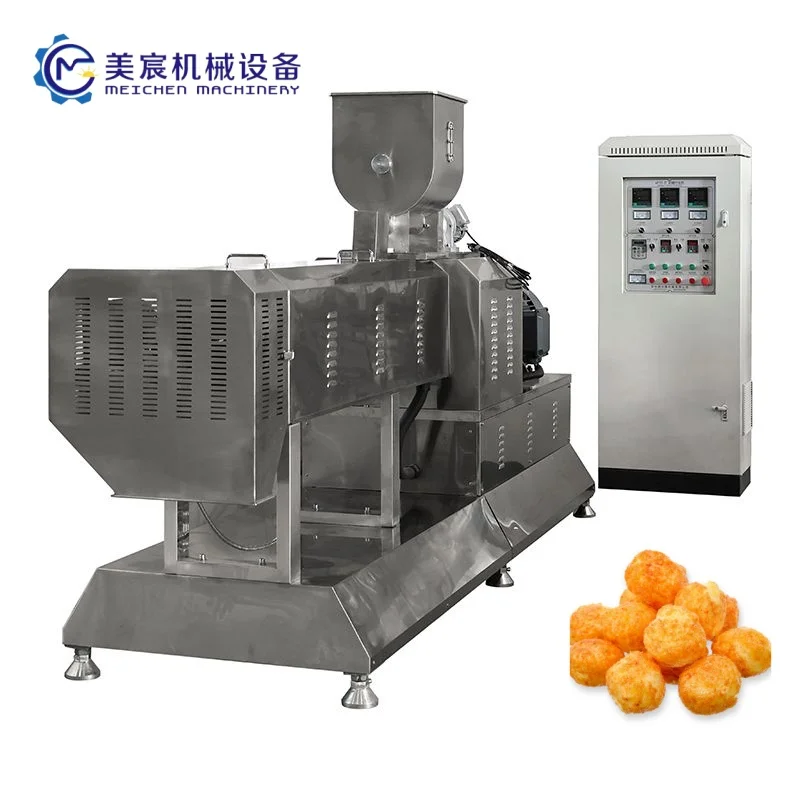
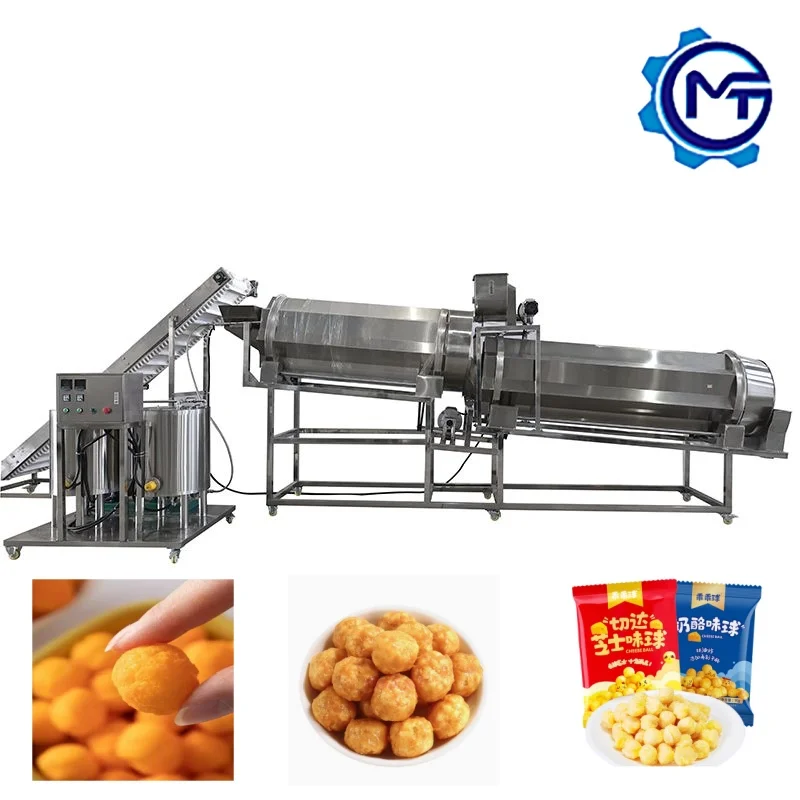
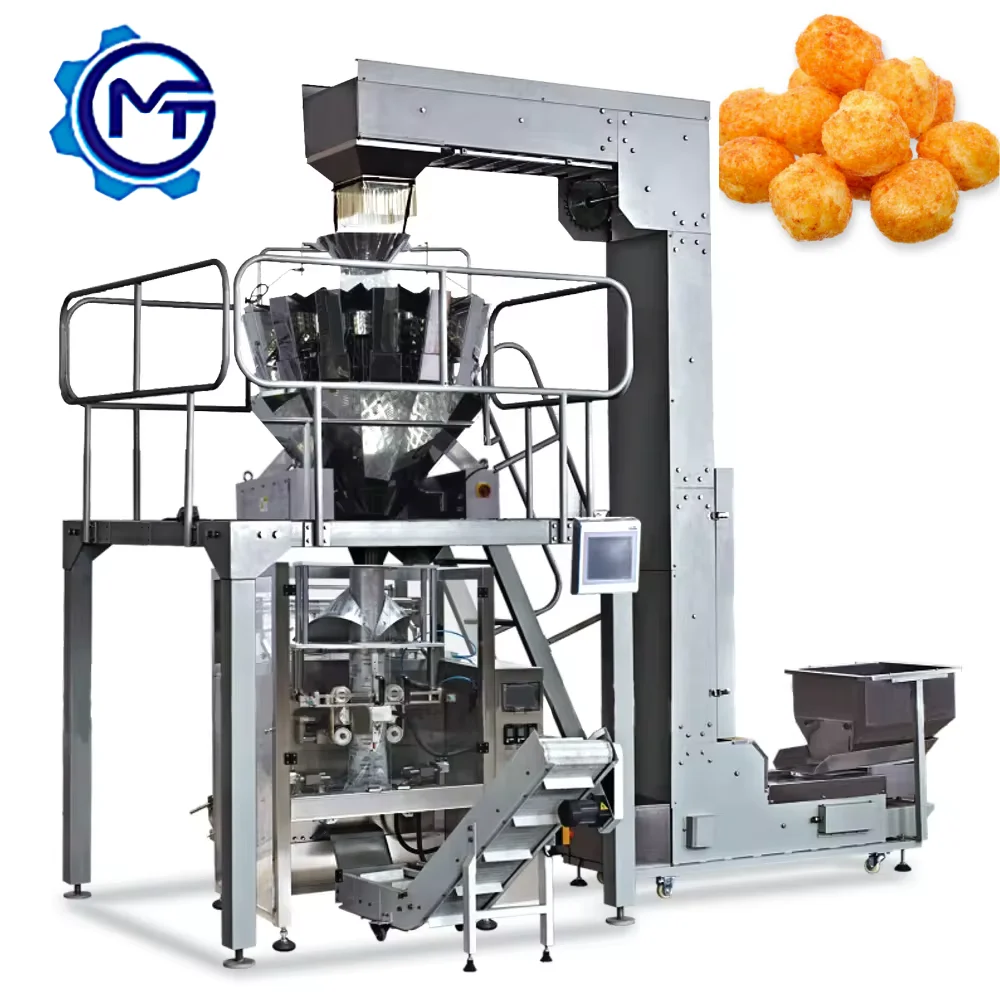
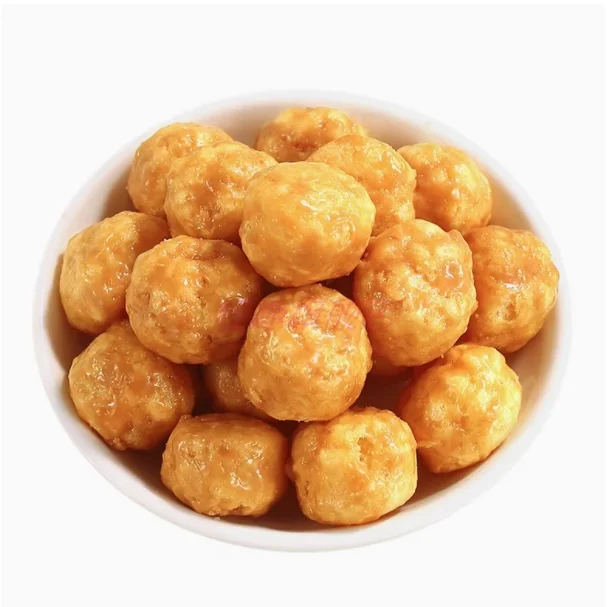
MT65/MT70/MT85/MT100 Twin Screw Extruder Snack Production Line, 120–800 kg/h, Frequency Speed Control — designed as a complete turnkey layout where extruder throughput is matched to dryer, coating drum and packing stations, preventing the bottlenecks common in multi-vendor assemblies. Screw configuration and die design are specified to your raw material and target snack shape, with electric, steam or gas heating options on the dryer to suit local utilities.
- Trial runs on your raw material are completed in-house before shipment, so product development starts on proven parameters — not after installation
- Core filling modules can be added to the same base extruder platform without replacing the line
- Electrical schematics, voltage and control language are confirmed to your market standard before production begins
Description
Throughput-Matched Turnkey Layout — Every station from batching to packing is configured as a single integrated project, so the extruder, dryer, and coating drum run at synchronized rates without material backlog.
Technical Specifications
| Parameter | Value |
|---|---|
| Product Type | Twin Screw Extruder Puffed Snack Food Production Line |
| Model | MT65 / MT70 / MT85 / MT100 |
| Screw Type | Twin-screw |
| Installed Power | MT65 — 130 kW / MT70 — 180 kW / MT85 — 220 kW / MT100 — 240 kW |
| Real Power Consumption | MT65 — 95 kW / MT70 — 120 kW / MT85 — 130 kW / MT100 — 160 kW |
| Output Capacity | MT65 — 120–150 kg/h / MT70 — 200–300 kg/h / MT85 — 300–500 kg/h / MT100 — 600–800 kg/h (basis not stated in source — confirm raw material, moisture content and die configuration) |
| Control System | Frequency speed controlling system |
| Heating Source Options (Dryer) | Electric / Steam / Gas |
| Line Stations | Mixing & batching → Extruding → Drying → Coating / Flavouring → Cooling → Packing → Stacking |
| Die Configuration | Interchangeable dies for cheese ball, ball, tube, stick, ring, fruit loop, star, wheel, flower, heart shapes |
| Core Filling Option | Available with added core-filling machine and cutting machine |
| Lubrication | Automatic lubricating and cooling system |
| Raw Materials | Corn, rice, wheat, oat, barley flour and similar grain-based materials |
| Assembly State | Complete turnkey line |
| Warranty | 1 year free warranty |
| Standards | CE, ISO |
Application Suitability
| Application | Material or Output |
|---|---|
| Puffed cheese ball production | Corn grits and cheese powder coating |
| Extruded ring and tube snacks | Rice flour and wheat flour blends |
| Core-filled snack balls | Grain-based shell with cream or chocolate filling |
| Multi-grain extruded fruit loops | Oat, barley, and corn flour mixtures |
| Star and wheel shaped puffed snacks | Corn and rice flour with adjustable moisture |
| Breakfast cereal pellet formats | Fortified wheat and oat flour blends |
Why Nominal Capacity Figures Mislead Snack Line Buyers
A twin screw extruder snack production line turnkey rated at 500 kg/h on paper often delivers considerably less once your actual formula and die shape enter the barrel.
I once visited a snack factory in Zhejiang where the extruder was running at roughly two-thirds of the quoted output because the corn grits they sourced locally had a different particle size than what the machine was originally set up for. The dryer was oversized for the actual throughput, burning extra gas every shift, while the coating drum sat half-empty. Nobody had verified the full line against the buyer’s real raw material before the containers left the factory [NEED_CITE: importance of raw material verification before equipment shipment].
When you evaluate a twin screw extruder snack production line turnkey, the capacity number on the spec sheet is only the starting point. The actual output depends on your specific flour blend, moisture content, die geometry, and the expansion ratio your market expects. Every figure in the table above must be confirmed against your formula before the line is built.
Throughput Synchronization Across Every Station
The most common failure in a snack extrusion project is not the extruder itself but the mismatch between stations. When the extruder pushes product faster than the dryer can remove moisture, material piles up on the conveyor and begins to clump. This twin screw extruder snack production line turnkey is configured so that the drying capacity, flavouring drum volume, and cooling conveyor length are all calculated against the extruder’s verified output for your specific product shape and raw material. The result is a continuous flow where no single station forces the others to idle or overflow.
Utility Planning Before the Foundation Is Poured
A complete snack line draws power, steam, gas, and compressed air from multiple points, and getting the utility layout wrong after the floor is poured is an expensive correction. For this reason, the project sequence begins with a utility requirement map that matches your facility’s available supply to each station’s demand. The dryer alone can run on electric, steam, or gas heating, and the choice affects both the upstream transformer sizing and the local energy cost per shift [NEED_CITE: industrial energy cost comparison for electric versus gas-fired dryers]. Electrical schematics and voltage confirmation are completed before production starts so that the control panels match the target market grid standard.
Reading the Spec Sheet Against Your Product Target
The installed power figures across the four models — from 130 kW on the MT65 to 240 kW on the MT100 — reflect the mechanical energy available for shear and cooking inside the barrel. Real power consumption is lower because the motors do not run at full load continuously, but the gap between installed and consumed power varies with raw material viscosity and screw configuration. The twin-screw design allows operators to adjust the screw profile and barrel temperature zones to match different grain flours, from fine rice flour that gelatinizes quickly to coarser corn grits that need longer residence time. Interchangeable dies mean the same extruder platform can switch between a cheese ball die and a tube die without changing the base machine, though each shape will alter the expansion ratio and therefore the downstream drying time. The automatic lubricating and cooling system maintains screw shaft temperature within a consistent range, reducing wear on the screw elements during extended production runs.
The Cost of Skipping the Trial Run
I have seen buyers accept shipment without a trial run on their own raw material, only to discover during commissioning that the product density was outside their market specification. The floating feed that sinks, or the puffed ball that comes out too dense for the packaging weight target — these problems surface only when the machine runs on the actual flour blend the buyer will use in production [NEED_CITE: common commissioning failures in extrusion line installations]. Correcting the screw configuration after the line is installed means flying in an engineer, sourcing replacement screw elements, and losing weeks of production while the new setup is tested.
Why This Line Is Configured as a Single Project
The entire line from batching to stacking comes from one supplier, which means throughput calculations are coordinated across every station rather than left to individual vendors who have no visibility into each other’s equipment. Screw configuration and die design are specified to your raw material and target product shape before the extruder is assembled, not copied from a generic build. An in-house testing workshop runs your actual raw material through the extruder before shipment, producing a trial run report that documents the product density, expansion ratio, and moisture content achieved. Pre-sales consultation covers line layout, utility planning, and phased installation scheduling, and on-site commissioning includes operator training so your team understands how to adjust screw speed, barrel temperature, and die selection for different snack formats.
Documentation & Verification
- Line layout and capacity calculation based on your raw material and target snack shape
- Screw and die configuration record documenting the exact profile for your formula
- Trial run report from in-house testing workshop on your flour blend before shipment
- Electrical schematic with voltage and frequency matched to your local grid standard
- CE declaration of conformity and ISO certificate included with shipping documentation
- Operation and maintenance manual with wear parts list for screw elements and dies
Installation, Commissioning & Support
- Foundation and floor space plan provided based on the selected model’s overall dimensions and station sequence
- Dedicated power circuit sized to the model’s installed power, from 130 kW on MT65 to 240 kW on MT100
- Line arrives in sectional modules for phased installation matching your facility readiness schedule
- First-run commissioning includes screw speed and barrel temperature calibration for your raw material
- Operator training covers die changeover procedure across all interchangeable shapes
- Wear parts list identifies screw elements and dies with reorder specifications for ongoing maintenance
Preparing Your Inquiry
When you are ready to discuss a twin screw extruder snack production line turnkey, the most useful information to share starts with your raw material type and its moisture content, the specific snack shape or shapes you plan to produce, and your target output in kilograms per hour. Equally important are your local voltage and frequency standards, the heating source available for the dryer, and the floor area and ceiling height of the intended production space. If you have existing upstream or downstream equipment that the new line must connect to, include those specifications so the layout can account for the interface points.
Frequently Asked Questions
Q: How is the actual line capacity verified against my raw material and target snack shape before shipment?
A: Your raw material is shipped to the in-house testing workshop where the extruder runs a trial under production conditions. The resulting trial run report documents the output rate, product density, and expansion ratio achieved with your specific flour blend and die configuration, so the capacity figure is confirmed before the line leaves the factory.
Q: How do you match throughput between the extruder, dryer, flavouring drum and packing station to avoid bottlenecks?
A: Each station is sized based on the verified extruder output for your product. The dryer length, flavouring drum volume, and cooling conveyor speed are all calculated to handle the same mass flow rate, so material moves continuously without accumulating between stations or forcing any single unit to idle.
Q: What voltage, frequency and control language options are confirmed before production starts?
A: The electrical schematic is prepared after confirming your local grid standard, including voltage and frequency. The control panel labeling and frequency speed controlling system interface language are set to match your operator team’s requirements before the panels are wired.
Q: What does the on-site installation, commissioning and operator training process look like for a complete turnkey line?
A: Installation follows a phased schedule aligned with your facility readiness. Commissioning includes running your raw material through every station, adjusting screw speed and barrel temperature, and verifying product quality. Operator training covers daily start-up, die changeover, and routine maintenance of the automatic lubricating and cooling system.
Q: How is the phased installation schedule structured for a new snack factory build, and what utility connections must be prepared in advance?
A: The schedule is built around your construction timeline, with equipment delivery staged to match floor readiness. A utility requirement document lists the power circuits, gas or steam lines, and compressed air connections needed at each station so your contractor can prepare them before the equipment arrives.
Related products
-

Full Automatic Puffed Corn Snack Food Extruder Puffed Snack Corn bar Making Machine
¥8,500.00 Select options This product has multiple variants. The options may be chosen on the product page -

Automatic Corn Crisps Extruder Production Machine for Maize Chips and Corn Sticks New Condition
¥8,000.00 Select options This product has multiple variants. The options may be chosen on the product page -

New Condition Automatic Corn Puff Snacks Food Extruder Cheese Ball Making Machine Plant
¥100.00 Select options This product has multiple variants. The options may be chosen on the product page -

Automatic Rice Crispies Extruder Machine/Chocolate Corn Flakes Extrusion Plant/wheat Flaking Snacks Production Line
¥8,500.00 Select options This product has multiple variants. The options may be chosen on the product page


